

Deep Creek Hot Springs sits along the Mojave River fork of the same name, in the San Bernardino National Forest, where the high desert meets the southern edge of the Transverse Ranges. Six or seven geothermal pools, depending on what counts as a pool, fed by water that emerges from the rock at roughly 117 degrees and cools downstream. Granite boulders the size of cars, willow trees, the cold creek running past the hot pools so you can step out of one temperature into the other.
I have been there several times over the years, always in via Bowen Ranch. It is one of the more remarkable places in Southern California, and at the moment, you cannot legally visit. Forest Supervisor Danelle D. Harrison signed Order 05-12-52-25-02 on July 2, 2025, closing the area through June 7, 2027. So this guide is two things at once. It is a record of what the canyon is, for the people who have been before and want to remember it accurately. And it is the reference you want when the closure lifts and the trailheads reopen.

Key Takeaways
- Currently closed. Forest Service Order 05-12-52-25-02, in effect July 2, 2025 through June 7, 2027. Penalty for entering: up to $5,000 and six months. Only Pacific Crest Trail Long-distance Permit holders are exempt.
- Located along the Deep Creek fork of the Mojave River, San Bernardino National Forest, about 8 miles north of Lake Arrowhead, 2.5 hours from Los Angeles, and roughly 4,500 feet elevation.
- The hike from Bowen Ranch is roughly 2 miles each way with about 1,000 feet of elevation change. The descent is gentle, the return climb is brutal in the sun.
- Bowen Ranch fee is $10 per person for day-use, paid at the trailhead via cash, card, or Zelle.
- Source water emerges around 117°F. The pools you actually sit in run about 100°F to 110°F depending on which pool and how the cold creek is mixing in.
- Do not submerge your head. The water can carry Naegleria fowleri, a free-living amoeba that causes a brain infection with greater than 97 percent case fatality. Per the CDC, the only transmission route is through the nose. Drinking the water does not cause it. Diving and dunking does.
- Designated a National Wild and Scenic River on March 12, 2019. The Forest Service notes Deep Creek “supports the greatest diversity of wildlife habitats of any drainage on the San Bernardino National Forest.”
Why It’s Closed Right Now
The closure is not a mystery. It is the predictable consequence of a place that combined a backcountry hike, geothermal pools, a cold-water river, and tens of thousands of visitors a year with no rangers, no trash service, no bathrooms, and a steep canyon that climbs past 100 degrees in summer.
Aztec Falls is the triggering rationale, the next pool system upstream from the springs along the same Deep Creek corridor. Aztec Falls has logged multiple drowning deaths since 2018. A 2025 closure order covers both Aztec Falls and the springs as a single restricted area, on the Forest Service’s stated rationale of public safety.
Independent of the falls, the springs themselves see a steady cadence of search-and-rescue calls. In May 2025, San Bernardino County Sheriff’s Aviation hoisted an injured hiker out of the canyon after rain delayed the helicopter response. In September 2024, a 69-year-old man from Lucerne Valley walked out from the Bowen Ranch area near the springs trail and was reported missing. In July 2021, a single party of six dehydrated hikers from Lancaster had to be lifted out by Air Rescue 40-King-5 and 40-King-6 in 100°F-plus heat. A month before that, a 21-year-old from Oceanside passed out from heat-related illness mid-hike and required a 90-foot helicopter hoist. The pattern is consistent. Heat, dehydration, and the brutal return climb are the routine offenders, with the canyon’s terrain making ground rescue impractical.
Trash and human-waste accumulation became its own crisis. Pools were never built or sanctioned by the Forest Service. They were shaped over decades by a small group of volunteers who hauled rocks and concrete in by hand, and the same volunteers have been the only consistent stewards. They cannot keep pace with peak weekend crowds.

Layered on top: the canyon was federally designated a National Wild and Scenic River on March 12, 2019, under the John D. Dingell Jr. Conservation, Management, and Recreation Act. That designation protects 34.5 miles of Deep Creek and Holcomb Creek, with 22.5 miles classified as Wild and the remainder Scenic or Recreational. Deep Creek is also a California Wild Trout stream and contains the federally endangered Southwestern Arroyo Toad alongside the Mountain Yellow-legged Frog. Forest Service rangers aren’t closing this area arbitrarily. It is closing a federally protected wildlife corridor that has been carrying recreation pressure it was never designed to absorb.
Order 05-12-52-25-02 stays in effect through June 7, 2027. Penalty for being inside the perimeter without an exemption: up to $5,000 for an individual, $10,000 for an organization, six months in jail, or some combination. Pacific Crest Trail Long-distance Permit holders, FS-7700-48 permit holders, and on-duty officers are the only people who can legally be in there right now.
The Pools
Six or seven pools, depending on what counts. Volunteers from the Deep Creek crew reshape the rock dams seasonally as the creek floods and drains, so what was a separate pool last year may be a connected basin this year. Largest of them is also the most popular, holding comfortable warmth because cold creek water mixes through it. Smaller pools, set higher in the rock, run hotter.

Source water comes out of the rock face at roughly 117 degrees. Local volunteer naming covers the Crab Cooker or Lobster Boil at the source (small enough that only your lower legs fit, sitting straight from the rock at full temperature), Arizona at about 107 degrees and big enough to function as the social pool, Anniversary deeper at three to four feet around 104 degrees with the best canyon view, the Womb swimmable at 103 degrees and the closest thing to a natural hot tub, and Serenity a midday pool that warms anywhere from 101 to 112 depending on the day. There is a smaller pool higher up the boulder cluster that comes in at about body temperature and feels almost cold by comparison. Phoenix Pool, furthest upstream, is the small fed-from-the-source pool that most regulars remember most clearly. It lies right next to the cold creek at maybe 60 degrees. You move between them.
The boulders the pools sit in are granitic. The existing geological literature for the area, USGS unit CAgrMZ3, identifies the rock as Mesozoic granitic. Granodiorite, granite, quartz monzonite, quartz diorite. The same plutonic family that built the Sierra Nevada batholith and weathered into the smooth boulders at Joshua Tree. Permian-to-Cretaceous in age, mostly Cretaceous, intruded as molten plutons hundreds of millions of years ago, lifted and unroofed by the rise of the Transverse Ranges, weathered by what amounts to nothing fancier than wind and water until they look exactly like the boulders you see now. Same family of rock as Yosemite, just shorter and hotter.

The Rules That Still Apply
Independent of the closure, the standing Forest Service rules at Deep Creek Hot Springs are:
- No camping at the springs.
- No campfires.
- No glass.
- Pack out everything you pack in. There is no trash service.
- Do not drink the water and do not submerge your head.
- No bicycles on the Pacific Crest Trail through this section.
- If you are camping along the PCT, you must be at least one mile from the creek.
Forest Service rangers have historically not pursued nudity citations at the springs as a matter of practice, but there is no official sanction for the clothing-optional tradition. Maximum penalty for any Forest Service citation in this area, including any closure or use-restriction violation, is $5,000 and six months. Don’t argue with a ranger.
Candle wax on the rocks is a real thing. Don’t bring candles.
Choosing Your Trailhead
Four established approaches reach the springs. None of them is short or easy. Most visitors take Bowen Ranch or Bradford Ridge.
| Trailhead | One-way | Elevation gain | Vehicle | Fee | Best for |
|---|---|---|---|---|---|
| Bowen Ranch | ~2 mi | ~1,000 ft | High-clearance 2WD adequate | $10/person | Shortest hike, secured parking, the standard route |
| Bradford Ridge | 2.5–2.6 mi | 1,312 ft | Any vehicle on paved Hwy 173 | Free roadside | Quieter, technical descent, accessible from Lake Arrowhead/Inland Empire |
| PCT (Mojave Dam) | ~6 mi | 1,489 ft | Any vehicle | Free | Long, exposed, flat-grade approach for hikers and PCT through-traffic |
| BLM “Freedom Trail” | Variable | n/a | 4WD high-clearance required | Free | Off-road approach, call BLM Barstow for current passable spurs |

The Four Routes
Each trail to Deep Creek is steep at some point and exposed for most of its length. None of these are beginner trails. Each requires plenty of water (a gallon per person), real shoes, and reserves left for the climb out.
Bowen Ranch
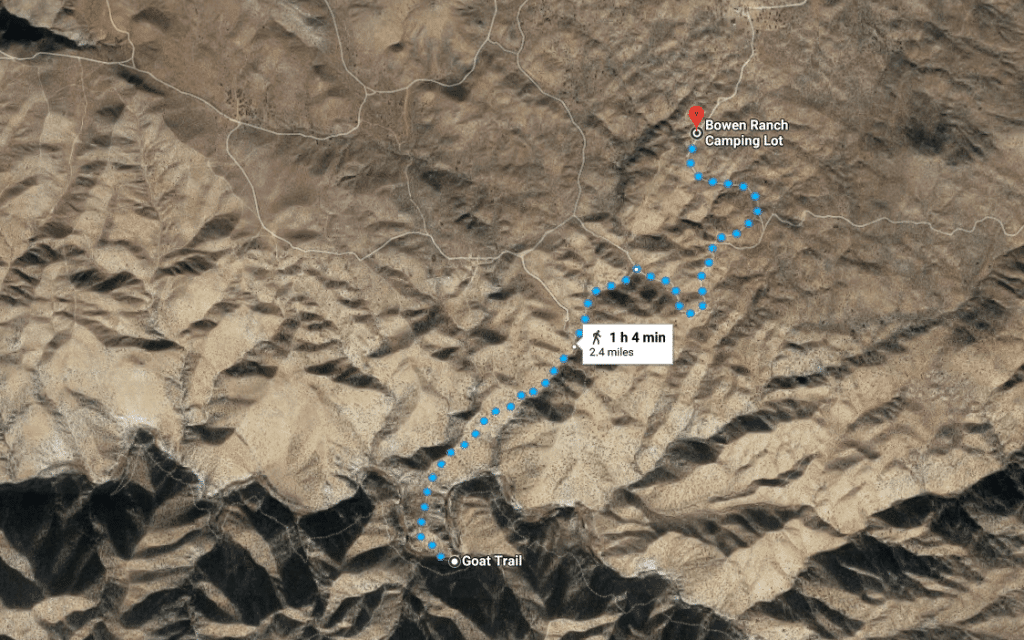
Google Maps Coordinates: 34.364506, -117.158645
Bowen Ranch is private property at 5900 Bowen Ranch Road, Apple Valley, originally homesteaded by the Bowen family in 1924 and now operated as a 160-acre tract surrounded by BLM and Forest Service land. Owners maintain the parking, the day-use registration, and security on the lot. This is the trailhead where break-ins are rare and rescues stage. Trade-off: a six-mile drive on washboard dirt to reach the gate.
Bowen Ranch’s own guidance: a high-clearance two-wheel-drive vehicle is fine for the road in. Sedans get tagged in winter washouts and during monsoon weather, but the road itself is bumpy rather than technical. Online forums often warn that 4WD is required for this approach. Overstated. Save that warning for the BLM routes.
Day-use fee runs $10 per person, framed as a donation. Payment is accepted via cash, card, Zelle (760-261-1054), and an after-hours drop box. Gate hours run 7 a.m. to midnight; the trail-access cutoff is 3 p.m. arrival to allow time to hike to the springs and back before the 5 p.m. day-use closure. A small unmanned booth at the entrance gate handles the registration. From there you continue half a mile to the parking lot signed “No vehicles beyond this point.” The trail begins at the south end of the lot.
Official Forest Service designation: Hot Springs / Goat Trail 3W02. Numbers vary by source on the exact distance, somewhere between 1.34 miles (Forest Service) and 2.4 miles (most reviewer reports), depending on which fork of the springs you cross to. Plan on roughly two miles each way to the largest pool, with about 1,000 feet of elevation change. Descent runs sandy and gradual, then steeper toward the canyon floor. A creek crossing is required to reach the actual hot pools. Water runs cold even in summer.
Return climb is what gets people. Hike out takes about 90 minutes for fit hikers, longer in heat, with the steepest grade in the last quarter-mile coming up to the parking lot. There is no shade. This is where most of the search-and-rescue calls originate.
Bradford Ridge
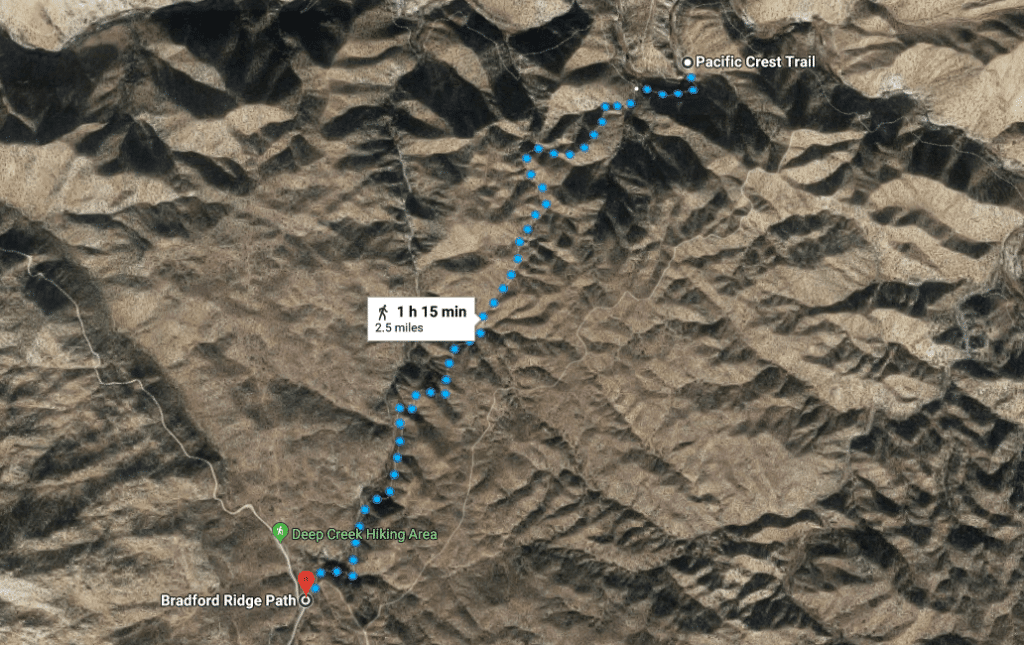
Google Maps Coordinates: 34.318447, -117.196208
Bradford Ridge starts on Highway 173 a few miles north of Lake Arrowhead. There is a gate across the highway past the trailhead, blocking the dirt road into the high desert. That gate has been there for years and is not a recent change. Trail itself remains open, beginning on the right side of the concrete bridge that crosses Kinley Creek.
The trail follows the east bank of Kinley Creek for the first 25 minutes, then peels right and climbs over a ridge before dropping into Deep Creek Canyon. About 15 minutes into the descent you hit a fork. Right is shorter and steeper, about ten minutes faster. Straight ahead follows Bradford Ridge proper. Both meet the Pacific Crest Trail; turn right (the upstream direction, toward Mexico) and the springs are a short walk.
Round-trip is 5.2 miles with 1,312 feet of gain. Plan three to three and a half hours, more if you actually soak. Descent has a section of loose gravel where reviewers consistently advise going down on your butt rather than risking a slide. Trekking poles help. There are no bathrooms at the trailhead.
Vehicle break-ins at the Bradford Ridge parking are persistent. Hide everything before you arrive, not after. Don’t leave anything visible, including chargers and gym bags. Trailhead is roadside on a public highway with no security.
One closure note. Bradford Ridge trail itself sits on National Forest land outside the 50-foot Deep Creek closure buffer, so the trail is not closed. Closure starts when you reach the PCT and turn upstream toward the springs. Without a PCT Long-distance Permit, that’s where the legal trip ends through June 2027.
Pacific Crest Trail (Mojave River Dam)

4629–4641 Arrowhead Lake Rd, Hesperia, CA 92345.
Pacific Crest Trail crosses directly through the Deep Creek canyon, which is what put the springs on the long-distance hiking map decades before social media did. To access from the road, take the Main Street exit off I-15 in Hesperia, head east about six miles to Rock Creek Road, then south on Arrowhead Lake Road for roughly five miles. Park at the turnout near the locked yellow gate, walk past the gate, and cross the top of Mojave Dam to reach the PCT.
From the dam, it is approximately six miles each way to the springs along the PCT. Round-trip is 12.6 miles with 1,489 feet of gain. Grade runs mostly mild, but the trail is exposed end to end. Plan on five hours moving time at a steady pace, longer in summer.
This is the route most directly affected by the closure. PCT corridor through Deep Creek is the closure’s geographic core, and PCT Long-distance Permit holders are the only people legally inside it right now. If you carry the permit and are doing the southern half of the trail, the springs section is still part of the route. If you are a section hiker without the long-distance permit, this approach is off-limits through June 2027.
For PCT through-hikers planning water carries through this section, pctwater.com is the trail’s de facto water-source database, kept up by hiker reports. Worth checking before any dry stretch.
The “Freedom Trail” and Other BLM Routes
“Freedom Trail” is informal trail-community shorthand for one of the BLM-designated dirt approaches into the canyon. No official Forest Service trail goes by that name. BLM Barstow Field Office maintains current information on which spurs are passable. They require a phone call before you go.
BLM Barstow Field Office: 760-252-6000. Address: 2601 Barstow Road, Barstow, CA 92311. These approaches are real off-roading, not just bumpy dirt. 4WD with high clearance is the minimum. Sedans get stuck. I haven’t tried it.
What You’d Bring (When It Reopens)
- One gallon of water per person (in a three-liter hydration bladder at minimum).
- Real food. The hike out burns through whatever you brought, and the heat suppresses appetite, which is its own problem.
- Reef-safe mineral sunscreen. The pools and the creek connect to a federally protected riparian habitat. Conventional chemical sunscreens contribute to a real ecological problem.
- SPF hat with neck and ear coverage.
- Layers in winter. Cold here is real after sunset, and the canyon shadows early.
- Hiking shoes that can get wet. The creek crossing is unavoidable.
- $10 cash per person for Bowen Ranch (or pay via Zelle at 760-261-1054).
- Trash bags. Yours and an extra. The pack-it-out rule is the only thing keeping the canyon habitable, and the volunteer crew has been carrying that load for decades.
- Flashlight with spare batteries. The trail is genuinely hard to follow in the dark, and getting caught at dusk is a common rookie move.
- Basic first aid kit with at least an ace bandage, bandaids, aspirin, a whistle, and a Sharpie (the Sharpie matters for snake bites; more on that below).
- A towel. The point of all this is to soak.
If you have sensitive skin, a few days after a Deep Creek visit you may notice red, itchy bumps where your swimsuit was held against your skin. That is Pseudomonas folliculitis, caused by Pseudomonas aeruginosa, which lives in untreated geothermal water. Per the CDC, most cases clear in seven to ten days without treatment. Strongest risk factor is how long you sit in the water. Witch hazel helps the itch in the meantime.
Clothing-Optional Etiquette

Deep Creek has been clothing-optional for decades. Forest Service rangers haven’t historically pursued nudity citations as a matter of practice, but the official position is silent rather than supportive. If a ranger or law enforcement officer arrives, get dressed. Don’t make it a thing. Maximum penalty for any Forest Service citation here is $5,000 and six months, and rangers are not in a debating mood.
Some people hike portions of the trail nude, particularly the final stretch into the canyon. Don’t be surprised when you round a corner and see more skin than your usual hiking trail.
For anyone unfamiliar with clothing-optional environments, this is not a sexual or lewd space. People behave the way they would clothed. Etiquette: don’t stare, don’t photograph other people, don’t comment.
Camping at Bowen Ranch
Camping at the springs themselves is prohibited and always has been. Camping at Bowen Ranch, the property the trailhead occupies, is the legal alternative.
Bowen Ranch occupies 160 acres at the canyon edge, surrounded by BLM and Forest Service land, with sites ranging from dispersed dry camping to glamping tents. Trailhead camping costs $15 per person. Juniper Flats sites are $25 per person. Glamping tents run $110 a night for two, with $25 for each additional guest. Bowen has picnic tables, fire pits where seasonal restrictions allow, and firewood for sale on-site. Cell service is intermittent. Nearest urban services sit about 12 miles away.
The property’s been an access point to the springs for nearly a century. It is one of the few places where camping under the desert sky in this part of the San Bernardino range is straightforward, legal, and properly serviced.
Cell Service

Part of the appeal of being out here is the inability to connect. Most of the canyon has no signal. The exceptions: the Phoenix Pool area at the upstream end of the springs has scattered reception, the hill to the northeast (away from the standard exit route) has the best reception, and the Bowen Ranch trail itself has intermittent bars on the higher sections.
Reliable enough for emergencies. Not reliable enough to plan around. The locals have been reporting near-daily search-and-rescue calls for years now, and most of those calls are heat exhaustion, not lost hikers. People underestimate the climb out and the temperature differential between the pool and the trail.
The Frogs, the Toads, and the Wild Canyon

Congress’s 2019 Wild and Scenic River designation under the Dingell Act protects 34.5 miles of Deep Creek and Holcomb Creek. Forest Service language describes the canyon as supporting “the greatest diversity of wildlife habitats of any drainage on the San Bernardino National Forest.” That is the kind of language federal land managers use when they mean it.
Mountain Yellow-legged Frog (Rana muscosa) is one of the species the canyon was protected for. It was once common across the Sierra and Southern California ranges. By 2002, fewer than 200 wild adults remained in Southern California, with one San Bernardino population dropping to 20 individuals. Recovery has been slow and federal, with U.S. Fish and Wildlife, the Forest Service, USGS, the San Diego Zoo Wildlife Alliance, the Birch Aquarium at Scripps, the Wildlands Conservancy, and other partners running a coordinated reintroduction program. Since 2010, more than 15,000 captive-bred frogs have been released across the species’ historical range. Most recent major release happened in August 2025, when 350 frogs were placed in Bluff Lake at the eastern edge of the San Bernardino Mountains. As of 2024, the IUCN Green List still classifies the species as Largely Depleted.
Deep Creek lies inside the species’ historical range and is one of the canyons the agencies watch closely. Currently named active reintroduction sites in the most recent SBNF translocation NEPA project are Tahquitz, Willow, Bluff Lake/Siberia Creek, and Sugarloaf Pond. Deep Creek is part of the broader recovery picture, not a current release site, which is a meaningful distinction worth getting right.
Southwestern Arroyo Toad (Bufo californicus), also federally endangered, lives in the Deep Creek canyon and burrows into the sandy banks during the day. That chorus you hear in the dark on a quiet spring night is theirs, partly. Frogs and toads are why the closure exists in the form it does, alongside the rescue numbers and the trash. This canyon got a federal protection status, and Forest Service rangers are now actually using it.
Beyond the amphibians, the surrounding San Bernardino National Forest holds black bear, mountain lion, mule deer, bighorn sheep, bald eagle, peregrine falcon, and red-tailed hawk across its 4,200 to 10,000 feet of elevation range. Pinyon pine and oak in the lower bands, juniper, pine, and fir higher up. None of which you usually see at the springs themselves, which are firmly in the high-desert zone.
Snakes

If you hike Deep Creek without seeing a Mojave green, you didn’t see one. They were there. Crotalus scutulatus, the Mojave rattlesnake, averages three to four feet, with a greenish-gray to olive-tan ground color and dark diamond blotches that have light borders. The tail rings give it away: the dark rings are narrower than the light rings, the opposite of the Western Diamondback. The species’ range covers most of southeastern California, the Mojave proper, and the desert flanks of the Transverse Ranges, from sea level to about 8,200 feet.
The reason ER docs pay particular attention to Mojave bites: the venom carries a Type A neurotoxin that most rattlesnakes don’t have. Some Mojaves carry only the neurotoxic Type A; some carry only the hemotoxic Type B (the more common rattlesnake venom profile); some carry both. There is no way to tell from looking at the snake. The clinical implication is that Mojave bites can present without the immediate swelling and tissue damage that announces a typical rattlesnake bite, and then go systemic with neurological symptoms. This is why the protocol calls for getting to medical care quickly, not waiting for symptoms.
Floris Gierman of Extramilest wrote what I have found to be the best practical advice on remote-trail snakebite response:
- No first aid is much better than performing bad first aid. Don’t cut at or around the bite, don’t compress the limb with a cord or bandage, don’t try to extract or neutralize venom by any of the folk methods (electricity, fire, permanganate, salt, mouths, mud, leaves).
- All commercial snake bite kits are dangerous and should not be used. The Snake Bite Poison Line confirms this.
- A lot of bite injuries happen in the panic immediately after the bite. People trip, fall off the trail, hurt themselves worse than the snake did. Stay calm. Walk 20 to 30 feet from the snake.
- Sit down. Venom can drop your blood pressure too low to keep blood pumping to your head while standing. Sitting reduces fainting risk in the first few minutes.
- Remove rings, watches, tight clothing from the bitten limb before swelling makes it impossible.
- Take five minutes to plan the evacuation. The only effective treatment is antivenom administered at a hospital.
- Don’t wait for symptoms. Call 911 if you have signal, call the Park Ranger if you don’t and there’s a number. If no service, think back to the last time you had bars and head that way.
- Take a photo of the snake if you can. ER staff use it to identify the right antivenom.
- Use the Sharpie. Circle the bite location with the time. Circle the leading edge of the swelling with the time. Update every 15 to 30 minutes. Note any unusual symptoms (metallic taste, vision changes, ringing in ears, headache, nausea, dizziness, shortness of breath) with timestamps.
- If you can’t reach help by phone, walk slowly. Hydrate, eat if you can. People walk out from serious bites and survive because they got to medical care. Be cautious about driving yourself, since some bites can suddenly limit your ability to drive safely.
Frequently Asked Questions
Is Deep Creek Hot Springs open right now?
No. Forest Service Order 05-12-52-25-02 closed the area effective July 2, 2025 through June 7, 2027. Only Pacific Crest Trail Long-distance Permit holders are exempt. Penalty for entering the closure perimeter is up to $5,000 for an individual ($10,000 for an organization) and up to six months in jail.
When does Deep Creek Hot Springs reopen?
The current closure expires June 7, 2027. The Forest Service can extend or modify it before that date.
Where is Deep Creek Hot Springs?
Along the Deep Creek fork of the Mojave River, in the San Bernardino National Forest, about 8 miles north of Lake Arrowhead and roughly 2.5 hours from Los Angeles. Coordinates approximately 34.34°N, 117.18°W, at about 4,500 feet elevation.
How do you get to Deep Creek Hot Springs?
Four established trailheads when the area is open: Bowen Ranch (the standard route, $10 per person, about 2 miles each way), Bradford Ridge from Highway 173 (5.2 miles round-trip), the Pacific Crest Trail from Mojave River Dam parking in Hesperia (about 12.6 miles round-trip), and informal BLM 4WD approaches that require a call to the BLM Barstow Field Office at 760-252-6000.
How long is the hike to Deep Creek Hot Springs?
From Bowen Ranch (the shortest route): about 2 miles each way with about 1,000 feet of elevation change, roughly 90 minutes down and 90 minutes back for fit hikers. From Bradford Ridge: 5.2 miles round-trip with 1,312 feet of gain. From the PCT/Mojave Dam parking: 12.6 miles round-trip with 1,489 feet of gain.
How hot is the water at Deep Creek Hot Springs?
Source water emerges from the rock around 117°F. The pools you actually sit in run from about 100°F (in the largest, most popular pool where cold creek water mixes through) up to about 110°F in the smaller upper pools. The Crab Cooker pool at the source itself can sit at the full source temperature, around 117°F.
Is Deep Creek Hot Springs clothing optional?
Yes, by long tradition. The Forest Service has not historically pursued nudity citations at the springs, but the official position is silent rather than supportive. If a ranger arrives, get dressed.
Can I bring a dog to Deep Creek Hot Springs?
Strongly inadvisable. The pools can carry Naegleria fowleri, a free-living amoeba that causes a brain infection with greater than 97 percent case fatality. Dogs that submerge their heads are at the same risk humans are. The water also carries the highest fecal coliform counts measured anywhere in the San Bernardino National Forest. Dogs that drink the water are at risk.
Is Deep Creek Hot Springs free?
The springs themselves are on Forest Service land and free to access. Bowen Ranch, the standard trailhead, is private property and charges $10 per person for day-use parking and trail access. Bradford Ridge and Mojave Dam parking are free.
Do I need a 4WD vehicle to reach Bowen Ranch?
No. Bowen Ranch’s own guidance is that 4WD is not necessary. The six-mile dirt access road is bumpy but not technical. A high-clearance two-wheel-drive vehicle handles it fine in normal conditions. Sedans get tagged in winter washouts and during monsoon weather. The 4WD-required framing applies to the BLM ‘Freedom Trail’ approaches, not Bowen Ranch.
Is the water at Deep Creek Hot Springs safe to drink?
No. Beyond the Naegleria fowleri risk, the water carries high fecal coliform counts from human and animal use. Pack in your drinking water (one gallon per person minimum).
What is the best time of year to visit Deep Creek Hot Springs?
Late fall through spring, when the air temperature on the trail is manageable. Summer afternoons regularly hit 100°F-plus on the exposed climb out, which is when most of the heat-related rescues happen. Winter brings cold nights and the occasional Highway 173 closure but is otherwise hikable. Spring brings PCT through-hiker traffic and wildflower blooms.
Bottom Line
Deep Creek Hot Springs is the most famous closed hot spring in California right now. The closure extends through June 7, 2027, and was signed for genuine reasons: a long history of drowning fatalities at Aztec Falls just upstream, near-daily search-and-rescue calls in the canyon itself, and a federally designated Wild and Scenic River corridor that has been carrying recreation pressure beyond what the volunteer caretakers could absorb.
If you’ve been before, you know what’s worth coming back to. If you haven’t, this is the file to keep open until June 2027. Bowen Ranch as the standard trailhead, $10 per person, two miles each way, the climb out the part that gets you. Six or seven pools at 100 to 110 degrees with the cold creek running past. The granite. The willows. The frogs you don’t see and the toads you sometimes hear at night. The volunteers who’ve been carrying the place for decades.

Article Updates
May 1, 2026: Major rewrite to reflect Forest Service Order 05-12-52-25-02 closing the area July 2, 2025 through June 7, 2027. Corrected Bowen Ranch fee ($10 per person, not $5), corrected vehicle guidance per Bowen Ranch’s own current advice (4WD not required), corrected geology citation (Mesozoic granitic rocks, not volcanic), updated mountain yellow-legged frog recovery numbers (15,000+ released since 2010), corrected Mojave rattlesnake species name (Crotalus scutulatus) and added Type A neurotoxin context. Added 2019 Wild and Scenic River designation, specific recent search-and-rescue incident references, trailhead comparison table, expanded FAQ. Stripped photographer credits per current image policy.
July 19, 2024: Edited some words for clarity, added sunscreen info.


If going in thorough apple valley to deep creek just the man who owns the property whom u pay $10 too is a BIG ASSHOLE AND HAS BEEN KNOW 2 BREAK IN THE CARS !! WE THANK GOD GOT VIDIO ! I DONT RECOMEND GOING IN THIS WAY !
I loooove hot springs! I think it would be so cool to try and hit up all the natural hot springs parks in the US (kind of like how people try and hit all the National Parks, you know?). xo, Brittany Nicole | http://www.theblistblog.com
Wow this post has SO much information. I’m glad for the bit on poisonous snakes as we don’t deal with that much here in Iowa. Also I may have to look into more clothing optional hikes for when my wild side needs out!
These Hot Springs look like a great place to spend some ‘me time’ with nature! I’d love to visit there on my next Cali trip!
That sounds like a really great place to spend time at. As for me, I would be more concerned about disturbing a “nope rope”, AKA a snake. I really did like your snake bite advice and jotted a few things down.
WOW what an adventure and what a great list of things to bring and what you can and can not do! We live in California and might have to check this out!
This was so nice to know! I recently moved nearby and didn’t know about the hot springs!
If I ever make it again to California, this is definively someplace I’d like to visit. I love walking in nature.
I wish you had talked about your heartbreak. Not to open a wound, but I especially enjoy hearing about the person behind the blog.
The hot springs sound amazing. I also love your inspirational tip! I’m definitely going to bring along a trash bag during the next hike we take as a family.
This looks lovely! I love myself a good hot spring. It’s one of the main reasons I want to visit Iceland! Jeez – California sure does have everything! Those snakes though. Eeek
Thanks for the great report. I hope to visit that area next year. . We always bring extra garbage bags ,it is maddening that people dont realize vandalisim , indifference to private property, and litter is the magic solution to get every hot spring declared a nuisance and closed. Pretty soon there will be no clothing optional wild springs left.