
Guests catch banana on the rim, glance up with the expression of someone bracing for a Bananas Foster shooter, and sip anyway out of politeness. Then they ask what is in it. I have poured this drink for people who turned up their nose at the first whiff and finished asking for a second round, and the pattern has held long enough that I stopped explaining the drink in advance and started letting the glass do the work.

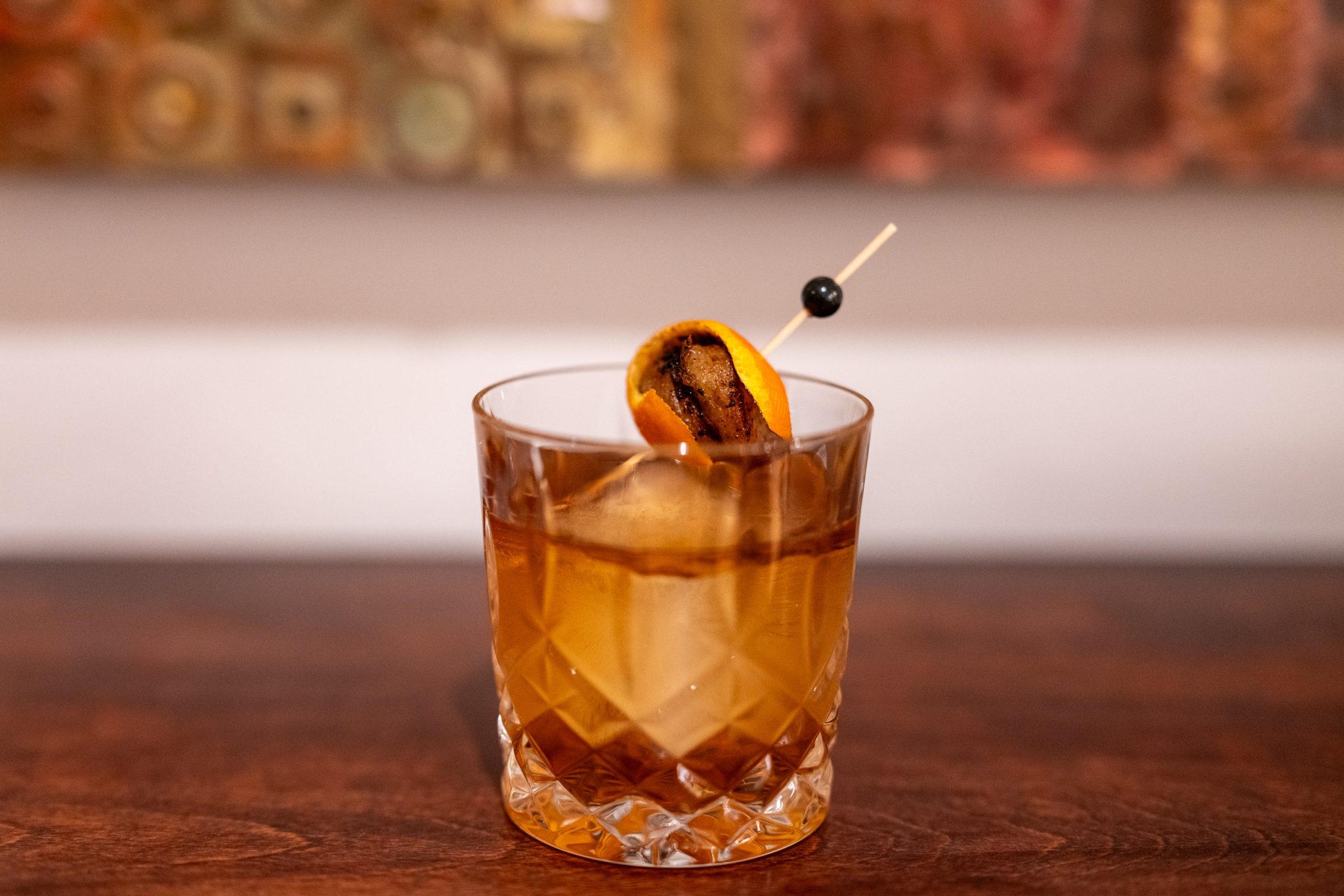
The Banana Old Fashioned is a stirred bourbon Old Fashioned where a real-banana liqueur replaces the sugar, served over a single large rock with an expressed orange peel. It is dessert-adjacent, autumn-evening, after-the-kids-are-down, and built on the same spirit-sugar-bitters-water template Jerry Thomas codified in his 1862 manual How to Mix Drinks, or The Bon Vivant’s Companion.
Version I make at home is straightforward enough that the build itself takes about thirty seconds once the bottles are out. Decisions that matter are upstream: which banana liqueur, which bourbon, which ice format, and whether to commit to the sautéed-banana garnish or stop at an expressed orange peel.
Key Takeaways
- The liqueur is the call. Tempus Fugit Crème de Banane (around $40 retail) and Giffard Banane du Brésil (around $30) are real-fruit, real-distillate liqueurs. 99 Bananas, DeKuyper, and Hiram Walker are corn-syrup-and-artificial-flavor liqueurs that work in a Daiquiri but collapse in a stirred, no-citrus drink.
- The bourbon should already lean toward dark fruit. Sherry-finished, Cognac-finished, or port-finished bourbons share flavor DNA with banana. Doc Swinson’s Alter Ego Triple Cask is the article’s pick. Angel’s Envy Port-Finished and Buffalo Trace are workable alternatives at different price tiers.
- Ice format matters more here than in a regular Old Fashioned. The banana liqueur’s sweetness magnifies as the drink warms. A 2-inch sphere reduces dilution by roughly 60% over a 20-minute drinking window compared to standard 1-inch cubes. Crushed ice turns this drink into water in six minutes.
- No additional sugar. The liqueur is around 25% ABV and roughly 30% sugar by weight. It carries the sweetener load on its own. Adding simple syrup makes a banana-Sprite.
- Stir, do not shake. Twenty to thirty seconds in a mixing glass over ice. This is a silky, viscous drink. Aeration ruins it.
- Express the orange peel. The first two sips are 90% nose. Without the orange oil floating on the surface, the banana liqueur reads as candy. With it, the orange oil, bourbon, and banana ester triangulate into something that tastes like dessert without tasting like syrup.
Where this drink sits in the Old Fashioned family
The Old Fashioned is one of those cocktails whose origin story is tidier in the brochure than in the archives. Louisville’s tourism office credits the Pendennis Club, where in the 1880s a member named Colonel James E. Pepper allegedly handed off the recipe to the Waldorf bar in New York. The Pendennis Club was founded on June 28, 1881. Pepper did not become a member until 1893. The Chicago Daily Tribune was already discussing “old fashioned cocktails” in February 1880, more than a year before Pendennis even existed. Jerry Thomas’s “Whiskey Cocktail” template from 1862 (spirit, sugar, bitters, water) is structurally what we now call an Old Fashioned.
Spirit plus sweetener plus bitters plus dilution from ice melt is a frame. Swap the sweetener for maple syrup and you get Don Lee’s Benton’s Old Fashioned, the bacon-fat-washed bourbon drink built at PDT in 2007 that gave the modern bar world a license to load flavor into the spirit-and-sweetener slots without breaking the template. Banana Old Fashioned is the same kind of move. Replace the sugar with banana liqueur and you keep every other proportion intact: 2 oz bourbon, half-ounce of liqueur in the sweetener slot, two dashes of Angostura, a single large rock, an expressed orange peel.
Wisconsin made the same structural move in a different direction half a century earlier. Brandy Old Fashioned that runs the Wisconsin supper-club circuit is, structurally, a flavored Old Fashioned that nobody calls a flavored Old Fashioned. Korbel resumed brandy production in the 1960s under winemaker Adolf Heck, after Christian Brothers shipped thousands of cases into the state in 1946, and Korbel’s marketing slogan in Wisconsin (a nickel more and worth it) embedded brandy as the regional default.
The banana liqueur is the whole drink
Banana liqueur lives in two distinct categories that share a shelf and not much else. On one side: real-fruit, real-distillate liqueurs that capture the actual aroma compounds in a banana, especially isoamyl acetate, the ester responsible for what people think of as banana flavor. On the other side: corn-syrup bases with artificial banana flavoring, sold mostly to the shot-and-frozen-drink market. In a Banana Daiquiri, the citrus and rum mask the difference. In a stirred, spirit-forward, no-citrus drink, the artificial banana has nowhere to hide.
Tempus Fugit Crème de Banane
Tempus fugit is Latin for “time flies.” John Troia and his partner Peter Schaf founded Tempus Fugit Spirits to revive 19th-century French liqueur recipes that had gone commercially extinct. They launched their Crème de Banane in late 2018, built from period formulas, with the explicit goal of recreating the flavor of the Gros Michel banana, the variety that dominated the global trade until Panama disease wiped out commercial cultivation in the 1950s. Cavendish bananas (the kind you eat today) carry less of the isoamyl acetate ester that gives banana candy its banana-ness.
Real Ecuadorian bananas, with the white flesh and the peels macerated in two separate batches, each distilled into its own eau-de-vie, then blended and sweetened. Result: 26% ABV, amber from the fruit rather than from coloring, and drier on the palate than most liqueurs. It runs $36.99 to $44.99 retail at Bay Area shops like Bitters and Bottles in San Mateo and Binny’s online, with Wine-Searcher averaging around $43 ex-tax.
Giffard Banane du Brésil
Émile Giffard founded the house in Angers, France in 1885; he was a pharmacist who originally created Menthe-Pastille and built a family liqueur business that still operates today. Banane du Brésil is 25% ABV, made from slow maceration of Brazilian banana puree alongside a banana distillate produced from Caribbean fruit, then finished with oak-aged Cognac. The Cognac note is the first difference in a side-by-side tasting of Giffard and Tempus Fugit; it adds a richer, slightly oaked character.
Vinepair credits the wider US availability of Banane du Brésil as the moment banana made its serious entrance into high-end bars and cocktails, before Tempus Fugit even launched. It earned a Gold Medal at the Beverage Testing Institute’s International Review of Spirits in 2007 and a Silver at the San Francisco World Spirits Competition in 2014. It runs around $30 retail.
With a sherry-and-Cognac-finished bourbon like Doc Swinson’s, Giffard doubles down on the Cognac note. Tempus Fugit creates more contrast because its drier eau-de-vie character cuts against the cask sweetness rather than reinforcing it. I keep both. If a reader is buying one bottle, the answer depends on which bourbon is in the house: pick Tempus Fugit for cask-strength bourbons that need contrast, Giffard for softer mainstream bourbons that benefit from the oak amplification.
99 Bananas, DeKuyper, Hiram Walker
99 Bananas is bottled at 99 proof (49.5% ABV per Sazerac’s product specification) in Louisville. It is high-test artificial-banana fuel, closer to Goldschläger or Fireball in market position than to a dessert liqueur. DeKuyper traces back to a 1695 Dutch origin, and their Crème de Banana is described in their own marketing as distilled with “top-grade banana extract,” which is the polite way of saying artificial banana extract. Hiram Walker, established 1858 in what became Walkerville, Ontario, sits in the same tier. These bottles have a place: a Banana Daiquiri or a Banana Cream Pie shooter at a wedding bar where someone needs a use for thirty bottles of cheap bananas. Not a stirred, spirit-forward, no-citrus cocktail where the artificial flavoring sits on top of the bourbon and announces itself.
If a reader has only one of these on the shelf, the right call is not to fake it. Either order a bottle of high quality banana liqueur and wait, or pick a different cocktail. The Banana Old Fashioned is one of those drinks where the ingredient ceiling defines the result, and the corn-syrup tier puts that ceiling lower than the format can carry.
Bourbon pairing logic
Banana wants a bourbon that already leans toward dark fruit. PX sherry casks contribute notes of raisin, dates, and candied fruit; Oloroso sherry casks contribute fig, cinnamon, clove, and a dry nuttiness; Cognac casks contribute sultanas, liquorice, oak, and caramel. Each of those flavor lanes overlaps with the caramelized banana esters in a real-fruit liqueur. Banana on its own can read flat and one-note in a stirred drink. Pair it with a bourbon whose finish is already doing some of the dark-fruit work and the cocktail develops layers it cannot reach with a clean, neutral bourbon base.
Doc Swinson’s Alter Ego Triple Cask
Pour I default to is Doc Swinson’s Alter Ego Triple Cask. It’s a 6-year-old bourbon, 95.8 proof, mash bill of 75% corn / 21% rye / 4% malted barley, finished separately in Oloroso sherry, Pedro Ximénez sherry, and Cognac casks for 11 to 24 months depending on the cask, then blended back together in a Cognac foeder before bottling. As a sipping bourbon the reviews are split. Whiskey Wash and KL Wines like it; Breaking Bourbon’s review of release 21-009 says the finishes were “fighting for dominance and nobody won.” For neat sipping that may be the verdict. For a cocktail where the finish is supposed to add complexity to the modifier, all three lanes pull their weight. PX bridges to the candied banana note, Oloroso adds the dry savory backbone the drink needs to avoid sweetness collapse, and Cognac mirrors what is happening in a Giffard pour. It runs $70 to $95 depending on retailer.
If you want a premium alternative: Angel’s Envy Port-Finished
Closer alternative at the premium end is Angel’s Envy Port-Finished Bourbon. Brand’s own tasting notes and Breaking Bourbon’s review both flag dried apples and bananas, vanilla, and a slight red-wine tartness on the finish. Port finish does conceptually what the PX and Cognac do for the Doc Swinson; it adds dark stone-fruit sweetness that bridges to banana. Angel’s Envy comes in at 86.6, which is fine in a glass but limited in a stirred cocktail with ice dilution. If I am building over a 2-inch sphere with a long sit, Doc Swinson holds up better. For a quick build over a single 2-inch cube and a 15-minute drinking window, Angel’s Envy works.
If you want a mainstream alternative: Buffalo Trace
Buffalo Trace at $32 to $45 is the workhorse answer. It drinks like a more expensive bottle in an Old Fashioned, with honeyed sweetness and gentle oak that play well with the banana liqueur without competing. Trade-off: it is softer than the cask-finished options, which means a Buffalo Trace Banana Old Fashioned will lean a touch sweeter overall. Fix: push the Angostura up to three dashes and pull the banana liqueur back to a third of an ounce. Maker’s 46, the version of Maker’s aged with extra French oak staves for a couple of months, sits in the same mainstream lane. Both work. Both are cocktail-tier rather than pairing-tier picks. If a reader has not yet decided, this is a good guide to the best bourbons for stirred drinks.
If you want to break the format on purpose: aged rum
Old Fashioned format is more elastic than its name suggests, and the cleanest variant uses an aged rum instead of bourbon. Planteray XO 20th Anniversary (formerly branded Plantation XO before the 2024 rebrand) is double-aged: 8 to 15 years in tropical bourbon casks in Barbados, then up to 10 years in ex-Ferrand French oak casks. Brand’s own tasting notes include toasted coconut, banana, and warm spices. Banana is already on the rum’s profile; the liqueur amplifies a thread that is there. Diplomático Reserva Exclusiva also works and is what Diplomático’s own brand site recommends for the format. Appleton 12-Year is the dry-rum option that an audience like Inu A Kena’s documents as the standard for a Rum Old Fashioned. White rum, vodka, and gin all collapse into a banana cordial. The base spirit needs character to push back against the modifier.
The build
A standard pour, the way I make it at home:
- 2 oz bourbon (Doc Swinson’s Alter Ego Triple Cask is the call; substitute as discussed above)
- 1/2 oz banana liqueur (Tempus Fugit Crème de Banane or Giffard Banane du Brésil)
- 2 dashes Angostura aromatic bitters
- Optional: 1 dash Regan’s Orange Bitters No. 6 (the Wondrich-favored citrus bitter, adds an extra orange lift on the nose)
- One large ice format in the rocks glass (a 2-inch cube or 2-inch sphere)
- Wide strip of orange peel for the express-and-drop garnish
Combine the bourbon, banana liqueur, and bitters in a mixing glass with cracked ice. Stir for twenty to thirty seconds, until the mixing glass is cold to the touch and the spirit has the silky weight that says you are at the right dilution. Strain into the rocks glass over the large ice format. Hold the orange peel skin-side-down two to three inches above the surface, snap it firmly to express the oils across the top of the drink, run the colored side around the rim, and drop it in.
If you do not own a proper bar setup, the Cocktail Kingdom Essential Bar Tools Set at $150 is the kit serious bartenders actually use behind real bars. Koriko weighted shaking tins, Hawthorne strainer, 1 oz / 2 oz jigger, seamless 500 mL mixing glass, and a 30-33 cm barspoon, all stainless steel. Mixing glass matters more than the strainer; a Japanese-style mixing glass is heavier, holds cold longer, and produces a better stir than the cocktail shaker most home bars try to repurpose for stirred drinks.
Glassware and ice
A whiskey Old Fashioned over crushed ice is just a softer Old Fashioned. A Banana Old Fashioned over crushed ice is undrinkable by minute six because the dilution gets ahead of the bourbon and the banana liqueur reads as syrup-water. Math, roughly:
A 2-inch ice sphere reduces dilution by approximately 60% over a 20-minute drinking window compared to standard 1-inch cubes, per the surface-area math, and spherical ice melts roughly 20 to 40% slower than traditional cubes. A practical bar choice that works almost as well is a 2×2-inch cube; many high-quality bars use 2-inch square cubes as a compromise between the visual of a sphere and the operational simplicity of a tray. A silicone mold that does both 2-inch cubes and 2.5-inch spheres in one tray runs around $15 and is the right entry point if a reader does not already have one.
Clear ice melts more slowly than cloudy ice because it is denser, with fewer trapped air bubbles. The directional-freezing method, which makes clear ice at home, takes 18 to 24 hours per cube and requires a small insulated cooler in the freezer. A regular 2-inch cube tray is fine.
Glassware-wise the drink lives in a rocks or Old Fashioned glass, 6 to 10 oz, with enough weight that it sits well in the hand. Aesthetic call is between the modern thick-bottomed style (Schott Zwiesel, the Era line) and the more traditional cut-crystal look (Riedel Spey or the Drink Specific Glassware double-rocks). My pick: a Schott Zwiesel Era 12 oz Double Old Fashioned, four-glass set at $42, German-made tritan crystal, dishwasher-safe, survives daily use without etching. Riedel sets are prettier on a tray but more demanding to wash.
Garnish: orange peel and the sautéed-banana option
Orange peel is not negotiable. Citrus oils sit on the cocktail surface and aromatize the first sip; they do not mix into the drink so much as sit on top of it. In an orange peel that means linalool and myrcene, the same aroma compounds that make orange smell like orange. Dale DeGroff and David Wondrich resurrected the discipline of expression during the early-2000s craft cocktail revival. Cut a wide strip of peel with a vegetable peeler, holding it pith-side down so you take the colored layer with as little white as possible. Hold the peel two to three inches above the cocktail surface, colored side facing the drink. Snap or fold the peel firmly skin-side out. Oils mist visibly in good light. Run the colored side around the rim. Drop the peel in.
The sautéed-banana garnish is the second move, and the one that turns this from a quick stirred drink into a special-occasion presentation. It takes about ten minutes and produces enough garnish for two to three drinks plus a quiet bonus dessert.

Slice a ripe banana into half-inch coins. Melt a tablespoon of butter in a small skillet over medium heat. Add a tablespoon of brown sugar and let it dissolve into the butter. Lay the banana coins in a single layer and cook 60 to 90 seconds per side, until they take on color and the sugar starts to caramelize. Pull the pan off the heat. Add a splash of bourbon, return the pan to the heat, and let the alcohol vapor catch a flame from the burner (or light it with a long match). The flame burns off the alcohol and concentrates the sugar into a glaze. Let the bananas cool briefly before garnishing.

Float two coins on top of the drink, alongside the orange peel. The sautéed banana eats well after the cocktail is finished, which is part of the point. Do not flambé the bananas in the cocktail glass, which I see in some YouTube recipes. Burning sugar tastes like burning sugar.


Banana oleo saccharum, honestly
Oleo saccharum is Latin for “sugar oil.” Hannah Woolley printed a recipe for “Limonado” in 1670 that is the earliest documented use; David Wondrich has traced the technique back to 1707 and earlier. The modern revival belongs to Wondrich’s 2010 book Punch: The Delights (and Dangers) of the Flowing Bowl, where he wrote that lemon oil “adds a fragrance and a depth that marks the difference between a good Punch and a great one.” The traditional method packs lemon, orange, or grapefruit peel with sugar overnight, the salt-and-osmosis effect pulls citrus oils out into a syrup that holds them better than simple syrup or muddled fruit ever could. Citrus peels carry limonene and linalool.
The banana version that floats around modern bar manuals is doing something adjacent but not the same. Banana peels do not contain limonene or linalool. They have isoamyl acetate, the banana ester, but in much lower concentrations than the flesh of the fruit. So banana oleo saccharum is, in practice, a banana-scented sugar syrup made via peel maceration, rather than a true oleo in the citrus-oil sense. It still works, in the sense that it tastes like banana and uses fruit waste. It is not what you reach for in a Banana Old Fashioned where the liqueur is already carrying the banana load.
If a reader wants to make it for tiki use or to swap into a banana daiquiri instead of plain simple syrup, the method is straightforward:
- Dice the peels of two ripe bananas (skip the brown spots and any cardboard-feeling fibers)
- Weigh equal parts diced peel to sugar (100g of peel to 100g of sugar)
- Combine in a sealed jar and let sit overnight at room temperature, four hours minimum
- The sugar pulls water out of the peels and dissolves into syrup over a few hours
- Once the sugar has fully dissolved, blend the mixture and strain through cheesecloth
- Refrigerate in an airtight container; use within a week
The result is a banana syrup that holds aroma better than commercial banana syrups built on glucose. Use it in tiki drinks, glaze sautéed bananas with it, or stir it into bourbon-and-soda highballs when the banana liqueur bottle is empty.
Variations and adjacent drinks
Bananas Foster Old Fashioned
Add a quarter-ounce of dark rum and a dash of vanilla extract to the build, garnish with a flambéed banana coin instead of an orange peel. This is the dessert version. It tilts the drink toward New Orleans tableside-prep territory. Serve after a steak dinner with a small scoop of vanilla bean ice cream alongside the glass.

Banana bread Old Fashioned
Different drink. The “banana bread Old Fashioned” search results that show up on Google are usually built around banana-bread-flavored simple syrup or a banana-bread-aged bourbon, not banana liqueur. Closer in spirit to a Carrot Cake Old Fashioned than to the one below.
Aged-rum Banana Old Fashioned
Planteray XO 20th Anniversary, Diplomático Reserva Exclusiva, or Appleton 12-Year. The drink is technically still an Old Fashioned by template, but the experience is closer to a Mai Tai’s introspective cousin than to a bourbon Old Fashioned. Drink it differently. Stir longer (the rum carries more residual sugar than bourbon does, which means dilution actually helps the balance).
Don Lee’s Benton’s Old Fashioned (the structural ancestor)
Not a banana variant, but the canonical “flavored Old Fashioned” that licensed everything else in the category. Don Lee built it at PDT in 2007 with bacon-fat-washed Four Roses bourbon, a quarter-ounce of Grade B maple syrup, and two dashes of Angostura. Fat-washing infused the bourbon with bacon flavor; the syrup replaced the sugar; an expressed orange peel anchored the nose. The Banana Old Fashioned is the same kind of move (a flavor-forward modifier loaded into a structural slot the format already provides) and Lee’s drink is what made the move legible to bar programs everywhere.
If you like the elevated craft-cocktail direction, the Midnight Manhattan is the next stop. For something pulled directly from the bourbon-cocktail canon without the modifier sleight-of-hand, the Bottled in Bond cocktail shows what the format does at full volume. And for the Sacramento crowd that would rather drink locally first, Sacramento Beer Week covers the regional craft-drink scene the same way.

Recipe
Banana Old Fashioned
Ingredients
Equipment
Method
- Add bourbon, banana liqueur, and bitters to a shaker filled with ice and stir vigorously for 30 seconds or until thoroughly chilled.
- Strain into a double old-fashioned glass with a large ice cube.
- Add garnish and serve.
- Peel and cut banana into 1/2" thick slices.
- Add butter and brown sugar into a saucepan on high heat. When butter is melted, add bananas.
- Sauté bananas until they begin to cook. When they are almost done, add a splash of bourbon into the pan and light it on fire to glaze and caramelize the bananas.
- Blow out the flame.
- Fold an orange peel over a banana slice and hold in place with a bamboo toothpick.
Nutrition
Notes
Tried this recipe?
Let us know how it was!Frequently Asked Questions
What is a Banana Old Fashioned?
A Banana Old Fashioned is a stirred bourbon cocktail built on the classic Old Fashioned template (spirit + sweetener + bitters + ice melt) where banana liqueur replaces the sugar. The standard build is 2 oz bourbon, half-ounce of real-banana liqueur (Tempus Fugit Crème de Banane or Giffard Banane du Brésil), two dashes of Angostura bitters, served over a single large rock with an expressed orange peel.
Is crème de banane the same as banana liqueur?
The terms are used interchangeably for products in the same category, but they signal different production tiers in practice. Crème de banane is the French-style designation, used by Tempus Fugit and Giffard for their real-fruit liqueurs. Banana liqueur as a label is broader; it includes both the real-fruit options and corn-syrup-based artificial-banana liqueurs like 99 Bananas, DeKuyper, and Hiram Walker. If a recipe calls for “crème de banane” specifically, the writer usually means a real-fruit product.
What is the best banana liqueur for a Banana Old Fashioned?
Tempus Fugit Crème de Banane (around $40) and Giffard Banane du Brésil (around $30) are the two real-fruit, real-distillate options. Tempus Fugit is drier and more spirit-forward, with a two-batch eau-de-vie character. Giffard is richer with a Cognac-cask finish that adds oak. Both work; the call depends on which bourbon is in the glass. Use Tempus Fugit when the bourbon is cask-finished and needs contrast, Giffard when the bourbon is mainstream and benefits from amplification.
Does banana liqueur have real banana in it?
It depends on the bottle. Tempus Fugit and Giffard distill real bananas (Ecuadorian and Brazilian, respectively) and contain no artificial flavoring. Marie Brizard’s crème de banane sits between real-fruit and artificial. 99 Bananas, DeKuyper, and Hiram Walker use corn syrup with banana flavoring rather than fruit distillation. The label and the price tier are usually a reliable guide; anything under $20 retail is probably the artificial side of the line.
Is 99 Bananas the same as crème de banane?
No. 99 Bananas is bottled at 99 proof (49.5% ABV) and uses corn syrup with artificial banana flavoring. It is closer in market position to Goldschläger or Fireball than to a French-style crème de banane. It works in shots and frozen blender drinks where citrus or rum can mask the artificial note, but it does not work in a stirred, no-citrus cocktail like an Old Fashioned where the flavor sits exposed on top of the bourbon.
What bourbon should I use in a Banana Old Fashioned?
Bourbons finished in sherry, Cognac, or port casks pair best because they share dark-fruit flavor compounds with the banana liqueur. Doc Swinson’s Alter Ego Triple Cask (Oloroso/PX/Cognac finish, $70-$95) is the article’s primary pick. Angel’s Envy Port-Finished works at the premium end with a banana note already on its finish. Buffalo Trace ($32-$45) and Maker’s 46 are solid mainstream alternatives. Avoid neutral or wheated bourbons that lack dark-fruit complexity; the banana will dominate them.
Can I make a Banana Old Fashioned without banana liqueur?
Possible but not recommended. The liqueur is doing two things at once: contributing banana flavor and providing the sweetener. Substituting banana syrup or banana oleo saccharum plus simple syrup gets you part of the way there, but the texture and depth from a real-fruit eau-de-vie liqueur are hard to replicate. Wait until you have the bottle. The Banana Old Fashioned is one of those drinks where the ingredient ceiling defines the result.
What is the difference between a Banana Old Fashioned and a banana bread Old Fashioned?
Different drinks. A Banana Old Fashioned uses banana liqueur in the sweetener slot of a stirred bourbon cocktail. A banana bread Old Fashioned typically uses a banana-bread-flavored simple syrup or a banana-bread-aged bourbon, leaning into the cinnamon, nutmeg, and warm-spice notes of the baked good rather than the fruit on its own. The banana bread version sits closer to a fall-spice variant; this article’s drink sits closer to a craft-cocktail dessert.
What is banana oleo saccharum and do I need it?
Banana oleo saccharum is a peel-extracted sugar syrup made by macerating banana peels with equal-weight sugar overnight, then blending and straining. It works as a sweetener in tiki drinks and banana daiquiris and is useful for reducing food waste. You do not need it for a Banana Old Fashioned, where the liqueur is already carrying the sweetener and flavor load. Banana peels lack the limonene and linalool that make a true citrus oleo work, so the technique is closer to a flavored syrup than to a real oleo in the historical sense.
What glassware should I use for a Banana Old Fashioned?
A rocks glass or Old Fashioned glass, 6 to 10 oz, with a heavy bottom that sits well in the hand. Schott Zwiesel Era and Riedel Drink Specific Glassware are both standards; the Schott Zwiesel sets in tritan crystal are dishwasher-safe and survive daily use, while the Riedel sets are prettier on a tray. Plain whiskey tumblers work fine; the drink does not require a specialty glass.
Does banana liqueur go bad?
Banana liqueur is shelf-stable for years if unopened and stored in a cool, dark place. After opening, real-fruit liqueurs like Tempus Fugit and Giffard are best within 12 to 18 months because aroma compounds slowly oxidize. Corn-syrup liqueurs last longer because there are fewer volatile compounds to lose. If the smell is muted compared to a fresh bottle, or the color has darkened noticeably, it is past its window for cocktail use.
When should I serve a Banana Old Fashioned?
Post-dinner, autumn or winter, after the kids are down. Banana plus bourbon is a heavy combination, so it is not a 4 PM summer-patio drink. The pairings that work best are dark chocolate, espresso desserts, or a wedge of banana bread. It also holds up well alongside a cigar; the PX and Cognac cask notes in a finished bourbon pair classically with cigar smoke.
The products linked in this article are collected in the The Home Bar list on the MK Library Amazon storefront.
Affiliate Disclosure: Some links in this article are Amazon Associate affiliate links. If you buy through one, MK Library earns a small commission at no additional cost to you. I only link products I would put in my own kitchen or bar.
Article Updates
- May 2, 2026: Full elevation rewrite under the Mike Kahn craft-cocktail byline. Added detailed banana liqueur category breakdown (Tempus Fugit launch context, Giffard production process, the corn-syrup tier directly framed), expanded bourbon pairing with cask-finish chemistry and three alternative price tiers, added build specs and stirring technique, dilution-rate analysis with ice format math, expanded garnish technique with citrus-oil chemistry, reframing of banana oleo saccharum, four new variation sections, and a 12-question FAQ with FAQPage schema. Two inline SVG diagrams: banana liqueur category comparison and ice format dilution.
- July 14, 2025: Recipe card refresh.
- April 3, 2024: Original article published.



Hi MK! This looks fun and easy – the banana oleo saccharum is also going in my recipes to try. Can you describe an ideal banana peel to use? Does the thickness of the phloem bundles matter? Thanks!
Ideal would be a banana that just turned yellow – doesn’t have brown, and very subtle hints of green. It’ll be firm enough to hold shape, ripe enough to have higher sugar content. I don’t think I’d worry about phloem bundle thickness too much, I haven’t noticed a difference.