

The Midnight Manhattan was built in Detroit in 2012 and crowned in New York on Travis Fourmont’s birthday, January 7, 2013. Fourmont was tending bar at Roast, Michael Symon’s steakhouse on the ground floor of the Westin Book Cadillac downtown, when he submitted the recipe to Woodford Reserve’s national Master of the Manhattan competition. He flew to New York and stirred the drink in front of David Wondrich, Andy Seymour, and Woodford’s master distiller Chris Morris at No. 8 in Manhattan. He won. Roast closed nine years later, after Saturday service on January 8, 2022, and the room where the drink was made is gone now.
The recipe is what’s left.
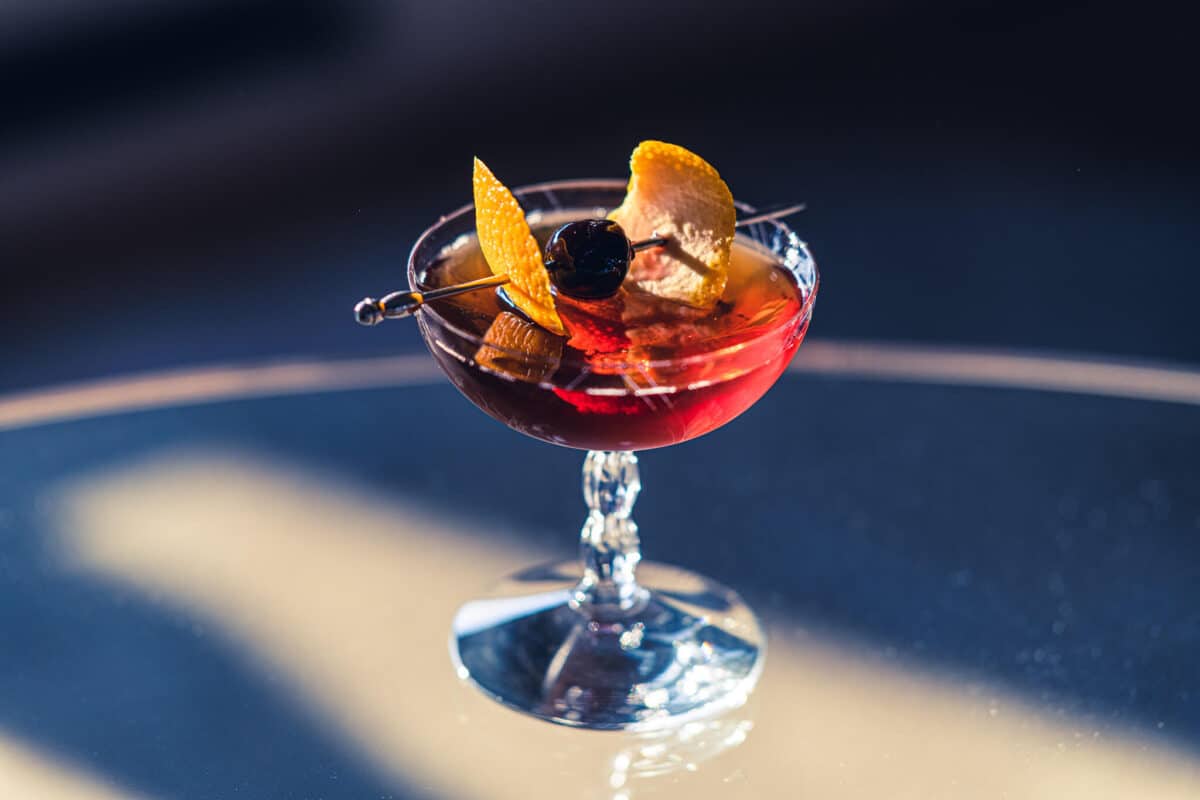
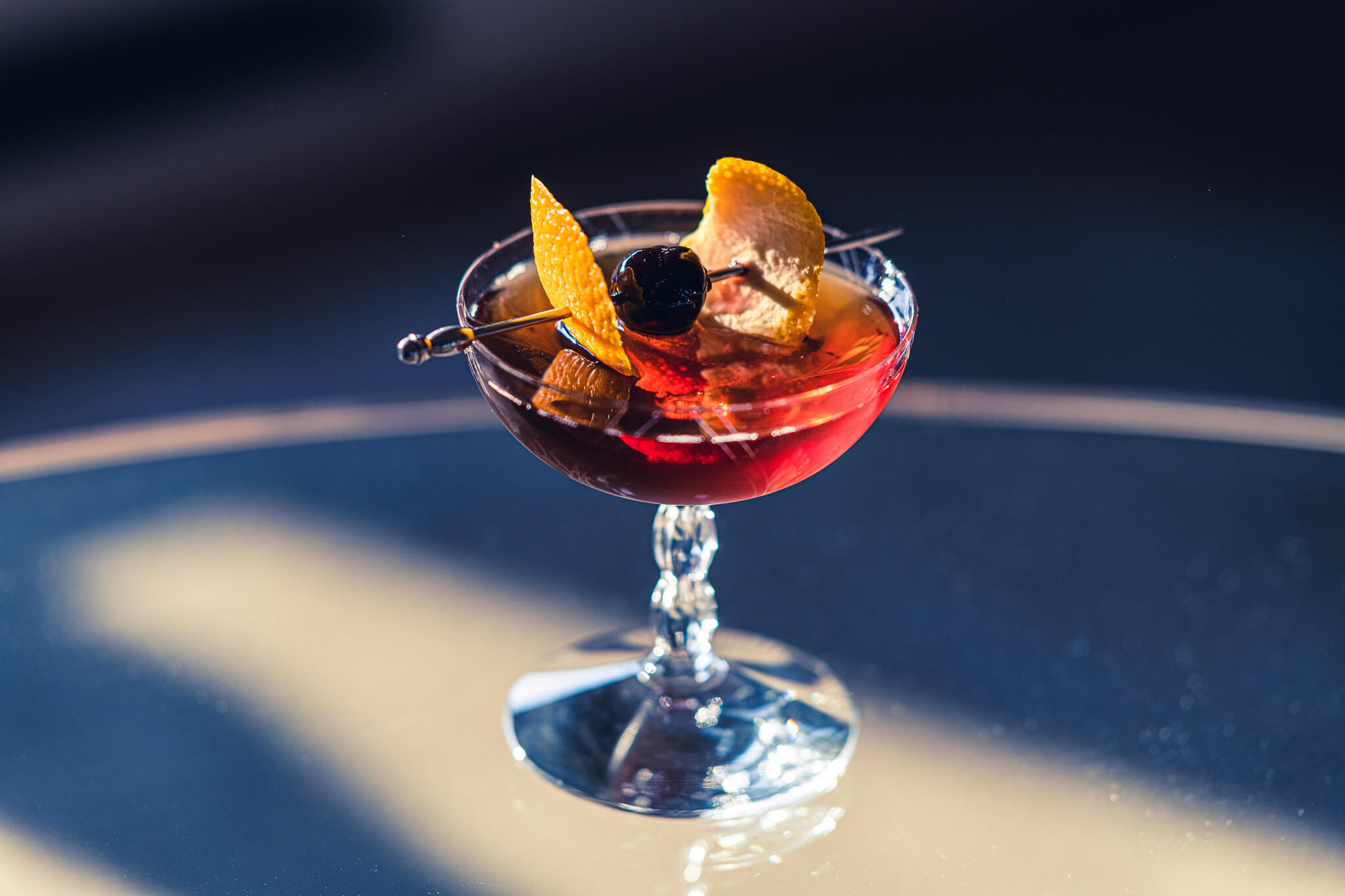
It’s a Manhattan that swaps sweet vermouth for an Italian amaro, layers in a bitter orange liqueur and Danish cherry liqueur, and finishes with four dashes of orange bitters and a flambéed orange twist over the top. Underneath, it’s bourbon body, amaro spine, two flavor bridges. The “Midnight” in the name is the color, not Halloween. Heering and amaro both pour dark, the drink lands after dinner, and the article filed under Halloween here is just where the October-30 publication date dropped it.
What follows is the Mike-byline rewrite. Brown-Forman’s 2013 release left the amaro and cherry calls generic; the recipe card below preserves Fourmont’s original specs with brand calls filled in for the bottles you can buy at home. Everything else here is the deeper pour: Black Manhattan ancestry that explains the architecture, bottle history that explains the choices, build technique that holds the drink together, and the four other 2013 competition finalists you have probably never heard of.
Key Takeaways
- It is a Black Manhattan with two bridges. Strip the curaçao and the Heering and the architecture underneath is 75% of Todd Smith’s 2005 Black Manhattan from Bourbon & Branch in San Francisco. Fourmont halved the amaro pour and replaced the missing half with curaçao plus Heering for orange and cherry depth.
- The amaro should be Averna. The official 2013 release left it generic (“Italian Amaro”), but the bittersweet caramel-cola profile is what the Heering and curaçao are calibrated against. Averna is the structurally correct call. Other amari shift the drink into different territory.
- The cherry is Heering. “Danish Cherry Liqueur” in any cocktail context means Cherry Heering, made in Copenhagen since 1818. Do not substitute Luxardo Maraschino, which is a clear, dry, almond-pit-forward distillate from a different category.
- The bourbon is Woodford Reserve. The drink was designed against Woodford’s 18% rye mash bill at 90.4 proof. Maker’s 46 (the listed alternative) is wheated and has no rye spice; it makes a softer, sweeter drink. Russell’s Reserve 10 or Bulleit are closer like-for-like substitutes.
- The garnish is a flambéed orange twist, not a Luxardo cherry. Fourmont’s submitted method specifies the twist. The orange-stack of the drink (curaçao, four dashes of orange bitters, the twist on top) is what the entire architecture is built around.
- Stir, do not shake. Thirty seconds in a mixing glass with hard ice. Strain into a chilled coupe or Nick & Nora. The drink is silky, dark, and aromatically dense. The four dashes of orange bitters is double the classic Manhattan count, and that aromatic load is part of the design.
Where this drink sits in the Manhattan family
Manhattan format is older than the Manhattan Club origin story credits. Earliest known printed reference is a “New York Letter” column in the Olean Democrat, September 5, 1882, observing that “a mixture of whiskey, vermouth and bitters came into vogue” and was being called variously the Manhattan, the Turf Club, and the Jockey Club. First written recipes ran in 1884 across four bartender’s books published the same year (O.H. Byron, George Winter, J.W. Gibson, Charlie Paul). David Wondrich’s archive work attributes the drink to a New York saloon proprietor named George Black, who ran the Manhattan Inn at 439 Broadway from 1874 until his death in 1881. Hoffman House head bartender William Mulhall named Black in Valentine’s Manual of New York in 1923 as the inventor of “probably the most famous drink in the world in its time.”
The Lady Randolph Churchill story you may have heard, where Winston’s mother allegedly inspired the drink at an 1874 Manhattan Club banquet, does not survive contact with the calendar. Lady Churchill gave birth to Winston at Blenheim Palace on November 30, 1874. That banquet was held a month later, while she was still in England. Manhattan Club did not move to her family’s Jerome mansion until 1899. Wondrich has been patient about this for years.
The legend is a 1945 newspaper-column embellishment, repeated in 1950, repeated since.
What makes the Manhattan structurally important, per Gary “gaz” Regan, is that it added vermouth (an aromatized fortified wine) to the spirit-sugar-bitters template that defined the Old Fashioned Whiskey Cocktail. Regan called it “the drink that changed the face of cocktails.” The vermouth slot is the load-bearing element. Modern bartender practice has taken full advantage of that fact by experimenting with what fills it.
The Black Manhattan is the structural ancestor. Todd Smith built it at Bourbon & Branch in San Francisco around 2005 (formalized in print and on bar menus by 2008): two ounces of rye, one ounce of Amaro Averna, a dash of Angostura, a dash of orange bitters (Regan’s, preferably), and a brandied cherry. Imbibe Magazine and Punch both treat it as the canonical amaro-Manhattan and the moment Averna-for-vermouth became the bartender shorthand for “what if we made a Manhattan that hits harder.” If you have only ever made a Manhattan with sweet vermouth, the Black Manhattan is the bridge piece. Averna carries the bittersweet load that vermouth would otherwise carry, except more concentrated, more bitter, and pulled toward dark caramel and cola.
Fourmont’s move with the Midnight Manhattan was to halve Smith’s one-ounce Averna pour to half an ounce, then replace the missing half with two quarter-ounces of color and bridge: orange liqueur on one side, Danish cherry liqueur on the other. Same architecture: bourbon body, amaro spine, two flavor bridges. Once you see the Black Manhattan underneath, the Midnight stops looking like a Halloween novelty and starts looking like a serious entry in the bittersweet-Manhattan family.
Travis Fourmont and the 2013 Master of the Manhattan
Fourmont came to Detroit from Portland in 2008. Roast was opening that fall. Michael Symon’s steakhouse in the Westin Book Cadillac was a 200-seat downtown showpiece a year after the city’s bankruptcy filing rumors started, and the bar program needed a Portland-grade craft cocktail program in a market that didn’t have one yet. Fourmont brought it. Per his Metromode profile from 2014, his first day at Roast he showed up “with bitters in hand” and asked the kitchen where the Peychaud’s was.
They didn’t have any.
By 2012 he had a top-ten finish at the Bombay Sapphire “Most Imaginative Bartender” national competition in Las Vegas. By January 7, 2013 he was on a stage at No. 8 in Manhattan, stirring his Midnight Manhattan in front of David Wondrich, Andy Seymour, and Chris Morris. He won. It was his birthday. Prize: placement in a Woodford Reserve advertisement in Esquire. Brown-Forman had been running the Manhattan Experience as an Esquire co-promotion since at least 2009. Fourmont wasn’t a one-off; he was the 2013 entry in a brand-building exercise that pulled the best Manhattan riff out of US craft bartenders every year.
Post-win arc: Fourmont sat next to a representative from Detroit-based Great Lakes Wine & Spirits on the flight back from New York. They created a corporate mixologist position for him. He held it for years. He co-founded Bailout Productions with a former Roast colleague. Hour Detroit and Metro Times named him Best Bartender in 2012 and 2013. He was developing Bar Pigalle in Brush Park before the broader Detroit cocktail scene’s expansion paused.
Roast closed permanently after Saturday-night service on January 8, 2022, after thirteen years. Westin Book Cadillac had just changed hands to a Taconic Capital Advisors / Oxford Capital Group joint venture, and Symon’s group made the call. Staff were blindsided. Cleveland Scene ran the closure under the headline “Heartbroken.” The room where the Midnight Manhattan was poured for the first time is gone. The recipe is what’s left, and it’s a real one.
The recipe Fourmont submitted
The official recipe, as Brown-Forman released it after Fourmont’s win and BourbonBlog covered it on January 22, 2013:
- 2 oz Woodford Reserve
- ½ oz Italian Amaro
- ¼ oz Bitter Orange Liqueur
- ¼ oz Danish Cherry Liqueur
- 4 dashes House-Made Orange Bitters
- 1 orange twist, flambéed (garnish)
Method, verbatim from the release: “Pour all ingredients over ice and stir. Strain into a chilled cocktail glass. Garnish with a flambéed orange twist.”
Brown-Forman left the amaro and cherry liqueur generic in the official release. No brand names, by design. The recipe stays non-prescriptive so any bartender can riff with what’s on the back bar, and the brands you would actually pour are downstream editorial reads supported by structural logic. I’ll work through them in the next section.
The four dashes of orange bitters deserves a flag of its own. A classic Manhattan calls for two dashes total. Fourmont was making his bitters in-house at Roast, 2013 Detroit, peak craft cocktail revival, when house bitters were on most serious bar programs. The four-dash count is part of why this drink reads aromatically dense against a regular Manhattan.
The bottles
Italian Amaro: Averna
Amaro Averna is the structurally correct call. Founded 1868 in Caltanissetta, Sicily, by Salvatore Averna using a recipe reportedly given to him by herbalist monks at the San Spirito Abbey. Bottle now runs 29% ABV (it was 32% historically, and the brand reformulated downward over the last decade or so, which matters if you’re reading older recipes built against the 32% spec). Bittersweet on the palate: bitter orange zest, mocha coffee, licorice, gentian, quinine, caramel, cola, rosemary, with a caramel addition that gives it that mouth-coating quality.
In a Manhattan-family drink it does what sweet vermouth does, except harder.
Several alternatives shift the drink in different directions. Amaro Nonino Quintessentia from Friuli is brandy-based and reads more delicate, more orange-and-saffron, less caramel. Amaro Montenegro from Bologna runs lighter, more orange-forward, less bitter. Cynar out of Padua, artichoke-based, reads herbaceous and savory. Punt e Mes from Carpano in Turin, dating to 1870, is technically a vermouth-amaro hybrid at 16% ABV, and the drink starts to read like a fortified-wine Manhattan with bittersweet emphasis. Averna is the canonical reading because the Black Manhattan precedent set the tone, and because the bittersweet-caramel profile is what the Heering and Pierre Ferrand are calibrated against. If you have one amaro in the house, it should be Averna for this drink.
Danish Cherry Liqueur: Cherry Heering
Cherry Heering, founded in 1818 by Peter F. Heering in Copenhagen, is the world’s first commercial cherry liqueur and the unambiguous answer to “Danish Cherry Liqueur” in any cocktail recipe. There is no other Danish cherry liqueur of meaningful commercial presence. Production is real fruit: Stevns cherries, harvested in August, crushed with the stones (which is what gives Heering its almond-marzipan undernote, similar to what noyaux contributes to Maraschino). Herbs and spices are added; the liqueur ages a minimum of three years in oak cask. Bottled at 24% ABV. Historical canon: Singapore Sling at Raffles Hotel, Blood and Sand.
Dozens of pre-Prohibition recipes specify Heering by name.
Do not substitute Luxardo Maraschino. They are different categories. Maraschino is a clear, dry, almond-pit-forward distillate from the marasca cherry. Heering is a sweet, dark red, fruit-and-spice macerate. Substituting one for the other does not give you the same drink. Treat Heering as required for this build, not optional.
Bitter Orange Liqueur: Pierre Ferrand Dry Curaçao
Pierre Ferrand Dry Curaçao Ancienne Méthode launched in the US in 2012, jointly developed by Maison Ferrand proprietor Alexandre Gabriel and cocktail historian David Wondrich. It is a recreation of 19th-century dry curaçao, designed for the modern craft bar. Production: bitter Curaçao orange peels macerated with vanilla, prunes, lemon peels, sweet oranges, and over a dozen other ingredients in unaged brandy, then redistilled, blended with aged brandy and Pierre Ferrand Cognac, and matured in oak. Bottled at 40% ABV with 180 g/L sugar (the “dry” in “dry curaçao” is real), retail around $30 for 750 mL.
Cointreau is the listed alternative on the original article and it works, but it is a downgrade for this drink. Cointreau is a triple sec: neutral-spirit base, citrus-only botanical, 40% ABV, distinctly sweeter than Pierre Ferrand, no Cognac warmth and no spice complexity. Grand Marnier is closer in body (it is also Cognac-based) but sweeter and more orange-forward than Pierre Ferrand. Any of the three works, but Pierre Ferrand is what the drink is calibrated against. There is a non-trivial reason that Wondrich, who judged the 2013 competition, was already collaborating on the bottle Fourmont’s drink uses; the curaçao and the Black Manhattan ancestry are the two pieces of context that make the Midnight Manhattan land cleanly on the palate of someone who has been paying attention to the craft cocktail revival.
The bourbon: Woodford Reserve
Woodford Reserve Distiller’s Select is what the drink was designed against. Brown-Forman launched the brand in 1996 from its Glenn’s Creek site in Versailles, Kentucky, on land that has had a working still since Elijah Pepper moved his distillery there in 1812. Mash bill: 72% corn / 18% rye / 10% malted barley. Rye percentage is high for a bourbon and the malted barley percentage is unusually generous, which is what gives Woodford its peppery backbone and unusual depth for a 90.4 proof pour. Without that rye spice working as a counterweight to the amaro’s bitterness and Heering’s sweetness, the cocktail would slump.
Maker’s 46 is listed as the alternative on the existing recipe card, and it deserves a closer look. Maker’s 46 is wheated bourbon: the mash bill is 70% corn, 16% red winter wheat, 14% malted barley, with no rye in the bill at all. “46” comes from Bill Samuels Jr.’s 2010 project where ten seared French oak staves are inserted into the barrel after Maker’s Mark fully matures and finishes nine weeks in the limestone cellar against those staves. Result: more vanilla, more baking spice, more sweetness, and zero rye spice. A Midnight Manhattan made with Maker’s 46 will be softer, sweeter, more dessert-leaning, less complex.
It is not the same drink.
If you are substituting, Russell’s Reserve 10 (90 proof, similar mash bill) or Bulleit Bourbon (28% rye, even spicier) are closer like-for-like swaps. Maker’s 46 is the easier-to-like-immediately pour but pulls the drink in a different direction. Woodford is what the cocktail was designed against; Maker’s 46 is what you reach for when Woodford isn’t on the shelf.
You could also make this drink with rye instead of bourbon. Fourmont submitted bourbon. The original article on this site noted that rye also works as a substitute, and that read holds: rye pulls the drink toward the Black Manhattan template more cleanly (Smith’s drink was always rye-based) and adds spice that the amaro absorbs gracefully. Bourbon is the canonical version, but rye is a legitimate substitution that respects the family resemblance.
The build
Construction is straightforward enough once the bottles are out. Decisions that matter are upstream (which amaro, which curaçao). Technique is short.
- 2 oz Woodford Reserve
- ½ oz Amaro Averna
- ¼ oz Pierre Ferrand Dry Curaçao
- ¼ oz Cherry Heering
- 4 dashes Regan’s Orange Bitters No. 6
- Wide strip of orange peel, for the flambéed-twist garnish
Combine all liquid ingredients in a mixing glass with hard ice. Stir for thirty seconds, until the mixing glass is cold to the touch and the spirit has the silky weight that says you are at the right dilution. Strain into a chilled coupe or Nick & Nora glass. Pour should fill the glass to about three-quarters of an inch from the rim. Flambé garnish goes on next, and is the show.
If you do not own a proper bar setup, the Cocktail Kingdom Essential Bar Tools Set at $150 is the kit serious bartenders actually use behind real bars. Koriko weighted shaking tins, Hawthorne strainer, 1 oz / 2 oz jigger, seamless 500 mL mixing glass, and a 30-33 cm barspoon, all stainless steel. Mixing glass is what matters most for this drink; a Japanese-style seamless mixing glass holds cold longer, dilutes more cleanly, and produces a noticeably better stir than an improvised cocktail shaker.
Glassware and the flambéed orange twist
The drink is served up, in a chilled stemmed cocktail glass. A coupe (rounded bowl, 5 to 7 oz) and a Nick & Nora (smaller, more conical, 5 to 6 oz, named after the Thin Man movies) both work; both are standard for stirred Manhattan-family drinks served up. A Nick & Nora reads slightly more austere and modern; a coupe reads more 1920s speakeasy and is the better Halloween mood call if you are leaning into that. A set of four Nick & Nora glasses at $33 is the right entry point for someone building a Manhattan-and-Martini setup. A vintage-style coupe set of six at $50 leans more 1920s if that’s the room you are pouring in.
The flambéed orange twist is theater, but the chemistry is real. Cut a wide strip of orange peel with a vegetable peeler, holding it pith-side down to take the colored layer with as little white as possible. Hold the peel skin-side-down, two to three inches above the cocktail surface. Light a long match or kitchen torch and bring the flame between the peel and the surface of the drink. Snap the peel firmly. Oils mist out, catch the flame as they pass through it, caramelize on contact, and fall onto the surface of the cocktail. Visible flame plus changed-aroma profile (volatiles transform passing through fire) is the spectacle. Curaçao plus four dashes of bitters plus expressed twist on top, all calibrated to land at once on the first sip. Skipping the twist is skipping what the rest of the drink is calibrated against.
You can add a Luxardo cherry inside the glass alongside the twist. The original 2013 submission did not specify it, but it is a defensible craft-bar default and a frequent home-bar move. Luxardo Original Maraschino Cherries in the 400 g jar (around $25) are the standard; Luxardo has been making them in the Veneto since 1905, with about 30,000 proprietary marasca cherries cultivated by the family annually. Bright-red supermarket “maraschino” cherries (the dyed bing cherries packed in corn syrup) are a different product entirely, and do not belong on a craft cocktail.
The other 2013 finalists
The Midnight Manhattan won against five other regional finalists, all built on Woodford Reserve and judged at No. 8 in Manhattan in front of Wondrich, Seymour, and Morris. Each of the other finalists is a serious drink in its own right; reading them together is a useful tour of where craft cocktail thinking was in late 2012 and early 2013.
- East of Hudson (Garron Gore, Savannah, GA): 2 oz Woodford, ½ oz Carpano Antica Formula, ½ oz Punt e Mes, 2 dashes Angostura, house-smoked cherry. The most traditional of the field. A Manhattan that doubles down on vermouth complexity by splitting Carpano with Punt e Mes.
- The Lineage (Charles Tappan, Washington DC): 2 oz Woodford, 1 oz Lillet Rose, 2 dashes Peychaud’s, smoked-honey ice cubes (made with lapsang souchong tea), Woodford-and-cane-sugar flambéed Amarena cherry. The most overbuilt entry. A Manhattan re-imagined through New Orleans and the Drambuie Highlands.
- The Jerry Thomas Experiment (Marc Yanga, Philadelphia): 2 oz Woodford, 1 oz Carpano Antica, ¼ oz orange curaçao (Grand Marnier and simple syrup blend), 3 dashes Regan’s No. 6, a fine spray of Campari and marasca cherry liqueur, flambéed orange peel. A Manhattan dressed as a Sazerac.
- The Big Horse (Kyle Grosz, Portland, OR): 2 oz Woodford, ¾ oz Cocchi Barolo Chinato, ½ oz Original Combier, 2 dashes Fee Brothers Old Fashioned, garnish of Woodford and vanilla-infused cranberries. The most “winter sweater” of the six. Quinine-led from the Cocchi.
The Midnight Manhattan won because it sits in the middle of the field on technique difficulty. The over-engineered finalists are dazzling at a competition stage and impossible to reproduce at a Tuesday-night dinner party. Fourmont’s drink uses no smoking equipment, no flavor sprays, no overnight ice projects, no infusions. Five ingredients you can stock from a competent wine-and-spirits shop, a stir, a strain, a flambéed twist. It is replicable at home, which is partly why the recipe has had a life past the competition.
Fourmont’s drink holds up either way.
When to drink it
This is an after-dinner drink. Woodford at 90.4 proof plus a half-ounce of amaro is heavy enough that the cocktail doesn’t read as an aperitif, and the bittersweet amaro pulls the experience toward digestif territory. It pairs well with dark chocolate (cherry and amaro both bridge), espresso desserts, a thoughtfully made cigar (Cognac note in the curaçao does classical work alongside cigar smoke), and the kind of late conversation that doesn’t have anywhere it has to be by 9 PM. Halloween framing is real but secondary; the dark color and after-dinner posture make this an October drink the way a Negroni Sbagliato is a January drink. Season fits, drink isn’t seasonal. If you only pour this once a year on October 30th, you are underusing it.
If you are putting together a craft-cocktail home-bar trajectory and the Midnight Manhattan is what brought you here, the natural next stops are the Banana Old Fashioned for a similar bourbon-and-modifier architecture in a different family, the Bottled in Bond cocktail for what the bourbon-canon does at full volume, and Sacramento Beer Week for the regional craft-drink scene if NorCal is home territory. Two dashes of Angostura aromatic bitters alongside the Regan’s pushes the spice profile up if you find your batch leaning sweet.
Recipe
Midnight Manhattan Cocktail
Ingredients
Equipment
Method
- Combine bourbon, amaro, and liqueurs into a mixing glass with ice and stir.
- Strain into a coupe glass.
- Flambe orange peel and skewer with cherry.
- Serve.
Nutrition
Notes
Tried this recipe?
Let us know how it was!
Frequently Asked Questions
What is a Midnight Manhattan?
The Midnight Manhattan is a stirred bourbon cocktail built around 2 oz Woodford Reserve, ½ oz Italian amaro (canonically Averna), ¼ oz bitter orange liqueur (Pierre Ferrand Dry Curaçao or Cointreau), ¼ oz Cherry Heering, and 4 dashes of orange bitters, served up in a chilled coupe with a flambéed orange twist. Created by bartender Travis Fourmont at Roast in Detroit and crowned the 2013 Master of the Manhattan in Woodford Reserve’s national competition.
Who created the Midnight Manhattan?
Travis Fourmont, a bartender who came from Portland to Roast (Michael Symon’s steakhouse in the Westin Book Cadillac, downtown Detroit) when it opened in 2008. Fourmont won the 2013 Master of the Manhattan competition on his birthday, January 7, 2013, at No. 8 in Manhattan, judged by David Wondrich, Andy Seymour, and Woodford master distiller Chris Morris. Roast closed permanently in January 2022.
What is the Master of the Manhattan competition?
An annual national bartender competition run by Brown-Forman / Woodford Reserve, in collaboration with Esquire magazine, that has been running since at least 2009. Bartenders from US craft cocktail markets submit Manhattan riffs built on Woodford Reserve. Six regional finalists are selected and the winner is crowned at a finale night in Manhattan, judged by spirits journalists and Woodford’s master distiller. The 2013 winner was Fourmont’s Midnight Manhattan.
What is the difference between a Midnight Manhattan and a Black Manhattan?
The Black Manhattan (Todd Smith, Bourbon & Branch SF, 2005) is 2 oz rye + 1 oz Averna + 1 dash Angostura + 1 dash orange bitters + brandied cherry. The Midnight Manhattan halves the amaro pour to ½ oz, swaps rye for bourbon (Woodford), and adds ¼ oz curaçao plus ¼ oz Cherry Heering as orange and cherry bridges. Same amaro-replaces-vermouth architecture; the Midnight has more layered modifiers.
What Italian amaro should I use in a Midnight Manhattan?
Averna. The official 2013 release left it generic (“Italian Amaro”), but the bittersweet caramel-cola profile of Averna is what the Heering and curaçao are calibrated against, and the Black Manhattan precedent (Todd Smith’s 2005 drink that this descends from) standardized Averna-for-vermouth as the Manhattan-family substitution. Amaro Nonino, Montenegro, Cynar, or Punt e Mes will all work but shift the drink toward different territory.
Can I make a Midnight Manhattan with rye instead of bourbon?
Yes. Fourmont submitted bourbon, but rye works and pulls the drink closer to the Black Manhattan template (Smith’s drink was always rye-based). Rye adds spice that the amaro absorbs cleanly and the cherry liqueur balances. Bourbon is the canonical version of the Midnight Manhattan; rye is a legitimate substitution that respects the family resemblance.
What is a substitute for Cherry Heering?
Cherry Heering does not have a clean substitute in a craft cocktail. It is a sweet, dark, oak-aged macerate from Stevns cherries crushed with the stones, made in Copenhagen since 1818, at 24% ABV. Luxardo Maraschino is a different category altogether, a clear, dry, almond-pit-forward distillate, and does not work as a substitute. If Heering is unavailable, the closest analogs are Maraska Cherry Liqueur (Croatian, slightly sweeter) or De Kuyper Cherry Brandy (lower-tier, less complex). The drink is named for Heering’s cherry note; substituting flattens the profile.
Pierre Ferrand Dry Curaçao vs Cointreau in a Midnight Manhattan?
Pierre Ferrand Dry Curaçao Ancienne Méthode is the structurally correct call: Cognac base, recreation of 19th-century dry curaçao, developed by Maison Ferrand and David Wondrich, launched 2012, 40% ABV with relatively low sugar (180 g/L). Cointreau works as a substitute but the drink will be sweeter, more orange-forward, and missing the Cognac warmth. Grand Marnier sits between them. The four dashes of orange bitters and the flambéed orange twist on top of this drink are calibrated against Pierre Ferrand’s specific spice-and-Cognac profile, so the substitution is noticeable.
What glassware is best for a Midnight Manhattan?
A chilled coupe (5 to 7 oz, rounded bowl) or Nick & Nora (5 to 6 oz, more conical) glass. Both are standard for stirred Manhattan-family drinks served up. The drink is not built for a rocks glass and does not work over ice; the recipe ratio is calibrated for the dilution that comes from stirring with ice and then straining off. Rocks-glass service would pull the drink in a different direction and lose the layered structure.
What does a flambéed orange twist do for a cocktail?
The citrus oils on the surface of an orange peel caramelize when they pass through a flame. The visible spectacle is the flame itself; the chemistry is that the oils’ volatile compounds change as they pass through fire and land on the cocktail surface. The result is a stronger, more concentrated orange aroma on the first sip and a slight caramelized sweetness on the rim. The Midnight Manhattan’s curaçao + four dashes orange bitters + flambéed twist together form an orange aroma stack that lands all at once.
Can I batch a Midnight Manhattan ahead of time?
Partly. The bourbon, amaro, curaçao, and Heering can be pre-mixed and refrigerated for up to a week without flavor loss; bottle-mix the four ingredients in their original ratio, label, and store cold. The orange bitters and the flambéed twist must be added per glass at service. For a dinner party, the move is to batch the four spirits and bring out the bitters bottle and the orange peeler at serving time. This holds the drink’s aromatic top intact.
What food pairs with a Midnight Manhattan?
After-dinner pairings: dark chocolate (the cherry and the amaro both bridge to it), espresso-based desserts, banana bread (the bourbon-and-cherry profile lands well there), aged hard cheese, or a thoughtfully made cigar. The drink is too heavy for an aperitif and too sweet to drink alongside steak; it sits cleanly at the end of the meal, alongside or just after dessert.
The products linked in this article are collected in the The Home Bar list on the MK Library Amazon storefront.
Affiliate Disclosure: Some links in this article are Amazon Associate affiliate links. If you buy through one, MK Library earns a small commission at no additional cost to you. I only link products I would put in my own kitchen or bar.
Article Updates
- May 2, 2026: Full elevation rewrite under the Mike Kahn craft-cocktail byline. Reframed the drink around its Black Manhattan ancestry (Todd Smith, Bourbon & Branch SF, 2005) and Travis Fourmont’s 2013 Master of the Manhattan win at Roast Detroit. Added Manhattan format history with the Lady Randolph Churchill myth debunked, Manhattan Club / George Black origin via Wondrich; bottle-by-bottle deep dive (Averna, Cherry Heering 1818, Pierre Ferrand Dry Curaçao 2012 with Wondrich collaboration, Woodford Reserve mash bill specs, Maker’s 46 limitations as a substitute); the build technique with stirring and the flambéed-twist garnish chemistry; the four other 2013 finalist recipes (East of Hudson, The Lineage, Jerry Thomas Experiment, The Big Horse); and a 12-question FAQ with FAQPage schema. Two inline SVG diagrams: Manhattan family tree (Classic / Perfect / Black / Midnight) and flavor architecture stack.
- July 9, 2025: Recipe card refresh.
- October 30, 2020: Original article published.


