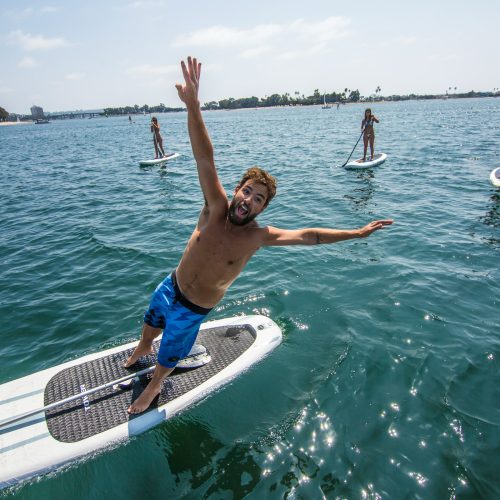
From September 18 to 20, 2026, I raced all three disciplines of the USA SUP National Championships in Gig Harbor, Washington, on an inflatable SUP: the 100 meter sprint on Friday, a 10K on open salt water south toward the Tacoma Narrows on Saturday, and the technical course on Sunday. I finished fifth of six men’s inflatable entrants in both the sprint and the 10K, then came second in my technical preliminary heat and hurt my arm at the end of that run, which kept me out of the final.

2026 was the first year USA SUP ran a separate inflatable division at Nationals, with prize money in all three races.
Before the race I went looking for a straight answer on what the weekend involved and came up with three pages of fragments. One of the course pages still described a venue in Long Beach, California. So I put together what I could verify, filled in the gaps from the official bulletin USA SUP sent race week, and added every result, chart and searchable table as each day was scored.
Key Takeaways
- Friday sprint result: fifth in the men’s inflatable division, 37.121 seconds in the preliminary and 41.302 in the final over 100 meters. Six men and three women contested the first inflatable sprint national championship.
- Saturday 10K result: fifth in the men’s inflatable division, 1:18:33 for 4.75 mph, which is faster than my 4.47 mph training pace over ten miles.
- Sunday technical: second in my preliminary heat in 5:18.58, then an injury at the end of that run kept me out of the final. Twenty-two points across the Big Three.
- The inflatable division was new for 2026, sponsored by Hydrus Boardtech, with men’s and women’s categories, no age groups, and prize money in all three races. An Under 15 youth division was also new.
- Dates and venue: September 17 to 20, 2026, in Gig Harbor, Washington, with clinics Thursday, 100 meter sprints Friday, distance racing Saturday and the technical course Sunday. Sprints and technical racing ran from Skansie Brothers Park; the distance races started outside the harbor entrance. The Narrows Challenge hosted, organized by the Gig Harbor Canoe and Kayak Racing Team.
- Candice Appleby, an 8-time world champion, taught two clinics Thursday: footwork and board skills from 1:00 to 3:00 pm, and stroke technique and glide from 4:00 to 6:00 pm, $145 each and capped at 12 paddlers.
- It was a selection event for the 2026 ICF SUP World Championship in Sabaudia, Italy, and for the ACA Nations Cup US team.
- The 10K runs south from the Gig Harbor entrance to a buoy turn at 5 km near Point Evans, then back, on tidal salt water.
- A Coast Guard approved PFD and a leash are required at all times, along with bright colors for visibility.
- My own preparation was 12 sessions, 65.1 miles and 22.3 hours over 35 days, logged on an Apple Watch with GPS tracks.
- Eight of the nine inflatable sprinters rode the same loaned Hydrus board, most of us for the first time.
The Race at a Glance
Headquarters was Skansie Brothers Park, 3211 Harborview Drive in Gig Harbor, with food trucks on site. The sprints and the technical course both ran from the park. Saturday’s 10K started outside the harbor entrance, and the 5K stayed inside the harbor.
| Day | Time | Event |
|---|---|---|
| Thursday, September 17 | 1:00 to 3:00 pm | SUP Footwork and Board Skills Clinic with Candice Appleby |
| Thursday, September 17 | 4:00 to 6:00 pm | SUP Stroke Technique and Glide Clinic with Candice Appleby |
| Friday, September 18 | 9:00 am | Sprint check-in opens, Skansie Brothers Park |
| Friday, September 18 | 11:30 am | Sprint race meeting |
| Friday, September 18 | 12:00 pm | 100 meter sprint races start |
| Friday, September 18 | 4:00 pm | Sprint awards |
| Friday, September 18 | 5:00 pm | Pro paddle panel and social |
| Saturday, September 19 | 9:00 am | Narrows Challenge check-in |
| Saturday, September 19 | 12:00 pm | 10K race meeting |
| Saturday, September 19 | 1:00 pm | 10K distance race start, all watercraft |
| Saturday, September 19 | 1:30 pm | 5K check-in |
| Saturday, September 19 | 2:30 pm | 5K race meeting |
| Saturday, September 19 | 3:00 pm | 5K distance race start, inside the harbor |
| Saturday, September 19 | 4:00 pm | Awards for all distance races |
| Saturday, September 19 | 5:00 pm | Bands and drone show |
| Sunday, September 20 | 8:30 am | Technical race meeting, Skansie Brothers Park |
| Sunday, September 20 | 9:00 am | Technical races start |
| Sunday, September 20 | 1:00 to 2:00 pm | Technical awards, overall awards |
Overall awards and the naming of the ACA Nations Cup US team both happened Sunday after the technical racing finished. The overall USA SUP National Champion ranking counts only USA SUP members, and members also carry National Championship points into their regional rankings.
Age Groups and Divisions
| Division | Ages |
|---|---|
| Youth (new in 2026) | Under 15 |
| Junior | 15 to 17 |
| Open | 18 to 49 |
| Senior Masters | 50 to 59 |
| Golden Masters | 60 to 69 |
| Legends | 70 and over |
| Inflatable (new in 2026) | No age groups; men’s and women’s divisions |
Thursday Clinics With Candice Appleby
The day before the sprints, eight-time world champion Candice Appleby ran two back-to-back sessions through Ocean Academy. Each was two hours, $145, capped at 12 paddlers, and open to every level. The sessions required your own board, PFD and leash, and check-in was 15 to 20 minutes before the start.
| Clinic | Time | Covers |
|---|---|---|
| SUP Footwork and Board Skills | 1:00 to 3:00 pm | Cross-stepping, pivot turns, board control and balance, foot position for speed and maneuverability |
| SUP Stroke Technique and Glide | 4:00 to 6:00 pm | The four phases of the stroke, catch mechanics, power phase, timing and rhythm, efficiency for sprint and distance |
Pivot turns and cross-stepping decide Sunday’s technical course, and the stroke session feeds straight into Friday’s sprints and Saturday’s 10K. Appleby’s OC1 outrigger stroke clinic was scheduled for Friday morning, September 18, before the sprints started at noon.
What the Big Three Covers
The Big Three entry puts you in all three disciplines for $210.
The 100 Meter Sprint
Roughly 25 to 50 seconds of work, run as preliminary heats and a final. The format guaranteed each entry at least two runs. Everything is decided by the start and the first ten strokes. There is no pacing strategy and no recovery inside the race.
The Technical Course
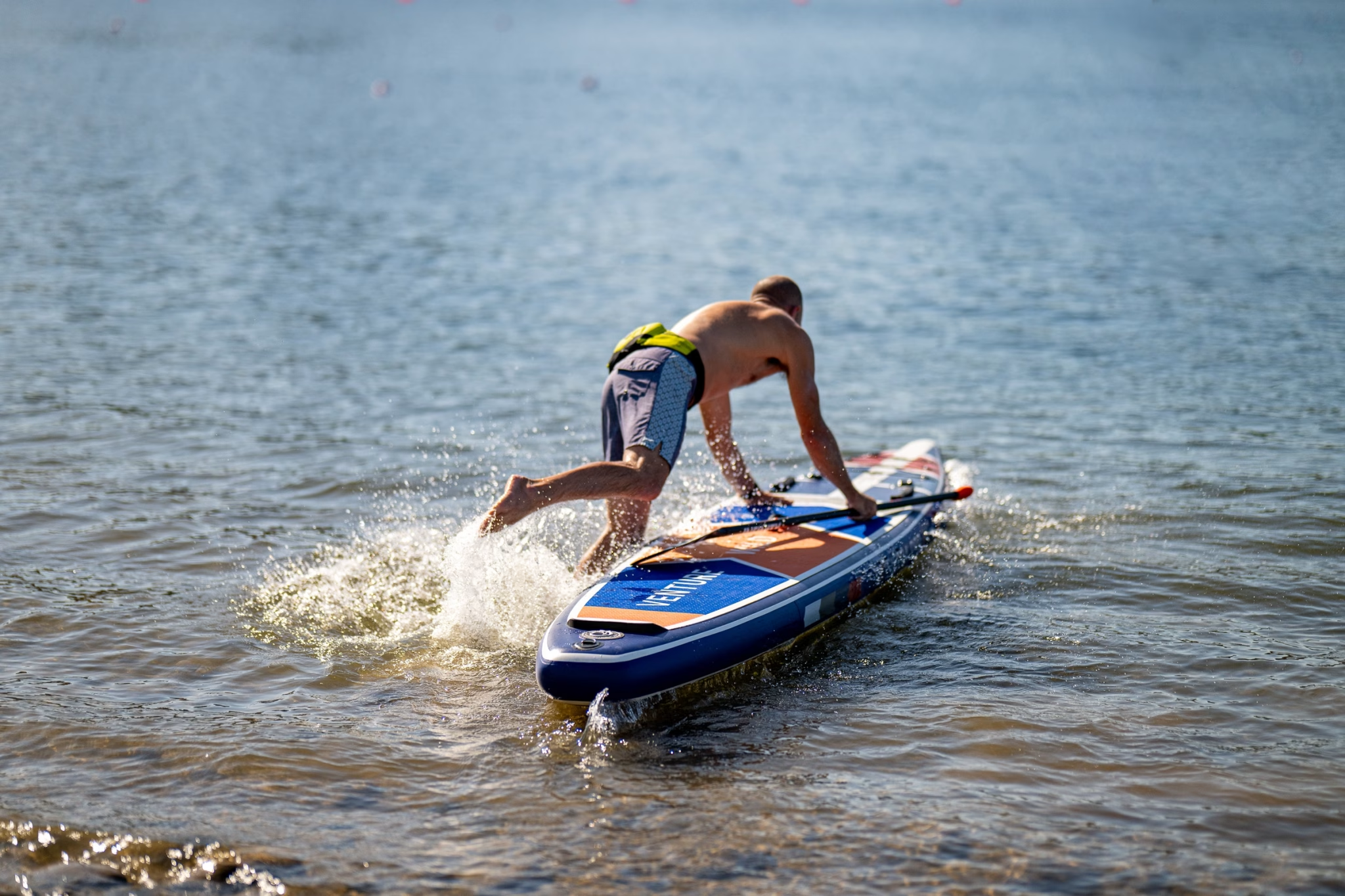
A short buoy course with repeated turns, also run as heats. Technical racing rewards the paddler who can carry speed through a turn and accelerate out of it, which is a different skill from going fast in a straight line. This is the discipline that punishes an inflatable hardest, because a softer rail and more volume make a board slower to bite and turn.
The 10K Distance Race
Roughly 6.2 miles, which at 3.4 to 5 mph is 75 to 110 minutes of continuous work. Saturday’s distance racing went off with all watercraft together, so outriggers, surfskis and kayaks shared the water with the SUP field.
Castaneda-Babarro et al. (2020) found 45 strokes per minute the most economical cadence for international SUP racers, and that holds for the 10K. It has nothing useful to say about a 25 to 50 second sprint, where the race is decided before economy matters and the rate goes wherever the start demands. The technical course sits between the two: rate climbs out of every turn and settles on the straights. I train cadence with a metronome, a protocol I detail in my SUP speed benchmarks.
The Courses, and Why the Narrows Is Different
The Narrows Challenge runs three distance courses off the same start and finish, just outside the Gig Harbor entrance near Lighthouse Point.
| Course | Distance | Route |
|---|---|---|
| Short | 5 km, about 3 miles | South along the shoreline to a buoy at 2.5 km, then back |
| Intermediate | 10 km, about 6 miles | South to Point Evans, buoy turn at 5 km, then back |
| Expert | 20 km, about 12 miles | South under the Narrows Bridge, turnaround at 10 km between Narrows Park and Point Fosdick |

This is a tidal channel, and the Tacoma Narrows moves a large volume of water on an exchange. Current runs with you in one direction and against you in the other, which means a 10K out-and-back is never two even halves. A pace that feels sustainable on the way out can be unreachable on the way home. Which half hurts depends on when the gun goes off.
Race Director Tod Cole describes the event as built on a reputation for “a challenging, fair, and exhilarating race.”
Tides, Current and Weather for Race Weekend
NOAA predicted tides for Gig Harbor at station 9446369 and currents in the Narrows at two 2015 survey stations. The nearest of those, PUG1524, sits at roughly the latitude of the Point Evans turn buoy.
| Day | Race | Predicted tide at Gig Harbor |
|---|---|---|
| Friday, September 18 | Sprints, 12:00 pm | High water 12:58 pm at 10.1 ft. Sprints ran within an hour of the high. |
| Saturday, September 19 | 10K, 1:00 pm | Still flooding at the gun, high water 2:27 pm at 10.3 ft. |
| Saturday, September 19 | 5K, 3:00 pm | Started half an hour after the high, on a falling tide. |
| Sunday, September 20 | Technical, 9:00 am | Mid-flood off a 6:51 am low of 1.4 ft, water rising all morning. |
NOAA’s Tacoma gauge, the nearest station that measures water level, recorded Saturday’s high at 1:24 pm at 10.7 feet, 33 minutes earlier and half a foot higher than its own prediction. Friday’s high came at 12:12 pm and Sunday’s morning low at 6:42 am, each within 20 minutes of predicted. Water stood 0.2 to 0.7 feet above prediction through every race window. The readings are still marked preliminary.
What the Current Was Predicted to Do in the 10K
The prediction had the current still flooding at the 1:00 pm Saturday start, which in the Narrows means water moving southeast, the same direction as the outbound leg toward Point Evans, at about 0.8 knots and fading. Slack was due at 2:14 pm, near where the turn buoy sits, and the ebb was then to build northwest, back toward the harbor, to about 0.6 knots by 4:00 pm. No meter records current in the Narrows, so whether slack came on time is not on record.
| Time | Predicted current at PUG1524 | Effect on the course |
|---|---|---|
| 1:00 pm | 0.78 kt flood | Gentle push south on the outbound leg |
| 1:30 pm | 0.47 kt flood | Fading |
| 2:14 pm | Slack | Dead water around the turn |
| 3:00 pm | 0.39 kt ebb | Push north, toward the finish |
| 4:00 pm | 0.63 kt ebb | Stronger push home for anyone still out |
The 20K field went further south into faster water, where about 1.5 knots of ebb was predicted near the bridge by late afternoon. NOAA has no current station inside Gig Harbor or at the harbor entrance, so the start and finish water was extrapolated from a station about 2.5 miles south, and shoreline eddies do not appear in any prediction. The stations are also harmonic predictions from a 2015 survey rather than live meters.
Water Temperature and Race-Day Weather
Water temperature at NOAA’s Tacoma station read 56.7 degrees on September 17 and stayed between 56.5 and 57.2 degrees through all three race days. At 56.7 degrees, cold shock is in play for anyone who goes in off a pivot turn, and the leash keeps the board within reach of a paddler whose breathing just went ragged.
| Day | Forecast | Measured during racing |
|---|---|---|
| Friday, September 18 | Mostly sunny, high 71, southwest wind around 8 mph | Overcast at the noon start, clearing by 2:00 pm. 61 to 64 degrees, south-southwest wind 6 to 9 mph. |
| Saturday, September 19 | Mostly sunny, high 71, west northwest wind around 3 mph | Overcast through the 10K at 58 to 59 degrees. Wind 6 mph from the west-southwest at the gun, calm by 2:00 pm, 7 mph from the southeast by the 5K. The day topped out at 63. |
| Sunday, September 20 | Sunny, high 71, north wind 1 to 6 mph | Overcast at the 9:00 am start, breaking up by late morning. 54 to 61 degrees, wind calm to 5 mph. |
The marine forecast for Puget Sound called for wind of 5 to 10 knots and waves around 2 feet or less in every period of the weekend. Measured wind never reached 10 mph in any race window. NOAA’s Tacoma gauge records no wind or air temperature, which is why the weather column comes from the airport.
The Inflatable Division Is New in 2026
USA SUP lists three additions for 2026: an inflatable SUP category, an Under 15 youth category, and prize money for Open and iSUP across all three races. Gold sponsor Hydrus Boardtech underwrites the inflatable division, which has no age groups, only a men’s and a women’s race in each discipline. Until now an inflatable paddler entering Nationals raced against carbon and epoxy in the same field.
The gap between an inflatable and a rigid race board at the same effort is largest in the technical course and in choppy water, and it narrows on flat water at steady distance pace. A separate division means the results sheet compares boards that belong in the same column.
USA SUP President Linda McCoy framed the Gig Harbor partnership as “an inspiring example of the SUP community coming together to compete, support each other, and celebrate the shared passion for paddling.”
What Counts as a Race Inflatable
SUP racing settled on three board classes years ago: 12’6″, 14′, and Unlimited. The 14′ class is the dominant one worldwide and is what most serious distance racing is built around. Competitive 14′ inflatable race boards run about 26 inches wide at the most. Once a board reaches 27 inches or wider it is a touring shape, and it will paddle like one.
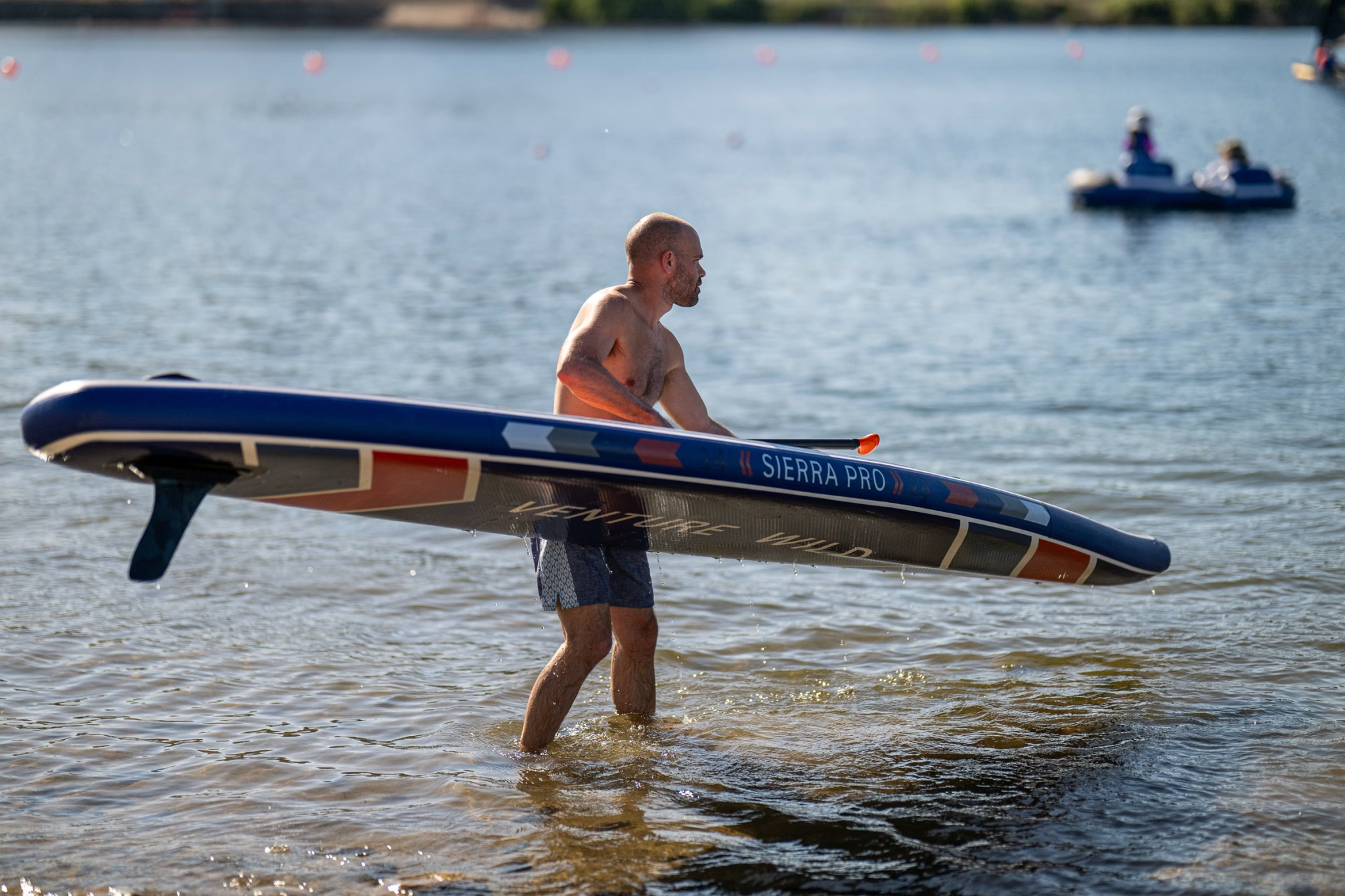
Those are industry conventions. USA SUP has not published an equipment rule for the division. No length, width, minimum PSI or fin specification appears on its 2026 event pages, in the official bulletin, or on either registration platform, and its ranking FAQ gives the reasoning: “Our goal is to keep it SIMPLE. Overall rankings within an event, only separated by gender.”
The ICF rulebook is the one governing document that defines an inflatable class in writing. It caps a 14-foot board at 427 centimeters, sets a 10 kilogram minimum weight, bars rudders, and confines fins to the rear third of the board. It sets no pressure rule either.
Hydrus, the division’s sponsor, loaned ten Elysium Air boards to competitors for the weekend. They measure 14 feet by 26.5 inches and run 15 to 20 PSI. That width sits just under the 27-inch touring line, on a board nobody had to measure to enter.
An underinflated board flexes in the middle, and that flex costs speed on every stroke. I worked through how PSI, board length and hull shape interact, with GPS data, in my SUP speed benchmarks.
Required Safety Equipment
Competitors bring their own PFD and leash to every on-water event.
- Always wear a Coast Guard approved PFD.
- Always wear a leash. Sea kayaks are the only exception.
- Wear bright colors for high visibility on the water.
The channel carries boat traffic for the length of the race.
My Thirty-Five Day Training Block
Between August 2 and September 5 I logged 12 sessions, 65.1 miles and 22.3 hours on the water. Every one was recorded on an Apple Watch with a GPS track.
| Date | Miles | Moving pace | Avg HR | Max HR | Active calories |
|---|---|---|---|---|---|
| August 2 | 2.19 | 2.57 mph | 149 | 185 | 406 |
| August 17 | 3.73 | 2.55 mph | 161 | 189 | 837 |
| August 21 | 1.20 | 1.89 mph | 85 | 129 | 237 |
| August 22 | 5.68 | 4.06 mph | 159 | 194 | 759 |
| August 24 | 8.31 | 4.47 mph | 164 | 182 | 994 |
| August 25 | 4.45 | 3.05 mph | 143 | 190 | 695 |
| August 26 | 5.71 | 3.65 mph | 133 | 178 | 770 |
| August 27 | 4.39 | 1.96 mph | 91 | 173 | 734 |
| August 29 | 10.76 | 4.37 mph | 152 | 178 | 1,531 |
| September 2 | 5.53 | 4.43 mph | 142 | 166 | 722 |
| September 4 | 2.48 | 4.39 mph | 156 | 179 | 382 |
| September 5 | 10.69 | 4.47 mph | 157 | 188 | 1,726 |
August 21 and August 27 both sit under 2 mph. August 27 ran 219 minutes with only 45 percent of that time moving, at a max heart rate of 173 and 734 active calories. That is buoy work: sprint into a turn, turn, accelerate out, drift back to the start, do it again. The clock keeps running while you set up for the next rep.
What the Numbers Say About Race Pace
Dividing distance by total elapsed time counts every water break and every buoy setup as slow paddling. Moving pace drops the stopped seconds and reports what you were doing while the board was moving. Across the sessions above, the two figures differ by about half a mile per hour.
Ten-mile efforts are the closest thing in my log to a 10K.

Last November I covered 10.60 miles at 3.92 mph moving. This September I covered 10.69 miles at 4.47. That is a little over half a mile per hour, or about fourteen percent, on the same board.
My fastest recorded pace did not improve much across that stretch, but I can now hold something close to it for ten miles instead of fading in the last two.
Five days before flying to Washington I raced the eight mile at PaddleSplash on Lake Natoma and finished in 1:49:01.53, first in SUP. Eight miles in that time is 4.40 mph on the total elapsed clock, buoy turns and water breaks included. The 4.47 figure above is moving pace with stopped time stripped out, so the race number is measured the harder way. Full account in my PaddleSplash race report.
Eating and drinking correctly over a two-hour effort is its own skill, and getting it wrong is how a good day falls apart in the last mile. I wrote about that failure in detail in why you bonk on long paddle board sessions, and the strength work underneath all of it is in my SUP strength program.
Friday Results: The 100 Meter Sprint
I finished fifth in the first men’s inflatable sprint raced at a USA SUP National Championships. The preliminary went 37.121 seconds. The final went 41.302.
| Round | Time | Place | Average |
|---|---|---|---|
| Preliminary, Heat 2, 12:08 pm | 37.121 | 2nd in heat | 6.03 mph |
| Final, 2:28 pm | 41.302 | 5th of 6 | 5.42 mph |
Sprints ran as lane races off a gun start, six lanes to a heat, heats leaving every four minutes from noon at Skansie Brothers Park. Six men entered the inflatable division, which put three of us in each preliminary heat with three empty lanes alongside. Nobody was eliminated. The preliminary set the seeding and sent all six into one final at 2:28.
I drew lane three in heat two at 12:08 and came second behind Paul Pianowski, who went 35.171 and would go on to win the division.

| Paddler | Region | Final | Preliminary |
|---|---|---|---|
| Paul Pianowski | SouthWest | 33.811 | 35.171 |
| Jeremy Nicholson | NorthCentral | 35.885 | 34.040 |
| Adrian Angell | NorthCentral | 37.294 | 35.489 |
| Michael Carney | SouthCentral | 39.951 | 40.396 |
| Darya Petrova | SouthEast | 40.990 | 39.381 |
| Michael Kahn | NorthWest | 41.302 | 37.121 |
| Jack Flynn | SouthCentral | 41.627 | 43.946 |
| Debbie Carrillo | SouthCentral | 49.448 | 42.601 |
| Linda McCoy | SouthCentral | 50.473 | 40.208 |
My final came in 4.181 seconds slower than my preliminary. Linda McCoy, who is also the president of USA SUP, went 40.208 in her preliminary and 50.473 in her final.
The preliminary heats had run three paddlers across six lanes, so everyone worked in clean water with a gap on at least one side. The final put all six of us on the line together. Partway down the course I got caught between the wakes coming off two boards, and from there I stopped sprinting and spent the rest of the run staying upright.

What the Sprint Speeds Look Like Across the Whole Field
Seventy-two athletes recorded a timed sprint on Friday across nine divisions, and the chart plots each at their quickest run of the day.

At 100 meters, 37.121 seconds averages 6.03 mph and 41.302 averages 5.42. Pianowski’s winning 33.811 averages 6.62. The fastest run of the day was David Boehne’s 24.379 on a hardboard, 9.18 mph.

Where the Inflatable Division Stands
Rank all 72 athletes who raced Friday by their fastest run and the nine inflatable racers land 31st, 32nd, 41st, 50th, 58th, 59th, 61st, 67th and 69th. Mine is the 50th.
Search the full results below by name, bib, region or division.
| Rank | Athlete | Bib | Gender | Region | Division | Board | 100 m | mph |
|---|---|---|---|---|---|---|---|---|
| 1 | David Boehne | #35 | Men | SouthWest | Open + Junior | Hardboard | 24.379 | 9.18 |
| 2 | Seychelle Webster | #88 | Women | SouthEast | Open + Junior | Hardboard | 26.025 | 8.60 |
| 3 | bodie von allmen | #64 | Men | NorthWest | Open + Junior | Hardboard | 26.050 | 8.59 |
| 4 | Campbell Carter | #3 | Men | SouthEast | Open + Junior | Hardboard | 26.420 | 8.47 |
| 5 | Cory Richardson | #89 | Men | Open + Junior | Hardboard | 26.464 | 8.45 | |
| 6 | Bo Weidner | #37 | Men | SouthWest | Open + Junior | Hardboard | 28.113 | 7.96 |
| 7 | Ryan Grady | #107 | Men | Open + Junior | Hardboard | 28.238 | 7.92 | |
| 8 | Ahmed Fakhry | #49 | Men | NorthWest | Open + Junior | Hardboard | 29.186 | 7.66 |
| 9 | Evan Young | #110 | Men | NorthEast | Open + Junior | Hardboard | 29.237 | 7.65 |
| 10 | Lindsay Weidner | #36 | Women | SouthWest | Open + Junior | Hardboard | 29.569 | 7.57 |
| 11 | Jonathan Grady | #108 | Men | Open + Junior | Hardboard | 29.629 | 7.55 | |
| 12 | John Batson | #81 | Men | SouthEast | 50-59 | Hardboard | 29.856 | 7.49 |
| 13 | Olya Raskina | #69 | Women | SouthWest | Open + Junior | Hardboard | 30.300 | 7.38 |
| 14 | Jack Hodge | #56 | Men | NorthWest | Open + Junior | Hardboard | 30.480 | 7.34 |
| 15 | Anthony Galang | #16 | Men | NorthCentral | 60-69 | Hardboard | 30.582 | 7.32 |
| 16 | David Alber | #63 | Men | NorthWest | Open + Junior | Hardboard | 30.588 | 7.31 |
| 17 | Bastien Donze | #48 | Men | SouthCentral | 50-59 | Hardboard | 30.893 | 7.24 |
| 18 | Tim Everson | #60 | Men | NorthWest | Open + Junior | Hardboard | 31.250 | 7.16 |
| 19 | Mark Hewitt | #38 | Men | SouthEast | 60-69 | Hardboard | 31.635 | 7.07 |
| 20 | Samantha Eastburn | #42 | Women | SouthWest | Open + Junior | Hardboard | 31.678 | 7.06 |
| 21 | John Hansen | #72 | Men | NorthWest | 60-69 | Hardboard | 31.920 | 7.01 |
| 22 | Karl Eugster | #2 | Men | NorthCentral | 60-69 | Hardboard | 31.953 | 7.00 |
| 23 | Alex Ostrowski | #28 | Women | Mexico | Open + Junior | Hardboard | 32.612 | 6.86 |
| 24 | David Reid | #74 | Men | 60-69 | Hardboard | 32.770 | 6.83 | |
| 25 | Alexander Vaughan | #41 | Men | NorthWest | 50-59 | Hardboard | 32.935 | 6.79 |
| 26 | Rob Heinemann | #30 | Men | SouthWest | 60-69 | Hardboard | 33.436 | 6.69 |
| 27 | Sean Sullivan | #23 | Men | SouthWest | 60-69 | Hardboard | 33.519 | 6.67 |
| 28 | Soryn Preston | #106 | Women | SouthWest | Open + Junior | Hardboard | 33.576 | 6.66 |
| 29 | Chris Ozzy Ostrowski | #27 | Men | Mexico | 50-59 | Hardboard | 33.623 | 6.65 |
| 30 | Rich DSouza | #31 | Men | SouthWest | 60-69 | Hardboard | 33.711 | 6.64 |
| 31 | Paul Pianowski | #46 | Men | SouthWest | Inflatable | Inflatable | 33.811 | 6.62 |
| 32 | Jeremy Nicholson | #54 | Men | NorthCentral | Inflatable | Inflatable | 34.040 | 6.57 |
| 33 | Meryl Bezrutczyk-Lauriat | #51 | Women | NorthWest | Open + Junior | Hardboard | 34.070 | 6.57 |
| 34 | JAY JUNIO | #61 | Men | Open + Junior | Hardboard | 34.071 | 6.57 | |
| 35 | Chris Grieve | #55 | Men | NorthWest | 50-59 | Hardboard | 34.161 | 6.55 |
| 36 | Ellison Smith | #7 | Men | NorthEast | Open + Junior | Hardboard | 34.255 | 6.53 |
| 37 | Adam Tischler | #6 | Men | NorthWest | 50-59 | Hardboard | 34.607 | 6.46 |
| 38 | Bruce Barry | #21 | Men | NorthWest | 70+ | Hardboard | 35.068 | 6.38 |
| 39 | Shirley Heinemann | #8 | Women | SouthWest | 60-69 | Hardboard | 35.432 | 6.31 |
| 40 | Hyunyung Boo | #34 | Women | NorthEast | Open + Junior | Hardboard | 35.473 | 6.31 |
| 41 | Adrian Angell | #11 | Men | NorthCentral | Inflatable | Inflatable | 35.489 | 6.30 |
| 42 | Ron Rillorta | #10 | Men | 50-59 | Hardboard | 35.633 | 6.28 | |
| 43 | Brenda Jin | #13 | Women | SouthWest | Open + Junior | Hardboard | 35.728 | 6.26 |
| 44 | Michael Power | #9 | Men | NorthWest | 50-59 | Hardboard | 36.141 | 6.19 |
| 45 | Alex Younger | #5 | Men | NorthWest | Open + Junior | Hardboard | 36.174 | 6.18 |
| 46 | Robert Wilkinson | #4 | Men | NorthCentral | 50-59 | Hardboard | 36.724 | 6.09 |
| 47 | Alyson Mrozinski | #105 | Women | Open + Junior | Hardboard | 36.826 | 6.07 | |
| 48 | Jay Ruffo | #71 | Men | NorthWest | Open + Junior | Hardboard | 36.932 | 6.06 |
| 49 | Bob Rueter | #75 | Men | NorthWest | 70+ | Hardboard | 37.023 | 6.04 |
| 50 | Michael Kahn me | #96 | Men | NorthWest | Inflatable | Inflatable | 37.121 | 6.03 |
| 51 | Christiana "ROO" Truebenbach | #62 | Women | NorthWest | Open + Junior | Hardboard | 37.145 | 6.02 |
| 52 | Ivan Storck | #24 | Men | NorthWest | 50-59 | Hardboard | 37.411 | 5.98 |
| 53 | Allen Alquist | #45 | Men | SouthEast | 50-59 | Hardboard | 37.557 | 5.96 |
| 54 | Barrie Williams | #18 | Men | SouthWest | 70+ | Hardboard | 37.616 | 5.95 |
| 55 | Kristin Thomas | #1 | Women | SouthWest | 60-69 | Hardboard | 37.856 | 5.91 |
| 56 | Jimmy Mooney | #58 | Men | SouthCentral | 60-69 | Hardboard | 38.166 | 5.86 |
| 57 | Haley Stumvoll | #19 | Women | SouthEast | Open + Junior | Hardboard | 38.468 | 5.82 |
| 58 | Darya Petrova | #65 | Women | SouthEast | Inflatable | Inflatable | 39.381 | 5.68 |
| 59 | Michael Carney | #12 | Men | SouthCentral | Inflatable | Inflatable | 39.951 | 5.60 |
| 60 | Michelle Feits | #15 | Women | SouthEast | 50-59 | Hardboard | 40.100 | 5.58 |
| 61 | Linda Mccoy | #14 | Women | SouthCentral | Inflatable | Inflatable | 40.208 | 5.56 |
| 62 | Ayman Zaki | #73 | Men | Open + Junior | Hardboard | 40.378 | 5.54 | |
| 63 | Conor Hartnett | #84 | Men | NorthEast | 50-59 | Hardboard | 40.593 | 5.51 |
| 64 | Karen Redmond | #22 | Women | SouthEast | 50-59 | Hardboard | 40.669 | 5.50 |
| 65 | Tricia Lyons | #33 | Women | NorthWest | 50-59 | Hardboard | 41.186 | 5.43 |
| 66 | Travis Prewitt | #91 | Men | NorthWest | 70+ | Hardboard | 41.299 | 5.42 |
| 67 | Jack Flynn | #98 | Men | SouthCentral | Inflatable | Inflatable | 41.627 | 5.37 |
| 68 | Jess Bouchee | #99 | Women | NorthWest | 50-59 | Hardboard | 42.220 | 5.30 |
| 69 | Debbie Carrillo | #77 | Women | SouthCentral | Inflatable | Inflatable | 42.601 | 5.25 |
| 70 | Julianne Veal | #20 | Women | SouthEast | 60-69 | Hardboard | 42.697 | 5.24 |
| 71 | Lisi Cole | #26 | Women | NorthWest | 50-59 | Hardboard | 45.350 | 4.93 |
| 72 | Amy Merten | #29 | Women | NorthWest | 50-59 | Hardboard | 47.410 | 4.72 |
Saturday Results: The 10K and the 5K
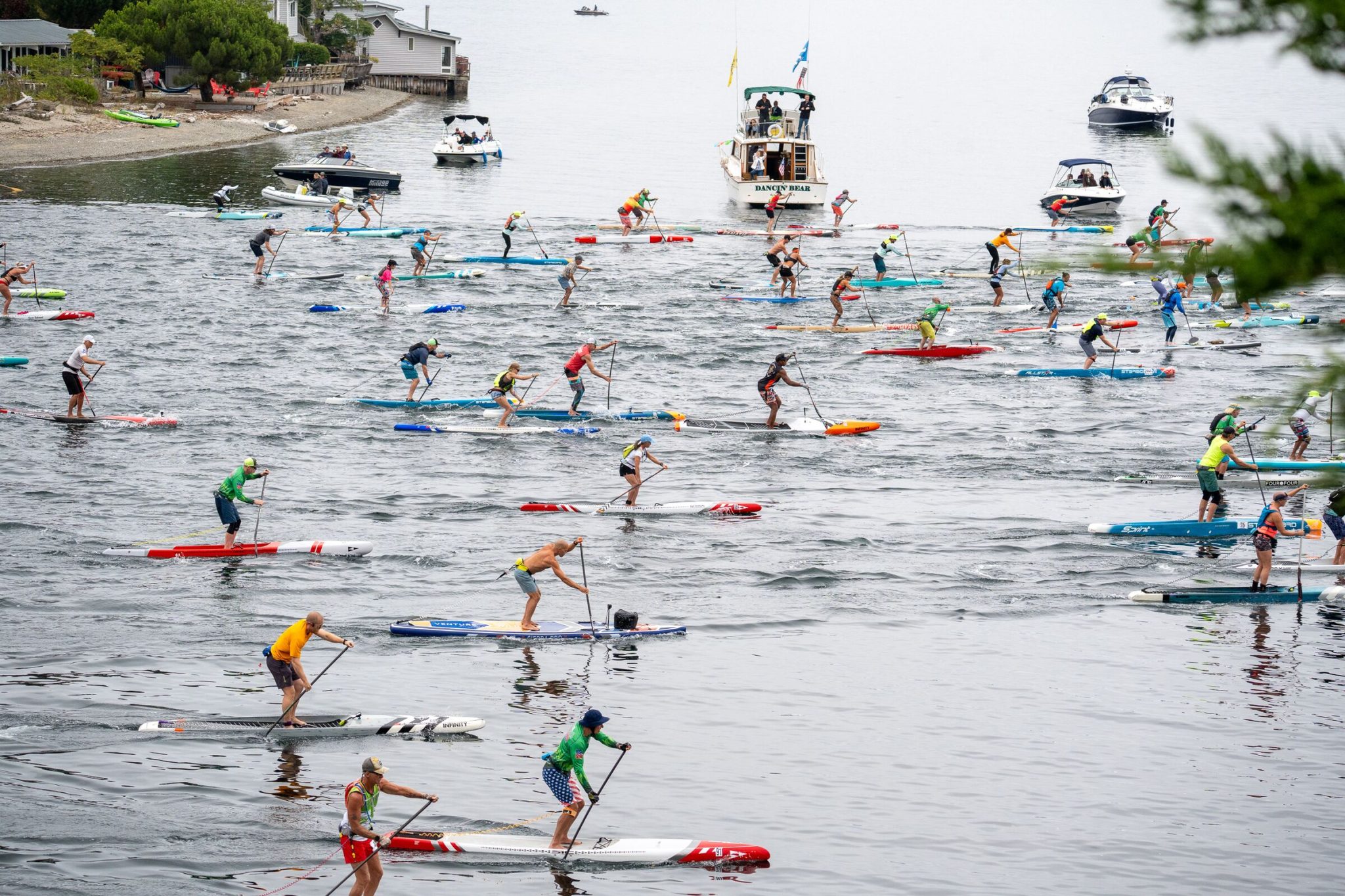
I finished fifth of six in the men’s inflatable 10K in 1:18:33, which averages 4.75 mph across the 6.2 miles.
| Paddler | Region | Time | mph |
|---|---|---|---|
| Paul Pianowski | SouthWest | 1:07:23 | 5.53 |
| Jeremy Nicholson | NorthCentral | 1:11:40 | 5.20 |
| Morris Paillet | SouthCentral | 1:13:31 | 5.07 |
| Adrian Angell | NorthCentral | 1:17:45 | 4.79 |
| Michael Kahn | NorthWest | 1:18:33 | 4.75 |
| Alex Hargrove | 1:19:40 | 4.68 | |
| Debbie Carrillo | SouthCentral | 1:32:04 | 4.05 |
| Linda McCoy | SouthCentral | 1:35:09 | 3.92 |
Adrian Angell took fourth 48 seconds up the course from me and Alex Hargrove came in 67 seconds back. Paul Pianowski won it in 1:07:23 for his second national title of the weekend. He also raced the 5K that afternoon on a hardboard and finished second of 28, 2.93 seconds behind Jack Hodge.
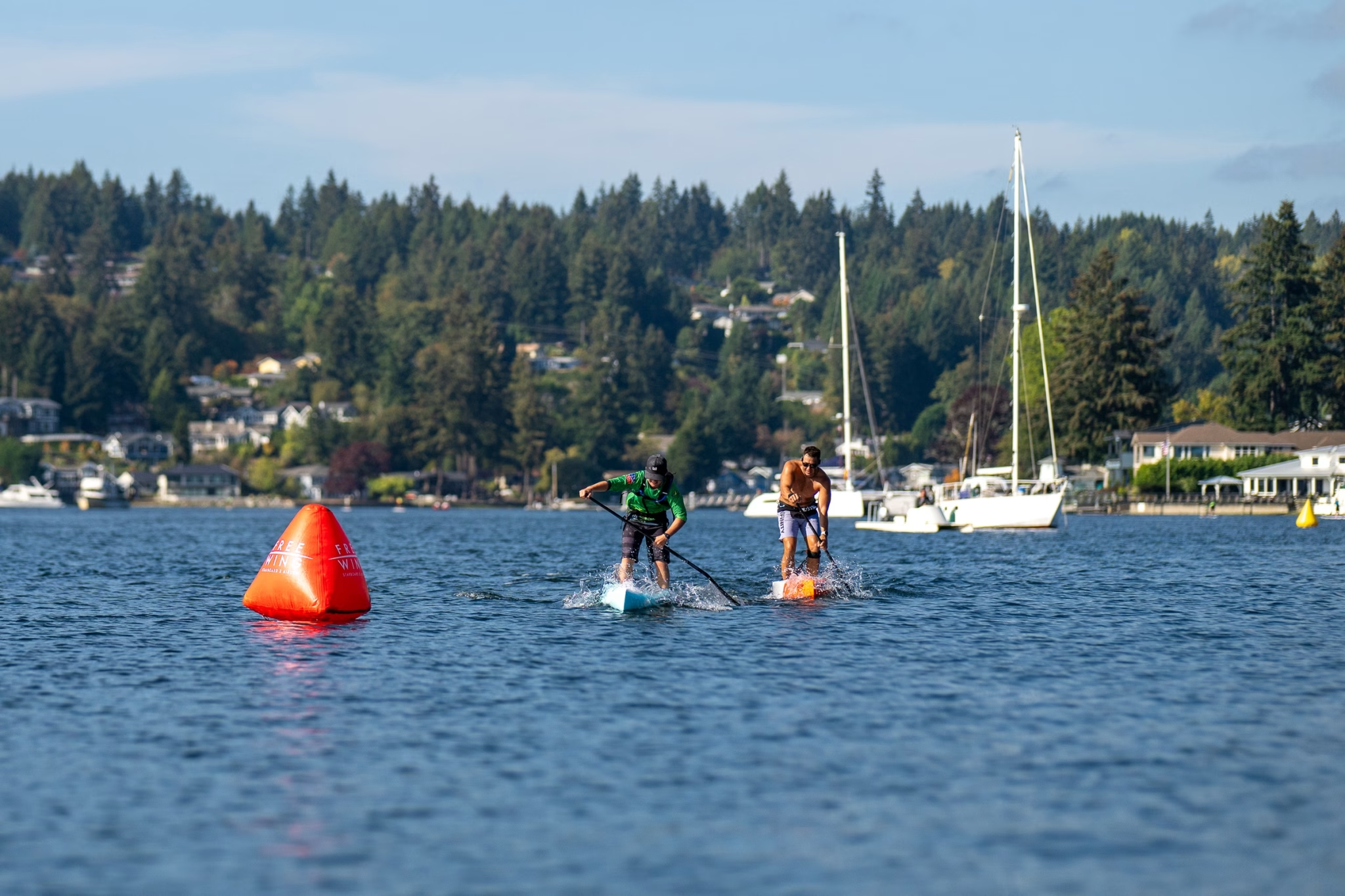
Jack Flynn and Michael Carney both raced Friday’s sprint and took the 5K on Saturday rather than the 10K. Morris Paillet and Alex Hargrove went the other way and raced the 10K without entering the sprint.
That 4.75 mph is quicker than anything in my training block. Sixty-six logged sessions put me at 4.47 mph on ten mile efforts, and PaddleSplash came in at 4.40 over eight miles six days earlier. The water likely did some of that work. The tide tables had a flood running south at the 1:00 pm start and an ebb building through the afternoon, which would push the outbound leg down the channel and the return leg back toward the harbor, and the wind at the airport dropped from 6 mph at the gun to calm an hour in.

Where the Inflatable Boards Landed
Ranking all 75 finishers of the 10K by average speed, the eight inflatable racers come in 19th, 38th, 44th, 51st, 54th, 57th, 70th and 72nd. Mine is the 54th.
Olya Raskina finished the 5K eighth of all 28 finishers in 32:14.50 on an inflatable, ahead of thirteen hardboards.
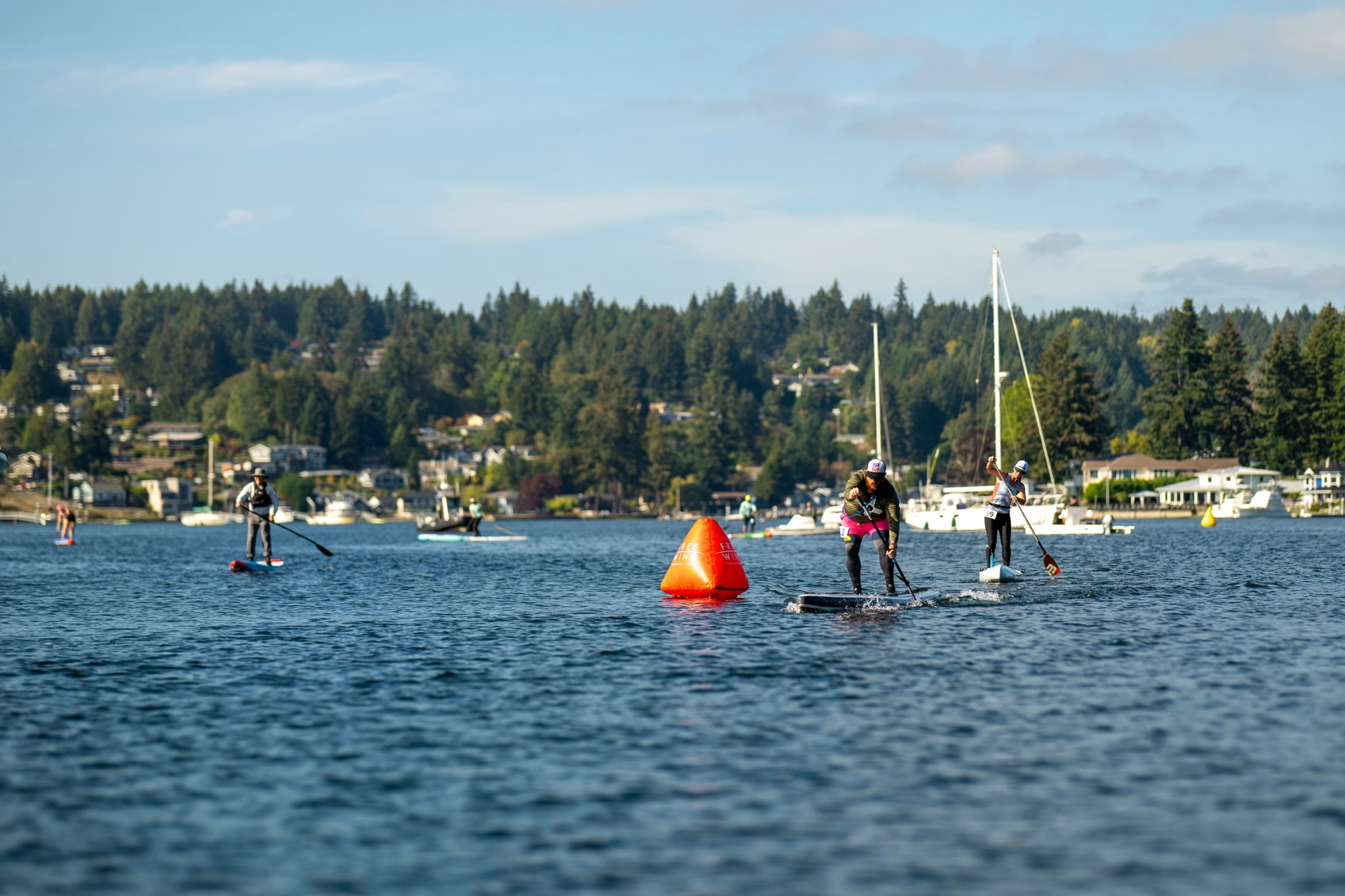
Search every scored finish from Saturday below by name, bib, region, division or distance.
| Race | Rank | Athlete | Bib | Gender | Region | Division | Board | Time | mph |
|---|---|---|---|---|---|---|---|---|---|
| 10K | 1 | bodie von allmen | #64 | Men | NorthWest | 18-49 | Hardboard | 58:26.00 | 6.38 |
| 10K | 2 | Campbell Carter | #3 | Men | SouthEast | 18-49 | Hardboard | 58:51.00 | 6.33 |
| 10K | 3 | John Batson | #81 | Men | SouthEast | 50-59 | Hardboard | 1:02:22.00 | 5.98 |
| 10K | 4 | Seychelle Webster | #88 | Women | SouthEast | 18-49 | Hardboard | 1:02:25.00 | 5.97 |
| 10K | 5 | Candice Appleby | #97 | Women | SouthWest | 18-49 | Hardboard | 1:02:31.00 | 5.96 |
| 10K | 6 | Ahmed Fakhry | #49 | Men | NorthWest | 18-49 | Hardboard | 1:03:43.00 | 5.85 |
| 10K | 7 | David Boehne | #35 | Men | SouthWest | 18-49 | Hardboard | 1:03:44.00 | 5.85 |
| 10K | 8 | Mark Klevinas | #102 | Men | 18-49 | Hardboard | 1:03:52.00 | 5.84 | |
| 10K | 9 | Soryn Preston | #106 | Women | SouthWest | 18-49 | Hardboard | 1:05:12.00 | 5.72 |
| 10K | 10 | Anthony Galang | #16 | Men | NorthCentral | 60-69 | Hardboard | 1:05:52.00 | 5.66 |
| 10K | 11 | Jack Hodge | #56 | Men | NorthWest | 15-17 | Hardboard | 1:05:58.00 | 5.65 |
| 10K | 12 | David Alber | #63 | Men | NorthWest | 18-49 | Hardboard | 1:06:17.00 | 5.62 |
| 10K | 13 | Ron Rillorta | #10 | Men | 50-59 | Hardboard | 1:06:20.00 | 5.62 | |
| 10K | 14 | Bo Weidner | #37 | Men | SouthWest | 18-49 | Hardboard | 1:06:35.00 | 5.60 |
| 10K | 15 | Robb McEachran | #59 | Men | 50-59 | Hardboard | 1:06:43.00 | 5.59 | |
| 10K | 16 | Ethan Huff | #44 | Men | NorthWest | 18-49 | Hardboard | 1:06:49.00 | 5.58 |
| 10K | 17 | Alexander Vaughan | #41 | Men | NorthWest | 50-59 | Hardboard | 1:06:52.00 | 5.58 |
| 10K | 18 | Alex Ostrowski | #28 | Women | Mexico | 18-49 | Hardboard | 1:06:59.00 | 5.57 |
| 10K | 19 | Paul Pianowski | #46 | Men | SouthWest | Inflatable | Inflatable | 1:07:23.00 | 5.53 |
| 10K | 20 | Cory Richardson | #89 | Men | 18-49 | Hardboard | 1:07:29.00 | 5.53 | |
| 10K | 21 | Lindsay Weidner | #36 | Women | SouthWest | 18-49 | Hardboard | 1:07:41.00 | 5.51 |
| 10K | 22 | cody bean | #78 | Men | NorthWest | 18-49 | Hardboard | 1:07:46.00 | 5.50 |
| 10K | 23 | Tyler Martin | #82 | Men | 50-59 | Hardboard | 1:08:27.00 | 5.45 | |
| 10K | 24 | Ahmed Salem | #53 | Men | NorthWest | 18-49 | Hardboard | 1:08:46.00 | 5.42 |
| 10K | 25 | Alex Younger | #5 | Men | NorthWest | 18-49 | Hardboard | 1:08:53.00 | 5.41 |
| 10K | 26 | Chris Grieve | #55 | Men | NorthWest | 50-59 | Hardboard | 1:09:02.00 | 5.40 |
| 10K | 27 | Bastien Donze | #48 | Men | SouthCentral | 50-59 | Hardboard | 1:09:08.00 | 5.39 |
| 10K | 28 | Brenda Jin | #13 | Women | SouthWest | 18-49 | Hardboard | 1:09:15.00 | 5.38 |
| 10K | 29 | Samantha Eastburn | #42 | Women | SouthWest | 18-49 | Hardboard | 1:09:23.00 | 5.37 |
| 10K | 30 | Bruce Barry | #21 | Men | NorthWest | 70+ | Hardboard | 1:09:51.00 | 5.34 |
| 10K | 31 | Olya Raskina | #69 | Women | SouthWest | 18-49 | Hardboard | 1:10:11.00 | 5.31 |
| 10K | 32 | Karl Eugster | #2 | Men | NorthCentral | 60-69 | Hardboard | 1:10:21.00 | 5.30 |
| 10K | 33 | JAY JUNIO | #61 | Men | 18-49 | Hardboard | 1:10:37.00 | 5.28 | |
| 10K | 34 | Ellison Smith | #7 | Men | NorthEast | 18-49 | Hardboard | 1:10:57.00 | 5.25 |
| 10K | 35 | Mark Hewitt | #38 | Men | SouthEast | 60-69 | Hardboard | 1:11:17.00 | 5.23 |
| 10K | 36 | Tim Everson | #60 | Men | NorthWest | 18-49 | Hardboard | 1:11:24.00 | 5.22 |
| 10K | 37 | Hyunyung Boo | #34 | Women | NorthEast | 18-49 | Hardboard | 1:11:24.00 | 5.22 |
| 10K | 38 | Jeremy Nicholson | #54 | Men | NorthCentral | Inflatable | Inflatable | 1:11:40.00 | 5.20 |
| 10K | 39 | David Reid | #74 | Men | 60-69 | Hardboard | 1:11:48.00 | 5.19 | |
| 10K | 40 | Brian Huvane | #83 | Men | NorthWest | 50-59 | Hardboard | 1:12:07.00 | 5.17 |
| 10K | 41 | Chris Ozzy Ostrowski | #27 | Men | Mexico | 50-59 | Hardboard | 1:12:09.00 | 5.17 |
| 10K | 42 | Bob Rueter | #75 | Men | NorthWest | 70+ | Hardboard | 1:12:32.00 | 5.14 |
| 10K | 43 | Ines Lamadrid | #39 | Women | SouthCentral | 50-59 | Hardboard | 1:13:04.00 | 5.10 |
| 10K | 44 | Morris Paillet | #87 | Men | SouthCentral | Inflatable | Inflatable | 1:13:31.00 | 5.07 |
| 10K | 45 | Brown Fihaki | #94 | Men | NorthWest | 50-59 | Hardboard | 1:14:29.00 | 5.00 |
| 10K | 46 | Rich DSouza | #31 | Men | SouthWest | 60-69 | Hardboard | 1:14:30.00 | 5.00 |
| 10K | 47 | Kim Rueter | #76 | Women | 50-59 | Hardboard | 1:16:25.00 | 4.88 | |
| 10K | 48 | Meryl Bezrutczyk-Lauriat | #51 | Women | NorthWest | 18-49 | Hardboard | 1:17:03.00 | 4.84 |
| 10K | 49 | Tricia Lyons | #33 | Women | NorthWest | 50-59 | Hardboard | 1:17:11.00 | 4.83 |
| 10K | 50 | Barrie Williams | #18 | Men | SouthWest | 70+ | Hardboard | 1:17:17.00 | 4.82 |
| 10K | 51 | Adrian Angell | #11 | Men | NorthCentral | Inflatable | Inflatable | 1:17:45.00 | 4.79 |
| 10K | 52 | Robert Wilkinson | #4 | Men | NorthCentral | 50-59 | Hardboard | 1:17:51.00 | 4.79 |
| 10K | 53 | Laris Grikis | #104 | Men | 50-59 | Hardboard | 1:18:06.00 | 4.77 | |
| 10K | 54 | Michael Kahn me | #96 | Men | NorthWest | Inflatable | Inflatable | 1:18:33.00 | 4.75 |
| 10K | 55 | Ivan Storck | #24 | Men | NorthWest | 50-59 | Hardboard | 1:18:49.00 | 4.73 |
| 10K | 56 | Tracy Spohn | #159 | Women | 18-49 | Hardboard | 1:19:29.00 | 4.69 | |
| 10K | 57 | Alex Hargrove | #86 | Men | Inflatable | Inflatable | 1:19:40.00 | 4.68 | |
| 10K | 58 | Karen Kennedy Decaran-Voigt | #43 | Women | 50-59 | Hardboard | 1:19:41.00 | 4.68 | |
| 10K | 59 | Conor Hartnett | #84 | Men | NorthEast | 50-59 | Hardboard | 1:20:50.00 | 4.61 |
| 10K | 60 | Allen Alquist | #45 | Men | SouthEast | 50-59 | Hardboard | 1:21:57.00 | 4.55 |
| 10K | 61 | Evan Young | #110 | Men | NorthEast | 18-49 | Hardboard | 1:21:58.00 | 4.55 |
| 10K | 62 | John Hansen | #72 | Men | NorthWest | 60-69 | Hardboard | 1:22:58.00 | 4.49 |
| 10K | 63 | Shirley Heinemann | #8 | Women | SouthWest | 60-69 | Hardboard | 1:25:32.00 | 4.36 |
| 10K | 64 | Karen Redmond | #22 | Women | SouthEast | 50-59 | Hardboard | 1:25:46.00 | 4.35 |
| 10K | 65 | Amy Merten | #29 | Women | NorthWest | 50-59 | Hardboard | 1:25:49.00 | 4.34 |
| 10K | 66 | Sarah Hess | #111 | Women | NorthWest | 18-49 | Hardboard | 1:25:57.00 | 4.34 |
| 10K | 67 | Julianne Veal | #20 | Women | SouthEast | 60-69 | Hardboard | 1:26:41.00 | 4.30 |
| 10K | 68 | Lambert Wixson | #92 | Men | NorthWest | 50-59 | Hardboard | 1:28:06.00 | 4.23 |
| 10K | 69 | Travis Prewitt | #91 | Men | NorthWest | 70+ | Hardboard | 1:31:26.00 | 4.08 |
| 10K | 70 | Debbie Carrillo | #77 | Women | SouthCentral | Inflatable | Inflatable | 1:32:04.00 | 4.05 |
| 10K | 71 | Downs Spitler | #79 | Men | 60-69 | Hardboard | 1:33:03.00 | 4.01 | |
| 10K | 72 | Linda Mccoy | #14 | Women | SouthCentral | Inflatable | Inflatable | 1:35:09.00 | 3.92 |
| 10K | 73 | Christiana "ROO" Truebenbach | #62 | Women | NorthWest | 15-17 | Hardboard | 1:36:35.00 | 3.86 |
| 10K | 74 | Lisi Cole | #26 | Women | NorthWest | 50-59 | Hardboard | 1:36:52.00 | 3.85 |
| 10K | 75 | Laura Jane Broigher | #103 | Women | 60-69 | Hardboard | 1:48:08.00 | 3.45 | |
| 5K | 1 | Jack Hodge | #56 | Men | NorthWest | 15-17 | Hardboard | 29:04.08 | 6.41 |
| 5K | 2 | Paul Pianowski | #46 | Men | SouthWest | 18-49 | Hardboard | 29:07.01 | 6.40 |
| 5K | 3 | Tyler Peterson | #117 | Men | 18-49 | Hardboard | 29:50.53 | 6.25 | |
| 5K | 4 | Calvin Rowland | #50 | Men | NorthWest | 50-59 | Hardboard | 30:14.81 | 6.16 |
| 5K | 5 | Joshua Proctor | #116 | Men | 18-49 | Hardboard | 31:18.55 | 5.95 | |
| 5K | 6 | Ayman Zaki | #73 | Men | 18-49 | Hardboard | 31:44.07 | 5.87 | |
| 5K | 7 | Haley Stumvoll | #19 | Women | SouthEast | 18-49 | Hardboard | 31:49.90 | 5.86 |
| 5K | 8 | Olya Raskina | #69 | Women | SouthWest | Inflatable | Inflatable | 32:14.50 | 5.78 |
| 5K | 9 | Brown Fihaki | #94 | Men | NorthWest | 50-59 | Hardboard | 32:23.14 | 5.76 |
| 5K | 10 | Rachel Cantore | #85 | Women | SouthEast | 18-49 | Hardboard | 32:44.13 | 5.69 |
| 5K | 11 | Rob Heinemann | #30 | Men | SouthWest | 60-69 | Hardboard | 34:03.83 | 5.47 |
| 5K | 12 | Kristi Turner | #80 | Women | 18-49 | Hardboard | 34:43.26 | 5.37 | |
| 5K | 13 | Mac Snow | #200 | Men | 18-49 | Hardboard | 34:48.62 | 5.36 | |
| 5K | 14 | Jack Flynn | #98 | Men | SouthCentral | Inflatable | Inflatable | 35:48.08 | 5.21 |
| 5K | 15 | Darya Petrova | #65 | Women | SouthEast | Inflatable | Inflatable | 36:10.34 | 5.15 |
| 5K | 16 | Meryl Bezrutczyk-Lauriat | #51 | Women | NorthWest | 18-49 | Hardboard | 36:11.63 | 5.15 |
| 5K | 17 | Jimmy Mooney | #58 | Men | SouthCentral | 60-69 | Hardboard | 36:50.64 | 5.06 |
| 5K | 18 | Michael Carney | #12 | Men | SouthCentral | Inflatable | Inflatable | 37:07.97 | 5.02 |
| 5K | 19 | Jess Bouchee | #99 | Women | NorthWest | 50-59 | Hardboard | 37:17.26 | 5.00 |
| 5K | 20 | Megan Gideon | #113 | Women | Inflatable | Inflatable | 38:09.10 | 4.89 | |
| 5K | 21 | Shirley Heinemann | #8 | Women | SouthWest | 60-69 | Hardboard | 40:56.34 | 4.55 |
| 5K | 22 | Natalya Shoror | #57 | Women | NorthCentral | 18-49 | Hardboard | 40:57.37 | 4.55 |
| 5K | 23 | Joanne Bromwell | #47 | Women | NorthWest | 60-69 | Hardboard | 42:19.05 | 4.41 |
| 5K | 24 | Gail Kotowski | #40 | Women | NorthEast | 70+ | Hardboard | 45:12.38 | 4.12 |
| 5K | 25 | Arjun Batchu | #100 | Men | NorthCentral | Inflatable | Inflatable | 45:29.44 | 4.10 |
| 5K | 26 | Maggie Bolton | #25 | Women | 18-49 | Hardboard | 46:00.29 | 4.05 | |
| 5K | 27 | Shannon Scott | #66 | Women | Inflatable | Inflatable | 46:02.41 | 4.05 | |
| 5K | 28 | Lori Smith | #52 | Women | NorthWest | Inflatable | Inflatable | 56:00.00 | 3.33 |
Sunday Results: The Technical Course
I came second in my technical preliminary heat in 5:18.58, then hurt my arm at the end of that run and did not start the final.
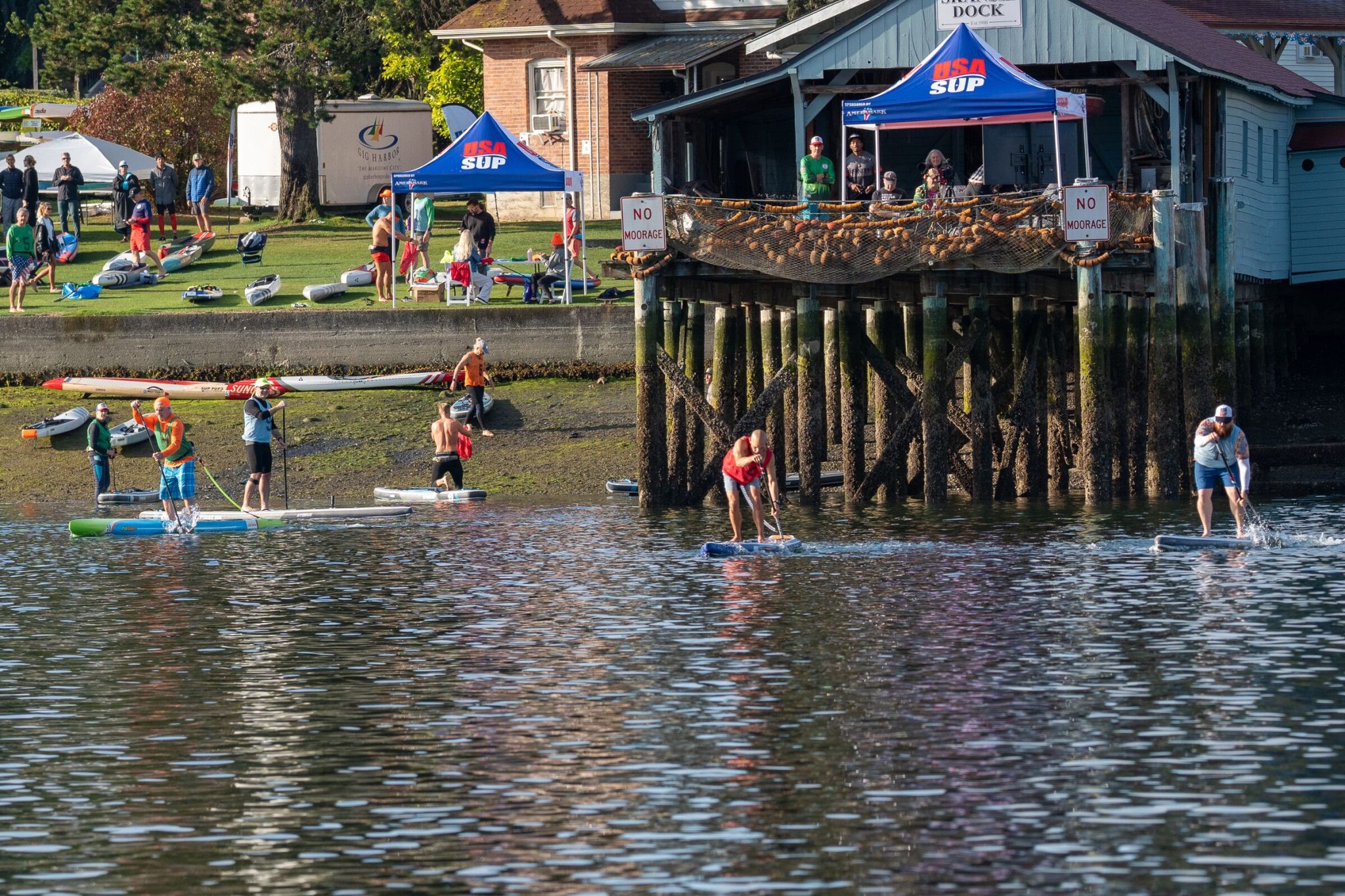
| Heat | Paddler | Time | Heat place |
|---|---|---|---|
| 1 | Adrian Angell | 5:16.31 | 1 |
| 1 | Michael Kahn | 5:18.58 | 2 |
| 1 | Michael Carney | 6:01.22 | 3 |
| 2 | Paul Pianowski | 5:05.44 | 1 |
| 2 | Jeremy Nicholson | 5:06.66 | 2 |
| 2 | Jack Flynn | 5:49.37 | 3 |
That 5:18.58 was the fourth quickest of the six preliminary runs, 2.27 seconds behind Adrian Angell and about twelve seconds off Paul Pianowski at the top of the other heat.

| Paddler | Time |
|---|---|
| Paul Pianowski | 4:52.21 |
| Jeremy Nicholson | 5:04.93 |
| Adrian Angell | 5:32.53 |
| Jack Flynn | 6:11.30 |
| Michael Carney | 6:12.79 |
| Darya Petrova | 6:13.45 |
| Debbie Carrillo | 6:26.85 |
| Linda McCoy | 6:52.28 |
| Michael Kahn | Did not start |
The scoring drops a paddler who does not start. My preliminary time is gone from the division standings, which list me sixth with no time and no points. The rest of this section counts that run, because it happened and it was timed.
Where the Technical Times Landed
Sixty-nine times were recorded across the eleven divisions that raced. USA SUP published no course distance for the technical, so these are elapsed times rather than speeds.

Pianowski’s winning 4:52.21 was quicker than all but eight paddlers in the whole field. My own 5:18.58 sits 37th of 69, which is the closest to the middle I came all weekend.
Ranked inside my own division I went fourth, fifth and fourth, against fifth, fifth and sixth on the official sheet.
| Discipline | My time | Inflatable division, by time | Official placing | Whole field |
|---|---|---|---|---|
| Sprint | 37.121 | 4th of 9 | 5th | 50th of 72 |
| 10K | 1:18:33 | 5th of 8 | 5th | 54th of 75 |
| Technical | 5:18.58 | 4th of 9 | 6th, did not start | 37th of 69 |
Adrian Angell, Jack Flynn and Michael Carney all went slower in the final than they had in their heats, so the quickest run of the day for three of the nine inflatable paddlers was a preliminary. Ordered by best run or by preliminary alone, I am fourth in the division.
Search every technical time below by name, bib, region or division.
| Rank | Athlete | Bib | Gender | Region | Division | Board | Time |
|---|---|---|---|---|---|---|---|
| 1 | Campbell Carter | #3 | Men | SouthEast | 18-49 | Hardboard | 4:18.62 |
| 2 | bodie von allmen | #64 | Men | NorthWest | 18-49 | Hardboard | 4:21.99 |
| 3 | John Batson | #81 | Men | SouthEast | 50-59 | Hardboard | 4:29.38 |
| 4 | David Boehne | #35 | Men | SouthWest | 18-49 | Hardboard | 4:29.76 |
| 5 | Bo Weidner | #37 | Men | SouthWest | 18-49 | Hardboard | 4:36.64 |
| 6 | Seychelle Webster | #88 | Women | SouthEast | 18-49 | Hardboard | 4:40.44 |
| 7 | Jack Hodge | #56 | Men | NorthWest | 15-17 | Hardboard | 4:44.15 |
| 8 | Soryn Preston | #106 | Women | SouthWest | 18-49 | Hardboard | 4:49.46 |
| 9 | Paul Pianowski | #46 | Men | SouthWest | Inflatable | Inflatable | 4:52.20 |
| 10 | Ethan Huff | #44 | Men | NorthWest | 18-49 | Hardboard | 4:52.31 |
| 11 | Lindsay Weidner | #36 | Women | SouthWest | 18-49 | Hardboard | 4:52.50 |
| 12 | Ahmed Fakhry | #49 | Men | NorthWest | 18-49 | Hardboard | 4:52.96 |
| 13 | David Alber | #63 | Men | NorthWest | 18-49 | Hardboard | 4:53.42 |
| 14 | Anthony Galang | #16 | Men | NorthCentral | 60-69 | Hardboard | 4:55.55 |
| 15 | Samantha Eastburn | #42 | Women | SouthWest | 18-49 | Hardboard | 4:56.17 |
| 16 | Tim Everson | #60 | Men | NorthWest | 18-49 | Hardboard | 4:57.51 |
| 17 | Adam Tischler | #6 | Men | NorthWest | 50-59 | Hardboard | 4:58.01 |
| 18 | Alex Ostrowski | #28 | Women | Mexico | 18-49 | Hardboard | 4:58.36 |
| 19 | Hyunyung Boo | #34 | Women | NorthEast | 18-49 | Hardboard | 5:01.36 |
| 20 | Alexander Vaughan | #41 | Men | NorthWest | 50-59 | Hardboard | 5:03.83 |
| 21 | Jeremy Nicholson | #54 | Men | NorthCentral | Inflatable | Inflatable | 5:04.93 |
| 22 | Cory Richardson | #89 | Men | 18-49 | Hardboard | 5:05.21 | |
| 23 | Ron Rillorta | #10 | Men | 50-59 | Hardboard | 5:05.38 | |
| 24 | David Reid | #74 | Men | 60-69 | Hardboard | 5:07.46 | |
| 25 | Chris Ozzy Ostrowski | #27 | Men | Mexico | 50-59 | Hardboard | 5:07.56 |
| 26 | JAY JUNIO | #61 | Men | 18-49 | Hardboard | 5:08.86 | |
| 27 | Ellison Smith | #7 | Men | NorthEast | 18-49 | Hardboard | 5:10.00 |
| 28 | Karl Eugster | #2 | Men | NorthCentral | 60-69 | Hardboard | 5:10.21 |
| 29 | Rachel Cantore | #85 | Women | SouthEast | 18-49 | Hardboard | 5:10.66 |
| 30 | Brenda Jin | #13 | Women | SouthWest | 18-49 | Hardboard | 5:10.87 |
| 31 | Olya Raskina | #69 | Women | SouthWest | 18-49 | Hardboard | 5:11.62 |
| 32 | Robb McEachran | #59 | Men | 50-59 | Hardboard | 5:14.33 | |
| 33 | Alex Younger | #5 | Men | NorthWest | 18-49 | Hardboard | 5:16.00 |
| 34 | Michael Power | #9 | Men | NorthWest | 50-59 | Hardboard | 5:17.81 |
| 35 | Christiana "ROO" Truebenbach | #62 | Women | NorthWest | 15-17 | Hardboard | 5:18.06 |
| 36 | Chris Grieve | #55 | Men | NorthWest | 50-59 | Hardboard | 5:18.49 |
| 37 | Michael Kahn me prelim | #96 | Men | NorthWest | Inflatable | Inflatable | 5:18.58 |
| 38 | Bob Rueter | #75 | Men | NorthWest | 70+ | Hardboard | 5:18.67 |
| 39 | Bastien Donze | #48 | Men | SouthCentral | 50-59 | Hardboard | 5:19.24 |
| 40 | Evan Young | #110 | Men | NorthEast | 18-49 | Hardboard | 5:19.91 |
| 41 | Haley Stumvoll | #19 | Women | SouthEast | 18-49 | Hardboard | 5:21.79 |
| 42 | Ahmed Salem | #53 | Men | NorthWest | 18-49 | Hardboard | 5:23.11 |
| 43 | Ayman Zaki | #73 | Men | 18-49 | Hardboard | 5:23.30 | |
| 44 | Ivan Storck | #24 | Men | NorthWest | 50-59 | Hardboard | 5:25.29 |
| 45 | John Hansen | #72 | Men | NorthWest | 60-69 | Hardboard | 5:25.51 |
| 46 | Robert Wilkinson | #4 | Men | NorthCentral | 50-59 | Hardboard | 5:27.45 |
| 47 | Ines Lamadrid | #39 | Women | SouthCentral | 50-59 | Hardboard | 5:29.57 |
| 48 | Kristin Thomas | #1 | Women | SouthWest | 60-69 | Hardboard | 5:29.69 |
| 49 | Adrian Angell | #11 | Men | NorthCentral | Inflatable | Inflatable | 5:32.53 |
| 50 | Barrie Williams | #18 | Men | SouthWest | 70+ | Hardboard | 5:32.56 |
| 51 | Conor Hartnett | #84 | Men | NorthEast | 50-59 | Hardboard | 5:33.57 |
| 52 | Tricia Lyons | #33 | Women | NorthWest | 50-59 | Hardboard | 5:37.80 |
| 53 | Mark Hewitt | #38 | Men | SouthEast | 60-69 | Hardboard | 5:38.17 |
| 54 | Allen Alquist | #45 | Men | SouthEast | 50-59 | Hardboard | 5:38.65 |
| 55 | Meryl Bezrutczyk-Lauriat | #51 | Women | NorthWest | 18-49 | Hardboard | 5:49.83 |
| 56 | Shirley Heinemann | #8 | Women | SouthWest | 60-69 | Hardboard | 5:50.12 |
| 57 | Bruce Barry | #21 | Men | NorthWest | 70+ | Hardboard | 5:59.58 |
| 58 | Karen Redmond | #22 | Women | SouthEast | 50-59 | Hardboard | 6:01.10 |
| 59 | Jimmy Mooney | #58 | Men | SouthCentral | 60-69 | Hardboard | 6:03.67 |
| 60 | Travis Prewitt | #91 | Men | NorthWest | 70+ | Hardboard | 6:10.63 |
| 61 | Jack Flynn | #98 | Men | SouthCentral | Inflatable | Inflatable | 6:11.30 |
| 62 | Michael Carney | #12 | Men | SouthCentral | Inflatable | Inflatable | 6:12.79 |
| 63 | Darya Petrova | #65 | Women | SouthEast | Inflatable | Inflatable | 6:13.45 |
| 64 | Jess Bouchee | #99 | Women | NorthWest | 50-59 | Hardboard | 6:13.80 |
| 65 | Amy Merten | #29 | Women | NorthWest | 50-59 | Hardboard | 6:14.45 |
| 66 | Debbie Carrillo | #77 | Women | SouthCentral | Inflatable | Inflatable | 6:26.85 |
| 67 | Julianne Veal | #20 | Women | SouthEast | 60-69 | Hardboard | 6:46.66 |
| 68 | Linda Mccoy | #14 | Women | SouthCentral | Inflatable | Inflatable | 6:52.28 |
| 69 | Lisi Cole | #26 | Women | NorthWest | 50-59 | Hardboard | 7:01.37 |
The Big Three, Finished
The overall standings score all three disciplines together and put every inflatable paddler in one list. Three firsts across the weekend were worth 75 points to Pianowski. My two fifths were worth 22.
| Points | Paddler | Sprint | 10K | Technical |
|---|---|---|---|---|
| 75 | Paul Pianowski | 1st | 1st | 1st |
| 65 | Debbie Carrillo | 2nd | 1st | 1st |
| 60 | Jeremy Nicholson | 2nd | 2nd | 2nd |
| 52 | Linda McCoy | 3rd | 2nd | 2nd |
| 45 | Adrian Angell | 3rd | 4th | 3rd |
| 22 | Michael Kahn | 5th | 5th | Did not start |
The zero also removes the combined time, so five of the six inflatable entrants carry a combined time in the official standings and I carry none. Michael Carney and Jack Flynn raced the 5K on Saturday rather than the 10K, which is why eight inflatable paddlers appear across the weekend and only six appear here.
Why I Did Not Start the Final
I hurt my arm at the end of the preliminary heat. Second place put me in the final, and for about an hour the plan was to start it, sit at the back and take last place to keep the result. I ended up dropping out of the final.
Arjun, an emergency room physician, and Carl, a nurse practitioner, were on the medical team. They taped, splinted and wrapped the arm and warned that another run risked turning an injury that would heal into one that needed surgery.
Natalya Shoror, LMT, who raced the 5K for NorthCentral, helped me think through whether to race on and how to advocate for myself when I got medical care back home. She owns Lafayette Massage Clinic and has a background in massage therapy and health coaching.
I spent the rest of the day in a splint and a sling, and paddlers I had raced ninety minutes earlier kept coming over to ask about it. I went home wanting to enter more of these.
Everyone on the Same Board
Eight of the nine of us in the inflatable sprint raced a Hydrus Elysium Air, loaned for the weekend by the division sponsor, and for nearly everyone it was a first ride. Paul Pianowski raced an Infinity.
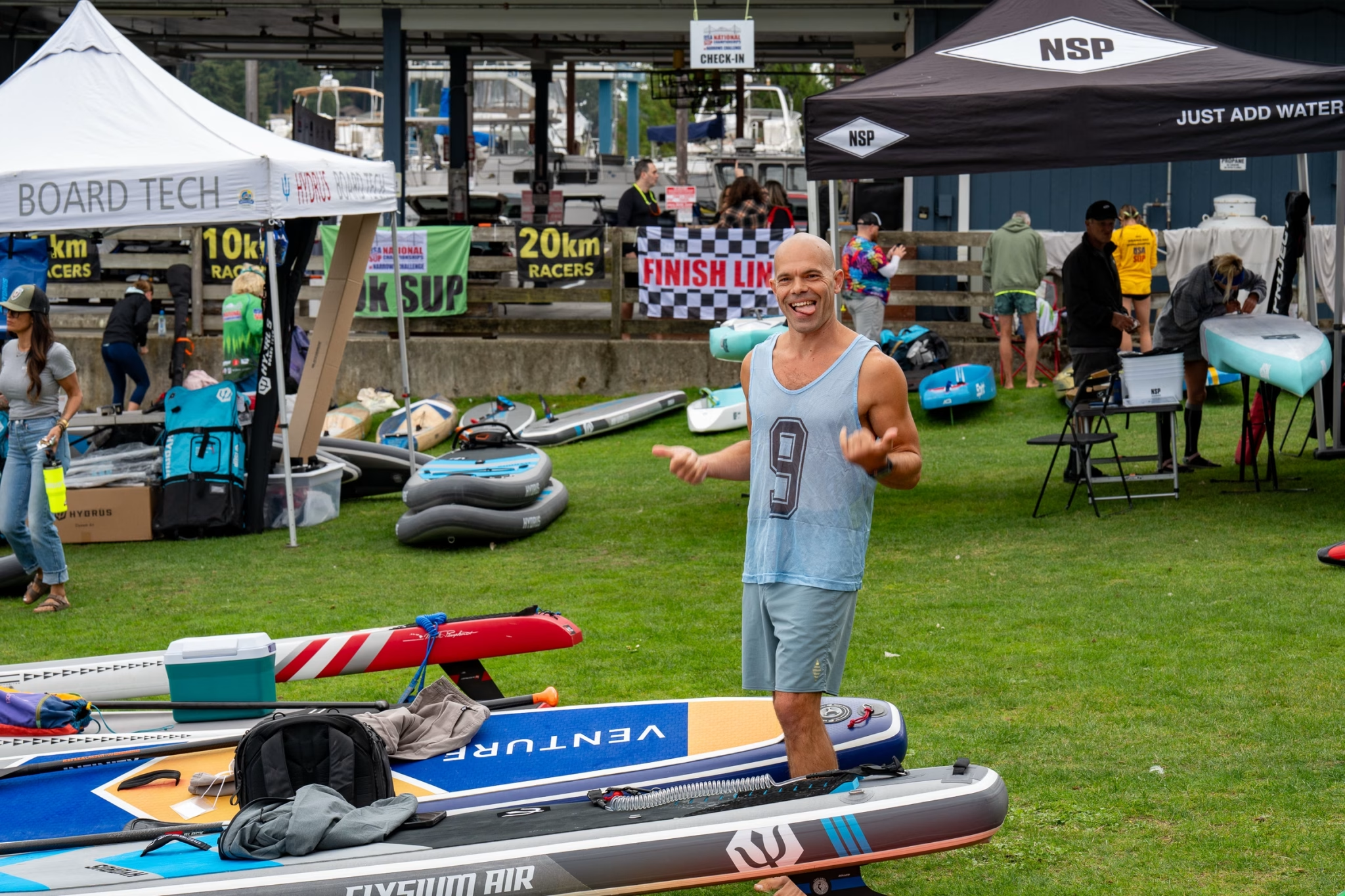
Put a group of practised paddlers on identical unfamiliar boards, on the same water, inside the same hour, and whatever the board does well and badly shows up all at once with the rider variable flattened as far as a race can flatten it. I learned more about how that hull behaves in forty seconds of sprint than a borrowed afternoon on flat water would have taught me.

I would like to see it run on purpose. An exhibition heat on one loaner model, a different model each year, would tell you more than any amount of solo testing.
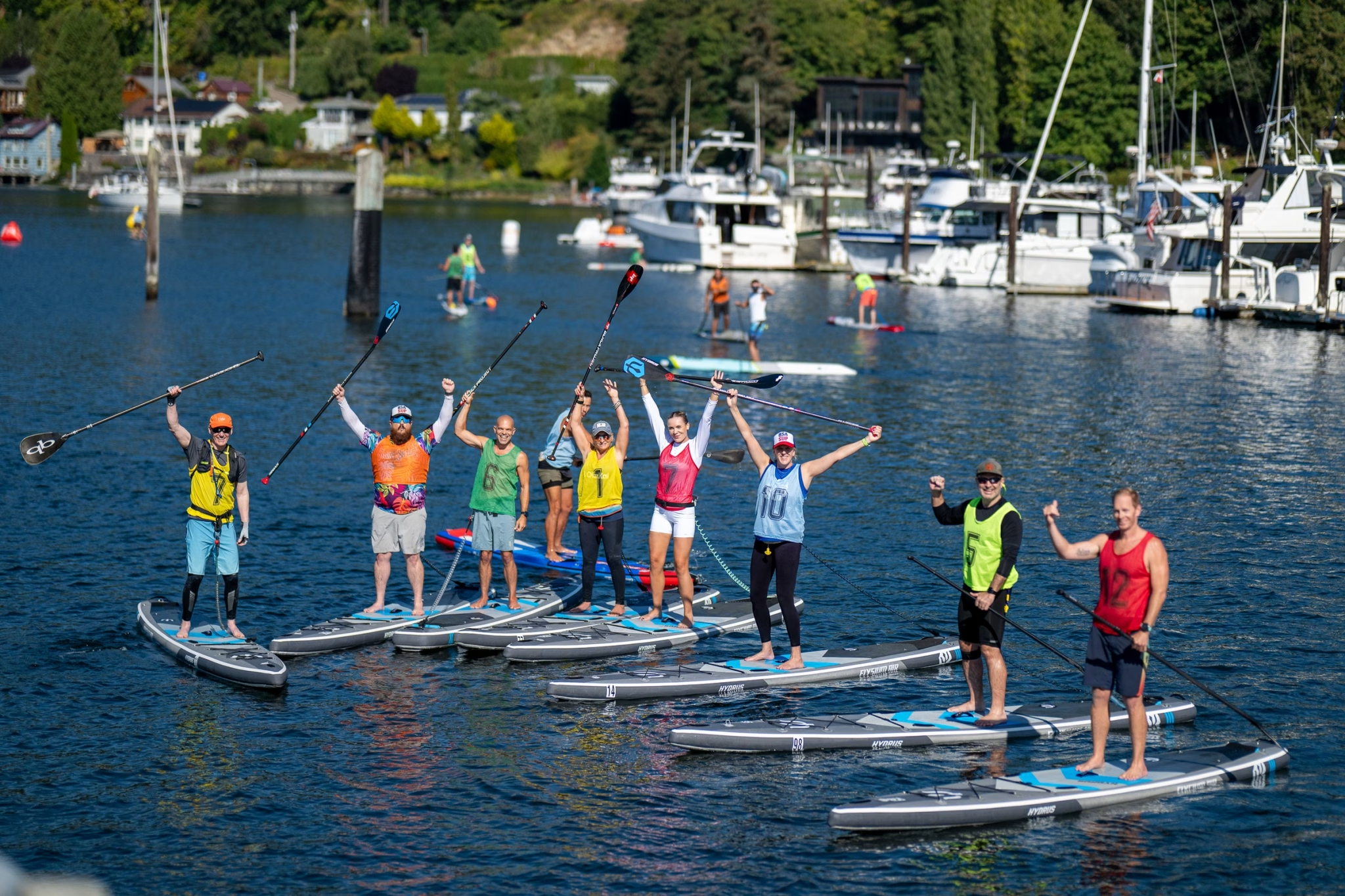
What I Heard on the Water
On the line before each start we sorted out loud who was going which way off the gun, so that nobody spent the first fifty meters climbing over anybody. Out on the course you called your pass before you made it, left side or right, and the paddler ahead of you made the room. Boards knocked together anyway, and when they did an apology came back down the water before either of us had finished wobbling.
Somebody went in during the 10K. The paddlers nearest him checked he was up and moving before they went back to their own race.
How to Enter
Registration moved to Pacific Multisports for 2026, which handled both the USA SUP entries and the Narrows Challenge races. The PaddleGuru listing carries the category breakdown and the ICF Worlds qualification note. The Big Three entry covering all three races was $210. USA SUP members got a $10 coupon code through the members’ forum.
USA SUP also offered a virtual option for anyone who could not get to Washington: the 5K or 10K distance, raced at your own local spot. Proof came from a PaddleLogger, Strava or Garmin track, emailed to info@usasup.org by September 20, 2026.
Boards, Travel and Lodging
Flying in without a board was workable. Gorge Performance ran the official board rental list, and Boards4USASUP@gmail.com handled board shares and requests for anything not listed. Seattle-Tacoma International Airport is less than half an hour from Gig Harbor. USA SUP held a room block at the Best Western Wesley Inn, and The Maritime Inn and The Waterfront Inn both sit near the harbor.
Megan and I drove up from Sacramento, about 740 miles each way in her 2023 Tesla Model Y on FSD (Supervised). Every charging stop and the two things the software got wrong are in my Sacramento to Gig Harbor road trip on Tesla FSD at The Weekly Driver.
Frequently Asked Questions
When and where were the 2026 USA SUP National Championships?
September 18 to 20, 2026, in Gig Harbor, Washington, with clinics on Thursday September 17. Race headquarters was Skansie Brothers Park at 3211 Harborview Drive. The event was hosted by The Narrows Challenge and organized by the Gig Harbor Canoe and Kayak Racing Team.
Is there an inflatable division at USA SUP Nationals?
Yes, and 2026 was the first year for it. The iSUP division, sponsored by Hydrus Boardtech, had men’s and women’s categories with no age groups, and there was prize money for both Open and iSUP in all three races.
What are the age groups at USA SUP Nationals?
Youth under 15, Junior 15 to 17, Open 18 to 49, Senior Masters 50 to 59, Golden Masters 60 to 69, and Legends 70 and over. The Under 15 division is new in 2026. The inflatable division has no age groups.
Were there clinics before the races?
Yes. Candice Appleby taught a footwork and board skills clinic from 1:00 to 3:00 pm and a stroke technique and glide clinic from 4:00 to 6:00 pm on Thursday September 17. Each cost $145, held 12 paddlers, and required your own board, PFD and leash.
What does the $210 entry cover?
Three days of competition across all three disciplines: the 100 meter sprint, the technical course, and the distance race. USA SUP members can apply a $10 coupon code.
How long is the 10K course?
10 kilometers, roughly 6 miles. It starts and finishes just outside the Gig Harbor entrance, runs south to a buoy turn at 5 km near Point Evans, and returns to the same line.
What safety equipment is required?
A Coast Guard approved PFD worn at all times, a leash worn at all times with sea kayaks the only exception, and bright colors for visibility on the water.
Does the race qualify you for anything?
It was a selection event for the 2026 ICF SUP World Championship in Sabaudia, Italy. The ACA Nations Cup US team was named on Sunday after the technical racing.
What board classes are used in SUP racing?
Three: 12’6″, 14′, and Unlimited. The 14′ class is the most common worldwide. Competitive 14′ inflatable race boards run no wider than about 26 inches.
Could you race without traveling to Gig Harbor?
Yes. USA SUP offered a virtual option for the 5K and 10K distance races, paddled at your own local spot, with a PaddleLogger, Strava or Garmin track emailed to info@usasup.org by September 20, 2026.
Is the 10K on flat water?
No. It is tidal salt water in a channel that moves current on the exchange, and Saturday’s distance racing started with all watercraft together. Water temperature at NOAA’s Tacoma station was 56.7 degrees on September 17, 2026. For the 1:00 pm start, NOAA predicted a flood pushing the outbound leg south, slack at 2:14 pm near the turn, and an ebb pushing the return leg home.
What is a realistic 10K pace on an inflatable?
The eight inflatable finishers in 2026 ran 1:07:23 to 1:35:09, or 5.53 to 3.92 mph. Paul Pianowski won it; I finished fifth in 1:18:33, 4.75 mph, against ten-mile training sessions of 4.37 to 4.47 mph moving pace on a 14-foot inflatable. Current and chop change the number substantially.
Affiliate Disclosure: Some links in this article are affiliate links. If you buy through one, I may earn a small commission at no additional cost to you.
Article Updates
- October 10, 2026: Added six race photos by Michael Carney: my sprint warm-up, preliminary heat and final on Friday, the 10K mass start on Saturday, and two from the technical preliminary on Sunday. Edited for clarity. Corrected Paul Pianowski’s overall line to three firsts, the sprint duration to the 25 to 50 seconds the results show, and the Hydrus count to eight of the nine inflatable sprinters. Added a sprint start photo.
- September 26, 2026: Added a photo from before my first sprint heat on the loaned Hydrus Elysium Air and a photo of the inflatable sprint field. Ranked my own times against all nine inflatable paddlers and added a sortable Gender column to the results tables.
- September 25, 2026: Replaced the lead photo with the start of the 5K. Added two photos from the Saturday 5K and Paul Pianowski’s 5K result. Rebuilt the sprint, distance and technical charts and the three searchable results tables as one field per race, ranked by time. Merged the inflatable results into single tables ordered by time.
- September 23, 2026: Added measured race-weekend conditions beside the predictions: NOAA’s observed water level at Tacoma and hourly weather at Tacoma Narrows Airport. Saturday ran cooler, cloudier and calmer than forecast.
- September 23, 2026: Rewrote the introduction, Key Takeaways and FAQ answers as a race report now that all three days are scored, and added the division’s 10K times to the pace answer. Corrected the Hydrus board’s width comparison to the 27-inch touring line.
- September 23, 2026: Clarified the credits for the help I got after the technical preliminary: Arjun, emergency room physician, and Carl, nurse practitioner, on the medical team, and how Natalya Shoror, LMT, helped me decide whether to race the final. Removed race-preview lines that no longer applied after the event, including the closing Race Week section, and tightened wording throughout.
- September 22, 2026: Credited the emergency room physician and nurse practitioner who splinted and wrapped the arm at the race, and Natalya Shoror, LMT.
- September 21, 2026: Added three first-hand sections: the medical advice behind scratching from the technical final, the loaned Hydrus boards that almost the whole inflatable sprint field rode for the first time, and the passing calls, apologies and line talk heard across all three days.
- September 21, 2026: Added Sunday technical results and the Big Three overall standings. Second in the preliminary heat in 5:18.58, no start in the final after an injury. Added a chart of all 69 technical times and a searchable table of every technical finisher. Results from paddleraces.com.
- September 20, 2026: Added Saturday distance results. Fifth in the men’s inflatable 10K in 1:18:33. Added the full inflatable 10K result, a chart of all 103 scored finishes across the 10K and 5K fields, and a searchable table of every distance finish. Results from paddleraces.com.
- September 18, 2026: Added Friday sprint results. Fifth in the men’s inflatable division, 37.121 in the preliminary and 41.302 in the final. Added the full inflatable results for both genders, a chart of all 72 timed sprints across the nine divisions that raced, and a searchable table of all 72 timed results. Results and timings sourced from paddleraces.com.
- September 17, 2026: Added race-week details from the official USA SUP bulletin: Skansie Brothers Park as race headquarters, hour-by-hour check-in, meeting and start times for all three days, the full age group structure, the inflatable division’s men’s and women’s categories and sponsor, the member requirement for overall rankings, proof requirements for virtual racers, and board rental and lodging. Added a section on Candice Appleby’s two Thursday clinics. Added NOAA tide, current and water temperature figures and the National Weather Service forecast for all three race days. Replaced the open question about official iSUP equipment rules: USA SUP has published none, and the ICF rulebook and the sponsor’s loaner board specifications now stand in their place.
- September 14, 2026: Added the PaddleSplash 8 Mile result from Lake Natoma on September 13, 2026 (1:49:01.53, first in SUP) to the race pace section as a timed data point five days out from Nationals.
- September 8, 2026: Added that the three events call for three different stroke rates, and that the 45 spm efficiency research applies to the 10K rather than the sprint. Added two photographs from a May 2026 session at Lake Natoma. Corrected a caption that described the board as a race board; it is a 14×28 touring shape, which the article’s own width guidance puts outside the race category.
- September 7, 2026: Article published ahead of the race. Schedule, courses, safety requirements and the new inflatable division verified against usasup.org, narrowschallenge.com and Visit Pierce County. Training block data covers 12 sessions from August 2 through September 5, 2026.
Official Pages and Entry Links
The information is spread across five sites that do not link to each other well.
- Event page: USA SUP 2026 National Championships. Dates, disciplines, the new categories, and the virtual option.
- Enter here (USA SUP): PaddleGuru registration. This is where the Big Three entry lives.
- Clinics: Footwork and Board Skills and Stroke Technique and Glide with Candice Appleby, via Ocean Academy.
- Enter here (Narrows Challenge): Pacific Multisports registration for the host event’s own races.
- Host and courses: The Narrows Challenge. Course descriptions, start and finish location, and the safety rules quoted above.
- Course maps: USA SUP race courses. Worth checking against the Gig Harbor descriptions, since this page still shows a California venue from a previous year.
- Live results: paddleraces.com. Heat draws, lane assignments and finish times to the thousandth, division by division, updated as each round is scored.
- Past results: National Championship results, 2023 through 2025, for a sense of the field.
- Qualifying series: 2026 Regional Race Series.
- Everything else on the calendar: USA SUP events.
- Governing body: USA SUP, including membership, which carries a $10 entry coupon.
Sources
- USA SUP, 2026 National Championships
- The Narrows Challenge, course descriptions and safety rules
- NOAA Tides and Currents, Gig Harbor tide predictions (station 9446369), Narrows current predictions (PUG1524 and PUG1527), Tacoma water temperature and observed water level (station 9446484)
- National Weather Service, Seattle forecast office, Gig Harbor gridpoint forecast and Puget Sound coastal waters forecast PZZ135, issued September 17, 2026
- National Weather Service and FAA, hourly surface observations for Tacoma Narrows Airport (KTIW), September 18 to 20, 2026, via the Iowa Environmental Mesonet ASOS archive
- International Canoe Federation, Stand Up Paddle Competition Rules 2025, chapter 3
- Hydrus Board Tech, Elysium Air specifications
- USA SUP, 2026 Nat Champs Bulletin, distributed to registered racers race week
- Ocean Academy, Candice Appleby clinic listings
- Visit Pierce County, USA SUP partners with The Narrows Challenge