
My shoulders quit before my legs do. Every time. Somewhere around mile 5 of a long paddle, the burn that started as a polite suggestion becomes a full negotiation.
My lats tighten into cables. My lower back starts barking. And my core, which I always assumed was “fine” because I can hold a plank for a minute, reveals itself as the weakest link in a kinetic chain I didn’t know existed.
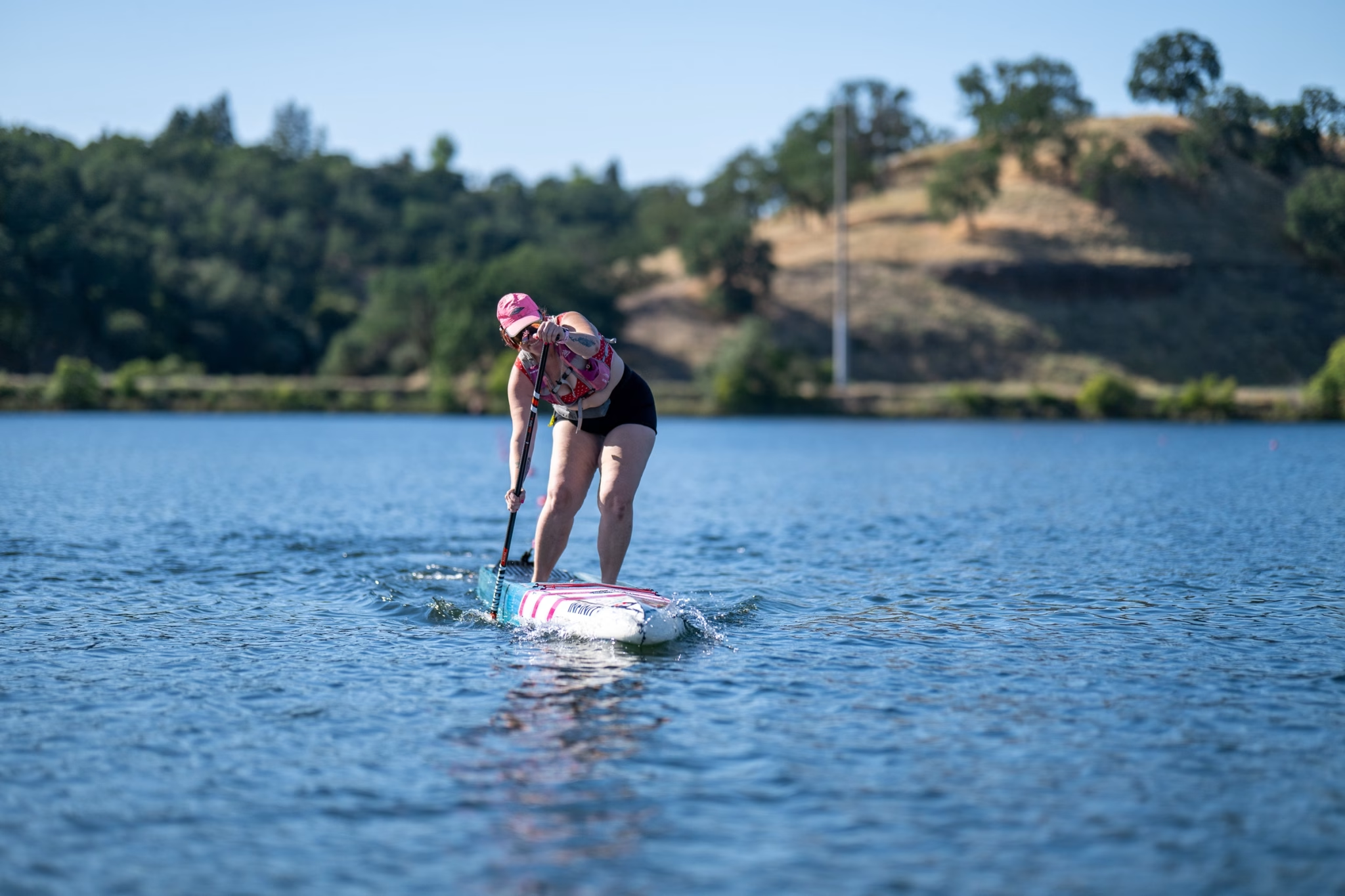
I discovered this the hard way during a February session on Lake Natoma. 8.19 miles, 152 BPM average, 965 active calories. By mile 5, I was cooked. Not cardiovascularly.
Muscularly. The engine had fuel (I’d finally fixed my nutrition strategy), but the chassis was falling apart. My paddle stroke shortened. My balance deteriorated in chop that wouldn’t have bothered me at mile 2. I finished, but ugly.
That session sent me down a research rabbit hole. If I’m burning 750 to 965 calories across 8+ miles at 152 to 154 BPM for two hours, this isn’t recreational floating.
This is endurance athletics. So I went looking for the science: what does SUP actually demand from your musculoskeletal system, and what does the peer-reviewed literature say about preparing for it? What I found changed how I think about my off-water training completely.
Key Takeaways
- Elite paddlers drive the board with their legs, not their arms. Top competitive paddlers plant the paddle, lift some weight off the board, and pull the board past the paddle using the posterior chain (glutes and hamstrings) with quads holding a semi-squat the entire session. Recreational paddlers who train arms and core but neglect legs fatigue earlier and compensate with the lower back. This is the single biggest gap in most amateur SUP training.
- Anti-rotation core training beats crunches for paddlers because the SUP stroke demands spinal stability under rotational load, not spinal flexion. McGill’s research shows the “Big 3” (curl-up, side plank, bird dog) build the endurance-based stability paddlers need.
- Your core fails before your arms on long paddles. EMG studies show the external obliques and rectus abdominis activate at 40-75% of maximum voluntary contraction during standing SUP, making core endurance the limiting factor on extended sessions.
- Single-leg balance training transfers directly to board stability. Research demonstrates that proprioceptive training improves neuromuscular control, sensory integration, and motor cortex activation, all of which reduce energy wasted on balance corrections while paddling.
- Shoulder injuries in paddle sports are preventable. The 2022 Bern Consensus Statement identifies rotator cuff weakness and scapular dyskinesia as modifiable risk factors. Targeted external rotation and scapular stability work addresses both.
- Hip and thoracic mobility determine stroke power and reach. Research on rotational athletes shows that limited hip rotation and thoracic spine mobility reduce power transfer and increase compensatory stress on the lumbar spine.
- Land-based strength training does transfer to water performance. Studies on competitive kayakers found that land-based ergometer and resistance training predicted on-water performance at distances from 200 to 2,000 meters.
- A 3-4 day weekly program is sufficient. The NSCA’s sport-specific training guidelines recommend periodized, progressive programs that complement (not replace) sport-specific practice. Two strength days and one mobility day, alongside paddle sessions, covers the bases.
The SUP Athlete’s Body: What Gets Worked
Before prescribing exercises, you need to understand the demand. A proper SUP paddle stroke isn’t an arm exercise. It’s a full-body kinetic chain that starts at your feet and transfers force through your legs, hips, core, lats, and shoulders before the paddle ever contacts water.
A 2020 EMG study in Applied Sciences (Bastos et al.) measured muscle activation during SUP paddling in kneeling versus standing positions. External oblique abdominis and triceps brachii showed significantly higher activation in standing. Standing up turns a moderate upper-body exercise into a demanding full-body effort.
Source: Bastos, F.N. et al., “Electromyography Analysis of Muscle Activation During Stand-Up Paddle Boarding: A Comparison of Paddling in Kneeling and Standing Positions,” Applied Sciences, 10(7):2356, 2020.
A separate 2023 neuromuscular assessment (Oliveira et al., Applied Sciences, 13(24):13265) recorded EMG data from the upper trapezius, biceps brachii, triceps brachii, tibialis anterior, and gastrocnemius medialis during SUP performance. The upper trapezius and triceps showed the highest percentage of maximum voluntary contraction (%MVC), highlighting these as primary fatigue sites.
Source: Oliveira, J.R. et al., “Neuromuscular Assessment of a Stand-Up Paddle Stroke,” Applied Sciences, 13(24):13265, 2023.
Here’s the cascade of what fatigues and when, based on the research and my own 8+ mile sessions:
| Muscle Group | Role in SUP Stroke | When It Fatigues | What Happens |
|---|---|---|---|
| Posterior chain (glutes, hamstrings, quads in semi-squat) | Primary engine in elite stroke mechanics: plant paddle, lift load off the board, pull board past the paddle | Last to fail in trained paddlers; first when untrained | Stroke power leaks, lower back recruits to compensate, lumbar pain develops |
| Core (obliques, rectus abdominis, transverse abdominis) | Rotational power generation, spinal stability, balance maintenance | Mile 3-4 on long sessions | Stroke shortens, balance degrades, lower back compensates |
| Latissimus dorsi | Primary pulling power during catch and power phases | Mile 4-5 | Pull weakens, stroke rate drops, shoulders take over |
| Shoulders (deltoids, upper trapezius) | Paddle lift, reach extension, overhead positioning | Mile 5-6 | Reach shortens, compensatory shrugging, impingement risk |
| Rotator cuff (infraspinatus, supraspinatus, teres minor, subscapularis) | Glenohumeral joint stabilization through entire stroke | Gradual, insidious | Clicking, aching, eventual injury if ignored |
| Lower legs (tibialis anterior, gastrocnemius) | Continuous balance micro-adjustments | Variable, worse in chop | Increased sway, wider stance, reduced confidence in rough water |
| Hip flexors and thoracic spine | Rotation, reach, power transfer from lower to upper body | Not fatigue but mobility limitation | Reduced stroke length, compensatory lumbar rotation, back pain |
The pattern is consistent across my paddle data. The September session (8.52 miles, 750 calories, no bonk) versus the February session (8.19 miles, 965 calories, bonked at mile 5) shows it. Same distance. Dramatically different energy cost. The September version of me had better conditioning, which meant better technique maintenance, which meant fewer wasted calories on sloppy strokes and balance corrections.
The Posterior Chain: The Engine the Pros Build First
I have to flag the biggest gap in how most recreational paddlers (including me) approach SUP training. We treat it as a core and shoulder sport. Pros treat it as a leg sport.
The mechanic to understand: at elite stroke speeds, the paddle is the anchor. You plant the blade, and your legs (glutes, hamstrings, quads in a semi-squat) drive your body and the board past the planted paddle. If you watch a pro paddler sprint from the side, the board appears to hop slightly with each stroke. That hop comes from the paddler briefly lifting load off the board through the posterior chain while the paddle holds water.
This is feedback I got from an accomplished racer after she read the first draft of this article. She prepared for World Championships by hammering the posterior chain. Her phrasing: “those muscles can go longer and harder than your core and back and arms. When your legs are weak, you start incorporating your lower back to pull the board.” That’s the failure mode most recreational paddlers will recognize after a long session: lats and arms toast, lower back lit up, glutes never really worked. The pattern is correct; the muscles got recruited in the wrong order.
The peer-reviewed evidence backs up what the racer described. Schram et al. (2019, PeerJ) compared experienced and inexperienced SUP paddlers in a biomechanical analysis of the stroke and found experienced paddlers use 66.4 degrees of hip range of motion compared to 50.0 degrees in inexperienced paddlers (p = 0.035), with significantly less shoulder ROM. The expert pattern is more hip, less shoulder. Hibbert et al. (2023, Sports) measured recreational paddlers and found they use under 20 degrees of hip motion regardless of posture, leaning hard on the shoulder to propel the board. The two studies together draw the gap clearly: the expert stroke is a hip stroke; the recreational stroke is a shoulder stroke.
Klitgaard and colleagues (2021, Sensors) instrumented elite sprint kayakers, including European and World Championship medalists, and showed that peak leg force, 10-second impulse, and stroke rate together predicted kayak velocity within 1 km/h, with an adjusted R-squared of 0.82. Nilsson and Rosdahl (2016, International Journal of Sports Physiology and Performance) went one step further: they locked the legs of elite kayakers and re-measured. Restricting leg drive reduced mean paddle force by 21% and kayak speed by 16%. That is the engine.
The injury-prevention case is just as direct. Castañeda-Babarro et al. (2021, International Journal of Environmental Research and Public Health) surveyed 97 international SUP race competitors and found 62.9% had sustained an injury, with back injuries accounting for 18% of all reported injuries. The strongest protective factor was resistance training: uninjured paddlers did roughly twice the weekly resistance work of injured paddlers. Tataryn et al. (2021, Sports Medicine – Open) meta-analyzed 8 RCTs covering 408 participants and showed that 12 to 16 weeks of posterior-chain resistance training outperformed general exercise for chronic low back pain (pain SMD -0.61, disability SMD -0.53). The exercise list in their analysis is almost identical to the one below. That alignment is not a coincidence; it is what the research community has converged on as the protective dose.
Two implications for training:
- Glutes are the engine, and they are slow-twitch dominant (52 to 68% by fiber type studies) for sustained output. Hamstrings are mixed fiber and trainable for endurance. A trained posterior chain can produce hours of stroke power that the arms physiologically cannot match. The deltoid is not built for two-hour output. The gluteus maximus is.
- The quads are an endurance muscle in SUP, not a power muscle. You’re holding a semi-squat the entire paddle. Quad endurance determines whether your stance stays athletic at mile 5 or collapses into a stiff-legged stand that lets the lower back take the rotational load.
Land training that addresses this loads the posterior chain with real resistance (not just bodyweight balance) and trains semi-squat endurance for the quads. The exercises below complement (not replace) the core and shoulder work that follows. For recreational paddlers, this section is probably the most consequential block in the whole program.
| Exercise | Target Muscles | Sets x Reps | Rest | Form Notes |
|---|---|---|---|---|
| Barbell or Kettlebell Hip Thrust | Gluteus maximus (primary), hamstrings | 3 x 8-10 | 90 sec | Shoulders on a bench, feet flat, hips drive up until thighs are parallel to the floor. Pause at the top. The glute squeeze should be aggressive enough that the bar wants to roll off. Load this. Bodyweight hip thrusts plateau quickly; this is the lift where progression matters. |
| Barbell or Dumbbell Romanian Deadlift | Hamstrings, glutes, posterior chain integration | 3 x 8 | 90 sec | Hinge at the hips, soft knees, bar travels close to the legs. Stop the descent where you feel the hamstring stretch but before the lower back rounds. Drive the floor away with the heels on the way up. RDL is the loaded version of the single-leg RDL further down; both belong in the program. |
| Goblet Squat (paused at parallel) | Quads, glutes, anterior core | 3 x 10 with 2-second pause | 60 sec | Dumbbell or kettlebell held at chest. Descend to parallel, pause 2 seconds at the bottom, drive up. The pause builds endurance in the exact semi-squat stance you hold on the board. Keep the chest tall; the moment it collapses, the lower back is recruiting. |
| Bulgarian Split Squat | Quads, glutes, hip stabilizers, single-leg balance | 3 x 8 each leg | 60 sec each side | Rear foot elevated on a bench, front foot far enough forward that the front knee tracks over (not past) the toes. Slow descent, drive up through the front heel. This is the highest-transfer single-leg exercise for SUP because it loads exactly the asymmetric stance that paddling demands. |
| Kettlebell Swing | Posterior chain power, hip extension | 3 x 15-20 | 60 sec | Hinge at the hips. The bell is propelled by an aggressive glute snap, not lifted by the arms. The arms only steer. This trains the explosive hip extension that powers a fast catch and pull. |
| Wall Sit (semi-squat hold) | Quad endurance in the exact SUP stance | 3 x 45-60 sec | 45 sec | Back flat to the wall, thighs parallel to the floor, knees over ankles. This is not a glamour exercise. It is, however, the most direct quad-endurance carryover in the program. If 45 seconds is hard, your stance on the board is collapsing at mile 3. |
Diagnostic: after your next long paddle, notice where the soreness is the next morning. If your glutes and hamstrings are sore, your stroke is recruiting the engine correctly. If only your lats, shoulders, and lower back are sore, the engine is offline and the upper body is doing the work it was never designed to do for two hours. That’s the signal to prioritize this section.
On-Water Cues: How to Know the Training Is Working
Gym work only matters if it reaches the water. The way you check is during the paddle itself, not on your post-paddle wattage chart. Six in-stroke cues that signal the posterior chain is online:
- Your knees stay slightly bent for the entire paddle. Not just at the start. Lock them out at mile 3 and the lower back is now generating force the legs were supposed to. Schram et al. (2019, PeerJ) measured this directly: experienced paddlers maintained 66 degrees of hip flexion ROM; inexperienced paddlers were stiff-legged at 50.
- You can feel the planted-side foot pushing down into the deck pad during the pull. Pressure into the board, not just hands on the paddle. If you don’t feel anything in your feet, your legs aren’t contributing.
- The top hand drives forward, not down. Down-press recruits the shoulder. Forward push recruits the lat and engages the trunk rotation that connects to the hips.
- You extract the blade before it reaches your hip. Pulling past the hip turns the stroke into a back exercise. Nilsson and Rosdahl (2016) showed elite paddlers extract well forward of the body and immediately reset for the next catch.
- At 30 minutes in, your glutes feel like they have been working. Not your shoulders alone. If only your shoulders are firing at the half-hour mark, your stroke pattern needs adjusting before fitness will fix anything.
- The board feels like it accelerates forward at the catch, not like you are dragging it backward. This is the racer’s “board hopping” cue in slower-paddler terms. You should feel the board scoot under you each stroke, not feel like you are pulling a heavy object toward you.
Heart-Rate Zones for SUP Training
The other way the gym work translates is through how hard each on-water session should be. Operating by feel is fine until you start chasing structured improvement. Heart-rate zones turn “I paddled hard today” into a number you can track and progress.
Estimate your max heart rate (HRmax) as roughly 220 minus your age. This is rough, but field-test accuracy improves it: do an all-out 5-minute paddle effort after a thorough warm-up, peak HR you see is close to your true max. Once you have HRmax, the zones map cleanly:
| Zone | % of HRmax | Feel | What it is for |
|---|---|---|---|
| Zone 1 | 50-60% | Easy chat pace, recovery breathing | Active recovery, beginner technique work, post-bonk paddles |
| Zone 2 | 60-70% | Conversational but full sentences only, nose breathing sometimes possible | Endurance base. Most training time lives here. Mitochondrial adaptation, fat oxidation, all-day pace |
| Zone 3 | 70-80% | Short sentences only, breathing through the mouth | Tempo / race pace. Where you race a 5-10 km paddle event |
| Zone 4 | 80-90% | Single words, focused breathing, sustainable for 20-40 minutes max | Lactate threshold intervals. Used in the build phase of race prep |
| Zone 5 | 90-100% | No talking, gasping | Sprint intervals only, 30 seconds to 4 minutes per rep |
For context: my two reference paddles both averaged 152 BPM. Measured against the highest heart rate my watch has ever recorded on the water, 195, that is 78 percent, which puts it in Zone 3 rather than the lactate-threshold territory I first assumed. Holding Zone 3 for two hours is still demanding, and it matches the bonked session story. A more sustainable training distribution would put 80% of paddle volume in Zone 2, 15% in Zone 3, 5% in Zone 4-5. Polarized training (mostly easy, occasionally very hard) is the structure the endurance research community has converged on for amateurs and elites alike (Stoggl & Sperlich, 2014, Frontiers in Physiology).
Core Stability: The Anti-Rotation Foundation
Here’s where things get complicated. Core training usually targets movement: crunches, Russian twists, sit-ups. For paddleboarding, that approach is backwards.
Dr. Stuart McGill, professor emeritus of spine biomechanics at the University of Waterloo, spent decades researching core function in athletes. His work, published extensively including in the Strength and Conditioning Journal (2010), demonstrates that the core muscles are primarily designed for stabilization, not movement. Their job is to prevent excessive motion in the spine while force is generated and transferred through the limbs.
Source: McGill, S.M., “Core Training: Evidence Translating to Better Performance and Injury Prevention,” Strength and Conditioning Journal, 32(3):33-46, 2010.
Think about a SUP stroke. Your paddle plants in the water on one side of the board. You pull your body past the paddle using your lats and back. That pulling force creates a rotational demand on your spine. Without a stiff, stable core, that rotational force leaks. Power dissipates. Your lower back absorbs torque it shouldn’t.
McGill’s research showed that stiffening the torso causes power generated at the hips to be transmitted more effectively through the core. Anti-rotation training teaches your core to resist unwanted rotation while allowing controlled, efficient rotation through the hips and thoracic spine. This is exactly what a powerful, sustainable paddle stroke requires.
The Core Stability Exercises
| Exercise | Target Muscles | Sets x Reps/Time | Rest | Form Notes |
|---|---|---|---|---|
| Pallof Press | Obliques, transverse abdominis, hip stabilizers | 3 x 10 each side | 45 sec | Press cable/band straight out from chest. Resist the pull. Hips square, no trunk rotation. Start with light resistance. If your hips shift, the weight is too heavy. |
| Dead Bug | Rectus abdominis, transverse abdominis, hip flexors | 3 x 8 each side | 45 sec | Back flat to floor throughout. Extend opposite arm and leg slowly. The moment your lower back lifts off the floor, you’ve gone too far. Breathe out on extension. |
| Bird Dog | Erector spinae, multifidus, glutes, shoulders | 3 x 10 each side | 30 sec | Extend opposite arm and leg without ANY rotation in the hips or torso. Place a water bottle on your lower back. If it falls off, you’re compensating. Hold the extended position for 2 seconds. |
| Side Plank | Obliques, quadratus lumborum, glutes | 3 x 30-45 sec each side | 30 sec | Straight line from head to heels. Don’t let hips sag or pike upward. For progression, add hip dips (lower hip toward floor and return) or lift the top leg. |
| Half-Kneeling Cable/Band Rotation (Anti-Rotation Hold) | Obliques, transverse abdominis, hip stabilizers | 3 x 8 each side | 45 sec | Half-kneeling position. Rotate to plant (mimicking paddle catch), hold 3 seconds, return with control. The hold at end range is where the real training occurs. No lumbar rotation. |
| McGill Curl-Up | Rectus abdominis (upper), obliques | 3 x 10 | 30 sec | NOT a crunch. One knee bent, hands under lower back to maintain neutral spine. Lift head and shoulders 1-2 inches only. Hold 8-10 seconds. This builds endurance in the position paddlers actually need. |
Why anti-rotation specifically for SUP: During every stroke, your body experiences a rotational pull toward the paddle side. A weak core allows your torso to twist excessively, bleeding power and stressing the lumbar spine. Anti-rotation exercises train exactly this capacity: maintaining a stable trunk while forces try to move it. McGill’s work on the “Big 3” (curl-up, side plank, bird dog) targets core muscular endurance rather than peak strength, which matters because you’ll take roughly 1,500-2,000 paddle strokes in an 8-mile session.
Balance Training: From Gym Floor to Open Water
To be completely transparent, I ignored balance training for years. I figured that paddling itself was sufficient balance practice. The research says otherwise.
A 2022 systematic review by Marcori et al. in Perceptual and Motor Skills examined single-leg balance training across multiple studies and found that dedicated proprioceptive training improved balance performance through increased neuromuscular activation, higher sensitivity of proprioceptors, enhanced motor control in the cortex, and better integration of the vestibular and visual systems.
Source: Marcori, A.J. et al., “Single Leg Balance Training: A Systematic Review,” Perceptual and Motor Skills, 129(2):340-364, 2022. PubMed.
A 2024 systematic review in Frontiers in Physiology further confirmed that instability resistance training significantly improves balance ability in athletes, with the strongest effects observed when training incorporates progressive challenge to the proprioceptive system.
Source: “The effect of instability resistance training on balance ability among athletes: a systematic review,” Frontiers in Physiology, 2024.
The key insight from Behm and Colado’s 2013 review in Sports Health is that instability training shouldn’t replace heavy lifting but should complement it. They found force output dropped 59.6% during a chest press on an unstable surface versus stable. The takeaway: train strength on stable ground, train balance with specific balance work. Don’t try to combine them into some circus act on a BOSU ball with dumbbells.
Source: Behm, D.G. & Colado, J.C., “Instability Resistance Training Across the Exercise Continuum,” Sports Health, 5(6):500-503, 2013.
The Balance Exercises
| Exercise | Target Muscles | Sets x Reps/Time | Rest | Form Notes |
|---|---|---|---|---|
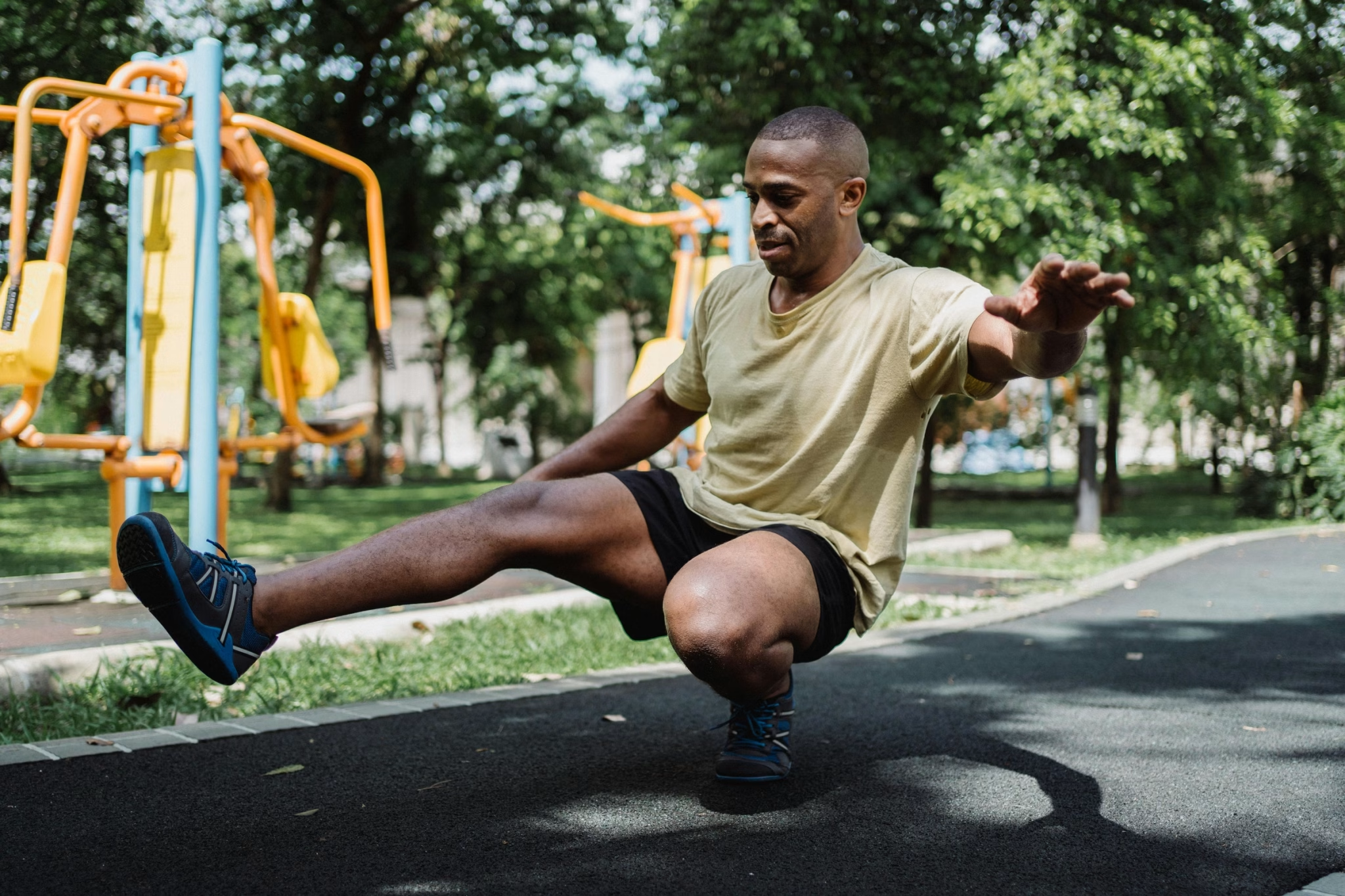
| Single-Leg Romanian Deadlift (bodyweight first) | Hamstrings, glutes, ankle stabilizers, entire posterior chain | 3 x 8 each leg | 45 sec | Hinge at hips, free leg extends behind you. Keep hips square. Touch the floor if mobility allows. The wobble IS the training. Add dumbbells only after you can do 8 clean reps bodyweight. |
| Single-Leg Stance with Eyes Closed | Ankle stabilizers, proprioceptive system | 3 x 30-60 sec each leg | 30 sec | Remove visual feedback to force proprioceptive adaptation. If you can’t hit 30 seconds, that tells you everything about why you struggle in chop. Near a wall for safety. |
| BOSU Ball Single-Leg Stance | Tibialis anterior, peroneals, gastrocnemius, soleus | 3 x 30-45 sec each leg | 30 sec | Stand on the flat side (dome down) for a less stable, more SUP-like challenge. Once stable, add a Pallof press hold for combined balance and anti-rotation. |
| Stability Ball Kneeling | Core, hip stabilizers, knee stabilizers | 3 x 30-45 sec | 45 sec | Kneel on a stability ball. Yes, this is terrifying the first time. Start near a wall. This mimics the unstable surface of a paddleboard and trains your reflexive stabilization system. Progress to kneeling paddle motions. |
| Single-Leg Squat to Box | Quads, glutes, ankle stabilizers, hip abductors | 3 x 6 each leg | 60 sec | Sit back to a bench or box (start high, lower over weeks). Control the descent. The eccentric loading builds strength in the exact position you’re in when absorbing wake and chop on the board. |
Progressive balance challenge: Start each balance exercise on stable ground. After 2 weeks, progress to a foam pad. After 2 more weeks, progress to a BOSU Balance Trainer or balance disc. The research consistently shows that progressive overload applies to proprioceptive training just as it does to strength training. Your nervous system adapts to challenge, then needs a new one.
Shoulder Strength and Stability
Shoulders are the canary in the paddler’s coal mine. They don’t scream until the damage is advanced.
The 2022 Bern Consensus Statement on Shoulder Injury Prevention (Schwank et al., published in the Journal of Orthopaedic & Sports Physical Therapy) reviewed evidence across overhead and rotational sports and identified key modifiable risk factors: rotational strength imbalance, scapular dyskinesia, and inadequate shoulder injury prevention programs. All three are addressable with targeted training.
Source: Schwank, A. et al., “2022 Bern Consensus Statement on Shoulder Injury Prevention, Rehabilitation, and Return to Sport for Athletes at All Participation Levels,” JOSPT, 52(1):11-28, 2022. Full Text.
A 2022 systematic review in the Journal of Experimental Orthopaedics (Asker et al.) found that rotator cuff weakness (both isometric and isokinetic) significantly increases the risk of future shoulder injuries in athletes performing repetitive overhead or rotational movements. Paddle sports qualify on both counts.
Source: Asker, M. et al., “Risk factors and prevention strategies for shoulder injuries in overhead sports: an updated systematic review,” Journal of Experimental Orthopaedics, 9:81, 2022. PMC.
The SUP stroke places unique demands on the shoulder. The catch phase requires overhead reach with the top hand while the bottom hand pulls. The power phase generates traction through the glenohumeral joint. Across 1,500+ strokes per session, even minor instability in the rotator cuff compounds into significant stress.
The Shoulder Exercises
| Exercise | Target Muscles | Sets x Reps | Rest | Form Notes |
|---|---|---|---|---|
| Band External Rotation at 90/90 | Infraspinatus, teres minor | 3 x 15 each arm | 30 sec | Elbow at 90 degrees, upper arm parallel to floor. Rotate forearm upward against band resistance. Slow and controlled. If you feel this in your upper trap, your elbow is drifting. This is prehab, not ego lifting. |
| Face Pulls | Rear deltoids, rhomboids, external rotators | 3 x 15 | 30 sec | Cable or band at face height. Pull toward face, separating hands at the end. Finish with thumbs pointing behind you. Squeeze your shoulder blades together at peak contraction for 2 seconds. |
| Y-T-W Raises (prone on bench or standing with band) | Lower trapezius (Y), middle trapezius (T), rotator cuff complex (W) | 2 x 10 each position | 30 sec between full sets | Light weight or thin band. Arms form Y overhead, T at sides, W with elbows bent. Control is everything. If you need more than 5 lbs for these, you’re compensating with bigger muscles. |
| Wall Slides | Serratus anterior, lower trapezius, rotator cuff | 3 x 12 | 30 sec | Back and arms against wall. Slide arms overhead maintaining contact with the wall through entire range. If your lower back arches off the wall, your thoracic extension is limited (see mobility section). |
| Serratus Punch (Push-Up Plus) | Serratus anterior | 3 x 12 | 30 sec | At the top of a push-up, protract your shoulder blades (push the floor away). Round your upper back slightly. This activates the serratus anterior, which is essential for healthy scapular mechanics during overhead reach. |
| Band Pull-Apart | Rear deltoids, rhomboids, middle trapezius | 3 x 20 | 30 sec | Hold band at arm’s length, shoulder width. Pull apart until band touches chest. Straight arms throughout. High reps, light resistance. This is your daily minimum for shoulder health. |
The ratio that matters: Research on overhead athletes consistently finds that the external-to-internal rotation strength ratio should be at minimum 66-75% (meaning your external rotators should produce at least two-thirds the force of your internal rotators). Internal rotators get strong from the pulling motion of each stroke while neglecting the external rotators. Every shoulder exercise above prioritizes the posterior chain and external rotation to restore that balance.
Hip and Thoracic Mobility
This is the section I personally needed most and ignored longest.
Research published in Physical Therapy (Van Dillen et al., 2008) examined hip rotation range of motion in people who participate in rotation-related sports. The finding: limited hip rotation was associated with increased prevalence of low back pain in rotational athletes. Your lumbar spine contributes only about 13 degrees of total rotation. When the hips can’t rotate sufficiently, the lower back tries to make up the difference.
Source: Van Dillen, L.R. et al., “Hip Rotation Range of Motion in People With and Without Low Back Pain Who Participate in Rotation-Related Sports,” Physical Therapy, 88(4):436-445, 2008. PMC.
A 2020 clinical reasoning framework published in the British Journal of Sports Medicine (Heneghan et al.) established thoracic spine mobility as a key factor in overhead and rotational sport performance. For rotational athletes, 50-70 degrees of active thoracic rotation represents a passing grade; 70-90 degrees is elite. The ability to create separation between hip and shoulder rotation has been correlated with increased trunk rotation velocity across multiple rotational sports.
Source: Heneghan, N.R. et al., “Clinical reasoning framework for thoracic spine exercise prescription in sport: a systematic review and narrative synthesis,” British Journal of Sports Medicine, 54(17):1046-1053, 2020. PMC.
On a paddleboard, your stroke length is directly limited by your thoracic rotation and hip mobility. Limited range means shorter strokes. Shorter strokes mean more strokes per mile. More strokes mean faster fatigue. The math is straightforward.
The Mobility Exercises
| Exercise | Target Area | Sets x Reps/Time | Rest | Form Notes |
|---|---|---|---|---|
| Hip 90/90 Stretch | Hip internal and external rotation | 3 x 45 sec each position | 15 sec between sides | Front leg at 90 degrees, back leg at 90 degrees. Sit tall. Lean forward gently over the front shin. Transition side to side (the “90/90 switch”) for dynamic mobility. If you can’t get both sit bones on the floor, that’s your current limitation staring you in the face. |
| Quadruped Thoracic Rotation (Thread the Needle) | Thoracic spine rotation | 3 x 10 each side | None (alternate sides) | On hands and knees, place one hand behind your head. Rotate that elbow toward the ceiling, then thread it under your body toward the opposite side. The key: lock your lumbar spine by keeping hips perfectly still. All rotation should come from the mid-back. |
| Half-Kneeling Hip Flexor Stretch with Rotation | Hip flexors (iliopsoas), thoracic spine | 3 x 45 sec each side | 15 sec between sides | Standard hip flexor stretch position. Squeeze the back glute. Then rotate your torso TOWARD the front leg. This combined stretch addresses two limitations at once. Breathe into the restriction. |
| Open Book (Side-Lying Thoracic Rotation) | Thoracic spine rotation, pec stretch | 3 x 8 each side | None (alternate sides) | Lie on your side, knees stacked at 90 degrees. Open the top arm across your body like a book opening, following your hand with your eyes. Let the chest open. Hold the end position for 3-5 seconds. If your knees separate, your rotation is coming from your lumbar spine, not thoracic. |
| World’s Greatest Stretch | Hip flexors, hamstrings, thoracic spine, adductors | 2 x 5 each side | None (alternate sides) | Lunge forward, plant same-side hand, rotate opposite arm to ceiling. This single exercise addresses nearly every mobility limitation relevant to paddling. Take your time with each rep. Quality over speed. |
| Standing Hip CARs (Controlled Articular Rotations) | Hip capsule, full hip range of motion | 2 x 5 each direction, each leg | None (continuous) | Stand on one leg, trace the largest circle possible with the other knee. Slow, controlled, maximal range. This maintains and expands available hip range of motion across all planes. Think of it as joint flossing. |
Sample Weekly Training Program
Here’s where the theory becomes practice. The NSCA’s guidelines emphasize that sport-specific training programs should be periodized, progressive, and designed to complement actual sport practice. For recreational SUP athletes paddling 2-3 times per week, a 3-4 day supplemental training program fills the gaps without creating overtraining stress.
| Day | Focus | Key Exercises | Duration |
|---|---|---|---|
| Monday | Posterior Chain + Core | Hip Thrust 3×10, Romanian Deadlift 3×8, Goblet Squat (paused) 3×10, Wall Sit 3×45-60 sec, then Pallof Press 3×10/side, Dead Bug 3×8/side, Bird Dog 3×10/side | 45-50 min |
| Tuesday | Paddle Session | On-water practice. Focus on technique, particularly driving the board past the planted paddle through the legs. Notice whether glutes engage or whether the lats are doing all the work. | 60-90 min |
| Wednesday | Shoulder Strength + Mobility | Band External Rotation 3×15/arm, Face Pulls 3×15, Y-T-W Raises 2×10 each, Serratus Punch 3×12, Band Pull-Apart 3×20. Then: Hip 90/90 3×45 sec, Thoracic Rotation 3×10/side, Open Book 3×8/side, World’s Greatest Stretch 2×5/side | 40-45 min |
| Thursday | Rest or Light Activity | Easy walk, gentle yoga, or foam rolling recovery session. Active recovery, not training. | 20-30 min (optional) |
| Friday | Legs + Balance + Core | Bulgarian Split Squat 3×8/leg, Kettlebell Swing 3×15-20, Single-Leg RDL 3×8/leg, then McGill Curl-Up 3×10, Side Plank 3×30-45 sec/side, Half-Kneeling Cable Rotation 3×8/side, Single-Leg Stance (eyes closed) 3×30-45 sec/leg, BOSU Stance 3×30 sec/leg | 45-50 min |
| Saturday | Paddle Session (Long) | Primary training paddle. Apply technique improvements from land-based work. Pay attention to stroke length, leg engagement, and where the soreness lands the next morning (glutes = good signal; lower back = signal to load the posterior chain harder). | 90-120+ min |
| Sunday | Rest | Full rest. Mobility work (hip 90/90, open book) if desired but no structured training. Recovery is when adaptation occurs. | Rest |
Scaling for beginners: If you’re new to structured training, start with just Monday and Wednesday for the first 2 weeks. Drop sets to 2 instead of 3. Reduce hold times by one-third. Add Friday and increase volume only after you’ve established the movement patterns. Consistency across 3 sessions per week produces better results than ambitious programs you abandon after 10 days.
Land-to-Water Progression
The honest question is whether gym exercises actually improve board performance. The evidence says yes, but with caveats.
A 2021 study in Frontiers in Physiology (García-Pallarés et al.) examining young kayakers and canoeists found that strength training intensity and volume significantly affected on-water performance, with land-based ergometer work predicting race times across distances from 200 to 2,000 meters. Measures of muscular fitness including strength, power, endurance, and VO2max were all associated with competitive paddling outcomes.
Source: García-Pallarés, J. et al., “Strength Training Intensity and Volume Affect Performance of Young Kayakers/Canoeists,” Frontiers in Physiology, 12:698145, 2021. PMC.
The NSCA’s principle of specificity (SAID: Specific Adaptation to Imposed Demand) applies here. The more closely your training mirrors the demands of paddling, the better the transfer. But the caveat from Behm’s research on instability training also applies: train the quality you want on the surface that best develops it. Strength on stable ground. Balance on unstable surfaces. Then integrate both on the water.
Here’s a realistic 6-week progression for taking gym gains to the board:
| Week | Focus | Land Training | Water Training | Integration Cues |
|---|---|---|---|---|
| Weeks 1-2 | Foundation | 3 days/week. Learn all exercises with proper form. Moderate intensity. Build consistency. | 1-2 paddles/week at comfortable pace. No performance focus. | Notice which muscles fatigue first on the board. This informs your land-training emphasis. |
| Weeks 3-4 | Progressive Loading | 3 days/week. Increase resistance on Pallof press, add weight to single-leg RDL. Progress balance exercises to unstable surfaces. | 2 paddles/week. One easy technique session, one moderate distance session. | During technique paddle, consciously engage core through each stroke. Focus on hip rotation rather than arm pulling. |
| Weeks 5-6 | Transfer | 3 days/week. Full program volume. Combined sessions (core + balance simultaneously). | 2-3 paddles/week. Include one longer session (5+ miles). Test endurance improvements. | Compare fatigue patterns to Week 1 notes. Stroke length, balance in chop, and shoulder endurance should all improve measurably. |
The transfer isn’t instant. Weeks 1-2 feel like the gym work and the paddling are separate activities. By weeks 3-4, you start noticing that your balance corrections are smaller, your stroke feels more connected to your hips, and your shoulders complain later in the session. By weeks 5-6, if you’ve been consistent, the improvement is unmistakable.
I noticed the difference most clearly in chop. Wind-generated waves that used to demand my full attention became background noise. My lower legs stopped burning at mile 3. That’s proprioceptive adaptation in action, exactly what the research predicted.
The Bottom Line
Paddleboarding isn’t just standing on a board and moving your arms. It’s a rotational endurance sport with the posterior chain (glutes, hamstrings, quads in a semi-squat) as the engine, the core as the stabilizer, and the shoulders and lats as the transmission. Train them in that order. Elite paddlers reach 5+ mph because they have hours of leg endurance to drive the board past the paddle; recreational paddlers stall at 3-4 mph because the upper body runs out of fuel before the legs ever fully engage.
The research is also clear that anti-rotation core work outperforms traditional core training for rotational athletes, single-leg balance training improves on-water stability through neural adaptation, shoulder prehab prevents the insidious injuries that end paddle seasons, and hip and thoracic mobility directly determines stroke efficiency. None of that is wrong. It’s just downstream of the legs.
A 3-4 day per week supplemental program, built around these evidence-based exercises and progressed over 6 weeks, produces measurable improvements in paddle endurance, balance, and technique maintenance. You don’t need a gym membership. A resistance band set with door anchor, a 65 cm stability ball, and floor space handle 90% of this program. What you do need is consistency and the humility to admit that holding a 60-second plank doesn’t mean your core is ready for 2,000 rotational strokes against water resistance.
Trust me on that last part. I learned it at mile 5.
When the training translates to the water, track it: the GPS speed benchmarks article shows what a fit recreational paddler actually averages, and the first race guide shows where the training plan starts to point if you want a goal beyond fitness alone.
Sources and Position Stands Referenced
- McGill, S.M. (2010). “Core Training: Evidence Translating to Better Performance and Injury Prevention.” Strength and Conditioning Journal, 32(3):33-46.
- Marcori, A.J., Monteiro, P.H.M., Oliveira, J.A., Doumas, M., & Teixeira, L.A. (2022). “Single Leg Balance Training: A Systematic Review.” Perceptual and Motor Skills, 129(2):340-364. PubMed
- Behm, D.G. & Colado, J.C. (2013). “Instability Resistance Training Across the Exercise Continuum.” Sports Health, 5(6):500-503.
- Schwank, A. et al. (2022). “2022 Bern Consensus Statement on Shoulder Injury Prevention, Rehabilitation, and Return to Sport for Athletes at All Participation Levels.” JOSPT, 52(1):11-28. Full Text
- Asker, M. et al. (2022). “Risk factors and prevention strategies for shoulder injuries in overhead sports: an updated systematic review.” Journal of Experimental Orthopaedics, 9:81. PMC
- Van Dillen, L.R. et al. (2008). “Hip Rotation Range of Motion in People With and Without Low Back Pain Who Participate in Rotation-Related Sports.” Physical Therapy, 88(4):436-445. PMC
- Heneghan, N.R. et al. (2020). “Clinical reasoning framework for thoracic spine exercise prescription in sport: a systematic review and narrative synthesis.” British Journal of Sports Medicine, 54(17):1046-1053. PMC
- Bastos, F.N. et al. (2020). “Electromyography Analysis of Muscle Activation During Stand-Up Paddle Boarding: A Comparison of Paddling in Kneeling and Standing Positions.” Applied Sciences, 10(7):2356.
- Oliveira, J.R. et al. (2023). “Neuromuscular Assessment of a Stand-Up Paddle Stroke.” Applied Sciences, 13(24):13265.
- García-Pallarés, J. et al. (2021). “Strength Training Intensity and Volume Affect Performance of Young Kayakers/Canoeists.” Frontiers in Physiology, 12:698145. PMC
- “The effect of instability resistance training on balance ability among athletes: a systematic review.” (2024). Frontiers in Physiology. Full Text
- Schoenfeld, B.J. (2010). “The Mechanisms of Muscle Hypertrophy and Their Application to Resistance Training.” Journal of Strength and Conditioning Research, 24(10):2857-2875.
Frequently Asked Questions
Is paddle boarding good exercise?
Yes. Long-distance SUP sits squarely in endurance-athletics territory. My own Apple Watch data across two recent sessions shows 750 and 965 active calories at average heart rates of 154 and 152 BPM, sustained for roughly two hours each. That works out to 376 and 444 calories per hour at Zone 3 intensity, comparable to a moderate trail run or hour-long cycling session. Add the continuous balance demand, the rotational core load, and the overhead shoulder work, and you have a workout that hits cardiovascular, strength, and proprioceptive systems at the same time.
How many calories does paddle boarding burn?
It depends on pace, conditions, body weight, and effort, but real data gives a useful range. A 2:10 paddle (8.19 miles at 3.8 mph average, with chop) showed 965 active calories on Apple Watch. A faster 2:00 session (8.52 miles at 4.3 mph, flatwater) showed 750 calories. Same heart rate average (152 BPM), different terrain. For most adults paddling at moderate effort, expect 350-500 calories per hour. Flatwater on a fast displacement board sits at the low end. Chop, wind, or a slower inflatable cruiser pushes the burn higher because you work harder to maintain pace.
What muscles does stand-up paddle boarding work the most?
EMG studies show that the core muscles (external obliques, rectus abdominis, transverse abdominis) are the primary workers during standing SUP, followed by the latissimus dorsi, triceps brachii, and upper trapezius. The lower leg muscles (tibialis anterior and gastrocnemius) work continuously for balance. Core activation is significantly higher in standing position than kneeling, which is why standing SUP is a substantially more demanding workout.
Do I need a gym membership to train for paddle boarding?
No. Roughly 90% of the exercises in this program require only resistance bands, a stability ball, and floor space. Single-leg balance work needs no equipment at all. The only exercises that benefit from gym equipment are face pulls and cable-based Pallof presses, and both can be replicated with a $15 resistance band anchored to a door frame or sturdy post.
How many days per week should I train for SUP?
The research supports 3-4 days of supplemental land-based training alongside 2-3 paddle sessions per week. Two dedicated strength days and one mobility day covers the essential bases. Beginners should start with 2 land-training days for the first 2 weeks before adding a third. Recovery days between sessions allow neuromuscular adaptation to occur.
Why is anti-rotation core training better than crunches for paddlers?
Dr. Stuart McGill’s research demonstrates that the core muscles are designed primarily for stabilization, not flexion. During a SUP stroke, your core must resist rotational forces while transferring power from your hips through your torso to the paddle. Anti-rotation exercises like the Pallof press and bird dog train this exact capacity. Crunches train spinal flexion, which isn’t the movement pattern paddlers need and can increase disc stress.
How long before I notice improvement on the water?
Noticeable improvements in balance and stroke consistency within 3-4 weeks of consistent training. Measurable endurance improvements (delayed onset of fatigue, reduced heart rate at the same pace) typically emerge by weeks 5-6. The research on training transfer shows that proprioceptive gains in particular happen relatively quickly because they involve neural adaptation rather than structural muscle changes.
What is the most common shoulder injury in paddle boarding?
Subacromial impingement and rotator cuff tendinopathy are the most common shoulder issues in paddle sports. They develop gradually from repetitive overhead reaching and pulling motions without adequate rotator cuff and scapular stability. The 2022 Bern Consensus Statement identifies rotational strength imbalance and scapular dyskinesia as the primary modifiable risk factors. Targeted external rotation and scapular stability exercises address both.
Should I do balance training on a BOSU ball or wobble board?
Both work, but with an important caveat from Behm’s research: use unstable surfaces specifically for balance training, not for heavy strength exercises. Force output drops by nearly 60% on unstable surfaces, which undermines strength development. Train balance on BOSU balls and wobble boards. Train strength on stable ground. Combining them into one exercise compromises both qualities.
Can yoga replace this SUP exercise program?
Yoga addresses mobility and some balance demands but lacks the anti-rotation core specificity and shoulder-specific strengthening that paddlers need. A regular yoga practice complements a SUP training program well, particularly for thoracic mobility and hip flexibility. But it doesn’t replicate the progressive resistance of Pallof presses, the targeted rotator cuff strengthening, or the sport-specific balance challenges this program provides.
How important is hip mobility for paddle boarding?
Research on rotational athletes shows that limited hip rotation increases lumbar spine stress and reduces rotational power. Your lumbar spine contributes only about 13 degrees of rotation. When hips are tight, the lower back compensates, leading to pain and reduced stroke efficiency. Adequate hip internal and external rotation allows a longer, more powerful paddle stroke with less energy expenditure per stroke.
What exercises should I do right before getting on the water?
A 5-10 minute pre-paddle warm-up should include hip CARs (5 each direction per leg), thoracic rotations (10 per side), band pull-aparts (20 reps), and single-leg stance holds (30 seconds per leg). This activates the stabilizer muscles, primes the proprioceptive system, and increases range of motion in the joints most critical for an efficient stroke. Skip static stretching before paddling; the full stretching protocol belongs in the post-session window, where the research actually supports it.
Will this program help prevent lower back pain from paddling?
Yes, through multiple mechanisms supported by research. Anti-rotation core training builds the spinal stability that prevents excessive lumbar movement during the paddle stroke. Hip mobility work ensures rotation comes from the hips rather than the lower back. Thoracic spine mobility allows the mid-back to contribute its share of rotation. McGill’s research specifically demonstrated that core muscular endurance (not strength) is the primary predictor of back health in active populations.
How does paddle boarding fitness compare to other endurance sports?
SUP at touring pace burns 615-708 calories per hour according to University of Montana research, placing it between moderate cycling and running in terms of metabolic demand. The unique difference is the simultaneous demand for upper body endurance, core stability, and proprioceptive control. Few sports require all three simultaneously for extended durations, which is why cross-training from running or cycling alone doesn’t fully prepare you for long paddles.
The products linked in this article are collected in the Paddle Fuel, Training and Recovery list on the MK Library Amazon storefront.
Affiliate disclosure: Some equipment links in this article are Amazon affiliate links. MK Library earns a small commission on qualifying purchases at no additional cost to you. All recommendations are based on the peer-reviewed training research discussed above, not compensation.
Article Updates
- August 5, 2026: Brought the personal training data in line with the raw Apple Health export, which a sibling article was corrected against in July but this one never inherited. The 152 BPM average is 78 percent of the highest heart rate the watch has recorded on the water, which is Zone 3, not the Zone 4 lactate threshold this article claimed. The two sessions did not share an average: September was 154 BPM, February 152. The calorie rate was 376 and 444 per hour, not the 375 to 480 range printed, which had divided by two hours instead of the real durations. Corrected in the FAQ and structured data as well as the body.
- May 22, 2026: Original research and publication. All peer-reviewed sources current as of publication date. Exercise prescriptions developed from cited NSCA guidelines and referenced research.


