
I’ve been paddling the American River for over a year. Long sessions, 7-8 miles at a stretch, averaging somewhere around 3.7 to 4.2 mph depending on conditions and how much I remembered to eat beforehand. Heart rate hovering around 152 BPM. Burning through 750-960 calories per outing. Good fitness, decent mileage, reasonable confidence on the water.
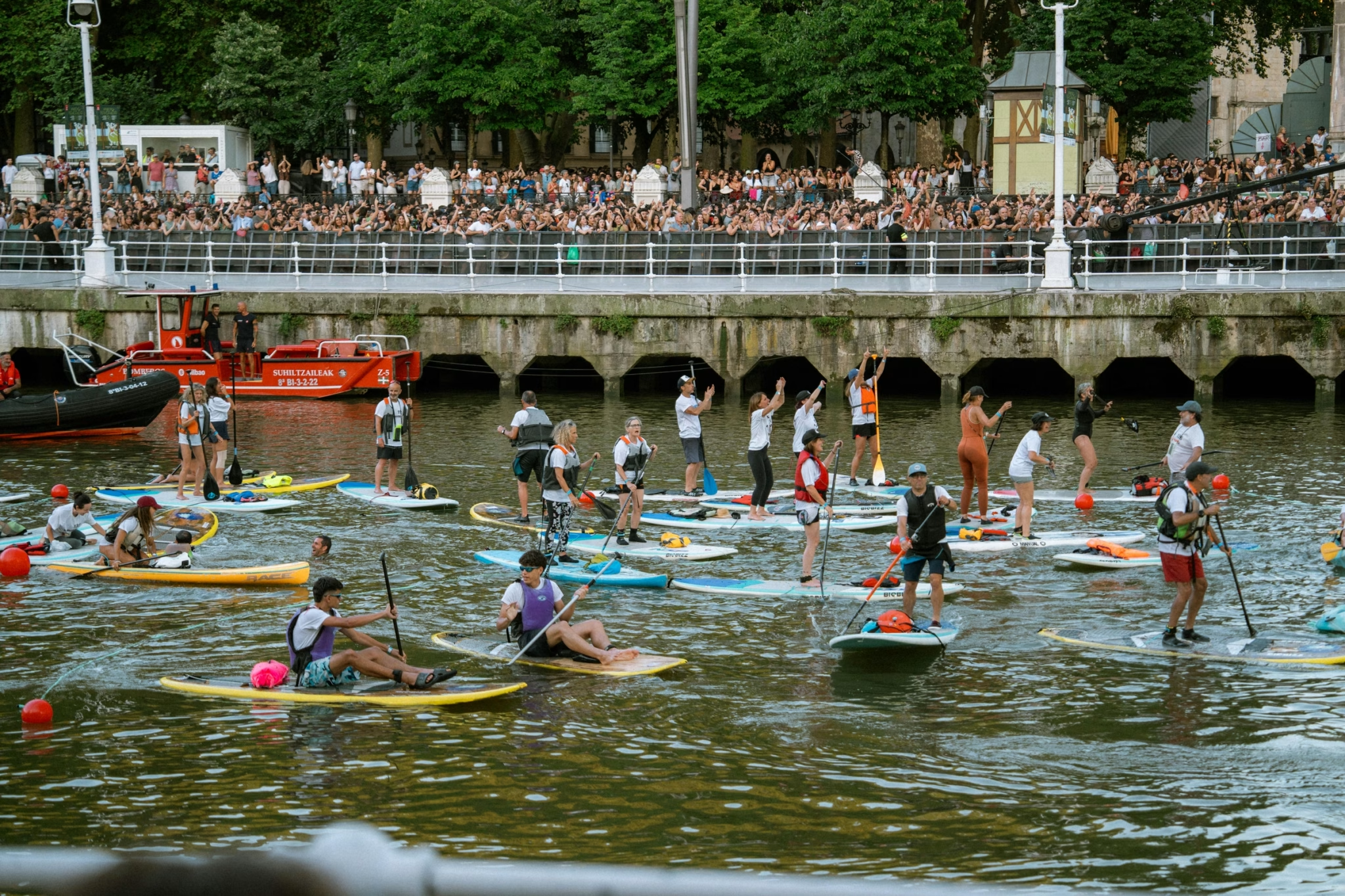
And yet the thought of entering an actual race made my stomach drop.
Not because of the distance. I can cover the miles. Not because of the physical demand. I’ve put in the hours.
The anxiety was something less rational and more primal: the fear of showing up and being exposed as a recreational paddler pretending to be something more. Of finishing dead last on an inflatable board while carbon fiber race machines disappear over the horizon. Of not knowing the etiquette, the procedures, the unwritten rules that every experienced racer apparently absorbs through osmosis.
So I did what I always do when something intimidates me. I over-researched it.
Pulled training studies from the Journal of Sports Sciences and the International Journal of Sports Physiology and Performance. Read every race guide I could find. Talked to paddlers who’d done it. Mapped out a training progression that moves beyond “go paddle for a while” into structured, periodized preparation. Studied the board I’m racing on, a $1,200 inflatable that the internet keeps telling me can’t compete with hardboards.
This is everything I’ve learned about preparing for a first race: the science, the logistics, and the gear reality. Mine was Battle of the Bay in 2025.
Update, September 14, 2026: I raced PaddleSplash on Lake Natoma, paddling the eight mile on September 13, 2026. I finished in 1:49:01.53 and took first in SUP. The full account is in my PaddleSplash race report.
Key Takeaways
- SUP racing is more accessible than you think: most events welcome beginners, recreational boards, and first-timers alongside competitive paddlers. You don’t need a $3,000 carbon fiber board to participate.
- Inflatable racing boards are legitimate: the Venture Wild Sierra Pro-Touring 14×28 ($1,200) runs at 20 PSI with dual-layer military-grade PVC, closing the rigidity gap significantly compared to budget inflatables at 12-15 PSI.
- A 6-8 week structured training plan built on periodization principles (base, build, peak, taper) can prepare a fitness paddler for race distances, and the training literature on periodized programs reports meaningful gains over comparable blocks, though the studies compare structured programs against each other rather than against doing nothing in particular.
- Pacing is everything for first-time racers: going out too fast is the single most common mistake. Negative splitting (starting conservative, finishing strong) produces better times than aggressive starts.
- Race logistics matter as much as fitness: knowing check-in procedures, leash and PFD requirements, warm-up timing, and start positioning prevents race-morning panic.
- Your average speed tells you more than you think: beginner racers typically fall in the 2.5-3.5 mph range, intermediate 3.5-4.5 mph, and competitive paddlers push above 5.5 mph. Knowing your baseline sets realistic expectations. (See SUP speed benchmarks by skill tier for GPS-anchored detail on where the times fall.)
Why Race at All?
To be completely transparent, I resisted this idea for months. Recreational paddling is meditative. You set your own pace, stop when you want, take photos of herons, adjust your route mid-session. Racing introduces competition, comparison, and the uncomfortable possibility of being objectively slow.
Then I looked at my own data.
My September 2025 session at Folsom: 8.51 miles, 4.2 mph average, 750 active calories, 152 BPM.
My February 2026 session at Fair Oaks: 8.19 miles, 3.7 mph average, 964 active calories, same 152 BPM. Five months later, covering less distance at the same heart rate while burning more calories. Getting less efficient, not more. Paddling without structure had stopped producing adaptation.
Research supports this observation.
A 2021 systematic review in Sports Medicine on tapering and on polarized training supports the same underlying principle: varying intensity deliberately beats grinding out every session at one pace (Mujika 2003; Stoggl and Sperlich 2014). Neither paper studied paddlers, and neither compared a plan against no plan. The principle applies across endurance disciplines: without progressive overload and recovery cycling, fitness stagnates.
Source: Mujika, I. et al., “Scientific Bases for Precompetition Tapering Strategies,” Medicine & Science in Sports & Exercise, 2003; Stoggl, T.L. & Sperlich, B., “Polarized training has greater impact on key endurance variables,” Frontiers in Physiology, 2014.
A race gives you a date on the calendar, a distance to prepare for, and a reason to push beyond comfortable. It transforms “I should do some intervals today” from a suggestion into a necessity.
There’s also the community element. SUP racing culture, from everything I’ve gathered, is remarkably welcoming. The same event that hosts elite outrigger paddlers doing 12-mile open water crossings also has a 3-mile fun paddle for people on rental boards. The spectrum is wide. The vibe is closer to a trail running community than a competitive rowing regatta.
Battle of the Bay: The Race on My Calendar
I chose the Battle of the Bay for specific reasons. It’s the 15th annual event, scheduled for September 26, 2026, launching from Dunphy Park in Sausalito. It is the 15th annual running, though the organizers are candid that COVID interrupted it and 2026 is only their second post-pandemic year. Even so, fifteen editions means established logistics, experienced safety crews, and courses refined through iteration, which matters when you are the first-timer.
Where the money goes is worth checking before you assume. The race information page still names Play Marin, a nonprofit providing outdoor recreation access to underserved youth in Marin County, but the organizers’ own home page for the 2026 event says profits go to “a charity TBD.” The race-information page also still describes the 2025 courses, so it is carrying last year’s copy. Treat the beneficiary as undecided until the organizers settle it.
Race Categories and Format
Battle of the Bay isn’t SUP-only. The field includes stand-up paddleboards, outrigger canoes, surfskis, rowing shells, and prone paddleboards. Multiple watercraft sharing the same course creates a unique dynamic. You’re not just racing other SUP paddlers. You’re navigating around a surfski that’s moving 8+ mph while you’re holding 4.
Do not plan around a distance yet. As of early August 2026 the organizers say they are still designing the 2026 courses and have published only the 2025 set “to give you a taste,” with new courses heading out toward the Golden Gate and some technical racing added. Historically the options have run from shorter recreational distances through longer competitive routes in Richardson Bay and out into open Bay water. The organizing principle stays consistent: challenging water, spectacular scenery, and enough distance variety that beginners and veterans both find appropriate courses.
Schedule and Requirements
| Time | Activity |
|---|---|
| 7:00 to 8:30 AM | Racer check-in at Dunphy Park, Sausalito. It closes at 8:30, not whenever you get there. |
| 8:20 AM | Mandatory skippers meeting. Miss it and you may not start. |
| 9:15 AM | Race start (outrigger, surfski, prone, SUP) |
| 12:30 PM | Awards |
| 1:00 PM | Technical racing, with its own awards at 1:30 PM |
Mandatory equipment: a life jacket and a board leash. The organizers state both plainly as race requirements, and race rules are what bind you on the day. Federal law separately requires a wearable life jacket aboard once you are outside a designated swim area, though it does not require adults to wear it, and no federal or California law requires a leash at all. On an ebb tide near the Golden Gate, wear both regardless.
Registration runs through PaddleGuru, the standard platform for paddlesport events. Early registration typically saves money and guarantees your spot. Races cap participation for safety reasons.
First-timer note: Arrive at least 90 minutes before the start. You need time for check-in, board setup, pump-up (if inflatable), warm-up paddle, bathroom, and the inevitable moment where you realize you left your water bottle in the car. Budget for chaos. Race mornings are not the time for tight scheduling. For the warm-up itself, lean dynamic; the long static-stretching work belongs in the post-paddle stretching protocol, not before the start gun.
Racing with an Inflatable: The Sierra Pro-Touring 14×28
Here’s where things get complicated.
Every forum thread about SUP racing eventually devolves into the same debate: inflatable versus rigid. Rigid wins on every spec sheet. Carbon fiber layups, displacement hulls, and zero flex mean better glide, better tracking, and better speed per stroke. An inflatable SUP racing against hardboards is bringing a pool noodle to a sword fight.
Except it’s not that simple. Not anymore.
The Board: Venture Wild Sierra Pro-Touring 14×28
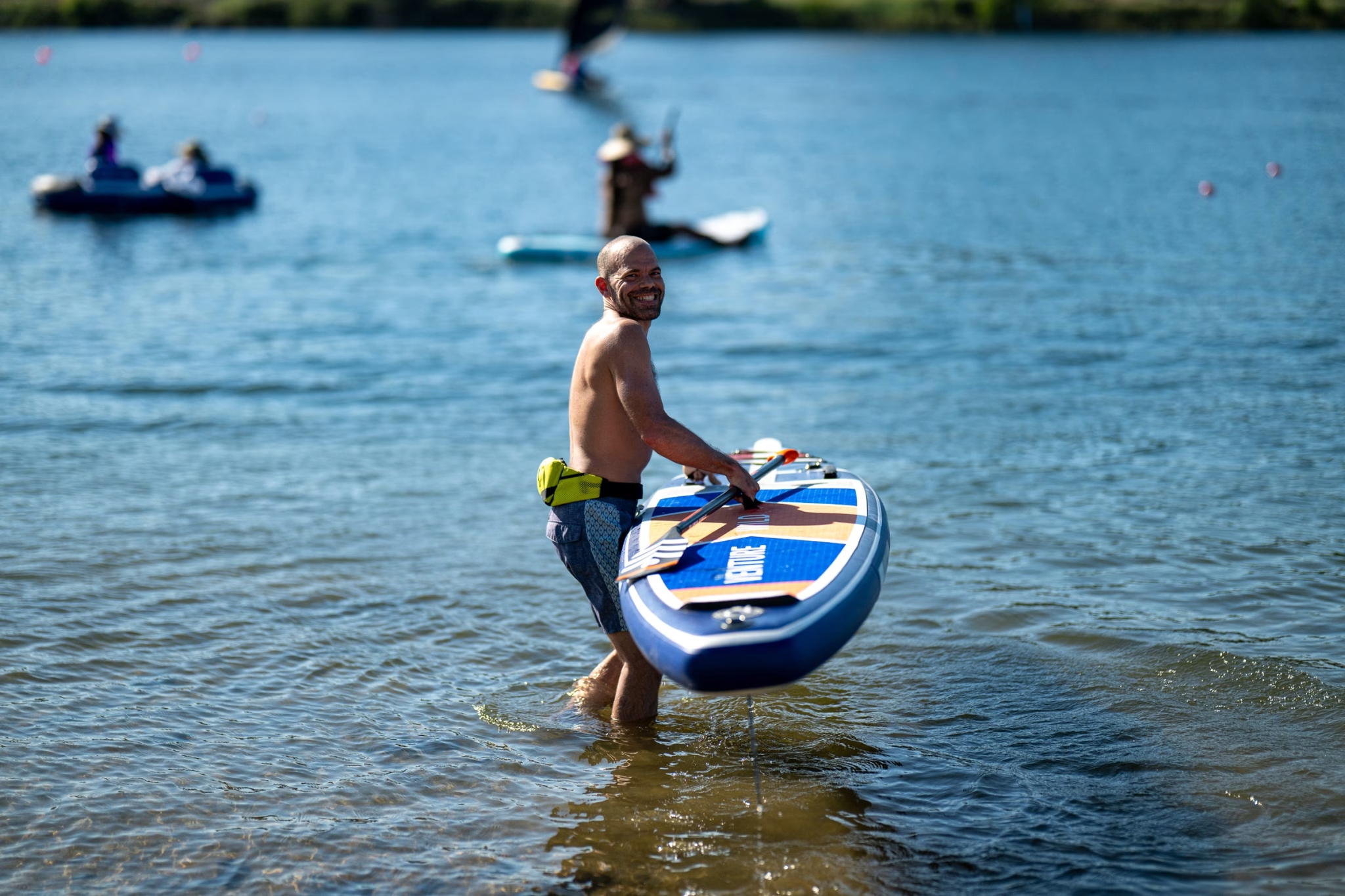
I’m racing on the Venture Wild Sierra Pro-Touring, a 14-foot by 28-inch inflatable racing board that costs $1,200. Here’s what makes it different from the $400 Amazon inflatable your cousin uses for lake selfies.
| Spec | Sierra Pro-Touring 14×28 | Typical Budget Inflatable |
|---|---|---|
| Length | 14 ft (427 cm) | 10-11 ft |
| Width | 28 in (71 cm) | 32-34 in |
| Max PSI | 20 PSI | 12-15 PSI |
| Construction | Dual-layer military-grade PVC | Single-layer PVC |
| Profile | Racing displacement nose | Flat planing hull |
| Target Paddler | Racing, touring, fitness | Casual recreation |
PSI and the Rigidity Reality
Inflation pressure changes everything about how an inflatable performs. At 12 PSI, a board flexes under your feet with every stroke. Energy transfers into deforming the board instead of moving it forward. At 20 PSI, that flex drops dramatically. The board doesn’t feel like a hardboard. I’m not going to pretend it does. But the difference between 12 PSI and 20 PSI is larger than the difference between 20 PSI and rigid construction.
Think of it logarithmically. Each additional PSI above 15 yields diminishing returns in flex reduction, but the first jump from 12 to 15, and then 15 to 20, transforms the ride. The dual-layer military-grade PVC construction on the Sierra Pro-Touring holds that pressure without seam stress, which is where cheaper inflatables fail. They’re rated for 15 PSI but the glue joints start protesting at 13.
What You Give Up
To be completely transparent about the performance gap: a competitive inflatable at 20 PSI is probably 5-10% slower than an equivalent rigid board over race distance. That gap widens in chop and confused water, where hull rigidity matters most. On flat water in calm conditions, the difference narrows.
For a first-time racer, that 5-10% is irrelevant. You’re not losing a race because of board material. You’re losing it because of conditioning, technique, pacing, and experience. Fix those first. If you’re still racing two years from now and chasing podium positions, then the board conversation matters. Right now, it’s a distraction from what actually needs work.
I haven’t tried a rigid race board yet. Maybe the difference would shock me. But I know this: I can transport the Sierra Pro-Touring in my car’s trunk, inflate it at the launch site in 15 minutes, and not worry about ding repair if it bumps a dock. For a first race, those practical advantages outweigh marginal speed deficits.
Gear You’ll Need on Race Day
Race gear splits into two categories: mandatory (they won’t let you start without it) and strategic (you’ll suffer without it).
Mandatory
- Board: Any SUP works for recreational categories. Race-specific divisions may have length requirements (12’6″ or 14′ classes are standard).
- PFD (Personal Flotation Device): USCG-approved Type III or Type V. Inflatable belt packs count at most events. A full vest restricts shoulder rotation for paddling, so belt-style PFDs are popular among racers.
- Leash: Coiled calf or ankle leash. In open water and current, a straight leash can create dangerous drag if you fall. Coiled leashes retract and keep slack off the water surface.
- Paddle: Sized correctly for your height. Racing paddles are typically 8-10 inches above your head. Carbon or fiberglass saves weight over aluminum, and you’ll feel every ounce over 5+ miles.
Strategic
- Hydration system: A hydration bladder (CamelBak or equivalent) bungeed to your board or worn as a vest. You need hands-free drinking access. Fumbling with a water bottle mid-race costs time and balance.
- Race nutrition: Energy gels, dates, or rice cakes in a waterproof hip belt or deck bag. For races over 90 minutes, you need 30-60 grams of carbohydrate per hour. (I wrote an entire article on why paddlers bonk and the SUP nutrition science behind preventing it.)
- Sun protection: Rashguard or SPF shirt, waterproof sunscreen applied 30 minutes before launch, hat with retention strap, polarized sunglasses with a floatable retainer. You’re on reflective water for hours. Sunburn is not a minor inconvenience; it’s a performance-degrading distraction.
- Clothing: Board shorts or compression shorts, moisture-wicking top. Nothing cotton. Cotton absorbs water, adds weight, and chafes. If water temperature is below 60°F, consider a wetsuit or drysuit. Hypothermia risk in San Francisco Bay is real.
- Dry bag: A 10L roll-top dry bag for car keys, phone, and anything that can’t get wet. Clip it to the board’s D-rings, not stacked on the nose where it catches wind.
- Pump: If racing inflatable, bring your pump and a pressure gauge. Arrive early enough to inflate calmly. Rushing a 20 PSI inflation is a cardiovascular event in itself.
Conditioning and Training: The 8-Week Plan
Here’s where the science gets practical. A structured training plan for paddle board racing draws from the same periodization principles used in rowing, kayaking, and outrigger canoe preparation. The research is clear: systematic progression through base building, intensity development, and pre-race tapering produces measurably better outcomes than random training. The on-water plan below pairs naturally with the SUP strength program for the off-water core, balance, and shoulder work that supports a faster stroke without breaking down between sessions.
A landmark meta-analysis by Bosquet et al. (2007) published in Medicine & Science in Sports & Exercise found that a 2-week taper reducing training volume by 41-60% while maintaining intensity produced optimal performance gains in endurance athletes. Separate research by Stoggl and Sperlich (2014) in Frontiers in Physiology demonstrated that polarized training (roughly 80% low intensity, 20% high intensity, minimal moderate work) produced greater improvements in VO2max and time-trial performance than threshold or high-volume training alone.
Sources: Bosquet, L. et al., “Effects of tapering on performance: a meta-analysis,” Medicine & Science in Sports & Exercise, 39(8):1358-1365, 2007; Stoggl, T.L. & Sperlich, B., “Polarized training has greater impact on key endurance variables than threshold, high-intensity, or high-volume training,” Frontiers in Physiology, 5:33, 2014.
I’m structuring my 8-week plan around these findings, adapted for SUP-specific demands. The plan assumes you can already paddle 5+ miles continuously at a conversational pace. If you can’t, extend the base phase by 2-3 weeks.
8-Week SUP Race Training Plan
Based on periodization research. Assumes 4-5 sessions per week, including cross-training. HR zones: Zone 1 (easy, conversational), Zone 2 (moderate, can speak in sentences), Zone 3 (tempo, can speak in phrases), Zone 4 (threshold, single words only), Zone 5 (max, no talking).
Weeks 1-2: Base Building
Goal: Aerobic foundation and paddle volume. 80%+ of work in Zones 1-2.
| Day | Session | Details |
|---|---|---|
| Monday | Rest or light yoga/stretching | Recovery focus, shoulder mobility work |
| Tuesday | Paddle: Easy distance | 5-6 miles, Zone 1-2, focus on stroke technique and catch timing |
| Wednesday | Cross-train: Strength (posterior chain priority) | Hip thrusts, Romanian deadlifts, Bulgarian split squats, kettlebell swings, then anti-rotation core (Pallof press, side plank) and shoulder prehab (face pulls, band rows). The posterior chain is the engine; train it first. 40-45 min |
| Thursday | Paddle: Moderate distance | 6-7 miles, Zone 2, steady state. Practice fueling and hydration |
| Friday | Rest or easy walk/swim | Active recovery only |
| Saturday | Paddle: Long session | 7-9 miles, Zone 1-2. Build distance confidence. Practice race nutrition |
| Sunday | Cross-train: Easy cardio | 30-40 min cycling, swimming, or jogging. Different movement patterns |
Weeks 3-4: Building Intensity
Goal: Introduce tempo and interval work. Still 75-80% Zones 1-2, but adding Zone 3-4 blocks.
| Day | Session | Details |
|---|---|---|
| Monday | Rest or yoga | Shoulder and hip mobility emphasis |
| Tuesday | Paddle: Tempo intervals | 5-6 miles total. After 1-mile warm-up: 4×3 min at Zone 3 with 2 min Zone 1 recovery |
| Wednesday | Cross-train: Strength + core (legs first) | Loaded RDLs, hip thrusts, Bulgarian split squats, then lat pulldowns and single-arm rows. Anti-rotation presses for core. Heavier loads now that base is in |
| Thursday | Paddle: Steady state | 6-7 miles, Zone 2. Working on maintaining stroke rate at lower effort |
| Friday | Rest | Complete rest or gentle stretching |
| Saturday | Paddle: Long + race pace blocks | 8-10 miles. Include 2×1 mile at target race pace (Zone 3). Evaluate pacing |
| Sunday | Cross-train: Moderate cardio | 40-50 min. Higher intensity than base phase. Build aerobic ceiling |
Weeks 5-6: Peak Training
Goal: Highest training load. Race-specific work with longer sustained efforts at threshold.
| Day | Session | Details |
|---|---|---|
| Monday | Rest | Critical recovery day. Don’t skip this |
| Tuesday | Paddle: High-intensity intervals | 5-6 miles. After warm-up: 6×2 min Zone 4 with 3 min Zone 1 recovery |
| Wednesday | Cross-train: Power + strength | Explosive movements: medicine ball rotations, plyometric rows, kettlebell swings |
| Thursday | Paddle: Race simulation | Race distance at race effort. Full nutrition and hydration protocol. Time it |
| Friday | Rest or light swim | Recovery priority. Shoulder maintenance |
| Saturday | Paddle: Long distance | 9-11 miles, Zones 1-2. Last big volume session. Mental endurance practice |
| Sunday | Cross-train: Easy | 30 min light activity. Preparing for taper |
Weeks 7-8: Taper
Goal: Reduce volume by 40-60% while maintaining intensity. Arrive fresh, not fatigued.
| Day | Session | Details |
|---|---|---|
| Monday | Rest | Trust the process |
| Tuesday | Paddle: Short intervals | 3-4 miles total. 4×90 sec at Zone 4 with full recovery. Keep the engine sharp |
| Wednesday | Light strength or mobility | Reduced load. Maintenance, not building. Foam rolling, stretching |
| Thursday | Paddle: Easy pace | 4-5 miles, Zone 1-2. Practice start sequence mentally |
| Friday | Rest | Pre-race rest day (Week 8). Gear prep, nutrition prep, route review |
| Saturday | Paddle: Short shakeout (Week 7) or Race Day (Week 8) | Week 7: 3 miles with 3×30 sec race pace surges. Week 8: RACE |
| Sunday | Rest or easy movement | Week 7: Active recovery. Week 8: Post-race recovery |
Why This Structure Works
The periodization model isn’t arbitrary. Research on endurance adaptations shows that aerobic base development (Weeks 1-2) builds mitochondrial density and capillary networks in working muscles. The intensity phase (Weeks 3-6) pushes lactate threshold higher and trains the neuromuscular system to sustain higher power outputs. The taper (Weeks 7-8) allows accumulated fatigue to dissipate while maintaining fitness, resulting in what exercise physiologists call “supercompensation.”
A study by Pyne et al. (2009) in the Journal of Science and Medicine in Sport examining competitive paddlers specifically found that training load management in the 2-3 weeks before competition was a stronger predictor of race-day performance than peak training volume. You don’t win races during your hardest training weeks. You win them during recovery.
Source: Pyne, D.B. et al., “Peaking for optimal performance: Research limitations and future directions,” Journal of Sports Sciences, 27(3):195-202, 2009.
The most recent meta-analysis on taper design comes from Wang, Wang, Gao, and Zhong (2023, PLoS ONE), pooling 14 studies and 174 endurance athletes. Their findings are specific enough to act on: optimal taper duration is 8 to 14 days, total training volume drops 41 to 60% during the taper, and intensity is maintained throughout. Time-trial performance improved by SMD -0.45 across the pooled studies (p < 0.05). The single most consequential variable was maintaining training frequency through the taper rather than reducing it: the meta-regression showed a significant performance bump (SMD -0.53, p < 0.05) for studies that kept session frequency steady even while cutting volume.
Translating that into a paddler-ready table:
| Days out | Paddle volume | Intensity | Strength work | Notes |
|---|---|---|---|---|
| Day 14 | 100% of peak weekly volume | Normal training mix | Normal lift sessions | Last week of full training. Anything you have not built by now stays unbuilt; do not panic-add. |
| Day 10 | ~80% | Race-pace efforts retained | Lighter loads, same frequency | Beginning of the taper. Cut volume by trimming session length, not session count. |
| Day 7 | ~60% | One short race-pace interval session | Light mobility-focused only | The Wang 2023 sweet spot. Keep showing up to your sessions; just make each one shorter. |
| Day 5 | ~50% | One short interval set at race pace | Optional light upper-body activation | You will feel itchy and undertrained. That is the supercompensation working. |
| Day 3 | ~45% | One short tempo block | Skip | Sharpening day. Quick paddle to keep neuromuscular firing patterns active. |
| Day 2 | 30% | Easy paddle only | Skip | Last on-water touch. Maximum 30 minutes, conversational pace. |
| Day 1 | Rest | None | None | No paddling. Walk if you need to move. Lay out gear, hydrate steadily, eat normally. |
| Race day | Race | Race pace per plan | None | The taper is the work you have already banked. The race is the cashout. |
Source: Wang, Z., Wang, Y., Gao, W. & Zhong, Y. “Effects of tapering on performance in endurance athletes: A systematic review and meta-analysis.” PLoS ONE, 18(5):e0282838, 2023. PMC Full Text.
Cross-Training for Paddlers
SUP racing loads the shoulders, lats, core, and legs in repetitive patterns. Without counterbalancing work, you’ll develop imbalances that lead to overuse injuries. The most common: rotator cuff strain, lat tendinopathy, and lower back compression from extended standing with trunk rotation. A 2017 survey of 240 stand-up paddlers found racing, competitive status and more than 4.8 hours a week on the board all raised injury risk.
Your cross-training should target:
- Rotational core strength: Pallof presses, woodchops, Russian twists. SUP power comes from core rotation, not arm pulling
- Posterior chain: Deadlifts, hip hinges, glute bridges. Your legs and hips provide the stable platform that your upper body works from
- Scapular stability: Band pull-aparts, face pulls, prone Y-T-W raises. Bulletproofing the shoulder complex for repetitive overhead-adjacent movement
- Lat and pulling strength: Rows, pulldowns, single-arm cable pulls. The primary movers in the paddle catch and pull phase
Speed Benchmarks and Pacing Strategy
One of the hardest things about preparing for a first race is calibrating expectations. How fast should you go? What’s a reasonable finish time? Where do you fit in the field?
Speed data from GPS tracking across recreational and competitive SUP paddlers falls into roughly four tiers.
| Level | Average Speed (mph) | Profile |
|---|---|---|
| Beginner | 2.5 – 3.5 | New to distance paddling, all-around boards, developing technique |
| Intermediate | 3.5 – 4.5 | Regular paddler, touring or race-shaped board, established fitness base |
| Advanced | 4.5 – 5.5 | Experienced racer, dedicated race board, refined technique and conditioning |
| Competitive/Elite | 5.5+ | Podium contender, carbon fiber race board, years of training, sponsored athletes |
Where My Data Fits
My own benchmarks put me squarely in the intermediate tier with occasional dips into beginner territory on tough days. My September session at Folsom (4.2 mph average over 8.51 miles) represents a strong intermediate effort. My February session at Fair Oaks (3.7 mph average over 8.19 miles, with significantly higher calorie burn) shows what happens when conditions, fueling, and winter detraining compound.
For the Battle of the Bay, my realistic target is sustaining 4.0-4.3 mph over race distance. Aggressive but achievable with structured training and proper nutrition.
The Case for Negative Splitting
The pacing strategy I’m committing to is a negative split: start conservative, finish fast. Research on pacing in endurance events consistently shows that athletes who start at or below target pace and progressively increase effort produce better finishing times than those who go out hard and fade.
A study by Abbiss and Laursen (2008) in Sports Medicine analyzing pacing patterns across endurance disciplines found that even pacing or negative splitting minimized metabolic disturbance and delayed neuromuscular fatigue compared to positive splitting (fast start, slow finish). The physiological rationale is straightforward: starting conservatively keeps you below anaerobic threshold longer, preserving glycogen and delaying the accumulation of metabolic byproducts that compromise performance.
Cadence is how you actually execute that plan. Pace is an outcome, and on the water it moves with wind, current and whoever just passed you. Stroke rate is an input you control directly. Castaneda-Babarro et al. (2020) tested international SUP racers at 45, 55 and 65 strokes per minute and found 45 the most efficient of the three, at 13% better than 55 and 17.5% better than 65. Their trials held power fixed at 75% of peak output, so the finding is about cost per unit of effort rather than raw speed. What it means for a first race is that the adrenaline spike at the start gun shows up as cadence long before it shows up as pace, and a rate you can count is a rate you can pull back. I work through the metronome drill for holding 45 in my SUP speed benchmarks.
Source: Castaneda-Babarro, A. et al., “The Effect of Different Cadence on Paddling Gross Efficiency and Economy in Stand-Up Paddle Boarding,” International Journal of Environmental Research and Public Health, 17(13):4893, 2020.
Source: Abbiss, C.R. & Laursen, P.B., “Describing and understanding pacing strategies during athletic competition,” Sports Medicine, 38(3):239-252, 2008.
For a first race, this is non-negotiable. The adrenaline of a mass start will push you to go out fast. Every instinct will scream “keep up with the group.” Resist. Paddle your own race. The people who blasted past you in the first mile will be the ones you’re reeling in at mile 5.
Pacing template for a 6-mile race at 4.0 mph target:
Miles 1-2: 3.8 mph (slightly below target, finding rhythm, letting heart rate settle)
Miles 3-4: 4.0-4.1 mph (settling into race pace, checking in with body)
Miles 5-6: 4.2-4.5 mph (progressive increase, emptying the tank in the final mile)
This produces a faster finish time than going 4.5 mph for miles 1-2 and fading to 3.5 mph.
Race Day: From Parking Lot to Finish Line
Race-morning logistics can make or break the experience. Here’s the timeline I’m building for myself, and the reasoning behind it.
The Night Before
Pack everything. Board, pump, paddle, PFD, leash, hydration bladder, nutrition (gels, dates, sports drink), sun protection, race clothing, dry bag, car keys, registration confirmation. Lay it all out. Check it twice. Then check it again because you forgot the sunscreen.
Eat a carbohydrate-heavy dinner by 7 PM. Pasta, rice, sweet potatoes. The glycogen loading principles from endurance nutrition research apply here: your muscles store roughly 300-400 grams of glycogen, and topping off those stores the night before requires 8-10 grams of carbohydrate per kilogram of body weight throughout the day.
Set two alarms. Seriously.
Race Morning
4.5 hours before start (4:45 AM for a 9:15 start): Wake up. Breakfast: high-carb, low-fiber, moderate protein. Oatmeal with banana and honey, white toast with jam, orange juice. Target 150-200 grams of carbohydrate. Hydrate with 16-20 oz of water or electrolyte drink.
2 hours before start (7:15 AM): Arrive at venue. Find parking (arrive early; waterfront parking disappears fast). Walk to check-in. Get your race bib, timing chip, and any last-minute course briefing updates.
90 minutes before (7:45 AM): Inflate board if running an iSUP. The Sierra Pro-Touring takes about 12-15 minutes to reach 20 PSI with a quality dual-action pump like the Thurso Surf. Attach leash, mount hydration bladder, secure dry bag. Do a quick on-water shake-out paddle: 5-10 minutes, easy pace, checking equipment.
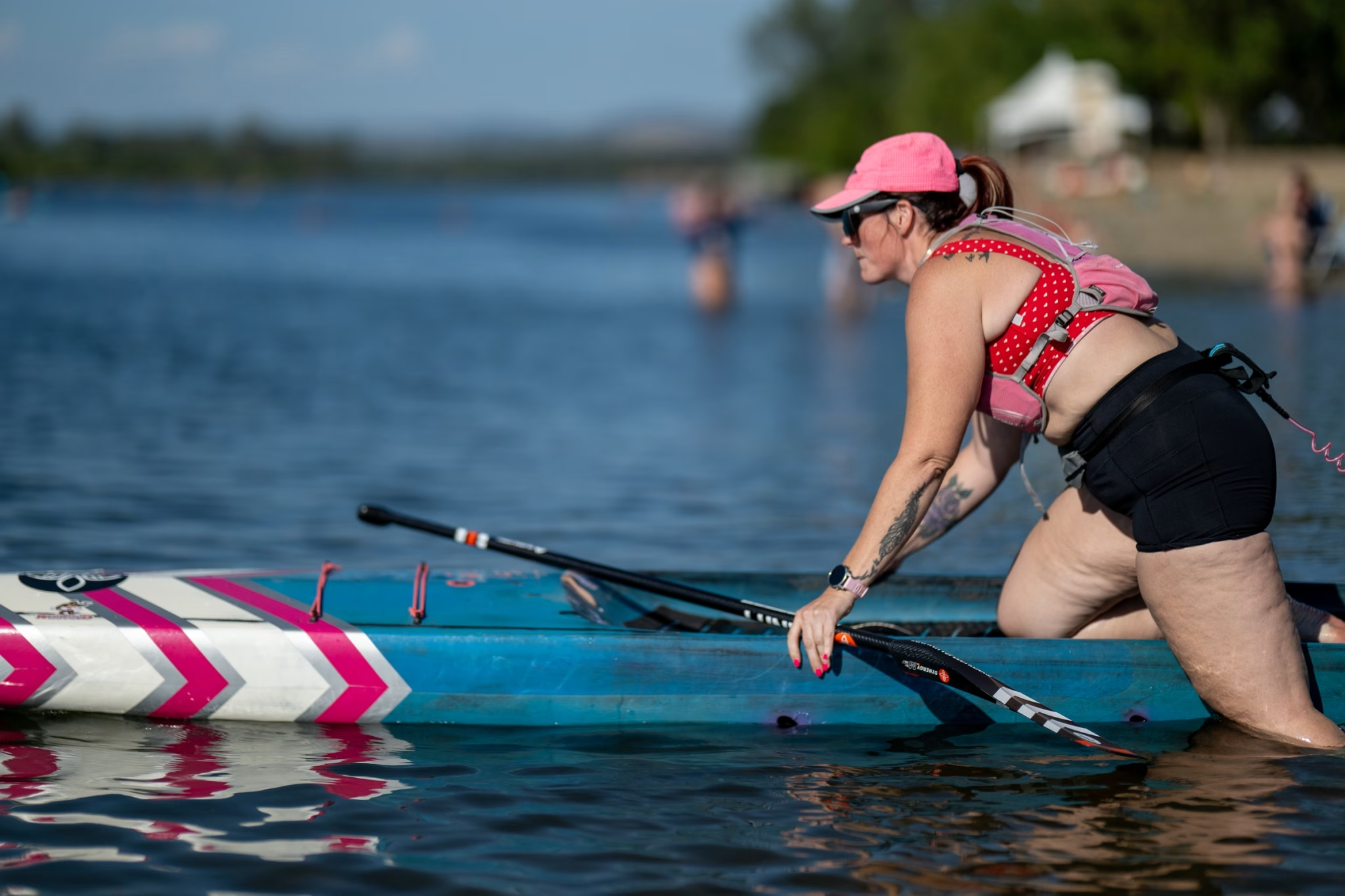

45 minutes before (8:30 AM): Small top-off snack: two dates or a banana, 30-50 grams of carbohydrate. Final bathroom visit.
15 minutes before (9:00 AM): Get on the water. Position for the start. First-time racers: start toward the outside, not in the middle of the pack. The start is chaotic, with paddles colliding and boards bumping. Experienced racers know the fastest lines and will fight for position. Give yourself space to find your rhythm without being caught in the washing machine.
During the Race
The first 500 meters will feel wrong. Your heart rate will spike from adrenaline, your pacing will be off, and the temptation to match faster paddlers will be overwhelming. Let them go. Settle into your breathing and find your stroke cadence. Check your pacing at the half-mile mark. If you’re above target speed, back off. You’ll need that energy later.
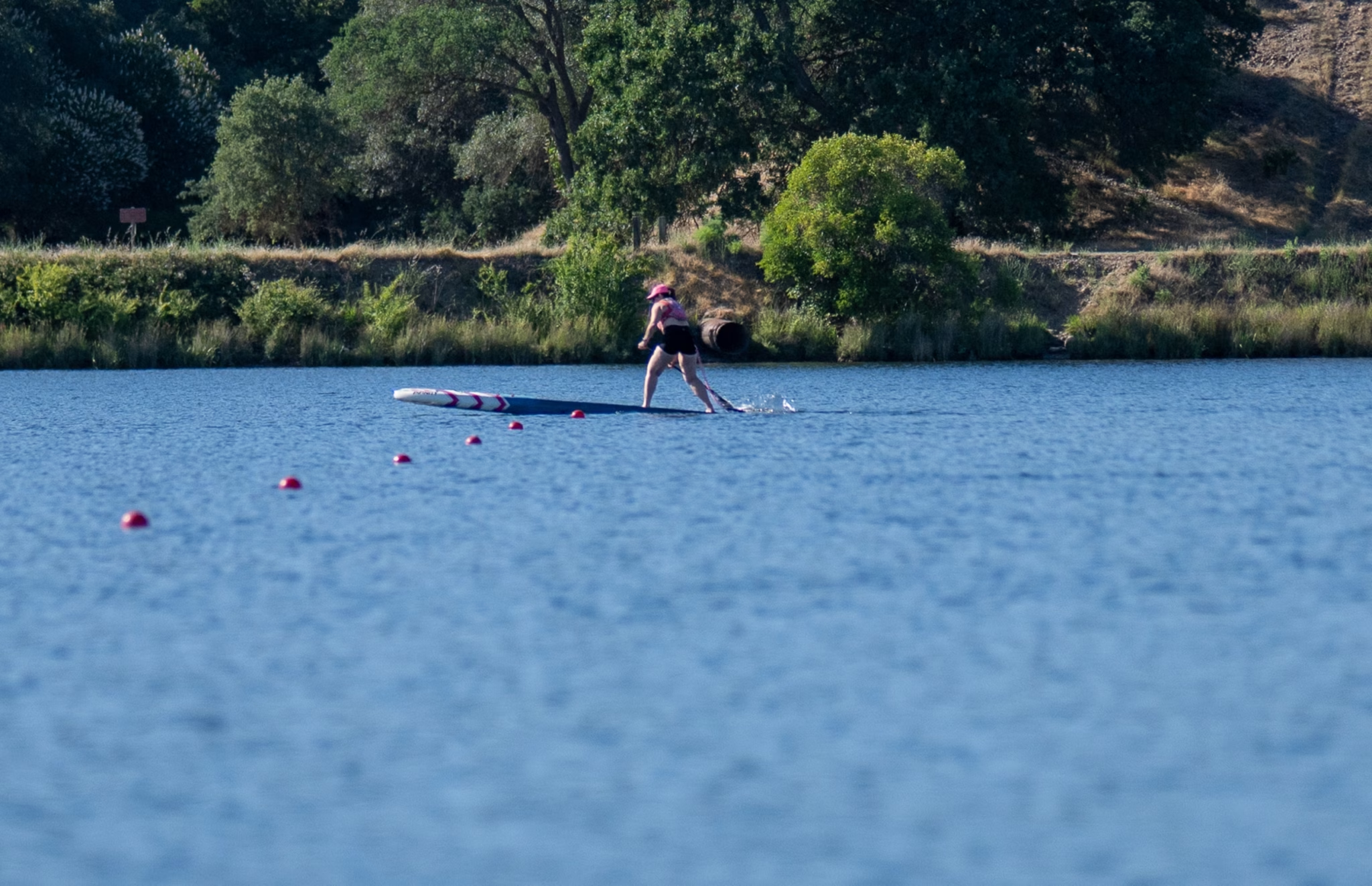
Begin fueling at the 20-30 minute mark. A few sips of electrolyte drink, half a gel. Don’t wait until you’re hungry. By the time hunger registers, glycogen depletion is already advancing.
At the midpoint, do a mental inventory. How does your body feel? Is your stroke still efficient or are you muscling it with your arms? Are you hydrated? Adjust accordingly. The back half of the race is where preparation separates from improvisation.
In the final mile, if you have anything left, progressively increase your effort. This is where the negative split pays off. You’re passing people who went too hard early. Your stroke is still clean because you didn’t burn out your shoulders in the first half. Empty the tank in the last quarter mile. Leave nothing.
Mental Preparation
I haven’t tried racing yet, so I can’t speak from experience on the mental component. The sports psychology literature, though, is consistent.
Process goals beat outcome goals. “Maintain 48 strokes per minute” is more actionable than “finish in the top 20.” You can control your stroke rate. You can’t control what everyone else does.
Segmenting the course reduces perceived effort. Rather than thinking “5 more miles,” think “paddle to that next buoy.” Break the race into manageable chunks. Each checkpoint is a small completion that feeds forward momentum.
Expect the low point. Somewhere between the one-third and two-thirds mark, every endurance athlete hits a psychological trough. Your body is working, the finish feels distant, and the novelty of the start has faded. This is normal and it passes. Keep paddling.
The Bottom Line
Your first paddle board race isn’t about winning. It’s about proving to yourself that you belong on the starting line. That the months of training, the gear decisions, the alarm set at 4:45 AM, and the nervous energy buzzing through your body at the start all add up to something real. The science says structured training works. The data says your pace is legitimate. The only variable left is whether you show up.
My first race was Battle of the Bay at Dunphy Park. Stop overthinking it. Register. The worst case scenario is that you finish. And finishing your first race is never a worst case.
Sources and Position Stands Referenced
- Bosquet, L., Montpetit, J., Arvisais, D. & Mujika, I. (2007). “Effects of tapering on performance: a meta-analysis.” Medicine & Science in Sports & Exercise, 39(8):1358-1365. PubMed
- Stoggl, T.L. & Sperlich, B. (2014). “Polarized training has greater impact on key endurance variables than threshold, high-intensity, or high-volume training.” Frontiers in Physiology, 5:33. PubMed
- Abbiss, C.R. & Laursen, P.B. (2008). “Describing and understanding pacing strategies during athletic competition.” Sports Medicine, 38(3):239-252. PubMed
- Pyne, D.B., Mujika, I. & Reilly, T. (2009). “Peaking for optimal performance: Research limitations and future directions.” Journal of Sports Sciences, 27(3):195-202. PubMed
- Mujika, I. (2010). “Intense training: the key to optimal performance before and during the taper.” Scandinavian Journal of Medicine & Science in Sports, 20(Suppl 2):24-31. PubMed
- Thomas, D.T., Erdman, K.A. & Burke, L.M. (2016). “Nutrition and Athletic Performance.” Joint Position Statement of ACSM, AND, and Dietitians of Canada. Medicine & Science in Sports & Exercise, 48(3):543-568. PubMed
- Kerksick, C.M. et al. (2017). “International society of sports nutrition position stand: nutrient timing.” Journal of the International Society of Sports Nutrition, 14:33. PMC Full Text
- Schram, B., Hing, W. & Climstein, M. (2016). “Laboratory- and field-based assessment of maximal aerobic power of elite stand-up paddle-board athletes.” International Journal of Sports Physiology and Performance, 11(1):28-32. PubMed
- Schram, B., Hing, W. & Climstein, M. (2015). “Profiling the sport of stand-up paddle boarding.” Journal of Sports Sciences, 34(10):937-944. PubMed
Frequently Asked Questions
Can you race on an inflatable paddle board?
Yes. Most SUP races allow inflatable boards, and high-performance inflatables like the Venture Wild Sierra Pro-Touring 14×28 ($1,200, 20 PSI, dual-layer military-grade PVC) are specifically designed for racing. You’ll concede roughly 5-10% speed to an equivalent rigid board, but for recreational and intermediate racers, fitness, technique, and pacing matter far more than board construction material.
How do I train for my first SUP race?
Follow a 6-8 week periodized training plan that progresses from base building (high volume, low intensity) through intensity development (tempo and interval work) to a pre-race taper (reduced volume, maintained intensity). Stoggl and Sperlich found a polarized structure produced a 17.4% improvement in time to exhaustion, measured against other structured programs rather than against unstructured training. Aim for 4-5 sessions per week including cross-training for core, shoulders, and posterior chain.
What speed should I expect in my first paddle board race?
First-time racers with a regular paddling base typically average 3.5-4.5 mph over race distances. Beginners fall in the 2.5-3.5 mph range, while competitive paddlers sustain 5.5+ mph. Your training GPS data is the best predictor: if you average 4.0 mph on training paddles of similar distance, expect a similar or slightly faster race pace due to adrenaline and competition effects.
What gear do I need for a SUP race?
Mandatory gear at most races includes a USCG-approved PFD (belt-style inflatable packs are popular), a board leash (coiled for open water), and your board and paddle. Strategic additions include a hydration bladder for hands-free drinking, race nutrition (gels, dates), sun protection (rashguard, waterproof sunscreen, hat with retention strap), and appropriate clothing for water temperature conditions.
How should I pace my first paddle board race?
Use a negative split strategy: start 5-10% below your target pace for the first third of the race, settle into race pace for the middle third, and progressively increase effort in the final third. Research on pacing in endurance events shows this approach minimizes metabolic disturbance and produces faster finishing times than going out hard and fading.
What should I eat before a paddle board race?
Eat a carbohydrate-heavy dinner the night before (pasta, rice, sweet potatoes). On race morning, consume a high-carb, low-fiber breakfast 3-4 hours before start (150-200g carbohydrate: oatmeal, toast, banana, juice). Add a small top-off snack (dates or banana, 30-50g carb) 30-45 minutes before the start. Begin fueling during the race within the first 30 minutes.
Is the Battle of the Bay race good for beginners?
The Battle of the Bay, held annually at Dunphy Park in Sausalito, is a well-established event (15th annual in 2026) with multiple course options accommodating different skill levels. The event includes SUP, outrigger, surfski, and rowing categories. Proceeds go to a charity the organizers had not yet named as of early August 2026. However, San Francisco Bay conditions (current, wind, chop) can be challenging, so previous open-water experience is recommended.
How long should my taper be before a SUP race?
Research supports a 2-week taper for endurance events. During this period, reduce training volume by 40-60% while maintaining workout intensity. A meta-analysis by Bosquet et al. (2007) found this approach produced optimal performance gains. Continue doing short, sharp interval sessions to keep your neuromuscular system primed, but cut total mileage significantly to allow accumulated fatigue to dissipate.
What’s the difference between a 12 PSI and 20 PSI inflatable SUP?
Inflation pressure dramatically affects inflatable SUP performance. At 12 PSI, boards flex noticeably under rider weight, absorbing energy that should propel the board forward. At 20 PSI, flex drops substantially, approaching (though not matching) rigid board stiffness. The improvement from 12 to 20 PSI is more significant than the remaining gap between 20 PSI and a rigid board. High-PSI boards require dual-layer PVC construction to safely hold the pressure.
Do I need a race-specific paddle board to enter a race?
No. Most SUP races have recreational or open categories that accept any board. However, board shape affects performance: a 14-foot narrow race board (28 inches wide) covers distance more efficiently than a 10-foot wide all-around board (32+ inches). If you’re paddling a recreational board, focus on enjoying the experience rather than competing on time. You can always upgrade equipment as your interest in racing grows.
How do I handle race-day nerves for my first SUP race?
Focus on process goals (maintain stroke rate, hit fueling schedule) rather than outcome goals (finish position, time). Arrive early to reduce logistical stress. Do a warm-up paddle to settle your nerves and check your equipment. Position yourself on the outside of the start to avoid the congestion of experienced racers jostling for position. Remember that every racer had a first race, and the SUP racing community is widely recognized as welcoming to newcomers.
Affiliate disclosure: Some gear links in this article are Amazon affiliate links. MK Library earns a small commission on qualifying purchases at no additional cost to you. All recommendations reflect real first-race gear choices, not compensation.
Article Updates
- September 15, 2026: Corrected the introduction, the September 14 update, and the closing section, which described PaddleSplash as my first race. My first race was Battle of the Bay in 2025.
- September 14, 2026: Added my result from the PaddleSplash 8 Mile at Lake Natoma on September 13, 2026. Finish time 1:49:01.53, first in SUP, with a link to the full race report.
- September 8, 2026: Added a stroke rate section to the pacing strategy, covering the Castaneda-Babarro (2020) cadence finding and the fact that its trials held power constant at 75% of peak output, so the result describes efficiency at a given effort rather than race speed. Added three photographs from a May 2026 session at Lake Natoma, replacing stock imagery as the article’s only illustration of the board, the launch and the course.
- August 5, 2026: Corrected time-sensitive race details ahead of the September 26, 2026 event. Added the racer check-in window, which closes at 8:30 AM, and the mandatory 8:20 AM skippers meeting, both of which this guide had omitted. Removed the statement that proceeds benefit Play Marin: the organizers’ race information page still says so, but their 2026 home page says the charity is undecided, and that page is also still carrying 2025 course copy. Flagged that the 2026 courses are still being designed, so no distance is confirmed. Corrected the claim that periodized training produces 15 to 20 percent gains over unstructured training, which no cited study measured, and restated the life jacket and leash requirements as race rules rather than Coast Guard law.
- May 22, 2026: Original research and race preview published. All training science and position stands current as of publication date. Race recap to follow after September 2026 Battle of the Bay.


