
Mile 4.5 of a 7-mile paddle. One moment you’re cruising, rhythm locked in, sun on your shoulders. The next, your paddle feels like it weighs forty pounds. Your arms turn to wet cement. Your brain gets foggy. You’re scanning the shore for somewhere, anywhere, to pull over and eat something. Anything.
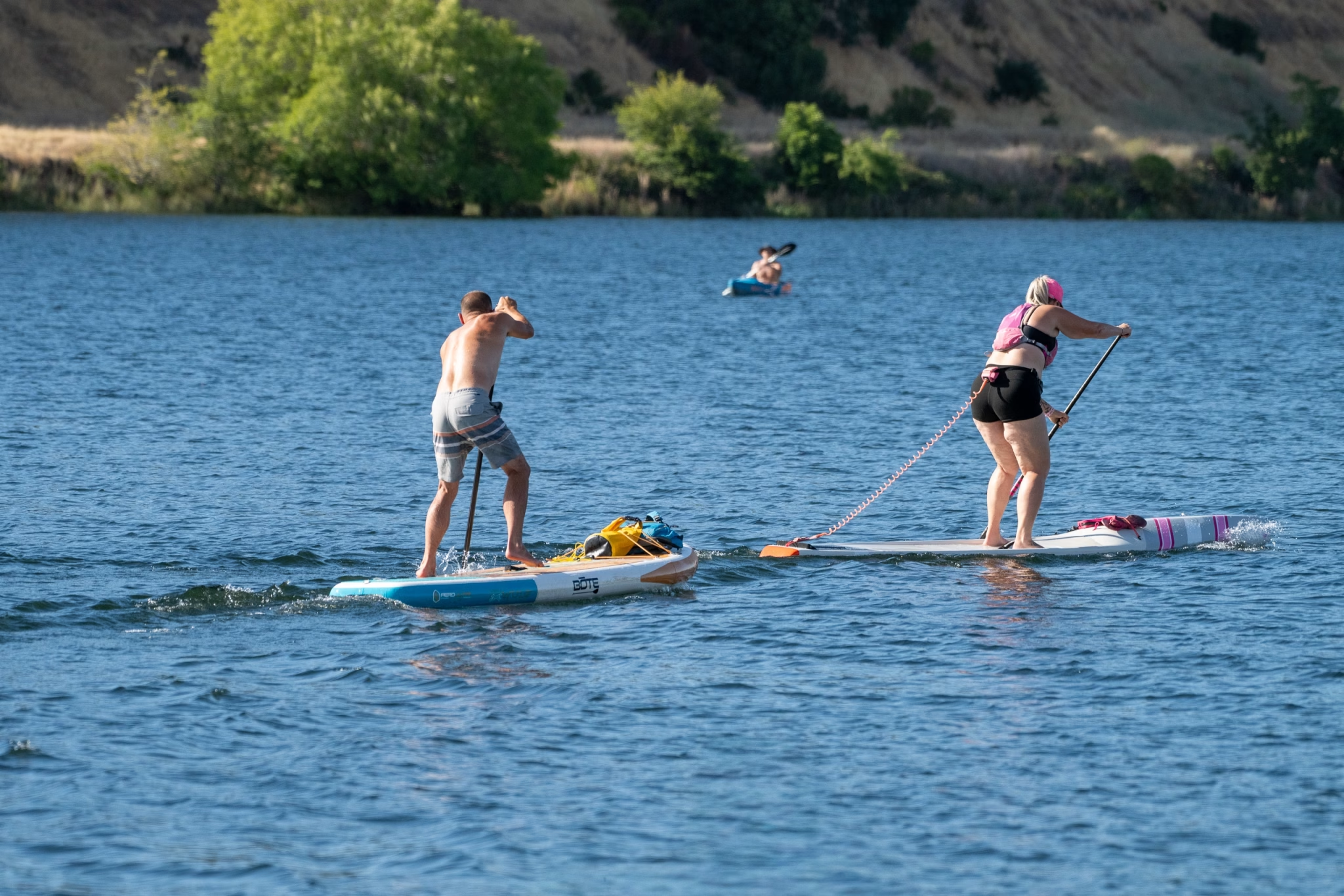
I know this feeling because I lived it recently. A 7-mile SUP session that should have been a strong finish turned into a survival crawl from mile 5 onward. Stopping every mile. Inhaling berries and coconut water on the board like a castaway who found a Whole Foods. Finishing the paddle absolutely demolished, then spending the rest of the day in a caloric black hole.
Turns out, everything about my fueling strategy was physiologically backwards. So I went deep into the peer-reviewed literature: position stands from the American College of Sports Medicine (ACSM) and the International Society of Sports Nutrition (ISSN), plus published research in the Journal of the International Society of Sports Nutrition, Medicine & Science in Sports & Exercise, and the Journal of Applied Physiology. What I found explains exactly why I hit the wall, why my mid-paddle berries were the wrong call, and what I should have been doing from the night before. With receipts.
Key Takeaways
- August 6, 2026: Repaired three dead product links. The Liquid I.V. and deck bag listings had gone unavailable, and the Nate’s Honey Minis listing went out of stock since the link audit five days ago; the honey now points to the identical product on its in-stock single-box listing. Nine affiliate links in total, all re-verified against Amazon’s Product Advertising API on this date.
- Bonking is glycogen depletion, and it’s predictable: untrained muscles store roughly 90-120 minutes of fuel at moderate intensity, which maps precisely to a mile 4-5 wall on a 7-mile paddle.
- You must eat BEFORE you’re hungry: carbohydrate intake should begin within the first 30 minutes of exercise and continue at 30-60 grams per hour (ACSM/ISSN guidelines).
- Berries are terrible mid-exercise fuel: high fiber slows gastric emptying, high water content means low caloric density, and fructose alone absorbs poorly compared to glucose-fructose combinations.
- Pre-paddle nutrition starts the night before: a high-carbohydrate dinner (8-10 g/kg/day) tops off glycogen stores that take 24 hours to fully replenish.
- The 30-60 minute post-paddle window is real: glycogen synthase enzyme activity peaks immediately after exercise, making this the most efficient time to refuel.
- Hydration means electrolytes, not just water: sodium intake of 500-700 mg/L in your drink supports intestinal water absorption during sessions over 2 hours (ACSM, 2007).
- SUP burns 615-1,130 calories per hour depending on intensity, making it a genuine endurance sport that demands endurance-level fueling.
Key Numbers at a Glance
| During-paddle carbs | 30-60 g/hr (begin within first 30 min) |
| Fluid intake | 0.4-0.8 L/hr (more in heat/sun) |
| Sodium in drink | 500-700 mg/L |
| Pre-paddle meal | 1-4 g carbs/kg, 1-4 hrs before |
| Post-paddle recovery | 0.9 g carbs/kg/hr + 0.3 g protein/kg/hr |
| SUP calorie burn | 615-1,130 cal/hr (touring to racing) |
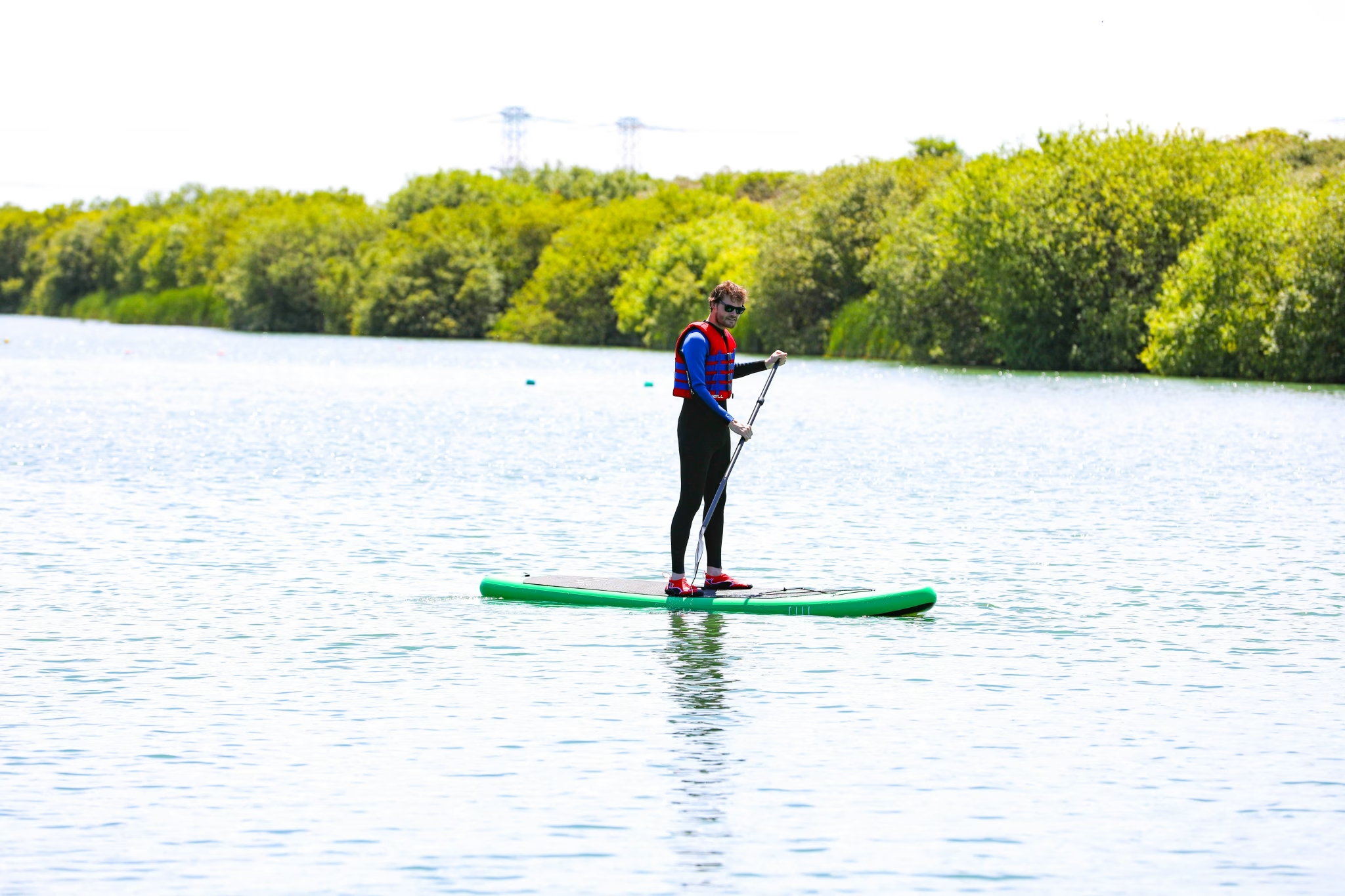
What Is Bonking? (And Why It Happens to Endurance Athletes)
Bonking is what happens when your muscles run out of stored carbohydrate fuel during sustained exercise. The technical term is glycogen depletion. The sensation is a sudden, dramatic loss of power: legs that feel filled with concrete, arms that won’t fire, a brain that goes foggy as blood sugar drops alongside the muscle fuel. Cyclists call it “the bonk.” Runners call it “hitting the wall.” On a board it is just “that thing that destroyed mile 5.”
Whatever you call it, the mechanism is identical across endurance sports. Your skeletal muscle stores roughly 300 to 400 grams of glycogen. Your liver holds another 80 to 100. Together, that’s 1,600 to 2,000 calories of carbohydrate fuel, which is most of what your body wants to burn at moderate-to-high intensity. When that storage runs low, two things happen at once: muscle fibers lose the ability to contract cleanly, and blood glucose drops fast enough to trigger your brain into rationing mode. Performance falls off a cliff.
The timeline depends on the sport, the intensity, and what you ate the day before. Here’s how the bonk shows up across the most common endurance pursuits:
| Sport | Typical Bonk Window (unfueled) | Intensity Profile | Characteristic Signs |
|---|---|---|---|
| Cycling | 2 to 3 hours | Variable; long climbs and sustained tempo efforts deplete fastest | Sudden inability to hold target wattage; legs feel “empty”; cognitive fog descending mid-climb |
| Running (marathon) | ~20 mile mark (“the wall”) | Steady-state, high carb-oxidation rate, very little fat-burning at race pace | Pace collapse despite same perceived effort; cramping; the well-documented “wall” emotion |
| Stand-up paddleboarding | 75 to 90 minutes (around mile 4-5 at touring pace) | Sustained upper-body and core engagement; routinely logged as “low intensity” | Arms turn to wet cement; balance falters; reaching for the deck pad instead of paddling |
| Trail running / ultra | 3 to 4 hours, often earlier in heat | Variable; long aerobic stretches punctuated by climbs | Nausea, mental “checking out,” loss of pace discipline |
The paddle board row is the one I lived through. I hit it at mile 4.5.
The Physiology of Bonking: What Happens at Mile 5
Let’s start with what went wrong inside my body, because understanding the mechanism makes the solution obvious.
Your Muscles Run on Glycogen (Until They Don’t)
Skeletal muscle stores approximately 300-400 grams of glycogen, your body’s preferred fuel for moderate-to-high intensity exercise. The liver holds an additional 80-100 grams. Together, these reserves provide roughly 1,600-2,000 calories of available carbohydrate energy.
Source: Murray & Rosenbloom, “Fundamentals of glycogen metabolism for coaches and athletes,” Nutrition Reviews, 2018; Hargreaves & Spriet, “Skeletal muscle energy metabolism during exercise,” Nature Metabolism, 2020.
At moderate intensity (which sustained SUP paddling absolutely qualifies as, burning 615-708 calories per hour for touring pace according to University of Montana research), your muscles oxidize a mix of carbohydrates and fat. But as intensity increases or duration extends, carbohydrate becomes the dominant fuel source.
Here’s the math that matters. At moderate SUP touring intensity, you’re burning roughly 2-3 grams of carbohydrate per minute. Over 120 minutes, that’s 240-360 grams. Your total glycogen storage? 380-500 grams. The margins are thinner than you think, especially if you started with anything less than fully topped-off stores.
How Many Calories Does Paddle Boarding Burn?
SUP is more demanding than it looks. Here’s how it stacks up against other endurance activities, based on published research for a 180-pound individual:
| Activity | Calories/Hour | Source |
|---|---|---|
| SUP touring (3 mph) | 615-708 | University of Montana / NK Sports |
| SUP racing | 720-1,130 | University of Montana / NK Sports |
| Running (6 mph / 10 min mile) | ~800 | Compendium of Physical Activities (MET 9.8) |
| Cycling (12-14 mph, moderate) | ~650 | Compendium of Physical Activities (MET 8.0) |
| Swimming (moderate freestyle) | ~475 | Compendium of Physical Activities (MET 5.8) |
| Hiking (moderate pace) | ~490 | Compendium of Physical Activities (MET 6.0) |
SUP touring burns in the same ballpark as cycling and swimming, and racing SUP approaches or exceeds running intensity. This is a full endurance sport masquerading as a relaxing water activity, and it needs to be fueled like one. If you’re putting in distance sessions like this, the board matters too. I race on Venture Wild inflatables, a California company building touring and race boards specifically for this kind of mileage (use code THEMK for 10% off).
The Wall Is a Metabolic Cliff, Not a Gradual Slope
What makes bonking so disorienting is how sudden it feels. You’re fine, you’re fine, you’re fine, and then you’re not. This isn’t psychological.
Research published in Frontiers in Physiology (Thomassen et al. 2025) put real numbers on this. In the glycogen-loaded condition, athletes failed at 258 ± 181 seconds. In the glycogen-depleted condition, they failed at 156 ± 75 seconds. Roughly a 40% reduction in time to task failure. The mechanism the authors implicate is not “your muscle fibers ran out of fuel and stopped.” It is that cell membrane excitability degrades when glycogen crosses a critical threshold around 77 mmol/kg dry weight: Na/K ATPase activity falters, ion handling gets sloppy, and your fibers lose the ability to fire cleanly. The contractile machinery is still there. The electrical signal that tells it when to contract gets noisy and unreliable. That is what a bonk actually is at the cellular level.
A 2024 study in Scandinavian Journal of Medicine & Science in Sports (Nielsen et al.) added another layer of precision. Glycogen does not drain uniformly across muscle fibers. The fibers with the most mitochondria, the ones doing the most oxidative work, deplete first. The bonk arrives in stages. It is a progressive dropout of your most useful fibers as each one hits its individual glycogen floor.

Source: “Exercise- and diet-induced glycogen depletion impairs performance during one-legged constant-load, high-intensity exercise in humans,” Frontiers in Physiology, 2025. Full text.
Simultaneously, blood glucose drops. Your brain, which relies almost exclusively on glucose, starts rationing. Cognitive function deteriorates. Decision-making gets sloppy. Your perceived effort skyrockets even though your actual output has cratered. That “fog” at mile 5? That’s your central nervous system running on fumes.
Here’s where things get complicated. A 53-page review published in January 2026 in Endocrine Reviews (Noakes, Prins, Buga, D’Agostino, Volek, and Koutnik) argues that the entire “muscle glycogen runs out and you stop” model is wrong. They make the case that falling blood glucose, not depleted muscle glycogen, is what triggers the bonk. The mechanism: when blood sugar drops, a neural reflex throttles motor-unit recruitment to protect the brain from hypoglycemic damage. Your muscles still have fuel. Your brain just refuses to let you use it. They claim that as little as 10 grams of carb per hour may be enough to prevent the cascade in trained athletes, which would mean the 60-to-120-gram orthodoxy I’ll walk you through later is dramatically overprescribed.
I’m not in a position to adjudicate this. Noakes has been arguing brain-centered fatigue models for two decades and they remain contested. The Thomassen 2025 muscle-glycogen data above is also rock-solid. Both can be partially true. What I know practically is that on the paddle, when I started eating earlier and more, the bonk stopped happening. Whether the mechanism upstream is muscle glycogen, blood glucose, or both, the field guide is the same: eat carbs during long sessions, don’t wait until you feel hungry, and don’t trust your gut to tell you when it’s running out of fuel.
Source: Noakes, T.D., Prins, P.J., Buga, A., D’Agostino, D.P., Volek, J.S., & Koutnik, A.P. “Carbohydrate Ingestion on Exercise Metabolism and Physical Performance,” Endocrine Reviews, 47(2):191-243, January 2026. PMC Full Text.
Benjamin Rapoport’s computational model from Harvard Medical School demonstrated that the probability of hitting the wall is contingent on stored glycogen, exercise intensity, pacing strategy, and body mass. For a 2+ hour session at moderate intensity with suboptimal glycogen stores and zero mid-exercise carbohydrate? Bonking isn’t a risk. It’s a certainty.
Source: Rapoport, B.I., “Metabolic factors limiting performance in marathon runners,” PLoS Computational Biology, 2010.
Why Mile 4-5 Specifically?
At a touring pace of roughly 3-3.5 mph, mile 4.5 falls right around the 75-90 minute mark. That maps almost perfectly to glycogen depletion timelines in untrained-to-moderately-trained endurance athletes. The research consistently shows the wall hits between 90-120 minutes at moderate intensity for individuals who haven’t carb-loaded or fueled during exercise.
In other words: my body did exactly what the science predicted. I just hadn’t read the science yet.
Signs You’re About to Bonk
Bonking doesn’t arrive without warning. The early signs are subtle enough to dismiss, and by the time the obvious ones hit, you’re already deep in glycogen debt. Knowing what to watch for buys you a 10-15 minute window to intervene.
Early warning signs (you can still prevent it):
- Pace drops without explanation. You’re paddling the same effort but moving noticeably slower. Your GPS or watch confirms it.
- Mild mental drift. You catch yourself zoning out, losing count of strokes, or forgetting what you were thinking about. This is your brain starting to ration glucose.
- Disproportionate perceived effort. What felt like a 6 out of 10 fifteen minutes ago now feels like an 8, without any change in conditions or pace.
- Stroke rate creeping up at the same speed. Short, fast, shallow pulls replacing long ones is the body defending pace as the legs and trunk fade. It is the same drift a metronome exposes on a hard training paddle, and a watch that records stroke rate will show it before your pace chart does. If your rate has climbed several strokes per minute and the GPS has not moved, eat.
- Mild irritability or impatience. The wind, the chop, the sun, the distance remaining all start bothering you more than they should.
Late warning signs (damage control mode):
- Sudden, overwhelming fatigue. Your arms feel heavy. Your paddle feels like it doubled in weight.
- Cognitive fog. Decision-making gets difficult. You might struggle with simple route choices or distance estimates.
- Shakiness or lightheadedness. Blood glucose has dropped significantly.
- Ravenous hunger. If you’re suddenly fantasizing about food mid-paddle, glycogen stores are critically low.
If you notice any early signs, eat something immediately. A gel, a handful of raisins, some pretzels. Don’t wait to see if it passes. It won’t.
Pre-Paddle Nutrition: Building the Fuel Tank
The fix starts long before you touch water.
The Night Before (Glycogen Loading)
The ISSN Position Stand on Nutrient Timing (Kerksick et al., 2017) states that endogenous glycogen stores are maximized by following a high-carbohydrate diet of 8-12 g of carbohydrate per kg of body weight per day. For a 180-pound (82 kg) paddler, that’s 656-984 grams of carbohydrate across the day before a long session.
Source: Kerksick, C.M. et al., “International society of sports nutrition position stand: nutrient timing,” Journal of the International Society of Sports Nutrition, 14:33, 2017. PMC Full Text.
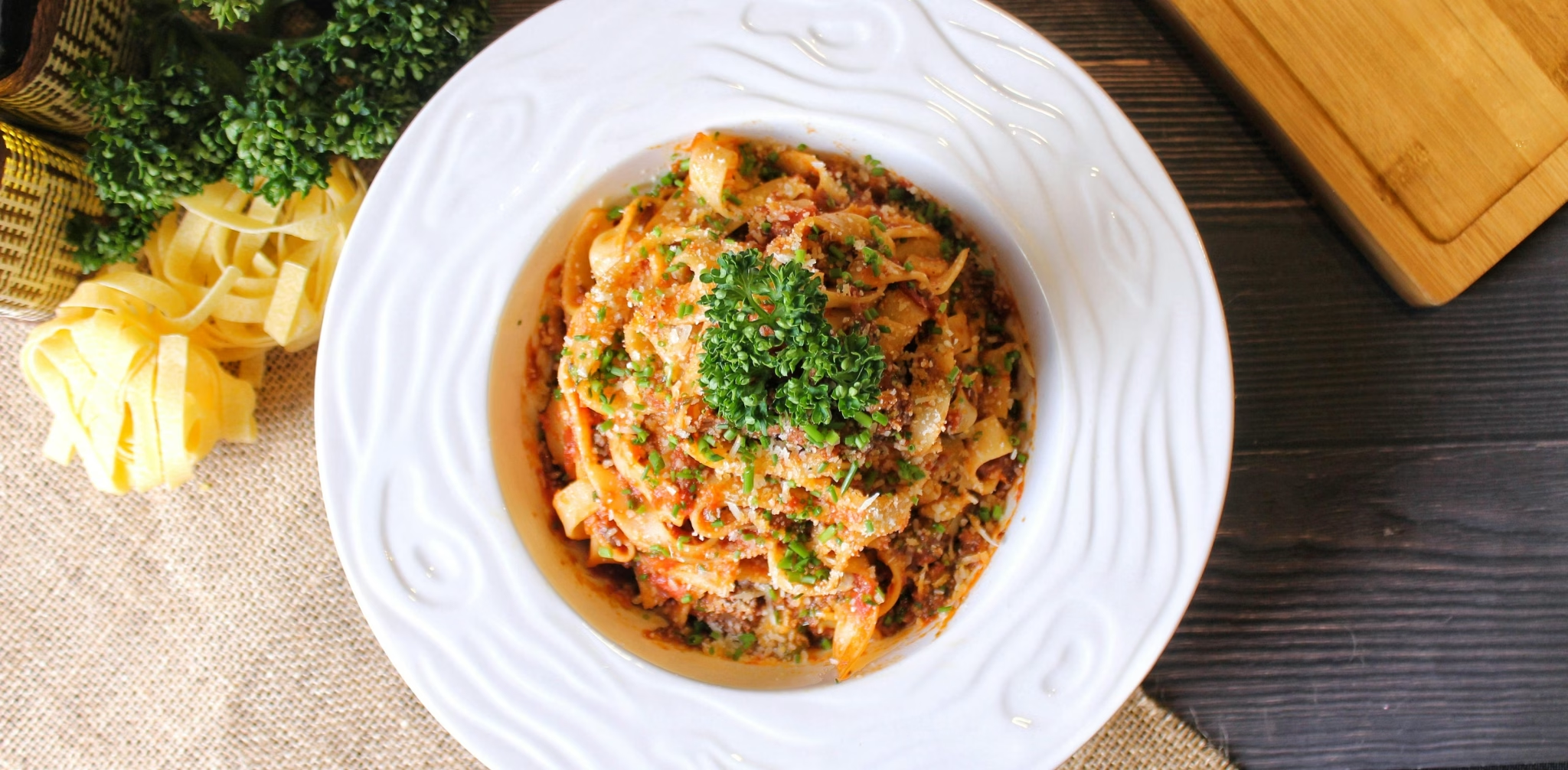
You don’t need to hit the upper range. But your dinner the night before a long paddle should be carbohydrate-forward. Think pasta with marinara, rice bowls, sweet potatoes, bread. This isn’t the meal to go low-carb.
The goal is simple: a carbohydrate-heavy dinner that you enjoy eating. Here are several options that hit the mark.
| Dinner Option | Approx. Carbs | Notes |
|---|---|---|
| Large bowl of pasta with marinara, garlic bread, side salad | 120-150g | The classic carb-load. Marinara keeps fat low compared to cream sauces. |
| Teriyaki chicken rice bowl with white rice, steamed vegetables | 130-160g | White rice digests faster than brown. Teriyaki sauce adds extra carbs. |
| Bean and cheese burritos (2) with Spanish rice | 140-170g | Beans provide both carbs and protein. Flour tortillas over whole wheat here. |
| Baked sweet potatoes (2 large) with butter, side of bread, fruit | 120-140g | Sweet potatoes are nutrient-dense carbs. Good option if you’re avoiding gluten. |
| Pancakes or waffles with maple syrup, fruit, scrambled eggs | 130-160g | Breakfast for dinner works. Syrup is pure simple carbohydrate. |
What to avoid the night before: Heavy cream sauces, excessive cheese, fried foods, or very high-fiber meals (like a massive bean chili). You want carbohydrate density without the fat and fiber that slow digestion. Save the Alfredo for a rest day.
2-4 Hours Before Launch: The Foundation Meal
The joint ACSM/AND/Dietitians of Canada Position Stand (Thomas et al., 2016) recommends consuming 1-4 g of carbohydrate per kg of body weight in the 1-4 hour window before exercise, scaled by timing: 1 g/kg at 1 hour, 2 g/kg at 2 hours, up to 4 g/kg at 4 hours.
Source: Thomas, D.T., Erdman, K.A., & Burke, L.M., “Nutrition and Athletic Performance,” Joint Position Statement, Medicine & Science in Sports & Exercise, 48(3):543-568, 2016. PubMed.
For a 180-pound paddler eating 3 hours before launch, that’s approximately 164-246 grams of carbohydrate. The meal should be relatively high in carbohydrate, moderate in protein, and low in fat and fiber to facilitate gastric emptying.
| Timing | Carb Target (82 kg) | Option A | Option B |
|---|---|---|---|
| 4 hours before | 328g (4 g/kg) | Large bowl oatmeal with banana, honey, and milk; toast with jam; orange juice | Pancakes (3-4) with maple syrup; scrambled eggs; fruit smoothie with juice base |
| 3 hours before | 246g (3 g/kg) | Bagel with peanut butter and banana; sports drink; handful of pretzels | White rice with scrambled eggs and soy sauce; white toast; apple juice |
| 2 hours before | 164g (2 g/kg) | White rice with a small amount of chicken; white bread; sports drink | Two slices white toast with honey and banana; sports drink |
Notice the pattern: every option leans on white, refined carbohydrates. This isn’t the time for steel-cut oats, sprouted grain bread, or quinoa bowls. Those are excellent for everyday nutrition but their fiber content slows the gastric emptying you need before a long paddle.
Research published in Medicine & Science in Sports & Exercise confirmed that consuming a high-carbohydrate meal 4 hours before prolonged cycling at 70% VO2max significantly increased both muscle and liver glycogen while boosting carbohydrate oxidation rates.
Key detail: white carbs outperform whole grains here. This feels counterintuitive. Whole grains are “healthier” in everyday nutrition. But before endurance exercise, you want rapid digestion and minimal fiber. White rice, white bread, regular pasta. Save the brown rice and whole wheat for recovery.
30-60 Minutes Before Launch: The Top-Off
A small, easily digestible snack of 30-50 grams of carbohydrate in the final hour before paddling provides a last bump to blood glucose without risking GI distress.
Good options: a banana (27g carb), a handful of raisins (22g carb per small box), a squeeze of honey, a sports drink, white toast with honey, or a rice cake.
Avoid anything high in fat, fiber, or protein at this point. Your stomach needs to be mostly empty when you start paddling. Standing on a board with a full gut is a recipe for nausea, and on SUP, nausea has consequences beyond discomfort.
During-Paddle Nutrition: The Part I Got Completely Wrong
This is where the science is most clear and where my strategy failed most spectacularly.
The Golden Rule: 30-60 Grams of Carbohydrate Per Hour
Both the ACSM (Thomas et al., 2016) and ISSN (Kerksick et al., 2017) position stands converge on the same recommendation for exercise lasting longer than 90 minutes: consume 30-60 grams of carbohydrate per hour. For sessions exceeding 2.5-3 hours, that number can increase to 60-90 g/hr using glucose-fructose combinations.
One update worth flagging: the 90 g/hr ceiling has been formally walked back in the contemporary peer-reviewed literature. A 2026 review in the Journal of Nutrition by Morton, Wallis, and colleagues (“From Metabolism to Medals”) states that for trained endurance athletes the upper limit “could increase from 90 to 120 g/h,” and documents elite ultra-endurance field practice at 120 to 200 g/hr. The mechanism is the same gut-transporter parallelism that underlies glucose-fructose blends: glucose loads SGLT1 transporters (which saturate around 60 g/hr), fructose loads GLUT5, so combining them lets the gut absorb both pathways simultaneously. Podlogar et al. (2022, European Journal of Applied Physiology) showed a 0.8:1 fructose-to-maltodextrin blend pushing peak exogenous oxidation to 1.60 g/min at 120 g/hr. None of which is to say recreational paddlers should chase 120 g/hr on a 2-hour outing. Stay at 30 to 60 g/hr for typical paddles. The 120 g/hr ceiling matters if you race long, train consistently at race pace, and have already done the work of training your gut to handle it.
The ISSN specifically recommends consuming a 6-8% carbohydrate solution (that’s 6-8 grams of carb per 100 ml of fluid) at regular intervals of every 10-12 minutes. This maintains blood glucose, delays glycogen depletion, and sustains performance.
Source: Kerksick, C.M. et al., 2017 (ISSN); Thomas, D.T. et al., 2016 (ACSM/AND/DC). See full citations above.
Critical timing point: You must begin eating within the first 30 minutes of exercise, well BEFORE you feel hungry. By the time you feel hungry, glycogen depletion is already advanced and blood glucose is dropping. Once you’re behind, it’s extremely difficult to catch up because gastric emptying slows as exercise intensity increases and glycogen stores decline.
What I Should Have Packed
| Food | Carbs per Serving | Why It Works |
|---|---|---|
| Energy gel (GU, Maurten, etc.) | 20-25g per packet | Rapid absorption, glucose-fructose blend, no fiber, minimal volume |
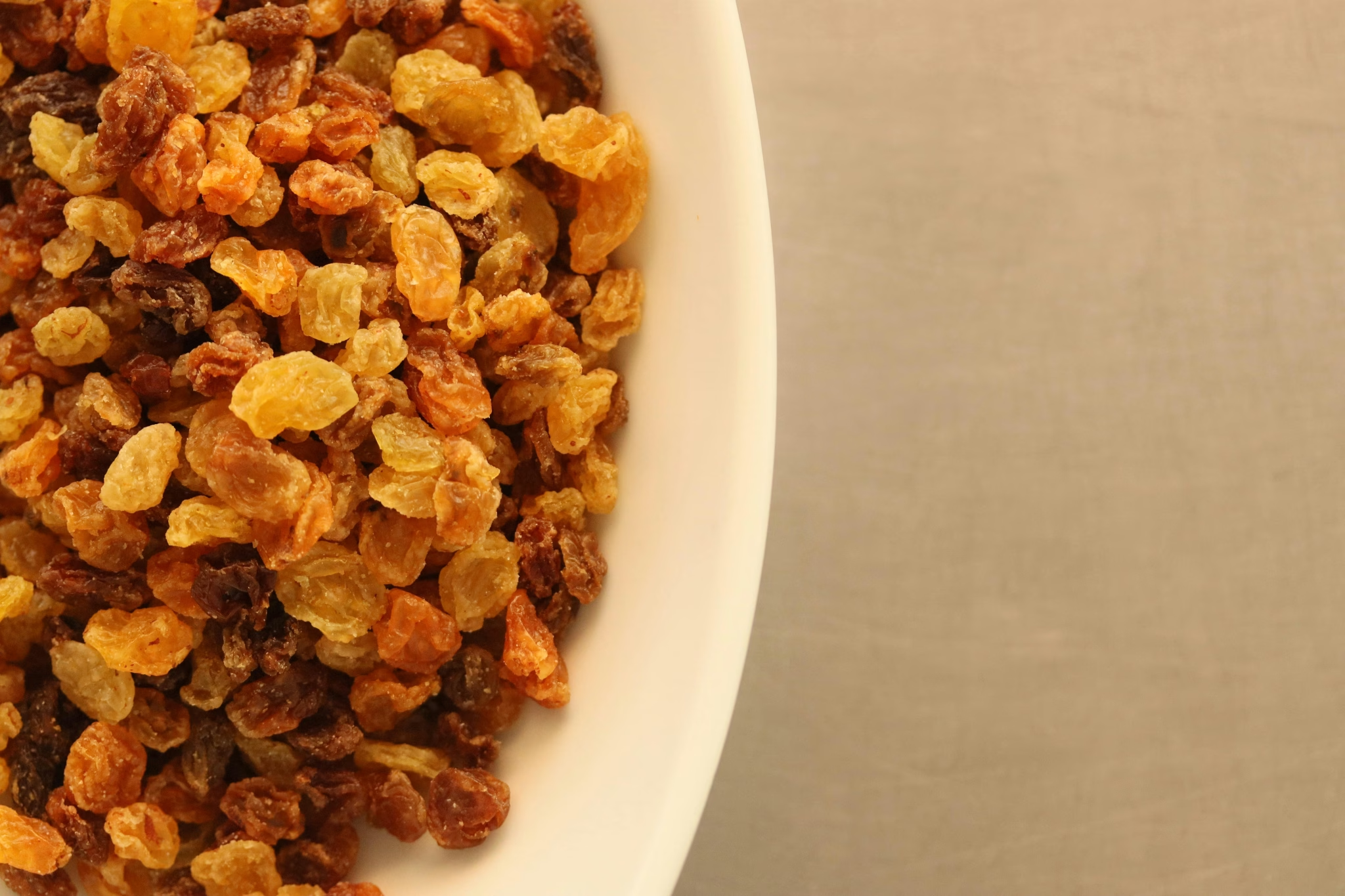
| Raisins (small box / 30g handful) | 22-34g | Studied in endurance trials as gel-equivalent; natural glucose-fructose blend, only 1g fiber per serving |
| Rice cakes (homemade or Skratch) | 25-35g each | Easy to chew, low fiber, white rice base digests quickly |
| Pretzels | 22g per oz | Simple carbs plus sodium, zero fiber, easy to store on board |
| Banana | 27g each | Natural glucose-fructose ratio near 1:1, studied in cycling time trials as sports-drink equivalent |
| Sports drink (Gatorade, Skratch Labs, etc.) | 14-21g per 8 oz | Carbs plus electrolytes plus hydration in one delivery |
| Honey packets/sticks | 17g per tbsp | Pure glucose-fructose, no chewing required, fast absorption |
A Practical On-Board Fueling Schedule for a 7-Mile Paddle
Assuming a 2-2.5 hour session at touring pace:
| Time/Mile | Action | Approximate Carbs |
|---|---|---|
| Mile 0.5 (15 min) | Start sipping sports drink; handful of raisins or half an energy gel | 15-20g |
| Mile 1.5 (30 min) | Finish first gel or squeeze of honey; continue sports drink sips | 15-20g |
| Mile 2.5 (50 min) | Rice cake or banana; electrolyte drink sips | 25-30g |
| Mile 3.5 (70 min) | Energy gel or handful of raisins; water or sports drink | 20-25g |
| Mile 5 (90 min) | Energy gel or pretzels with sports drink | 20-25g |
| Mile 6 (110 min) | Final gel or raisins if needed; sip sports drink to finish | 15-20g |
| Total | 110-140g over ~2 hrs (55-70g/hr) |
That schedule delivers 55-70 grams of carbohydrate per hour, right in line with recommendations for 2+ hour endurance sessions. The key is consistency. Small amounts at regular intervals, not emergency eating after you’ve already bonked.
One thing I’ve stopped stressing about: hitting the timing intervals exactly on the clock. A 2025 study in the European Journal of Sport Science (Jones, Vaz De Oliveira, Palmer, and colleagues) compared two fueling cadences in cyclists riding three hours at lactate threshold while consuming 90 grams of carb per hour. Group one ate 22.5 grams every 15 minutes. Group two ate 45 grams every 30 minutes. Total carbohydrate oxidation was identical (2.38 versus 2.33 grams per minute), neither group reported GI distress, and there was no measurable physiological difference between the two delivery patterns. Translated to paddling: if you’re crossing a windy section and don’t want to fumble with a gel packet, push it to the next calm stretch. As long as the hourly total lands, the gut doesn’t care whether you spaced it evenly.
Source: Jones, R.O., Vaz De Oliveira, M., Palmer, B., et al. (2025). “Different Carbohydrate Ingestion Patterns Do Not Affect Physiological Responses, Whole-Body Substrate Oxidation or Gastrointestinal Comfort in Cycling,” European Journal of Sport Science, 25(7):e12336. PMC Full Text.
Hydration and Electrolytes: More Than Just Water
The ACSM Position Stand on Exercise and Fluid Replacement (Sawka et al., 2007), which remains the most recent ACSM position on this topic, provides clear guidelines for endurance exercise hydration:
- Fluid intake: 0.4-0.8 liters per hour during intense endurance activity
- Sodium content: 500-700 mg/L in your drink to support intestinal water absorption
- Dehydration threshold: Performance declines when body weight loss exceeds 2% from water deficit
- Pre-hydration goal: Start euhydrated with normal plasma electrolyte levels
Source: Sawka, M.N. et al., “American College of Sports Medicine position stand: Exercise and fluid replacement,” Medicine & Science in Sports & Exercise, 39(2):377-390, 2007. PubMed.
On a SUP, you’re exposed to sun, wind, and reflected heat from the water. Sweat rates can easily exceed 1 liter per hour in warm conditions, and those losses get underestimated because the water splashing on you masks the sweating. The ACSM notes that when sweat rate exceeds 1.2 L/hr and activity lasts more than 2 hours, sodium supplementation becomes critical to prevent hyponatremia.
This is why plain water and coconut water alone aren’t sufficient. Coconut water has decent potassium but is surprisingly low in sodium. Most commercial brands (Vita Coco, Zico, Harmless Harvest) contain only 25-65 mg of sodium per cup, a fraction of the 500-700 mg/L the ACSM recommends for endurance hydration. For a 2+ hour paddle, you need a proper electrolyte drink or supplemental sodium.
Hydration setup for SUP: Carry at least 40-60 oz total fluid for a 2+ hour paddle. Use a hydration bladder (CamelBak or similar) attached to your board’s bungee system for hands-free sipping. A mix of sports drink (for carbs and electrolytes) and plain water works well. Target one sip every 10-15 minutes, not just when thirsty.
Bonking, Dehydration, or Hyponatremia? Three Different Cliffs
This is worth pulling apart because paddlers (myself included, the first time) confuse three distinct failure modes that all leave you crawling to shore. Treating dehydration like a bonk is useless. Treating hyponatremia like dehydration can kill you. They look similar from the deck of a paddle board. They are not the same thing.
| Condition | What’s Actually Happening | Telltale Symptoms | What to Do |
|---|---|---|---|
| Bonking (glycogen depletion) | Muscle glycogen drops below the threshold where contractile fibers fire cleanly; blood glucose may also be falling | Sudden power loss; cognitive fog; ravenous hunger; legs or arms feel “empty” | Eat 30 to 60 grams of fast carb immediately (gel, raisins, honey). Sit down for 10 minutes if you can. Effects take 15 to 20 minutes to reverse. |
| Dehydration | Body water deficit exceeding 2 percent of body weight; plasma volume drops, heart rate climbs to compensate | Elevated heart rate at same effort; dark urine; dry mouth; headache; perceived effort climbing without explanation | Drink to thirst with an electrolyte mix (500 to 700 mg sodium per liter). Don’t slam plain water; that can worsen sodium imbalance. |
| Exercise-associated hyponatremia (EAH) | Blood sodium drops below 135 mmol/L from excessive plain-water consumption or prolonged sweat-sodium loss without replacement | Nausea, vomiting, confusion, headache, unsteadiness; below 130 mmol/L none of the cases in the 2025 case-series literature were asymptomatic; severe cases progress to seizures | Stop drinking plain water. Take salt (electrolyte tabs, salty food). For severe symptoms (confusion, vomiting, unable to walk), call 911. This is a medical emergency. |
The trap is treating every failure as a bonk. Dumping three gels into yourself doesn’t help if the real problem is that you’ve been chugging plain water from your hydration bladder for two hours and your blood sodium has dropped. Carbs aren’t the fix there. Salt is. Knowing which cliff you’re on the edge of changes the right response by 180 degrees, and on hot Sacramento summer paddles the hyponatremia risk runs higher than the bonking risk for heavy plain-water drinkers. Pack salt. Pack electrolyte tabs. Don’t be the paddler who tries to gel their way out of a sodium crash.
Source: Armstrong, L.E., McDermott, B.P., Young, S.L., & Casa, D.J. (2025). “Exercise-Associated Hyponatremia: Serum Sodium, Symptomatology, Severity, and Sport Specificity,” Open Access Journal of Sports Medicine, 16:159-177. PMC Full Text.
What Went Wrong With the Berries: A Detailed Critique
Now for the part where I explain to myself, using published science, why my mid-paddle food choices were almost perfectly wrong for the situation.
Here’s what I ate at the halfway point of a 7-mile paddle after already bonking: 6 oz of raspberries, 6 oz of blueberries, 8 oz of coconut water, and 18 oz of Roar Organic Complete Hydration. Then continued sipping coconut water from miles 5-7.
Let’s break down why this didn’t work.
Problem 1: Caloric Density Is Abysmal
| What I Ate | Calories | Carbs | Fiber |
|---|---|---|---|
| 6 oz raspberries | ~53 | 12g | 7g |
| 6 oz blueberries | ~97 | 24g | 4g |
| 8 oz coconut water | ~46 | 9g | 0g |
| 18 oz Roar Organic | ~45 | 11g | 0g |
| Total | ~241 | 56g | 11g |
At first glance, 56 grams of carbohydrate looks decent. But there are three compounding problems.
Problem 2: Fiber Slows Everything Down When You Need Speed
Those 11 grams of fiber are actively working against you. Research on nutrient delivery during exercise consistently shows that fiber, fat, and protein all reduce carbohydrate and fluid delivery by slowing gastric emptying. The ACSM’s pre-exercise meal guidelines specifically recommend choosing foods lower in fat and fiber to reduce GI distress risk.
During exercise, blood flow is diverted from the digestive system to working muscles. Your gut is already operating at reduced capacity. Adding high-fiber food forces your compromised digestive system to do extra work, slowing absorption of the carbohydrates you desperately need and increasing the risk of cramping and bloating.
Raspberries are nature’s scrub brush. Incredible for daily nutrition. Terrible for acute mid-exercise energy delivery.
The Quiet Variable Nobody Talks About: Gut Training
Knowing you should eat 60 to 90 grams of carbs per hour and being able to actually digest 60 to 90 grams of carbs per hour are different problems. The bridge between them is a concept the endurance nutrition literature calls gut training.
Mlinaric and Mohorko’s 2025 systematic review in the Journal of the International Society of Sports Nutrition documented this clearly. Two weeks of daily one-hour training sessions at 60% VO2 max, with athletes deliberately consuming 90 grams of carbs per hour during those sessions, reduced GI symptoms by 60 to 63%. The intestinal transporters that move glucose and fructose into the bloodstream are adaptive. Push them with consistent demand and they upregulate. Sit on the couch all week and then try to slam four gels during a race and they will not be ready.
The implication for paddlers: bonk prevention does not start on the morning of your long paddle. It starts two weeks earlier when you decide to practice eating during your shorter training sessions, even when you don’t strictly need the fuel. Use your Tuesday and Thursday paddles to rehearse the exact gel, raisin, or honey routine you plan to use on Saturday. The gel that makes you nauseous on the first try will be tolerable by the third. By the fifth, your gut treats it as routine.
The other notable finding from that review: whole-food carb sources (rice cakes, raisins, dates) performed similarly to commercial gels in terms of symptom reduction. The form of the carb matters less than the conditioning of the gut. If you’ve trained your gut on rice cakes, rice cakes work. If you’ve trained it on gels, gels work. The food that fails is the food you’ve never practiced.
A 2026 paper in Experimental Physiology (Dean, Osborne, Subar, Hendrickse, and Gaffney) pushed this further. They compared a chewable glucose-fructose bar against a glucose-fructose hydrogel and a maltodextrin gel in trained athletes. The bar oxidized carbohydrate faster than either liquid format: 0.27 grams per minute exogenous oxidation, versus 0.21 for the hydrogel and 0.19 for the maltodextrin gel. Total carb oxidized over the session was 24.6 grams from the bar versus 17.8 grams from the gel, a 38 percent advantage. Sprint power at the end was identical across all three. The practical implication: a small bag of rice cakes, dates, or pretzels in your deck bag isn’t a compromise compared to an engineered gel. On a couple of metrics that matter, it’s the better tool.
Source: Dean, E., Osborne, A., Subar, D., Hendrickse, P., & Gaffney, C.J. (2026). “Comparative effects of a glucose-fructose bar, glucose-fructose hydrogel and maltodextrin gel on carbohydrate oxidation and sprint performance in Tier 2 athletes,” Experimental Physiology. DOI: 10.1113/EP093136.
What 90 Grams of Carbs Per Hour Looks Like
The number sounds intimidating. In practice it is two or three items you carry on the board, eaten on a clock. Here is what 60 to 90 grams per hour looks like across the common options, with the rough cadence you’d need to hit the target.
| Fueling approach | What you’d carry | Cadence | Real-world feel |
|---|---|---|---|
| 60 g/hr (recreational baseline) | 2 gels OR 1 small handful of raisins + 1 gel OR 1 banana + 1 gel | Every 25-30 min | Manageable for almost anyone after one or two practice paddles. The realistic target for 2-hour outings. |
| 75 g/hr (race-day standard) | 3 gels OR 2 gels + a small box of raisins OR 1 rice cake + 1 gel + a honey packet | Every 20 min | Doable with practice. Most amateur SUP racers operate here. |
| 90 g/hr (long-race ceiling) | 1 high-carb drink mix sachet (80 g in 16-20 oz water) + 1 gel OR 4 gels OR 1 high-carb sachet alone with timing discipline | Drink the mix steadily across the hour; supplement gel at 30-min mark | Gel-only is gut-fatigue territory. The drink-mix approach is dramatically easier on the stomach because you’re not slamming concentrated sugar. |
| 120 g/hr (elite race only) | 1 high-carb drink mix sachet (80 g) PLUS 2 gels (40-50 g) per hour, or a custom multi-transportable mix | Bottle plus gel every 30 min | Trained athletes only. Untrained gut will revolt. Gut training is non-negotiable at this level. |
High-carb drink mixes are the easiest path to 80-plus grams in an hour because they spread the load across the whole hour rather than concentrating it in three or four gel hits. Maurten 320 (80 g per sachet) uses a hydrogel formulation that the marketing claims is gentler on the gut; the literature isn’t quite as definitive as the brand copy implies but the product works. Skratch Labs Super High-Carb (100 g per serving) uses cluster dextrin and tastes more like a real drink. Both will get you to 90 g/hr without four gels of pure goo.
Second, the gel cadence at higher intake rates is closer than people realize. 90 g/hr from gels alone means a 22-25 g gel every 15 minutes. That is a lot of artificial sweetness in a row. Trying this on race day tends to end by hour two and bonk by hour three. Either move to a drink-mix-plus-supplemental-gel approach or shift to a hybrid with whole-food carbs (rice cakes, dates, a small bag of pretzels) that break the flavor monotony. The gut will accept variety more readily than four hours of the same gel flavor.
The 14-Day Pre-Race Gut Training Ramp
Translating the gut-training research into an actual two-week countdown looks like this. The premise: practice exactly the fueling protocol you plan to use on race day, on shorter paddles, until your gut treats it as routine.
| Day out | Session | Nutrition rehearsal | Why |
|---|---|---|---|
| Day 14 | 60-min paddle at Zone 2 (conversational pace) | Practice 90 g/hr exactly: one high-carb drink sachet (80 g) sipped across the hour, plus one gel at the 30-min mark | First real test of your gut at race intake. Expect some GI noise. That is normal and the whole point of the next 14 days. |
| Day 10 | 60-min paddle at Zone 2 | Repeat Day 14’s protocol exactly | Same protocol two more times before race day. Familiarity builds tolerance. |
| Day 7 | 90-min paddle at Zone 2-3 mix | 90 g/hr × 1.5 hours = 135 g total. One drink sachet + two gels. | Longer rehearsal at race-pace effort. By now the protocol should feel routine, not provocative. |
| Day 4 | 60-min Zone 2 | Full protocol, including any caffeine and electrolyte strategy you plan to use race day | Final rehearsal. Anything new here gets cut from the race plan; only what works. |
| Day 2 | 30-min easy paddle | Light snack only, no race-day products | Rest the gut for race day. |
| Day 1 | Full rest | Normal eating, hydrate steadily, no new foods | Bonus rule: do not try a new gel flavor 24 hours before a race. |
| Race day | Race | The exact protocol you practiced on Day 4 | Nothing new. The race is the test. |
Caffeine: The Single Most Reliable Performance Aid
If you are going to add one performance aid to a paddle session, make it caffeine. The 2021 ISSN position stand on caffeine and exercise performance (Guest et al., Journal of the International Society of Sports Nutrition, 18:1) concluded that 3 to 6 mg per kilogram of body weight, consumed 30 to 60 minutes before exercise, improves endurance performance by 2 to 4% across a wide range of trained and untrained populations. The mechanism is adenosine-receptor blockade in the central nervous system, which reduces perceived exertion and lowers the relative effort of a given pace.
Practical math: for a 170-pound paddler (77 kg), 3 mg/kg is about 230 mg, roughly the dose of a strong cup of coffee or two shots of espresso. 6 mg/kg is 460 mg, which is the upper end and where jittery or wired starts. Start lower, work up. The old “caffeine dehydrates you” warning has been debunked (Maughan & Griffin 2003) for habitual caffeine consumers, but the diuretic effect is mildly present in caffeine-naive drinkers. If you do not drink coffee normally, your race day is not the moment to find out how your gut handles 230 mg of it.
Find Your Actual Sweat Rate (Stop Guessing)
Generic hydration recommendations (0.4 to 0.8 liters per hour) are starting points, not personal numbers. Your sweat rate depends on body size, fitness level, ambient temperature, humidity, sun exposure, and the intensity you paddle at. Within that envelope, individuals can vary 3 to 4-fold. The fix is a one-time self-test that takes 90 minutes and a bathroom scale.
- Weigh yourself nude, immediately before the paddle.
- Paddle one full hour at your typical training pace. Drink as you normally would (or not at all, for cleanest math). Track exactly how many ounces of fluid you consumed.
- Towel off thoroughly. Weigh yourself nude again.
- Calculate: (weight loss in pounds × 16) + (ounces of fluid consumed) = your sweat rate in ounces per hour.
Example: I weighed 172 lb before, 170 lb after a 1-hour summer paddle, and drank 16 oz during. (2 × 16) + 16 = 48 oz/hr sweat rate. The target is to replace 75 to 80% of that during paddling, which works out to 36 oz/hr for me on a similar-conditions session. That is dramatically more than the generic guideline. Hotter days, hotter sun, faster pace all push the number up; cool overcast days drop it. Re-test once per season as conditions shift.
The 2015 Exercise-Associated Hyponatremia Consensus (Hew-Butler et al., Clinical Journal of Sport Medicine) flagged the opposite failure mode: sodium supplementation does NOT prevent EAH. The risk factor for exercise-associated hyponatremia is over-drinking, not under-salting. If you are a slow finisher who stays out for 4-plus hours and drinks heavily, the standard 500-700 mg sodium per liter in a normal sports drink is sufficient; piling on extra sodium tablets does not buy additional protection per the consensus statement. The 2025 hybrid-hydration review (Wierick et al., Nutrients) refines this further: in a mountain ultramarathon study, hyponatremic runners actually consumed less sodium and less fluid than their finishing peers. The story is more nuanced than “drink electrolytes,” but the consistent finding is to drink to thirst, not to schedule, and to match your fluid intake to your own measured sweat rate rather than a generic table.
Berries are predominantly fructose. And fructose absorption has a hard ceiling.
Research published in the Journal of Physiology (Jeukendrup, 2010) and confirmed in a comprehensive Nutrients review (Gonzalez et al., 2017) demonstrates that fructose uses the GLUT5 transporter in the small intestine, while glucose uses a separate transporter called SGLT1. SGLT1 can transport approximately 1 gram of glucose per minute (60g/hr). GLUT5 handles fructose at a lower rate.
Source: Jeukendrup, A.E., “Carbohydrate and exercise performance: the role of multiple transportable carbohydrates,” Current Opinion in Clinical Nutrition & Metabolic Care, 13(4):452-457, 2010; Gonzalez, J.T. et al., “Fructose co-ingestion to increase carbohydrate availability in athletes,” Nutrients, 2017.
When you consume a glucose-fructose combination (like raisins, honey, many energy gels, or sports drinks with multiple sugar sources), you access both transporters simultaneously. Exogenous carbohydrate oxidation rates jump to up to 1.5-1.75 g/min with dual-source carbohydrate, compared to a maximum of roughly 1 g/min from a single source. You’re opening two lanes on the highway instead of one.
My berries? Mostly fructose, hitting one transporter, with the fiber slowing even that down.
Problem 4: Too Little, Too Late
I ate nothing for the first 4+ miles. By the time I stopped to eat at the halfway mark, I was already in glycogen debt. The ISSN position stand is explicit: carbohydrate intake should be regular and begin early in exercise, not reactive after bonking.
Once you’ve bonked, you’re playing catch-up against your own physiology. Gastric emptying slows further when you’re glycogen-depleted and stressed. Blood flow to the gut decreases as your body prioritizes keeping depleted muscles working. The food you’re eating takes longer to become available as fuel.
What I Should Have Had Instead
| Instead of… | Should have had… | Why |
|---|---|---|
| 12 oz berries (150 cal, 11g fiber) | Handful of raisins + squeeze of honey (200+ cal, 1g fiber) | 33% more calories, 90% less fiber, natural glucose-fructose blend in both |
| Coconut water (46 cal, low sodium) | Sports drink with electrolytes | More carbs, more sodium, better intestinal absorption |
| Nothing for first 4 miles | Gel + sports drink every 20-30 min from mile 0.5 | Prevents glycogen depletion instead of trying to reverse it |
What I Eat Now: The Sprouts Run
After the berries fiasco, I overhauled my routine. Before every long paddle, I stop at Sprouts Farmers Market and grab their Turkey on Multigrain Grab & Go sandwich ($4.99), tortilla chips with a single-serve guacamole, and whatever drink catches my eye from the refrigerated case. I fill a 32-ounce Nalgene with water and a packet of Liquid IV. And right before I launch, I drink a Remedy Organics protein shake: 210 calories, 20 grams of protein, 11 grams of carbohydrate, MCT oil, Lion’s Mane mushroom, elderberry. Very impressive label.
It looks like a plan. But I wanted to test what these choices deliver against the research. So on a recent 8-mile paddle on Lake Natoma, I ran a deliberate experiment: drink the protein shake at launch, eat and drink nothing for the first four miles, then consume everything else during the last four miles. Downwind out. Upwind back. Starve the first half, feed the beast on the return.
Real Numbers From an 8-Mile Test (February 23, 2026)
| Metric | Value |
|---|---|
| Distance | 8.55 miles |
| Elapsed time | 2:22:55 |
| Average speed | 3.59 mph |
| Calories burned | 1,022 |
| Average heart rate | 139 BPM |
| Max heart rate | 164 BPM |
| Time in zones 3-5 (144+ BPM) | 81 min 29 sec (57% of session) |
My Strava caption: “First half downwind/starving. 2nd half upwind/feed the beast.” I spent over 81 minutes above 144 BPM, where carbohydrate becomes the dominant fuel substrate (Hargreaves & Spriet, Nature Metabolism, 2020). The watch and my legs disagree. My three highest readings, 164, 162 and 161, all land in the first 47 minutes, on the way out. Nothing in the back half of the paddle went above 147. So the hardest cardiovascular work happened early, unfuelled, while my stomach was still processing a multigrain turkey sandwich, and the crawl home was a low-output grind rather than a heroic effort.
What My Sprouts Haul Delivers
| Item | Calories | Carbs | Protein | Fat | Fiber |
|---|---|---|---|---|---|
| Remedy Organics shake (at launch) | 210 | 11g | 20g | 9g | 2g |
| Turkey on Multigrain sandwich (9 oz) | ~450 | ~44g | ~30g | ~16g | ~6g |
| Tortilla chips (~1.5 oz) | ~210 | ~28g | ~3g | ~10g | ~2g |
| Guacamole (single serve, ~2 oz) | ~100 | ~5g | ~1g | ~9g | ~3g |
| Liquid IV in 32 oz water | 45 | 11g | 0g | 0g | 0g |
| Total | ~1,015 | ~99g | ~54g | ~44g | ~13g |
Total calories (~1,015) roughly match what I burned (~1,022). Looks like energy balance on paper. But sports nutrition isn’t about totals. It’s about timing, composition, and absorption rate.
Where This Strategy Still Falls Short
The protein shake is the wrong pre-launch drink. Twenty grams of protein and nine grams of fat with only eleven grams of carbohydrate. The ACSM (Thomas et al., 2016) recommends pre-exercise intake be “relatively high in carbohydrate, moderate in protein, and low in fat and fiber.” My shake inverts that ratio. The MCT oil and Lion’s Mane are interesting on a label, but neither has conclusive evidence for endurance performance. A 12-ounce glass of orange juice would deliver 39 grams of fast-absorbing carbohydrate for the same calories. Three and a half times more usable fuel.
Multigrain bread slows gastric emptying. The Sprouts multigrain contains wheat bran, flax seeds, rye meal, oat flakes, sesame seeds, barley flakes, and soy grits. Outstanding for everyday nutrition. For pre-paddle fueling, all that fiber slows carbohydrate delivery when you need it fast. White or sourdough would be better choices here.
I ate nothing for the first 65 minutes. After the shake’s 11 grams of carbohydrate at launch, zero fuel for four miles. The ISSN is explicit: carbohydrate intake should begin within the first 30 minutes. By mile four, I was already in glycogen debt. Same mistake as the berries paddle, just dressed up in a Sprouts bag.
Then I crammed everything into the hardest hour. The outbound leg is where my heart rate sat highest, above 160 for a stretch, and that is when blood flow diverts from digestion to working muscles. Asking a turkey sandwich and guacamole to digest at 160 BPM is asking your gut to do its hardest job at its lowest capacity. One caveat on all of this: the watch logged only 12 heart-rate samples across 143 minutes, roughly one every 13 minutes, so treat the averages as a sketch rather than a trace.
44 grams of fat is too high for during-exercise eating. Fat delays gastric emptying more than any other macronutrient. Great for a recovery meal. Counterproductive for fuel you need absorbed while paddling.
To be completely transparent, some of this is working. Liquid IV is built on WHO Oral Rehydration Solution science, and its ~500 mg sodium per packet puts it right at the ACSM’s recommended range for endurance hydration. The tortilla chips provide sodium and quick starch. And the total caloric volume is a genuine improvement over berries and coconut water. The framework is right. The execution needs rearranging.
The Optimized Sprouts Run
Same grocery store, same budget, better science.
The Revised Pre-Paddle Plan
2-3 hours before launch: Eat the turkey sandwich. Ask for white or sourdough bread instead of multigrain if you can.
30 minutes before launch: Skip the protein shake. Grab orange juice, a banana, or both. Start sipping Liquid IV.
On the water (every 20-30 min from mile 1): Raisins, energy gels, honey squeezes, or tortilla chips for sodium. Continue sipping Liquid IV. Target 30-60 grams of carbohydrate per hour. This is the single most important change.
Post-paddle: NOW eat the guacamole with remaining chips. The Remedy Organics shake belongs here too: 20 grams of protein during the glycogen replenishment window is exactly what the ISSN recommends.
Same Sprouts trip, same grocery bill. The difference is eating the sandwich hours before, swapping the protein shake from pre-launch to post-paddle, and adding simple carbohydrate fuel throughout the miles. Everything I already buy. Just rearranged by the science.
Post-Paddle Recovery: The Window Is Real
After the paddle, I was ravenous and exhausted for the rest of the day. That’s not just “being tired.” That’s the downstream cost of severe glycogen depletion without proper recovery nutrition.
The Glycogen Replenishment Window
The ISSN Position Stand (Kerksick et al., 2017) reports that muscle glycogen synthesis is most efficient in the first 30-60 minutes post-exercise, when glycogen synthase (the enzyme responsible for storing glycogen) is most active. The recommendation: consume 1.2 g of carbohydrate per kg of body weight per hour for 4-6 hours post-exercise to maximally stimulate glycogen resynthesis.
For our 82 kg paddler, that’s roughly 98 grams of carbohydrate in the first hour post-paddle.
A 2021 meta-analysis in Sports Medicine – Open (Craven et al.) examined whether adding protein to carbohydrate improves glycogen resynthesis. The finding: when total caloric intake is matched, protein doesn’t significantly boost glycogen recovery over carbohydrate alone. However, when protein is added on top of carbohydrate (increasing total energy), glycogen synthesis does improve.
Source: Craven, J. et al., “The Effect of Consuming Carbohydrate With and Without Protein on the Rate of Muscle Glycogen Re-synthesis,” Sports Medicine – Open, 7:11, 2021. PubMed.
The practical takeaway from a 2025 narrative review in Sports Medicine (Springer) synthesizes the optimal approach: 0.9 g/kg/hr of carbohydrate plus 0.3 g/kg/hr of protein provides the most complete post-exercise recovery, addressing both glycogen resynthesis and muscle protein synthesis simultaneously.
Source: “Nutritional Strategies to Improve Post-exercise Recovery and Subsequent Exercise Performance: A Narrative Review,” Sports Medicine, 2025. PMC.
Immediate Post-Paddle (0-30 Minutes)
This is when compliance matters most and appetite is often lowest. Get something in immediately, even if you don’t feel hungry (though after a bonked paddle, you’ll feel hungry enough to eat your PFD).
Target: 50-80g carbohydrate + 20-25g protein
Quick options (grab one on the way to the car):
- Chocolate milk (the classic sports recovery drink): 16 oz = 52g carb, 16g protein
- Recovery shake: protein powder + banana + honey + milk
- Peanut butter and jelly sandwich on white bread: ~55g carb, 15g protein
- Greek yogurt with granola and honey: ~60g carb, 20g protein
- Cereal with milk (yes, really): a big bowl of your favorite cereal delivers fast carbs and protein from milk. ~65g carb, 12g protein
- Two bananas with a handful of pretzels and a sports drink: ~70g carb, minimal protein but fast absorption
The research doesn’t care about food quality here. It cares about speed of delivery. If the most appealing thing post-paddle is a sleeve of graham crackers and a glass of milk, that checks the box.
Recovery Meal (1-2 Hours Post-Paddle)
Target: High-carbohydrate, moderate protein, rehydration
| Meal | Approx. Carbs | Approx. Protein |
|---|---|---|
| Chicken burrito bowl: white rice, black beans, chicken, salsa | ~90g | ~40g |
| Pasta with meat sauce and garlic bread | ~100g | ~35g |
| Stir-fry with white rice, vegetables, and tofu or chicken | ~85g | ~30g |
| Poke bowl with white rice, fish, edamame, avocado | ~80g | ~35g |
| Two large slices of pizza with a side of fruit | ~75g | ~25g |
| Turkey or chicken sandwich on a sub roll with pretzels and juice | ~85g | ~30g |
The common thread: a substantial portion of white or refined carbohydrate (rice, pasta, bread) paired with a protein source. This isn’t the meal to count calories or restrict portions. Your glycogen stores are depleted and the enzyme responsible for refilling them is working at peak capacity. Feed it.
Rehydration Protocol
The ACSM recommends replacing 150% of fluid lost during exercise in the hours following activity. If you lost 2 pounds (roughly 1 liter of sweat), drink 1.5 liters in the 2-4 hours post-exercise, including sodium to support retention.
A simple approach: weigh yourself before and after paddling. Every pound lost equals approximately 16 oz of fluid to replace (multiply by 1.5 for the 150% guideline).
SUP-Specific Fueling Considerations
Paddleboarding creates unique challenges that running, cycling, and swimming don’t.
Balance and eating. You’re standing on an unstable surface. Eating requires stopping or at minimum slowing down. This means your food needs to be accessible without rummaging through a deck bag, and consumable in 30 seconds or less. Gels you can tear with your teeth. Raisins in a hip belt pocket. A honey squeeze you can cap one-handed. Sports drink in a hydration bladder with a bite valve. Anything requiring two hands, a plate, or careful unwrapping is going to end up in the water.
Sun exposure multiplies fluid needs. You’re getting direct sun from above and reflected UV from the water surface. On warm days, sweat rates can exceed what you’d experience running the same duration at the same perceived effort. Budget 25-50% more fluid than land-based recommendations suggest.
Core engagement changes digestion. SUP engages your core continuously for balance. This can increase intra-abdominal pressure and may contribute to GI distress, especially with high-fiber or high-fat foods. Another reason to keep mid-paddle fuel simple and easily digestible.
Cold water creates caloric demand. If you’re paddling in cooler conditions or water temperature is low, your body expends additional energy on thermoregulation. This increases caloric burn beyond what exercise intensity alone would predict.
The 5 Biggest Fueling Mistakes Paddlers Make
Every bonked paddle shares some combination of these. I made all five on the same session.
- Waiting until you’re hungry to eat. By the time hunger hits, glycogen stores are already critically low. The ISSN is explicit: start eating within the first 30 minutes, not at mile 4.5 when your arms stop working.
- Bringing “healthy” snacks instead of fast fuel. Berries, trail mix, protein bars. All great for a desk drawer. All terrible for mid-exercise energy. You need glucose-dense, low-fiber food that absorbs in minutes, not hours. Raisins, honey, gels, rice cakes.
- Relying on coconut water for electrolytes. Most commercial coconut water contains only 25-65 mg sodium per cup. The ACSM recommends 500-700 mg/L for endurance hydration. You’re getting roughly a tenth of what you need.
- Skipping the night-before carb load. Glycogen takes 24 hours to fully replenish. That pasta dinner isn’t optional. Starting a long paddle with half-full glycogen stores just moves the wall closer.
- Underestimating how many calories SUP actually burns. Touring pace burns 615-708 calories per hour. That’s comparable to moderate cycling. Two hours on the water can burn 1,200-1,400 calories. You can’t wing the nutrition on that kind of output.
The Bottom Line
Bonking on a long paddle isn’t a willpower problem. It’s a fueling problem. The science is unambiguous: for endurance sessions exceeding 90 minutes, you must consume 30-60 grams of carbohydrate per hour, beginning within the first 30 minutes, using easily digestible foods with minimal fiber. Start the meal planning the night before. Eat a high-carb breakfast 2-4 hours out. Top off with simple carbs 30 minutes before launch. And carry real fuel on the board, not just healthy snacks.
The berries were a well-intentioned mistake. They’re nutritional powerhouses for daily eating. For mid-exercise energy rescue, they’re bringing a library book to a knife fight. Trade them for raisins, honey, gels, rice cakes, and a proper electrolyte drink. Your mile 5 self will thank you.
Once the fueling is dialed in, the next questions are usually about speed and what to do with the fitness. The SUP speed benchmarks article shows what a well-fueled session looks like in GPS data. The SUP strength program covers the off-water core, balance, and shoulder work that lets your fuel reach the paddle. And if a goal would help, the first paddle board race guide walks through entering one without the panic.
Sources and Position Stands Referenced
- Noakes, T.D., Prins, P.J., Buga, A., D’Agostino, D.P., Volek, J.S., & Koutnik, A.P. (2026). “Carbohydrate Ingestion on Exercise Metabolism and Physical Performance.” Endocrine Reviews, 47(2):191-243. PMC Full Text
- Dean, E., Osborne, A., Subar, D., Hendrickse, P., & Gaffney, C.J. (2026). “Comparative effects of a glucose-fructose bar, glucose-fructose hydrogel and maltodextrin gel on carbohydrate oxidation and sprint performance in Tier 2 athletes.” Experimental Physiology. DOI: 10.1113/EP093136
- Jones, R.O., Vaz De Oliveira, M., Palmer, B. et al. (2025). “Different Carbohydrate Ingestion Patterns Do Not Affect Physiological Responses, Whole-Body Substrate Oxidation or Gastrointestinal Comfort in Cycling.” European Journal of Sport Science, 25(7):e12336. PMC Full Text
- Armstrong, L.E., McDermott, B.P., Young, S.L., & Casa, D.J. (2025). “Exercise-Associated Hyponatremia: Serum Sodium, Symptomatology, Severity, and Sport Specificity.” Open Access Journal of Sports Medicine, 16:159-177. PMC Full Text
- Kerksick, C.M., Arent, S., Schoenfeld, B.J. et al. (2017). “International society of sports nutrition position stand: nutrient timing.” Journal of the International Society of Sports Nutrition, 14:33. PMC Full Text
- Thomas, D.T., Erdman, K.A., & Burke, L.M. (2016). “Nutrition and Athletic Performance.” Joint Position Statement of ACSM, AND, and Dietitians of Canada. Medicine & Science in Sports & Exercise, 48(3):543-568. PubMed
- Sawka, M.N., Burke, L.M., Eichner, E.R. et al. (2007). “American College of Sports Medicine position stand: Exercise and fluid replacement.” Medicine & Science in Sports & Exercise, 39(2):377-390. PubMed
- Jäger, R., Kerksick, C.M., Campbell, B.I. et al. (2017). “International Society of Sports Nutrition Position Stand: protein and exercise.” Journal of the International Society of Sports Nutrition, 14:20. PMC Full Text
- “Exercise- and diet-induced glycogen depletion impairs performance during one-legged constant-load, high-intensity exercise in humans.” (2025). Frontiers in Physiology. Full Text
- Craven, J. et al. (2021). “The Effect of Consuming Carbohydrate With and Without Protein on the Rate of Muscle Glycogen Re-synthesis During Short-Term Post-exercise Recovery: a Systematic Review and Meta-analysis.” Sports Medicine – Open, 7:11. PubMed
- “Nutritional Strategies to Improve Post-exercise Recovery and Subsequent Exercise Performance: A Narrative Review.” (2025). Sports Medicine. PMC
- Gonzalez, J.T. et al. (2017). “Fructose co-ingestion to increase carbohydrate availability in athletes.” Nutrients. PMC Full Text
- Hargreaves, M. & Spriet, L.L. (2020). “Skeletal muscle energy metabolism during exercise.” Nature Metabolism, 2:817-828.
- Rapoport, B.I. (2010). “Metabolic factors limiting performance in marathon runners.” PLoS Computational Biology, 6(10):e1000960.
- Murray, B. & Rosenbloom, C. (2018). “Fundamentals of glycogen metabolism for coaches and athletes.” Nutrition Reviews, 76(4):243-259.
- University of Montana / NK Sports SUP-Specific Calorie Study. nksports.com
- Jeukendrup, A.E. (2010). “Carbohydrate and exercise performance: the role of multiple transportable carbohydrates.” Current Opinion in Clinical Nutrition & Metabolic Care, 13(4):452-457.
- Kern, M. et al. (2007). “Effects of raisins vs. commercial sports supplement on metabolic responses and cycling performance.” Medicine & Science in Sports & Exercise. PubMed
- Too, B.W. et al. (2012). “Natural versus commercial carbohydrate supplementation and endurance running performance.” Journal of the International Society of Sports Nutrition, 9:27. Full Text
- Nieman, D.C. et al. (2012). “Bananas as an energy source during exercise: a metabolomics approach.” PLoS ONE, 7(5):e37479. PMC Full Text
- Ainsworth, B.E. et al. (2011). “2011 Compendium of Physical Activities: A Second Update of Codes and MET Values.” Medicine & Science in Sports & Exercise, 43(8):1575-1581.
Frequently Asked Questions
What is bonking?
Bonking is what happens when your muscles run out of stored carbohydrate fuel during sustained exercise. The technical term is glycogen depletion. It feels like a sudden, dramatic loss of power: limbs that go heavy, a brain that gets foggy, and a perceived effort that skyrockets while your pace collapses. Cyclists call it “the bonk.” Runners call it “hitting the wall.” On a paddle board it typically arrives between mile 4 and mile 5 at touring pace if you haven’t fueled during the session.
What is bonking in cycling, running, and paddleboarding?
The underlying mechanism is identical in all three sports: muscle glycogen falls below the threshold needed for clean contraction, and blood glucose drops enough to trigger central nervous system rationing. The timing differs by intensity profile. Cyclists typically bonk between hours 2 and 3 of an unfueled ride. Marathon runners hit the famous “wall” around mile 20. Paddlers on stand-up boards typically bonk between 75 and 90 minutes (around mile 4-5 at 3-3.5 mph touring pace) because the sustained upper-body and core engagement burns carbohydrate faster than it feels like it should.
What’s the difference between bonking and dehydration?
Bonking is a fuel problem. Dehydration is a water problem. Bonking comes on suddenly and is fixed by carbohydrate (gels, raisins, honey, sports drink with carbs). Dehydration comes on gradually and is fixed by fluid with electrolytes. The third condition to know about is exercise-associated hyponatremia, where blood sodium drops below 135 mmol/L from drinking too much plain water. Hyponatremia presents with nausea, confusion, and headache, and is treated with salt, not more water. On hot summer paddles in California the hyponatremia risk for heavy plain-water drinkers runs higher than the bonking risk.
Why do I hit a wall at mile 4-5 on a long paddle?
At touring pace (3-3.5 mph), mile 4-5 falls around the 75-90 minute mark, which corresponds to the point where muscle glycogen stores become critically depleted in athletes who haven’t fueled during exercise. Your muscles store approximately 300-400 grams of glycogen, providing roughly 90-120 minutes of fuel at moderate intensity. Without carbohydrate intake during paddling, depletion is predictable and sudden.
How many calories does stand-up paddleboarding burn per hour?
According to research from the University of Montana, SUP touring at approximately 3 mph burns 615-708 calories per hour. Racing intensity increases that to 720-1,130 calories per hour. These numbers classify SUP as an endurance sport requiring endurance-level nutrition strategies for sessions over 90 minutes.
How many grams of carbohydrate should I eat per hour while paddling?
Both the ACSM and ISSN position stands recommend 30-60 grams of carbohydrate per hour for exercise lasting longer than 90 minutes. For sessions exceeding 2.5-3 hours, intake can increase to 60-90 g/hr using glucose-fructose combination products. Start eating within the first 30 minutes, not when you feel hungry.
Are berries a good mid-paddle snack?
No. While berries are excellent for daily nutrition, they’re poor mid-exercise fuel. They’re mostly water (low caloric density), high in fiber (slows gastric emptying), and predominantly fructose (uses only one intestinal transporter). For acute energy during exercise, you want low-fiber, calorie-dense, glucose-containing foods like raisins, honey, energy gels, rice cakes, or pretzels.
What should I eat the morning before a long paddle?
The ACSM recommends 1-4 g of carbohydrate per kg of body weight, scaled by timing. For a meal 3 hours before launch, target approximately 3 g/kg. For a 180 lb paddler, that’s around 246 grams of carbohydrate. Oatmeal with banana and honey, toast with jam, and orange juice is a solid example. Keep fat and fiber low for faster digestion.
Is coconut water a good sports drink for paddling?
Coconut water provides decent potassium but is surprisingly low in sodium. Most commercial brands contain only 25-65 mg per cup, far below the 500-700 mg/L that the ACSM recommends for endurance exercise hydration. For sessions over 2 hours with high sweat rates, a proper sports drink with adequate sodium content is more effective for intestinal water absorption and electrolyte replacement.
What’s the best post-paddle recovery food?
Current research recommends 0.9 g/kg/hr of carbohydrate plus 0.3 g/kg/hr of protein in the first hours after exercise. Consume an initial recovery snack within 30 minutes (chocolate milk, recovery shake, or PB&J), followed by a carbohydrate-rich meal with protein within 1-2 hours. Total glycogen replenishment takes approximately 24 hours.
What are the best whole-food alternatives to energy gels for paddling?
Raisins are the most research-backed option. Studies in Medicine & Science in Sports & Exercise and the Journal of Strength and Conditioning Research found raisins performed identically to commercial sports gels and chews during endurance exercise. They contain a natural glucose-fructose blend (engaging both intestinal transporters), pack 22g of carbohydrate per small handful with only 1g of fiber, and cost a fraction of gels. Honey in a reusable squeeze packet, rice cakes, and bananas are also excellent whole-food options with strong research support.
How much water should I drink during a 2-hour paddle?
The ACSM recommends 0.4-0.8 liters per hour during endurance activity. For SUP specifically, add 25-50% more due to sun exposure and reflected heat from the water. That translates to roughly 40-60+ ounces total over a 2-hour paddle. Use a hydration bladder for hands-free access and include electrolytes in at least half your fluid intake.
When should I start eating during a long paddle?
Within the first 30 minutes of exercise. The ISSN position stand is clear that carbohydrate intake should begin early, well before hunger signals, which indicate glycogen depletion is already advanced. Start sipping sports drink at mile 0.5 and consume your first solid fuel (gel, raisins, or similar) by mile 1-1.5.
What’s the difference between bonking and just being tired?
Bonking (glycogen depletion) is characterized by sudden onset: fine one moment, severely impaired the next. Research shows performance drops approximately 40% with glycogen depletion. Symptoms include cognitive fog, extreme fatigue disproportionate to effort, irritability, and ravenous hunger. Normal exercise fatigue is gradual and proportional to effort. Bonking is a metabolic cliff.
Can I train my body to need less fuel during long paddles?
Consistent endurance training improves fat oxidation capacity and can expand glycogen storage by 20-50% compared to untrained individuals (Sherman et al.). However, for high-intensity sessions over 2 hours, carbohydrate remains the dominant and rate-limiting fuel source. Training improves efficiency but doesn’t eliminate the need for mid-exercise carbohydrate intake during long sessions.
How long does it take to deplete glycogen stores while paddle boarding?
At moderate SUP touring intensity, glycogen depletion typically occurs between 90-120 minutes for individuals who haven’t carb-loaded or consumed carbohydrates during exercise. Your muscles store 300-400 grams of glycogen, providing roughly 1,600-2,000 calories. At touring pace, you’re burning 2-3 grams of carbohydrate per minute, which means stores can be substantially depleted within 2 hours. Training level, pre-exercise nutrition, and intensity all shift this timeline.
What are the symptoms of glycogen depletion?
Early symptoms include unexplained pace drops, mild mental drift, and effort that feels disproportionately hard. As depletion progresses, you’ll experience sudden overwhelming fatigue, cognitive fog, difficulty with decision-making, shakiness, lightheadedness, and intense hunger. The hallmark of glycogen depletion versus normal fatigue is how abruptly it hits. You can feel fine one minute and severely impaired the next. Research shows performance drops approximately 40% once glycogen falls below a critical threshold.
How does paddle boarding calorie burn compare to running or cycling?
SUP touring at 3 mph burns approximately 615-708 calories per hour for a 180-pound person, placing it in the same range as moderate cycling (~650 cal/hr) and above moderate swimming (~475 cal/hr). Racing SUP pushes calorie burn to 720-1,130 calories per hour, approaching running intensity (~800 cal/hr at 6 mph). These numbers come from University of Montana research and explain why paddle boarding demands the same fueling strategies as traditional endurance sports.
Is a turkey sandwich a good pre-paddle meal?
A turkey sandwich can work well, but timing and bread choice matter significantly. Eat it 2-3 hours before launch to allow for digestion of the protein and fat content. Choose white or sourdough bread over multigrain or whole wheat, as the lower fiber content allows faster gastric emptying. Skip high-fat additions like guacamole or mayo, which delay absorption further. The protein from turkey is fine in a pre-exercise meal when you have 2+ hours to digest, but immediately before launch, prioritize simple carbohydrates like juice, a banana, or a sports drink instead.
Should I drink a protein shake before paddling?
Not immediately before. Protein and fat slow gastric emptying while providing minimal quick-access fuel for exercise. The ACSM recommends pre-exercise meals be carbohydrate-dominant with moderate protein and low fat. A typical protein shake (20g protein, 9g fat, 11g carbs) inverts that ratio. If you want protein, consume it 2-3 hours before in a balanced meal. Within 30-60 minutes of launch, choose simple carbohydrates: orange juice, a banana, raisins, or toast with honey. Save the protein shake for post-paddle recovery, when your body actually needs amino acids for muscle repair and the protein contributes to glycogen resynthesis.
The products linked in this article are collected in the Paddle Fuel, Training and Recovery list on the MK Library Amazon storefront.
Affiliate disclosure: Some product links in this article are Amazon affiliate links. MK Library earns a small commission on qualifying purchases at no additional cost to you. All products are recommended based on the sports science discussed in this article, not compensation.
Article Updates
- September 8, 2026: Added stroke rate creep to the early warning signs. A rate climbing at unchanged GPS speed is short shallow pulls replacing long ones as the legs and trunk fade, and it registers before the pace chart moves.
- August 5, 2026: Re-derived every figure for the February 23 session from the raw Apple Health export rather than from screenshots. Four of seven were wrong: distance 8.39 to 8.55 miles, average speed 3.9 to 3.59 mph, average heart rate 145 to 139, and maximum heart rate 180 to 164. Calories and elapsed time were correct. The heart rate narrative was also backwards: the three highest readings all fall in the first 47 minutes, on the way out, and nothing in the back half went above 147, so the upwind return was a low-output grind rather than the zone 4 and 5 effort described. Added the caveat that the watch logged only 12 samples across 143 minutes.
- May 24, 2026: Added definitional opening section “What Is Bonking? (And Why It Happens to Endurance Athletes)” with a sport-by-sport bonk comparison table covering cycling, marathon running, stand-up paddleboarding, and trail/ultra running. Added a paragraph acknowledging Noakes et al. 2026 (Endocrine Reviews, January 2026), the 53-page review arguing that falling blood glucose rather than muscle glycogen depletion is the primary bonk trigger, and the practical implications for fueling strategy. Added new “Bonking, Dehydration, or Hyponatremia? Three Different Cliffs” section with a three-condition comparison table, backed by Armstrong et al. 2025 (Open Access Journal of Sports Medicine) exercise-associated hyponatremia review. Folded Dean et al. 2026 (Experimental Physiology) data on glucose-fructose bar carbohydrate oxidation (38 percent advantage over maltodextrin gel) into the whole-food fueling section. Added Jones et al. 2025 (European Journal of Sport Science) feeding-interval flexibility paragraph after the on-board fueling schedule (15-min vs 30-min cadence produces identical oxidation at 90 g/hr). Restructured FAQ with three new definitional questions at the top: “What is bonking?”, “What is bonking in cycling, running, and paddleboarding?”, and “What’s the difference between bonking and dehydration?” Mirrored the new questions in the FAQ JSON-LD schema.
- February 24, 2026: Added new section “What I Eat Now: The Sprouts Run” with real 8.39-mile paddle data (1,022 calories, 145 BPM avg HR, heart rate zone analysis), honest nutritional breakdown of my current Sprouts Farmers Market fueling strategy, science-backed critique of timing and macro composition, and an optimized fueling plan. Added two new FAQs on turkey sandwiches and protein shakes as pre-paddle meals. Added Liquid IV affiliate link.
- May 22, 2026: Original research and publication. All position stands and peer-reviewed sources current as of publication date.