
You finish an 8-mile paddle. Legs shaking, shoulders burning, absolutely cooked. You peel off your Apple Watch, scroll to the workout summary, and there it is. 3.7 mph average.
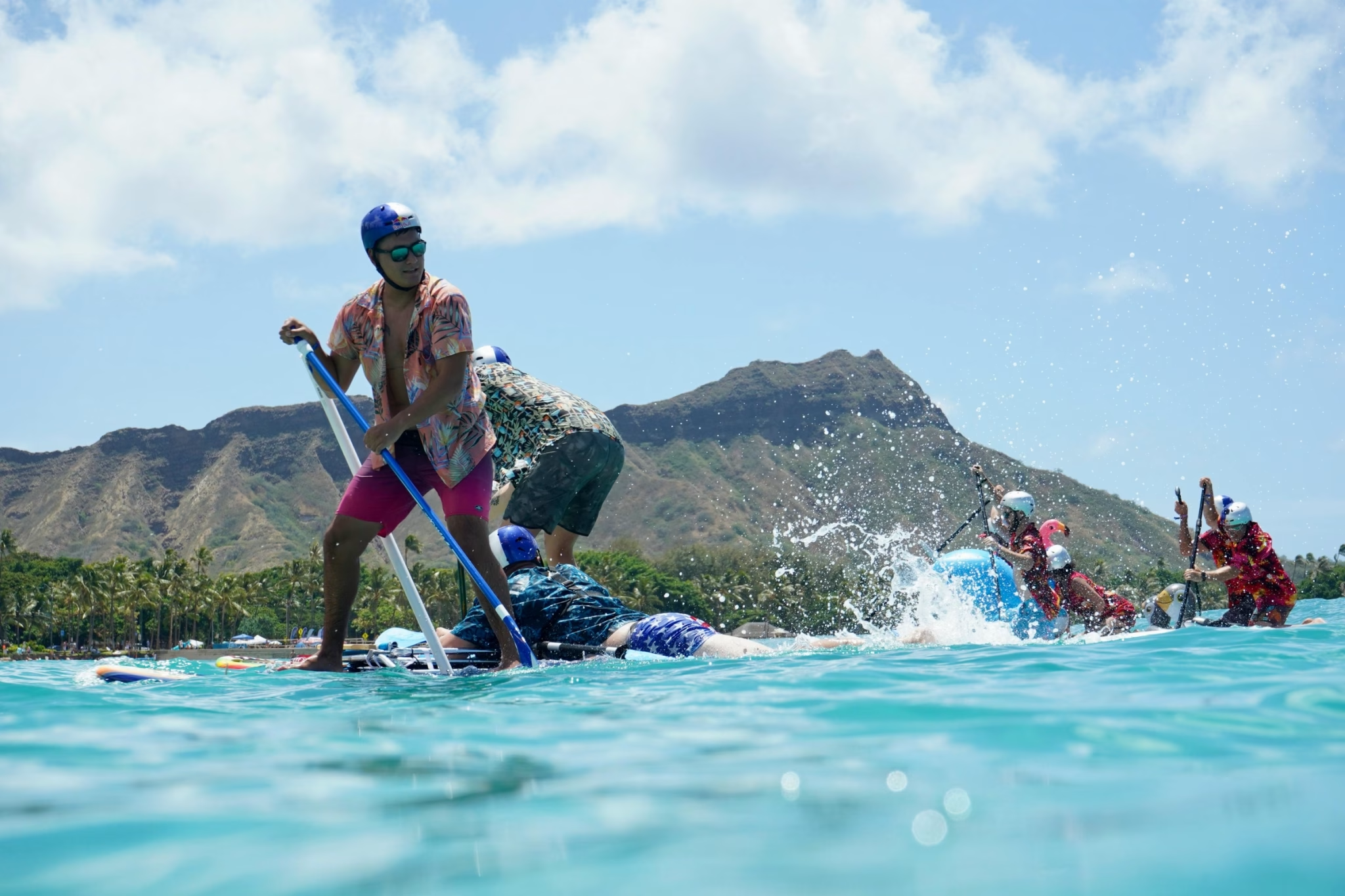
Your first thought: that can’t be right. You were working. Heart rate 152 BPM for two hours. Nearly a thousand calories torched. And the number staring back at you starts with a three?
So you open Google and type some version of “what is a good SUP speed.” And you get vague answers, conflicting ranges, and zero context for what those numbers mean on an inflatable board versus a rigid carbon race machine.
I have been chasing this question with GPS data for ten months. The answer now sits in 66 logged workouts covering 264.0 miles and 105.1 hours, exported straight out of Apple Health. Two of those sessions frame the range: one where everything clicked, 4.27 mph over 8.52 miles at Lake Natoma, and one where I bonked hard enough that the return leg cratered to 3.4 mph. Same board, heart rates two beats apart, half a mile per hour between them.
The most useful thing in that export was not a speed at all. It was discovering that 20 of my 66 logged sessions average under 2.5 mph, and that dividing by elapsed time instead of moving time had been understating my pace by about 13%.
Here’s what I’ve learned about inflatable SUP speed, backed by real workout data, hull speed physics, and where recreational paddlers actually fall on the spectrum.
Key Takeaways
- Average recreational SUP speed is 3.0-3.5 mph; if you’re consistently above 4.0 mph on an inflatable, you’re outpacing the vast majority of paddlers on the water.
- Inflatable SUPs are approximately 5-6% slower than rigid boards in controlled testing, according to ISLE Paddle Boards’ speed comparison. Technique and fitness dwarf that gap.
- Inflate to your board’s rated pressure and stop there; stiffness does keep climbing above 15 PSI (Green Water Sports measured 25 PSI as 53% stiffer than 15 PSI on a board without battens), but past the rating on the sticker you are buying seam stress rather than speed.
- Hull speed puts a 14-foot board near 4.83 knots (5.56 mph) under the displacement formula, but it is a rule of thumb rather than a wall. Elite sprinters clear it by a wide margin on flat water. For the rest of us it marks where drag starts getting expensive.
- Wind affects speed more than any equipment variable; in my own logs a 10-15 mph headwind costs me 20-30% of my cruising pace, while a matching tailwind gives back noticeably less.
- Nutrition and pacing determine your average more than your peak; my bonked session averaged 3.77 mph because the return leg cratered to 3.4, not because I couldn’t paddle faster.
- Clean your data before you judge it; 20 of my 66 logged sessions average under 2.5 mph, and restricting the average to the 35 sustained paddles moves it from 3.06 mph to 3.47 mph.
- Fitness shows up as a falling heart rate, not a rising speed; over ten months my long-paddle pace barely moved while the heart rate behind it fell from 154 BPM to 118 BPM at a greater distance, though part of that gap is my watch changing how densely it sampled.
- Track average speed over consistent distances, not max speed; max speed captures a single favorable stroke, not your actual paddling ability.
Speed Benchmarks by Skill Level: Where You Stand
The internet is full of speed charts that lump all paddle boards together. Touring boards, racing boards, inflatables, epoxy layups. They’re not interchangeable. The benchmarks below are calibrated for inflatable SUPs specifically, drawing on published speed tests from ISLE and SUPboarder Magazine, race results from the 2024 ICF SUP World Championships for the top tier, and my own tracked sessions on a 14×28 touring inflatable I race on.
| Skill Level | Average Speed (mph) | What This Actually Looks Like |
|---|---|---|
| Casual / Beginner | 2.0 – 3.0 | First season paddling. Stroke technique still developing. Frequent balance corrections. Enjoying the water, not chasing speed. |
| Recreational | 3.0 – 3.5 | Comfortable on the board. Consistent stroke rhythm. Can paddle 3-5 miles without stopping. This is where most regular paddlers land. |
| Fitness Paddler | 3.5 – 4.5 | Paddling as exercise. Tracking workouts. Efficient catch and pull. Can sustain pace for 60-90+ minutes. You’re faster than you think. |
| Competitive Amateur | 4.5 – 5.5 | Racing or training for races. High stroke rate with clean technique. Can hold 5+ mph for sprint segments. Probably on a 14-foot board. |
| Elite / Pro | 5.5 – 7.0+ over distance | Sponsored athletes, national-level racers. Rigid carbon boards (mostly). Sub-60-minute 10K times. Over a 100 m sprint the world’s best average close to 10 mph. A different sport entirely. |
Sources: ISLE Paddle Boards speed comparison testing; SUPboarder Magazine race iSUP head-to-head 2022; 2024 ICF SUP World Championships sprint results; author’s Apple Watch GPS data. The recreational and fitness tiers are calibrated against my own logged sessions rather than against a published survey.

Here’s the part most speed charts skip: context. A “fitness paddler” averaging 4.0 mph on an all-around inflatable is performing at a fundamentally different level than someone hitting 4.0 on a 14-foot carbon race board. The inflatable paddler is overcoming more drag, more flex, and more wind resistance. If that’s your number, own it.
And one technique piece that explains the elite tier’s separation from everyone else: at 5+ mph, the paddle is anchored and the legs drive the board past it. An accomplished racer described it to me this way after she read this article: “if you watch a pro sprinting, you’ll see the board kind of hopping. It’s not them pressing down on the board, it’s them actually lifting off the board slightly.” That lift comes from the posterior chain (glutes, hamstrings, quads in a semi-squat), not from arm power. Most recreational paddlers stall in the 3-4 mph range partly because the upper body is doing work the legs were supposed to do. The posterior-chain section in the SUP strength program addresses that gap directly.
Cadence is the other lever, and the research points the other way. Castañeda-Babarro et al. (2020, International Journal of Environmental Research and Public Health) tested 10 international SUP race competitors at 45, 55, and 65 strokes per minute. 45 spm was 13% more efficient than 55 spm and 17.5% more efficient than 65 spm, measured by gross efficiency and confirmed by lower rate-of-perceived-exertion scores at the slower cadence. The paper’s own conclusion is that international male SUP paddlers were most efficient and economical at 45 spm rather than 55 or 65. The instinct under fatigue is to spike the stroke rate, which is exactly the wrong move. Longer pulls at a slower cadence beat panicked spinning every time on a long session. Klitgaard et al. (2021, Sensors) reinforces this from the kayak side: peak leg force, 10-second impulse, and stroke rate together account for most of the variance in maximal velocity (adjusted R-squared 0.82), landing within 1 km/h for about two-thirds of the paddlers tested. The trio of leg drive, sustained pulling impulse, and managed cadence is what separates fast paddlers from spinning ones.
The cadence study is worth reading closely before treating 45 spm as a law. Ten male competitors, tested on an ergometer rather than open water, with every trial held at 75% of peak power output. At that fixed power the cost of spinning shows up on every measure taken at the eight-minute mark: oxygen consumption 34.4 against 38.6 and 38.7 ml/kg/min, blood lactate 3.5 against 4.2 and 5.3 mmol/L, and perceived exertion 6.0 against 6.9 and 7.6. Holding power constant is what makes the comparison clean, and it also sets the limit of what the result claims: 45 spm costs less for the same effort. The paper records no stroke length, so it cannot say whether the slower cadence moved the same water per pull.
How to Train to 45 SPM: The Metronome Protocol
Reading “paddle at 45 strokes per minute” is easy. Doing it without instrumentation is almost impossible. Almost nobody can hold a precise cadence by feel for more than two or three minutes; the rate drifts up under fatigue and stays high for the rest of the paddle. The fix is a metronome.
Free metronome apps work fine: Pro Metronome, SoundBrenner, even the iOS Music app on some devices. The trick is how you set the BPM. Stroke rate counts every stroke regardless of side. 45 spm means 45 strokes total per minute, alternating sides, which is one stroke every 1.33 seconds. Set your metronome to 90 BPM and you get one click per side per stroke. Click on the left, plant the paddle on the left. Click on the right, plant on the right. The rhythm becomes obvious in about three minutes.
| Practice phase | How long | What you are training |
|---|---|---|
| Week 1: hold the rhythm | 10 minutes per paddle, then build to 20 minutes | The neuromuscular pattern of matching paddle plant to a fixed beat. Expect to drift the first few times; that is the whole point. |
| Week 2: hold under mild fatigue | 30-40 minute Zone 2 paddles with metronome running the whole time | Notice when the rate wants to spike. Force it back to 90 BPM. This is the discipline that wins long races. |
| Week 3-4: hold under real load | 60-minute Zone 2-3 paddles, metronome optional | By now your internal cadence sense should be calibrated. Run the metronome periodically to verify rather than rely on it. |
| Race day | Full distance | Cadence by feel. The hours of metronome work mean 45 spm is the rate your nervous system defaults to. |
Whether your watch can check the rate for you depends on which watch. My own Apple Health export carries heart rate at five-second resolution and no stroke-rate field at all, which is the gap third-party apps like Paddle Logger, Waterspeed, and GoSUP exist to fill. Run one of those alongside the metronome if you want the cadence verified rather than felt. A Garmin running its SUP profile reports stroke rate on the watch itself, covered further down under GPS devices. The discipline is in the slowing. A 45 cadence feels too lazy. The numbers in the table above say it is the rate that produces the most speed for the least effort, which is the entire point.
My Real Numbers: 66 Sessions Over Twelve Months
The first version of this article leaned on two paddles. I now have 66 of them, logged on an Apple Watch between September 24, 2025 and September 5, 2026, and pulled out of Apple Health as raw workout records rather than app screenshots. That is 264.0 miles, 105.1 hours on the water, and 41,996 individual heart rate readings. Same paddler, same Venture Wild Sierra Pro-Touring 14×28 inflatable at 20 PSI, mostly the same few miles of Northern California flatwater.
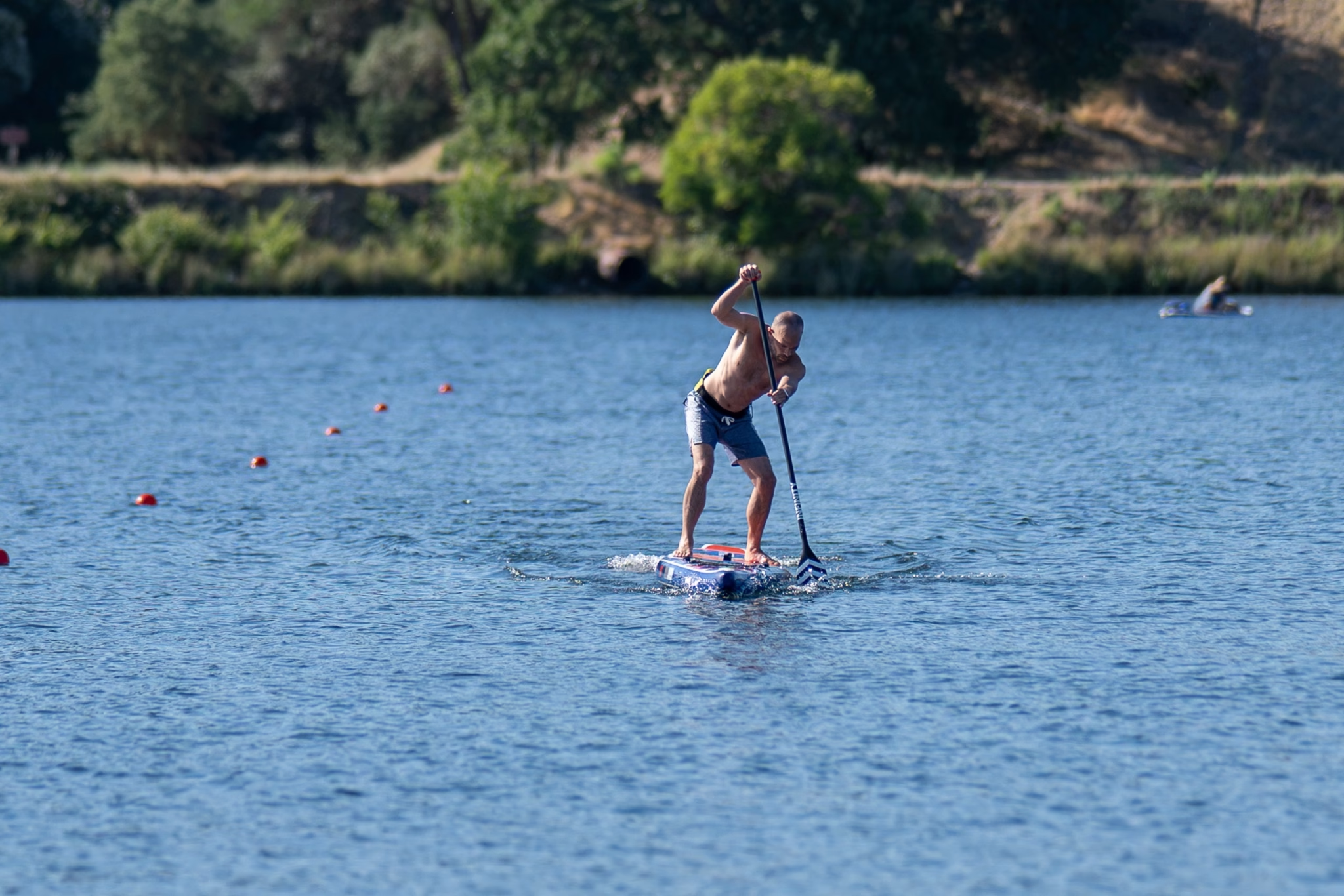
Ten months of logging taught me something I did not expect, and it has nothing to do with going faster.
Why Twenty of My Sessions Look Slow
Of those 66 workouts, 20 average under 2.5 mph. One ran 353 minutes and covered 3.05 miles, which works out to 0.52 mph. Another logged 211 minutes for 1.37 miles. I was not paddling for six hours at walking-backward speed. I launched, paddled a bit, beached the board, swam, ate a sandwich, talked to somebody about their dog, and forgot the watch was still recording.
Most of those are real time outdoors rather than paddling data, and mixing them into an average produces a figure that describes neither activity.
Not all of them, though, and this is where I had it wrong for a year. On August 27, 2026 I logged 219 minutes at 1.20 mph. By the rule below that is a watch left running. It was buoy work: sprint into a turn, turn, accelerate out, drift back, repeat. Max heart rate 173, and 734 active calories. The clock runs while you reset for the next rep, which is why the pace looks like a picnic and the calorie burn does not. A speed filter cannot tell the difference between a forgotten watch and interval training, so treat the bucket below as a first pass rather than a verdict.
| Bucket | Rule I applied | Sessions |
|---|---|---|
| Sustained paddle | 1.5 miles or more, 2.5 mph or faster | 35 |
| Short effort | Under 1.5 miles but 2.5 mph or faster | 10 |
| Under 2.5 mph | Any distance. Mixes stopped watches with drill work | 20 |
| No distance recorded | GPS never engaged | 1 |
Run the numbers both ways and the gap is not subtle:
| Metric | Every logged session | Sustained paddles only |
|---|---|---|
| Sessions counted | 66 | 35 |
| Distance | 264.0 miles | 191.9 miles |
| Mean average speed | 3.06 mph | 3.47 mph |
| Median average speed | 3.30 mph | 3.59 mph |
| Slowest session | 0.19 mph | 2.53 mph |
Before you compare your average to anyone else’s: 0.41 mph separates my lifetime average from the average of my sustained paddles. That is a 13% error, larger than the entire measured performance gap between inflatable and rigid boards. If you have ever looked at a lifetime average in a fitness app and felt slow, go filter out the sessions where you stopped for lunch. The real number usually comes out meaningfully faster than the one the app shows.
Session 1: Lake Natoma, September 24, 2025
| Metric | Value |
|---|---|
| Distance | 8.52 miles |
| Time | 1:59:41 |
| Average Speed | 4.27 mph |
| Speed Range | 0.2 to 5.2 mph (watch summary screen; the Health export carries no speed samples, so not reproducible from the raw export) |
| Active Calories | 750 |
| Average Heart Rate | 154 BPM |
| Max Heart Rate | 167 BPM |
Controlled from the first stroke. Calm water on Folsom’s Lake Natoma, minimal wind, consistent effort. I held 4.0 to 4.5 mph through the middle miles and never hit a wall. This remains my fastest sustained paddle over any real distance, and 750 calories across two hours is efficient output for that pace.
One correction worth making in public: an earlier version of this article credited this session with a 6.6 mph top speed. It did not have one. The Apple Watch record for September 24 tops out at 5.2 mph. The 6.6 figure came from a separate short paddle the day before, and I merged the two while writing from screenshots instead of from the underlying data. Pulling the full export is what caught it.
Session 2: Fair Oaks, American River, February 20, 2026
| Metric | Value |
|---|---|
| Distance | 8.19 miles |
| Time | 2:10:30 |
| Average Speed | 3.77 mph |
| Active Calories | 965 |
| Average Heart Rate | 152 BPM |
| Max Heart Rate | 161 BPM |
Nearly identical distance to the Lake Natoma paddle, nearly identical average heart rate, half a mile per hour slower. The outbound leg averaged 4.1 mph on strong, confident strokes. Somewhere around mile five the wheels came off. My return speed collapsed to 3.4 mph, and I burned 965 calories against the September session’s 750 because a depleted body thrashes instead of gliding. Those two leg figures come from the watch’s in-session summary, not from the Health export, which carries no splits.
What Ten Months Changed
Here is the part two sessions could never have shown me. Line up every paddle of eight miles or longer and the speeds look flat, even slightly worse. The heart rates tell a completely different story.
| Date | Distance | Avg Speed | Avg HR | Speed per beat of HR reserve |
|---|---|---|---|---|
| Sep 24, 2025 | 8.52 mi | 4.27 mph | 154 BPM | 0.0432 |
| Nov 22, 2025 | 10.60 mi | 3.58 mph | 148 BPM | 0.0387 |
| Feb 20, 2026 | 8.19 mi | 3.77 mph | 152 BPM | 0.0388 |
| Feb 23, 2026 | 8.55 mi | 3.59 mph | 139 BPM | 0.0427 |
| Jun 22, 2026 | 8.16 mi | 3.61 mph | 137 BPM | 0.0443 |
| Jun 29, 2026 | 12.01 mi | 4.05 mph | 161 BPM | 0.0384 |
| Jul 25, 2026 | 10.27 mi | 3.30 mph | 118 BPM | 0.0520 |
The last column divides average speed by heart rate reserve, using an assumed 55 BPM resting rate. It answers a more useful question than raw pace: how much boat speed am I getting per unit of cardiac effort?
In September I paddled 8.52 miles at an average of 154 BPM. In July I paddled 10.27 miles, nearly two miles farther, at 118 BPM. That is a 36-beat gap while covering more ground.
A caveat I only found by opening the raw samples: the September average is the mean of six heart rate readings taken roughly every fifteen minutes, with one gap of fifty minutes. The July average is the mean of 2,119 readings taken every five seconds. My watch changed recording regime around April 4, 2026, and nothing about that change was visible in the workout summaries I had been reading. Six spot-checks skew high because they miss the launch, the drift, the rest, and every easy minute in between. Some of that 36-beat gap is real aerobic adaptation. Some of it is instrumentation. I cannot cleanly separate the two, so treat the trend as directional rather than as a measured 36-beat improvement.
An earlier version of this section defended the figure by noting that the July session recorded heart rate across 99.8% of its elapsed time. That checks the wrong session and the wrong thing. Coverage measures how much of the workout the samples span, not how densely they fill it, which is why September reads 92% coverage on six readings. The sparse side was the side that needed checking.
My top-end speed barely moved in ten months. What changed is that distances which used to sit at threshold now sit in an easy aerobic zone. June 29 makes the same point from the other direction: 12.01 miles at 4.05 mph, my longest paddle in the dataset, at a pace I could only hold for eight miles the previous autumn.
What the full dataset says about my ceiling: it depends entirely on how long you want me to hold it. Past two hours, 4.05 mph is the wall. Between one and two hours it lifts to about 4.3. Under 20 minutes I have hit 4.6, and on one downstream run the watch recorded 5.92. Anyone quoting a single top-speed number for themselves is quoting a duration too, whether they mention it or not. For why the long-session number collapses when fueling fails, see my guide to bonking on long paddle board sessions. For the off-water work that raises it, the SUP strength program covers the core, balance, and shoulder training behind a faster stroke.
Speed by Duration, Not a Single Number
| Effort length | My best average | Where it came from |
|---|---|---|
| Two hours or more | 4.09 mph | 10.76 mi, Aug 29 2026 |
| One to two hours | 4.34 mph | 8.31 mi, Aug 24 2026 |
| Under 20 minutes, flatwater | 4.61 mph | 1.37 mi, Jul 29 2026 |
| Under 20 minutes, downstream | 5.92 mph | 1.21 mi, Jul 21 2026 |
That bottom row deserves a caveat rather than a victory lap. It was a downstream run with current underneath me, which is why it sits above the theoretical hull speed calculated further down. Moving water adds its speed to yours, and a GPS cannot tell the difference between a fast paddler and a helpful river. It is a real recorded number and it is not a measure of how fast I can paddle.
What the Heart Rate Data Reveals
The September and February paddles landed within two beats of each other, 154 and 152, on almost the same distance. One was half a mile per hour faster. Heart rate measures effort, not output. When glycogen-depleted muscles lose contractile force, your heart works just as hard and produces less boat speed. You feel like you are working, because you are. The work stops translating.
Across all 66 sessions my highest recorded heart rate is 195 BPM, on that July 21 downstream sprint. A 152 BPM average therefore sits around 78% of my observed maximum, which is a firm aerobic effort rather than the threshold grind it feels like at hour two.
This is why average speed over distance beats any single reading. Max speed is vanity. Average speed, cleaned of the sessions where you stopped for lunch, is truth.
Moving Pace Is the Better Measurement
Everything above divides distance by total elapsed time. That counts every water break, every buoy reset and every conversation as slow paddling, which is why the bucket filter was needed at all.
There is a cleaner way to do it. Every workout since the watch started recording GPS routes carries a track with a speed reading roughly once per second. Throw out the seconds where the board was not moving, and what remains is moving pace: what I was doing while actually paddling, with the stops removed rather than the whole session removed.
I ran it two independent ways as a check, integrating the GPS speed readings and separately computing distance between coordinates. They agree to within 0.01 mph. Changing the cutoff for what counts as moving, anywhere from 0.25 to 0.75 meters per second, moves the answer by less than a tenth of a mile per hour.
Measured that way, on the sessions of ten miles or more that best resemble a race:
| Session | Distance | Elapsed pace | Moving pace | Time moving |
|---|---|---|---|---|
| November 22, 2025 | 10.60 mi | 3.58 mph | 3.92 mph | 89% |
| July 25, 2026 | 10.27 mi | 3.30 mph | 3.49 mph | 92% |
| August 29, 2026 | 10.76 mi | 4.09 mph | 4.37 mph | 91% |
| September 5, 2026 | 10.69 mi | 3.95 mph | 4.47 mph | 86% |
Ten months separate the first row from the last, on the same board. Moving pace over ten miles went from 3.92 to 4.47 mph, a gain of about 14%.
My fastest recorded pace barely moved across that stretch. What changed is the ability to hold something near it for ten miles rather than fading in the last two. Those last two rows come out of a 35-day block of 12 sessions and 65.1 miles, which I put together for the 2026 USA SUP National Championships in Gig Harbor, racing the first inflatable division the event has held.
On September 13, 2026 I raced the eight mile at PaddleSplash on Lake Natoma and finished in 1:49:01.53, first in SUP. Eight miles in that time is 4.40 mph elapsed. Every elapsed figure in the table above is slower, the closest being 4.09 mph on August 29. The full account is in my PaddleSplash race report.
The Inflatable Versus Rigid Performance Gap
Let’s address the elephant on the water. Yes, rigid boards are faster. The question is: by how much?
ISLE Paddle Boards ran the most-cited comparison, timing a 12’6″ inflatable touring board against a 12’6″ Spear race board over a half-mile of flat water at Coronado Bay. Worth knowing before you lean on it: the boards are the same length but not the same hull category, and ISLE sells both. Their findings at casual and race pace:
| Effort Level | Inflatable touring (12’6″) | Epoxy race (12’6″) | Inflatable slower by |
|---|---|---|---|
| Casual pace | 3.78 mph | 3.96 mph | 4.5% |
| Race pace | 4.88 mph | 5.21 mph | 6.3% |
Source: ISLE Paddle Boards, “Inflatable vs Hard Paddle Boards: A Speed Comparison,” islesurfandsup.com.
A 5-6% gap. On an 8-mile paddle averaging 4.0 mph, that translates to roughly 5-6 minutes over two hours. Noticeable if you’re racing against rigid boards. Irrelevant if you’re chasing personal benchmarks or paddling for fitness.
Why Inflatables Are Slower
Flex under load. Even at maximum PSI, an inflatable board deflects slightly under your weight and stroke pressure. That flex absorbs energy that should propel you forward. Think of it as paddling on a slightly soft mattress versus a hard floor. Every stroke loses a fraction of its power to board deformation.
Hull profile limitations. Inflatable construction restricts hull shaping. Rigid race boards achieve deep displacement hulls with precisely engineered rocker profiles. Inflatables approximate these shapes but can’t replicate the sharp entry angles and clean waterline exits that minimize drag.
Weight. An inflatable 14-footer typically weighs 25-30 pounds. Rigid 14-foot carbon race boards commonly come in lighter, around 20 to 26 pounds, so the platform gives up a few pounds on top of the flex penalty above. On flat water that costs less than the flex does, but it compounds every time you accelerate out of a turn.
SUP California, the paddle shop in Folsom next to Lake Natoma, carries rigid 14-foot Infinity race boards. Jaime Johnson, who owns it, is a friend. Her shop has sponsored my race entries and provided gear, and I earn a commission on purchases made through links to her store.
When the Gap Narrows
Flat, calm water with no wind is where inflatables perform closest to rigid boards. The ISLE test was conducted on flat water, and their 5-6% gap represents close to the minimum difference. In these conditions, the inflatable’s disadvantages in hull shape and flex matter less because there’s no chop to amplify them.
When the Gap Widens
Choppy conditions and headwinds punish inflatables disproportionately. An inflatable’s broader profile catches more wind. Its flex increases in waves as the board works against inconsistent water surfaces. Nobody has published a controlled test of the gap in rough conditions, so I am not going to invent a percentage for it. Directionally, everything that makes an inflatable slower on flat water gets worse when the water stops being flat.
Paddle Board Speed Versus Kayak Speed
This comes up constantly on the water at Lake Natoma, usually from somebody deciding which one to buy. The two overlap far more than either camp likes to admit. The SUP rows below come from my own logs; the kayak rows are the ranges I see alongside me on the same water, not measured figures.
| Craft | Typical cruising speed | Notes |
|---|---|---|
| Recreational SUP | 3.0 – 3.5 mph | Standing, higher wind profile, single blade |
| Fitness or touring SUP | 3.5 – 4.5 mph | Where my own sustained paddles land |
| Recreational kayak | 3.0 – 3.5 mph | Wider hulls, seated, double blade |
| Touring or sea kayak | 3.5 – 4.5 mph | Longer waterline, better tracking |
| Racing SUP (14 ft) | 4.5 – 5.5 mph | Narrow, displacement nose |
Matched for effort and comparable equipment, a kayak holds a modest edge. The paddler sits lower, catches less wind, and moves a blade on both sides without rotating the whole body between strokes. That advantage grows in wind and shrinks to almost nothing on a calm morning.
Where the gap becomes obvious is stamina against weather. A headwind that flattens me on the board barely troubles a kayaker, because I am standing up acting as a sail and they are not. On flat water with no wind, a fit paddler on a 14-foot race SUP will keep pace with most recreational kayaks and beat a few of them.
How PSI Affects Your Speed
This is where inflatable-specific performance gets interesting, and where the overthinking usually starts.
Higher PSI equals a stiffer board. A stiffer board flexes less. Less flex means more of your stroke energy reaches the water. In theory, maximum PSI equals maximum speed. The physics checks out.
In practice, the limit is your board’s rating rather than the physics.
Green Water Sports ran the most thorough deflection testing published on inflatable SUP stiffness, and their numbers are blunter than the marketing suggests. On a board without stiffening battens, 25 PSI measured 53% stiffer than 15 PSI, and even on a batten-reinforced board the gap was 37%. Sag dropped from 7.5 cm at 15 PSI to 3.5 cm at 25. The per-step figures are steady rather than tapering: 10 to 15 buys about 37%, and 15 to 20 buys another 31%. Stiffness keeps climbing well past 15 PSI. What flattens out is the return on that stiffness once you are already at the pressure your board was built for, and what does not flatten out is the seam stress.
Source: Green Water Sports, “The Definitive Inflatable SUP Stiffness Guide,” greenwatersports.com.
| PSI Range | Stiffness Impact | Speed Relevance |
|---|---|---|
| 10-12 PSI | Significantly underinflated for most boards | Noticeable flex, drag increases, poor tracking. You’ll feel sluggish. |
| 13-15 PSI | Adequate for recreational paddling | Most of the rigidity gains happen here. Board performs reasonably well. |
| 16-20 PSI | Optimal for performance paddling | Another 31% stiffer than 15 PSI, and the board feels noticeably firmer underfoot. This is where race-oriented inflatables operate best. |
| 21-25 PSI | Real stiffness gain, real seam risk | Measurably stiffer again, 10-32% over 20 PSI depending on whether the board has battens. Above most boards’ rated pressure though, so not worth it unless yours is specifically rated for it. |
My board runs at 20 PSI, its manufacturer rating. That’s the pressure I’ve logged all my benchmark sessions at. Would 25 PSI make it stiffer? The Green Water Sports numbers say yes, measurably. It would also put me five PSI over what Venture Wild built the seams to hold, on a board I paddle for two hours at a stretch in Sacramento summer heat that raises the pressure further on its own. The rating is the answer.
Practical PSI advice: Inflate to your board’s rated pressure. Not below it, where you’re leaving real performance on the table. Not significantly above it, where you’re stressing construction with minimal return. If your board is rated for 15 PSI and you’ve been running it at 12, inflating to spec will make a bigger difference than any technique adjustment.
Factors That Affect Your Speed (Ranked by Impact)
Equipment matters, but less than the spec sheets imply. Here’s what actually moves the needle, roughly ordered from largest to smallest impact on your average speed.
1. Wind (Estimated Impact: 15-30% on Average Speed)
Nothing changes a session faster than wind. In my own logs a 10-15 mph headwind costs me 20-30% of my cruising pace. A matching tailwind gives back noticeably less, because the aerodynamic benefit of a reduced frontal profile is smaller than the penalty of standing up and fighting one.
My February session on the American River ran under light winds I logged at the time as 5-8 mph out of the west. Outbound with a slight tailwind: 4.1 mph. Return into it, compounded by bonking: 3.4 mph. My read is that wind accounted for something like 0.3 mph of that differential and nutrition failure for the rest, though a single round trip cannot separate them cleanly.
Pumped Up SUP puts the threshold where wind becomes noticeable at 9-12 mph, and calls 16 mph and above a real challenge where kneeling may be necessary. For benchmarking, calm conditions under 5 mph are essential. Otherwise, you’re measuring weather, not fitness.
2. Current (Estimated Impact: Variable, 0-100%)
River paddling adds a massive variable. The American River at Fair Oaks runs somewhere around 1.5-2.5 mph in my experience, depending on the section and the water level, though gauges publish discharge rather than surface speed so this is a paddler’s estimate rather than a measurement. Paddle downstream and you’re adding that to your speed. Upstream, you’re subtracting it. A round-trip averages out, but your GPS splits will look wildly inconsistent.
Lake paddling (like my Folsom sessions on Lake Natoma) eliminates current almost entirely. If you’re benchmarking, flat water with no current is the only comparable test environment.
3. Paddler Fitness and Technique (Estimated Impact: 10-25%)
A paddler with efficient technique extracts meaningfully more speed from the same effort than someone muscling through with poor form. Nobody has published a clean number for how much, and the ranges in these section headings are my estimates rather than measurements. The catch angle (how far forward you plant the blade), the pull path (straight back versus sweeping), paddle length (too short kills leverage, too long kills cadence), and stroke rate all compound.
VO2max correlates with sustainable pace. Higher aerobic capacity means you can maintain a faster speed at the same perceived effort. My 152 BPM average sits at roughly 78% of the 195 BPM maximum recorded across ten months of sessions, a firm aerobic effort with headroom above it. This is also the one factor I have watched move: by July I was covering ten miles at 118 BPM, and even after discounting for the sampling change described earlier, the direction is unmistakable.
4. Board Design (Estimated Impact: 5-15%)
Length. Longer boards are faster. The hull speed formula (1.34 times the square root of waterline length in feet) puts a 14-foot board with a 13-foot waterline near 4.83 knots (5.56 mph), the point where wave-making resistance starts dominating. A 12-foot board with an 11-foot waterline lands around 4.44 knots (5.11 mph). At race pace that is roughly half a mile per hour of ceiling.
Width. Narrower boards create less wetted surface area and less drag. My 28-inch board tracks tighter than a 32-inch all-rounder but demands better balance. I have only ever logged the one width, so I cannot put a number on the difference from my own data, and I have not found a controlled test that does.
Rocker. More rocker (nose-to-tail curvature) means better wave handling but slower flat-water speed. Race inflatables minimize rocker for straight-line efficiency.
Fin setup. A single large fin provides the best tracking and least drag for straight-line speed. Multi-fin setups add stability but increase resistance.
SUP California sells single race fins from Level Six ($40) and Black Project ($140).
5. Paddler Weight (Estimated Impact: 3-8%)
More weight means more displacement, which means more wetted surface area and higher drag. A 200-pound paddler pushes more water than a 160-pound paddler on the same board. The effect is modest on flat water but compounds over distance and in chop. Lighter paddlers also have less mass to decelerate between strokes, maintaining glide more efficiently.
6. Nutrition and Hydration (Estimated Impact: 0-20% Over Long Sessions)
Zero impact on a 30-minute paddle. Catastrophic impact on a 2-hour session if you get it wrong. My two benchmark sessions are the clearest illustration I have. Similar fitness, same board, same heart rate. The fueled session: 4.2 mph. The unfueled session: 3.7 mph. A 12% difference I attribute mostly to glycogen depletion in the back half, though two sessions five months apart is an illustration rather than a controlled experiment.
For sessions over 90 minutes, fueling strategy is a speed variable. Ignore it at your performance’s expense.
The Physics: Hull Speed and Why 6 MPH Costs So Much
Every displacement hull, including every SUP, has a reference speed set by its waterline length. The formula is straightforward:
Hull Speed (knots) = 1.34 x square root of Waterline Length (feet)
For a 14-foot racing SUP with approximately 13 feet of effective waterline:
1.34 x 3.61 = 4.83 knots = 5.56 mph
Source: Hull speed formula, standard naval architecture. See Wikipedia: Hull Speed; Omnicalculator hull speed calculator.
Here is the part I had wrong for a long time: 5.56 mph is not a wall. Modern naval architecture has largely retired hull speed in favor of the Froude number, and the reference page I cite for the formula says so plainly. Drag rises smoothly through that figure, often with no visible inflection at all, and long narrow hulls beat it routinely. Racing kayaks exceed their nominal hull speed by more than 100% without ever planing. A 14-foot board 28 inches wide has a length-to-beam ratio around 6 to 1, which puts it squarely in that slender-hull territory.
What is true is that drag climbs steeply as you push past a cruising pace, faster than the square of your speed once wave-making resistance dominates. There is no cliff. There is a bill that grows faster than your effort does, which is why 6 mph feels so much more expensive than 4.
My own records sit well inside that. My fastest sustained average on still water is 4.61 mph over 1.37 miles. Four shorter records in the export read higher, between 4.85 and 5.41 mph, but each covers under half a mile across one to five minutes, and one of them logs an average heart rate of 81 while supposedly sprinting. I treat those as GPS noise rather than personal records, and I am flagging them here rather than quietly dropping them from an article whose whole argument is that you should look at your raw data. The one figure that clears 5.56 is the July 21 downstream run at 5.92 mph, and that number belongs partly to the river.
Elite paddlers blow straight through the figure. At the 2024 ICF SUP World Championships at Nathan Benderson Park in Sarasota, Andrey Kraytor won the men’s 100 m sprint in 23.05 seconds, an average of 9.7 mph on a flat-water rowing course with no swell to help him. Katniss Paris took the women’s title at 28.32 seconds, 7.9 mph. Both are far above the 5.56 mph a 14-foot board is nominally limited to. Hull speed describes where drag starts getting expensive for the rest of us. It does not describe where the sport ends.
How to Measure and Track Improvement
You need data to improve. Feelings and perceived effort are unreliable narrators. Here’s what works.
GPS Devices That Work for SUP
Apple Watch (what I use). I paddle with an Apple Watch Ultra 3. The Paddling workout type tracks distance, speed, heart rate, and calories. Accuracy is solid for average speed. Max speed readings can spike from wrist movement, so take any reading above your sustained ceiling with skepticism. The Ultra handles water exposure and long days better, and any Series 7 or newer works fine. The gap is stroke rate: Apple Health carries no field for it, so holding a target cadence needs either a paddling app or a Garmin.
Garmin watches (Instinct, Fenix, Forerunner series). I paddle with an Apple Watch and have not tested a Garmin on the water. Garmin’s published documentation is the source for this entry. Their SUP activity profile records the metric this article spends a whole section teaching you to hold. The paddle-sports data fields include Stroke Rate, which Garmin defines as “the number of strokes per minute (spm),” alongside a session average, a total stroke count, and distance per stroke. Cadence on its own cannot tell you whether dropping to 45 spm made you more efficient or simply slower, because both read the same on a stroke-rate display. Distance per stroke is what separates them. The Instinct 3 Solar runs about $300 with a 10 ATM water rating and solar charging, which is what I would pick for long days on open water. The Instinct E at about $200 carries the identical eleven paddle-sports data fields and the same 10 ATM rating, and gives up solar charging and multi-band GPS to get there.
Two things surprised me reading the manuals, and both cut against how people shop for a paddling watch. The Forerunner 970, Garmin’s running flagship at more than twice the price of an Instinct, is rated Swim, 5 ATM where every Instinct, fenix and quatix in this table is 10 ATM.
The Descent Mk3 is stranger. It is a dive computer rated to 20 ATM, and it carries no SUP activity in its manual at all. The most water-resistant watch Garmin sells will not record your paddle. Water rating and paddle-sport support are separate questions.
| Model | SUP profile | Stroke fields | Water rating | Approx. price |
|---|---|---|---|---|
| Instinct E | Yes | Full set | 10 ATM | $200 |
| Instinct 3 Solar | Yes | Full set | 10 ATM | $300 |
| quatix 8 (marine) | Yes | Full set | 10 ATM | $1,200 |
| fenix 8 | Yes | Full set | 10 ATM | $850 |
| fenix 9 Pro Solar (August 2026) | Yes | Full set | 10 ATM | $1,100 |
| Forerunner 970 | Yes | Full set | Swim, 5 ATM | $750 |
| Descent Mk3 (dive) | No | n/a | 20 ATM | $1,200 |
| Apple Watch Ultra 3 | Paddling workout | No stroke rate | 100 m | $780 |
The fenix 9 landed on August 25, 2026 and is the newest of these. It does everything the others do for paddling and costs about $1,100. At the time of writing its Amazon listing was still pre-order, so check the ship date before you commit.
The Descent Mk3 is the one model here I have not linked, because a watch with no SUP activity cannot do the job this section is about.
Smartphone GPS apps (Strava, MapMyFitness, Waterspeed). Workable if your phone is in a waterproof case on the board. Less convenient than a watch. GPS accuracy suffers in a case at water level.
Which Metrics Matter
Average speed over distance. This is your benchmark. Track it monthly on the same route, in similar conditions. Improvement here reflects genuine gains in fitness, technique, or both.
Split consistency. Even splits (first half speed roughly matching second half) indicate proper pacing and nutrition. If your first half is 4.2 and your second half is 3.4, you went out too hard, fueled too little, or both.
Heart rate at given speed. Holding the same speed at a lower heart rate means improved cardiovascular efficiency. This is the truest measure of fitness progress.
Distance per stroke, if your watch reports it. Speed and cadence together tell you how much water each pull actually moves. Distance per stroke climbing while cadence holds steady is evidence that technique changed rather than fitness, and it is the one number that tells you whether slowing your cadence bought you anything.
Ignore max speed. It captures a single GPS ping during your most favorable conditions. A wave, a current assist, a wrist flick that confused the accelerometer. It tells you almost nothing about your paddling ability.
Controlling for Conditions
Benchmark on the same body of water, the same time of day if possible (wind patterns are often predictable), and the same gear: board, PSI, paddle. Lake Natoma is my testing ground because it’s flat, current-free, and sheltered from wind in the morning. The American River works for training but introduces too many variables for clean comparison.
Log conditions with every session: wind speed and direction, water state, temperature, what you ate and when. After six months, patterns emerge that numbers alone won’t reveal.
Setting Realistic Speed Goals
If you’re currently averaging 3.5 mph on an inflatable board and paddling regularly, here’s a reasonable progression timeline:
| Current Average | Realistic 3-Month Target | Primary Lever |
|---|---|---|
| 2.5 – 3.0 mph | 3.0 – 3.5 mph | Stroke technique (catch angle, blade exit, staying closer to the rail) |
| 3.0 – 3.5 mph | 3.5 – 4.0 mph | Stroke rate + cardiovascular fitness (paddle 3-4 times per week) |
| 3.5 – 4.0 mph | 4.0 – 4.3 mph | Pacing strategy + nutrition for longer sessions + interval training |
| 4.0 – 4.5 mph | 4.3 – 4.7 mph | Board upgrade considerations (longer, narrower) + structured training plan |
Each 0.5 mph increment gets harder to achieve than the last. Going from 3.0 to 3.5 is mostly technique. Going from 4.0 to 4.5 requires serious cardiovascular adaptation and refined pacing over distance. Going from 4.5 to 5.0 on an inflatable might be approaching the platform’s practical limit.
If you’re preparing to enter your first paddle board race, knowing your realistic speed bracket helps set finishing time expectations. A 5K race at 4.0 mph takes about 47 minutes. At 4.5 mph, roughly 41 minutes. Those five minutes feel like an eternity when you’re on the water.
What This Means for Your Own Numbers
If you’re averaging 3.5-4.5 mph on an inflatable racing SUP, you’re paddling well. Full stop. The inflatable platform costs you 5-6% versus rigid, pressure above your board’s rating buys stiffness you cannot safely use, and the biggest speed gains come from consistency, nutrition, and honest pacing rather than equipment upgrades.
Ten months of watch data taught me two things I would not have believed in September. The first is that a third of what I had logged as paddling was me standing in the shallows talking to strangers, and that counting it made me slower on paper than I actually was. The second is that a year of training showed up almost nowhere in my speeds. It showed up in my pulse. Same water, longer distance, a heart rate 36 beats lower, and I had to go back to the raw samples to learn that my watch had quietly changed how it measured that in April, so part of the drop belongs to the instrument rather than to me.
Track your sessions, clean them before you judge them, control your conditions, and eat before you’re hungry. The speed will come, and it will arrive quietly, disguised as an easier heart rate.
Sources
- ISLE Paddle Boards. “Inflatable vs Hard Paddle Boards: A Speed Comparison.” islesurfandsup.com.
- Green Water Sports. “The Definitive Inflatable SUP Stiffness Guide.” greenwatersports.com.
- SUPboarder Magazine. “14′ Race iSUP Test 2022: SUPBOARDER PRO HEAD TO HEAD.” supboardermag.com, August 2022.
- Hull Speed. Wikipedia. Standard displacement hull formula: 1.34 x sqrt(LWL in feet), and the limits of the concept in modern naval architecture.
- SUP Racer. “ICF SUP World Champs 2024: Faster Speeds, Action-Packed Racing, New Stars.” supracer.com. Sprint finals at Nathan Benderson Park, Sarasota.
- AquaSportsPlanet. “Paddleboard Speeds: Improving Your Performance.” aquasportsplanet.com. Background reading; not a source for the tier figures above.
- SipaBoards. “Under Pressure: How to Properly Inflate Your SUP.” sipaboards.com, April 2024.
- McConks SUP. “Inflatable SUP, Air Pressure, and Using This to Tune the Board’s Performance.” mcconks.com.
- Pumped Up SUP. “How Much Wind Is Too Much For A SUP Outing?” pumpedupsup.com.
- Blue Planet Surf. “The Fastest Race SUP? Displacement Hull vs Planing Hull and Weight.” blueplanetsurf.com.
- Seabreeze.com.au. “What Average Speed Do You Do?” Community forum thread. seabreeze.com.au. Paddler anecdotes worth reading; not a source for the tier figures above.
- Castañeda-Babarro, A. et al. (2020). “Physiological Effects of Stroke Rate in Stand-Up Paddle.” International Journal of Environmental Research and Public Health 17(13), 4893. pmc.ncbi.nlm.nih.gov.
- Klitgaard, K.K. et al. (2021). Kayak paddling performance and force production. Sensors. pmc.ncbi.nlm.nih.gov.
- Author’s Apple Watch workout data: 66 paddle-sports workouts recorded between September 24, 2025 and September 5, 2026, covering 264.0 miles and 105.1 hours, with 41,996 heart rate samples. Exported from Apple Health as workout-level records. Sessions classified as sustained paddles at 1.5 miles or more and 2.5 mph or faster; sessions under 2.5 mph excluded as recording artifacts. The export does not include GPS route data, cadence, stroke rate, or speed samples, and heart-rate sampling density changed from roughly one reading every fifteen minutes to one every five seconds in April 2026.
Frequently Asked Questions
What is a good average speed on an inflatable SUP?
For recreational paddlers, 3.0-3.5 mph is a solid average on an inflatable board. Fitness-oriented paddlers typically fall in the 3.5-4.5 mph range. Competitive amateurs on 14-foot inflatable race boards can sustain 4.5-5.5 mph. If you’re consistently above 4.0 mph on any inflatable, you’re outpacing the majority of paddlers on the water.
How much slower is an inflatable SUP than a rigid board?
Controlled speed testing by ISLE Paddle Boards found inflatable SUPs are roughly 5-6% slower than rigid epoxy boards of the same length. At casual pace, their 12’6″ inflatable touring board averaged 3.78 mph versus 3.96 mph for the 12’6″ epoxy race board. At race pace, the gap was 4.88 mph versus 5.21 mph. Worth knowing that the two boards are the same length but not the same hull category, and ISLE sells both, so the figure conflates construction with hull design. The difference is measurable but smaller than rigid-board marketing suggests.
Does PSI affect inflatable SUP speed?
Yes, and by more than the spec sheet suggests. Green Water Sports’ deflection testing measured 25 PSI as 53% stiffer than 15 PSI on a board without stiffening battens, and 37% stiffer on one with them. Stiffness keeps climbing rather than plateauing. The practical limit is not physics but your board’s rating: above it you are stressing seams for stiffness you cannot safely use. Inflate to the rated pressure and stop. Going from 10-12 PSI up to spec is where the real speed shows up.
What is the maximum speed of a 14-foot SUP?
The nominal hull speed of a 14-foot displacement hull is about 5.56 mph (4.83 knots), from the standard formula of 1.34 times the square root of waterline length in feet. It is a rule of thumb rather than a ceiling. Drag climbs steeply through that range, but long narrow hulls beat it routinely, and elite paddlers go far past it. The 2024 ICF world champion averaged 9.7 mph over a 100 m flat-water sprint. For recreational and fitness paddlers, 5.56 mph marks where effort stops buying much speed, not where speed becomes impossible.
How does wind affect SUP paddling speed?
Wind is the single largest environmental factor affecting SUP speed. In my own logged sessions, headwinds of 10-15 mph cost me 20-30% of my average speed. Tailwinds give back noticeably less, because the aerodynamic benefit of a reduced frontal profile is smaller than the penalty of fighting one while standing up. Pumped Up SUP puts the threshold where wind becomes noticeable at 9-12 mph and calls 16 mph and above a real challenge. For accurate speed benchmarking, paddle in conditions below 5 mph wind.
Why is my SUP speed faster going one direction than the other?
River current and wind direction are the most common causes. On the American River at Fair Oaks I estimate the current at 1.5-2.5 mph, which adds to your downstream speed and subtracts from your upstream speed. Wind creates a similar asymmetry. On round-trip paddles, these effects partially cancel out in your overall average, but your per-segment speeds will vary dramatically.
How do I track my SUP speed accurately?
A GPS-enabled smartwatch (Apple Watch, Garmin Fenix/Forerunner) worn on the wrist provides the most reliable speed data for SUP. Use the paddling or open water workout mode. Focus on average speed over distance rather than max speed, which can spike from wrist movement or GPS artifacts. Log conditions with every session for meaningful comparison.
Can I race competitively on an inflatable SUP?
Absolutely. Many local and regional races include inflatable categories, and some events are open-class where board type doesn’t matter. At the amateur level, paddler fitness and technique contribute far more to finishing time than the 5-6% speed gap between inflatable and rigid boards. A fit paddler on a 14-foot inflatable will beat an unfit paddler on a carbon race board every time.
How long does it take to improve my SUP speed by 0.5 mph?
For a recreational paddler moving from 3.0 to 3.5 mph, technique improvements can produce results within 4-6 weeks of consistent paddling. Moving from 3.5 to 4.0 mph typically requires 2-3 months of regular training with focus on cardiovascular fitness. Above 4.0 mph, each 0.5 mph increment takes progressively longer and may require structured interval training and race-specific preparation.
What factors matter most for increasing SUP speed?
In order of impact: wind and current conditions (largest variable), paddler fitness and cardiovascular capacity, stroke technique and efficiency, board design (length, width, hull shape), PSI inflation level, and paddler weight. For sessions over 90 minutes, nutrition and hydration become critical speed factors. Technique is the underrated variable and equipment the overrated one.
Is 4 mph fast on a paddle board?
On an inflatable SUP, 4.0 mph sustained over several miles puts you solidly in the fitness paddler category, faster than the large majority of recreational paddlers. For context, most casual paddlers average 3.0-3.5 mph, and competitive amateurs on racing inflatables average 4.5-5.5 mph. A consistent 4.0 mph average demonstrates good technique, reasonable fitness, and efficient pacing.
Should I upgrade to a rigid SUP for more speed?
Only if you’ve already maximized what your inflatable can offer. If you’re averaging under 4.0 mph, technique, fitness, and nutrition improvements will yield bigger gains than a board swap. If you’re consistently hitting 4.5+ mph and competing regularly, a rigid board’s 5-6% speed advantage becomes meaningful. Consider the trade-offs: rigid boards need roof racks, storage space, and are more fragile. For most fitness paddlers, an inflatable delivers 94-95% of a rigid board’s performance with far more convenience.
Why is my paddle board average speed lower than it feels?
Most likely because your watch kept recording while you stopped. Across 54 of my own logged paddle workouts, 18 averaged under 2.5 mph because the timer ran through beach breaks, swims, and conversations. Restricting the average to the 35 sustained paddles moves it from 3.06 mph to 3.47 mph, a 13% correction. Before comparing yourself to any published benchmark, filter out sessions where your average speed is implausibly low for the distance covered, then recalculate.
Is a paddle board faster than a kayak?
Generally no, though the gap is narrower than its reputation. Recreational kayaks and recreational SUPs both cruise around 3.0 to 3.5 mph, and touring kayaks and fitness SUPs both land near 3.5 to 4.5 mph. A kayaker sits lower, catches less wind, and uses a double blade, which gives them a modest advantage that grows considerably in windy conditions. On calm flatwater, a fit paddler on a 14-foot race SUP will keep pace with most recreational kayaks.
Does paddle boarding fitness show up as faster speeds?
Often it does not, at least not at first. Over ten months of logged sessions my average speed on long paddles barely moved, while my average heart rate for those same distances fell from 154 BPM to 118 BPM and my longest paddle grew from 8.5 miles to 12 miles. One caveat on that heart rate figure: the September average came from six readings and the July average from 2,119, because my watch changed sampling density in April, so part of the drop is instrumentation rather than fitness. The distance gain is not in question. Aerobic fitness usually appears as the same pace at a lower pulse, or a longer distance at the same pulse, before it appears as a faster number. Track heart rate alongside speed or you will miss the improvement entirely, and check how densely your device actually sampled before you celebrate.
Can a paddle board go faster than its hull speed?
Briefly, with enormous effort, or with help from moving water. The nominal hull speed of a 14-foot displacement board is about 5.56 mph, and it is a rule of thumb rather than a hard limit. My own GPS once recorded 5.92 mph averaged over 12 minutes, but that was a downstream run on a river, where current adds its own speed to the paddler’s. A GPS cannot separate the two. If you record a speed well above hull speed on a board, check whether you were paddling with current, wind, or a following swell before treating it as a personal record.
What is a good stroke rate for paddle boarding?
About 45 strokes per minute for steady distance paddling. Castaneda-Babarro et al. (2020) tested ten international SUP racers at 45, 55 and 65 spm at a fixed 75% of peak power output and found 45 spm was 13% more efficient than 55 and 17.5% more efficient than 65, with lower oxygen consumption, lactate and perceived exertion at every point measured. That figure comes from ten male competitors on an ergometer, so treat it as a well-supported starting point rather than a universal number. Sprinting is a different event with a different rate.
How do I measure my stroke rate on a paddle board?
Three options, in rough order of cost. A free metronome app set to 90 BPM gives you one click per side at 45 spm, which trains the rhythm but does not measure it. A paddling app such as Paddle Logger, Waterspeed or GoSUP will record cadence from your phone or watch. A Garmin watch running its SUP activity profile reports stroke rate on the watch during the paddle, along with distance per stroke, which is the pairing that tells you whether a slower cadence is actually working. Apple Health does not expose a stroke-rate field at all, which is why an Apple Watch alone will not answer this.
The products linked in this article are collected in the GPS Watches for Paddle Boarding list on the MK Library Amazon storefront.
Affiliate disclosure: Some gear links in this article are Amazon affiliate links. MK Library earns a small commission on qualifying purchases at no additional cost to you. The Apple Watch Ultra 3 is the watch I actually paddle with. The Garmin recommendations are based on each model’s published Garmin documentation, which I checked individually; I have not worn a Garmin on the water.
Article Updates
October 2, 2026: Added rigid race boards and race fins from SUP California, the Folsom paddle shop, with a note on my connection to the shop.
- September 14, 2026: Added the PaddleSplash 8 Mile result from Lake Natoma on September 13, 2026 (1:49:01.53, first in SUP) to the moving pace section as a timed race comparison against the training table. Rebuilt this Article Updates list, whose block markup was malformed and whose entries were out of date order.
- September 8, 2026: Added stroke rate coverage. Reported the cadence study’s limitations and its full physiological data (VO2, lactate and perceived exertion at 45, 55 and 65 spm), and noted that power was held constant at 75% of peak output, so the finding is about efficiency at a given effort rather than outright speed. Corrected the blanket claim that a watch cannot check your stroke rate; that is true of the Apple Watch export and not of a Garmin running its SUP profile. Expanded the Garmin entry with its documented paddle-sports stroke fields and added distance per stroke as a tracked metric. Two new FAQ entries on stroke rate. Checked every current Garmin model against its own owner’s manual and corrected a claim made earlier the same day: the Instinct 3 Solar is not the least expensive model carrying the SUP profile and full stroke fields. The Instinct E, at about $100 less, has the identical eleven paddle-sports fields and the same 10 ATM rating. Added a model comparison table, plus two findings that cut against how paddling watches get shopped: the Forerunner 970 is rated Swim, 5 ATM where every Instinct, fenix and quatix is 10 ATM, and the Descent Mk3 dive computer carries no SUP activity at all despite a 20 ATM rating. Added buying links for every model in the table and for the Apple Watch Ultra 3, so the Garmin and Apple paths are both visible in one place. The Descent Mk3 is deliberately left unlinked.
- September 7, 2026: Refreshed against a new Apple Health export. Dataset grew from 54 sessions to 66, covering September 24, 2025 through September 5, 2026: 264.0 miles, 105.1 hours, 41,996 heart rate samples. Added moving pace computed from GPS route tracks, and a new section comparing elapsed pace to moving pace on ten-mile efforts. Corrected the claim that every session under 2.5 mph was a watch left running; the August 27, 2026 session was interval work, not a forgotten timer. Best two-hour-plus average updated to 4.09 mph and best one-to-two-hour average to 4.34 mph, both from the new sessions. Sustained-paddle correction restated as 3.06 to 3.47 mph, a 13% difference.
- August 5, 2026: Fact-check pass with corrections. Disclosed a heart-rate sampling change that confounds the 154 to 118 BPM comparison: the September 2025 average is the mean of six readings taken roughly every fifteen minutes, the July 2026 average the mean of 2,119 readings taken every five seconds, after the watch changed recording regime around April 4, 2026. Removed a defense of that figure that cited sampling coverage, which measures the span of the readings rather than their density. Corrected the Green Water Sports stiffness finding, which was inverted in three places: their testing measured 25 PSI as 53% stiffer than 15 PSI without battens and 37% stiffer with them, not negligible. Corrected the treatment of hull speed from a physical ceiling to a rule of thumb, which is what the cited source says; added the 2024 ICF SUP World Championships sprint results (23.05 seconds over 100 m, 9.7 mph) in place of the claim that elite paddlers top out near 7 mph. Corrected the two-hour-or-longer best from 4.27 mph to 4.05 mph, since the Lake Natoma session runs 1:59:41. Corrected the description of the data cleaning: restricting to sustained paddles moves the average from 3.05 to 3.45 mph; removing only the 18 artifacts gives 3.80. Disclosed four short sessions that read between 4.85 and 5.41 mph and why I treat them as GPS noise. Put the ISLE percentages on one denominator (4.5% and 6.3%), noted that the two boards tested are different hull categories, and removed a strokes-per-minute figure that is not in the source. Replaced an instruction to read stroke rate off the Apple Watch, which my own export has no field for. Corrected the board name to Venture Wild Sierra Pro-Touring 14×28. Corrected the 12-foot hull speed figure to 4.44 knots (5.11 mph) to match the waterline convention used for the 14-footer, the sustained-paddle threshold to 1.5 miles to match the rule actually applied, the Klitgaard finding to include its “two-thirds of paddlers” qualifier, and the 5K pace delta to five minutes. Removed unsourced percentage estimates for wind, technique, board width, and rough-water performance, or attributed them as personal estimates. Added the ICF results and the two peer-reviewed papers cited in the body to the sources list, and marked a forum thread and an aggregator there as background reading rather than as sources for the skill-tier figures.
- July 30, 2026: Rebuilt the data sections on a full Apple Health export covering 66 paddle workouts from September 24, 2025 through September 5, 2026 (264.0 miles, 105.1 hours, 41,996 heart rate samples). Corrected a top-speed figure: the September 24, 2025 session was previously credited with a 6.6 mph maximum, which belonged to a separate paddle the day before; that session’s actual range was 0.2 to 5.2 mph. Corrected the maximum heart rate reference from an implied 180 BPM to the observed 195 BPM, revising the 152 BPM average from 82-85% of maximum to 78%. Reconciled the hull speed figure for a 14-foot board to 5.56 mph throughout, replacing an inconsistent 5.75 mph in two places. Replaced the single sustained-speed ceiling with speed benchmarks broken out by effort duration. Added sections on filtering recording artifacts out of workout data, on ten-month changes in heart rate at fixed distances, and on paddle board speed versus kayak speed. Added four FAQ entries.
- May 22, 2026: Original publication with Apple Watch data from September 2025 and February 2026 sessions.


