
Seven miles into an 8-mile paddle on Lake Natoma, I couldn’t straighten my fingers. Not the normal “my hands are tired” stiffness that fades on the drive home. This was the back of my right hand, wrist to knuckles, aching like I’d been punching a wall for two hours. The tendons across my hand were visibly swollen. Flexing my wrist sent a sharp sting radiating toward my thumb.

I finished the paddle. Of course I did. Then I spent the next three days wondering whether I’d managed to break something while doing what should be a low-impact sport.
I hadn’t broken anything. What I’d done was spend 8 miles in a death grip on a round paddle shaft, tensing muscles that were never designed for sustained maximal contraction, and irritating tendons that stay invisible until they are inflamed. The pain pattern, right across the dorsal (back) side of my hand and wrist, has a clinical name. Several, actually. And the underlying cause is embarrassingly preventable.
Here’s what I learned after going through the orthopedic and sports medicine literature, talking to a physical therapist, and completely rethinking how I hold a paddle.
Key Takeaways
- Dorsal hand and wrist pain in paddlers typically involves the extensor tendons, with intersection syndrome and De Quervain’s tenosynovitis being the two most common diagnoses.
- Overgripping (“death grip”) is the primary cause: sustained excessive grip force fatigues forearm extensors, compresses tendons, and creates friction at anatomical crossover points in the wrist.
- Optimal grip pressure is 3-4 on a 1-10 scale, roughly the force you’d use to hold a bird without letting it fly away or crushing it.
- Top hand and bottom hand serve different roles: the top hand guides and pushes, the bottom hand acts as a loose fulcrum. Squeezing both hands equally hard is the common error.
- Paddle shaft diameter affects required grip force: too-narrow shafts demand higher squeeze pressure from finger flexors, increasing extensor tendon strain.
- Eccentric wrist exercises reduce tendonitis risk by strengthening the extensor tendons under load, with research showing significant pain reduction within 6-12 weeks of consistent training.
- Persistent numbness, swelling that doesn’t resolve within 48 hours, or pain at rest are signals to stop paddling and see an orthopedic specialist.
Medical Disclaimer: This article is educational and based on published orthopedic and sports medicine research. It is not medical advice. If you’re experiencing persistent hand or wrist pain, see a qualified healthcare provider for proper diagnosis and treatment. The exercises described here are preventive; if you’re currently injured, get clearance from a medical professional before starting any exercise program.
Why Your Hands Hurt: The Anatomy Behind the Pain
The back of your hand and wrist is controlled by a network of extensor tendons that run from your forearm, across the wrist, and into your fingers. These tendons travel through six defined compartments on the dorsal side of the wrist, separated by a fibrous band called the extensor retinaculum. Two of these compartments are particularly vulnerable in paddlers.
Intersection Syndrome: Where Tendons Collide
About 4-6 centimeters above your wrist, the tendons of the first dorsal compartment (abductor pollicis longus and extensor pollicis brevis) cross over the tendons of the second compartment (extensor carpi radialis longus and brevis) at roughly a 60-degree angle. That crossover point is the intersection.
When you paddle with excessive grip force, the first compartment muscles hypertrophy. The fascial band surrounding them tightens. On each paddle stroke, these enlarged muscles drag across the second compartment tendons beneath them, wearing through the synovial sheath that normally provides frictionless gliding. The fascia rubs directly on raw tendon. The result is inflammation, crepitus (a creaking sensation you can feel with your fingers), and pain on the dorsal forearm proximal to the wrist.
Source: Draghi, F. & Bortolotto, C., “Intersection Syndrome: Ultrasound Imaging,” Skeletal Radiology, 43(3):283-287, 2014. See also: Grundberg, A.B. & Reagan, D.S., “Pathologic Anatomy of the Forearm: Intersection Syndrome,” Journal of Hand Surgery, 10(2):299-302, 1985.
A 2019 study published in the British Journal of Sports Medicine identified intersection syndrome as one of the most frequently misdiagnosed wrist overuse injuries in rowing and racquet sports, often confused with De Quervain’s tenosynovitis because the pain locations overlap. The distinction matters because treatment protocols differ.
How common is intersection syndrome in grip-heavy sports? Hoy, Trease, and Braybon (2019, BMJ Open Sport & Exercise Medicine) tracked an elite national rowing squad and found roughly 5% of athletes developed intersection syndrome over a 3-year window, with affected athletes losing 20 to 40% of their training period to the injury. General-population incidence sits at 0.2 to 0.37%, so the rowing rate runs 15 to 25 times baseline. The same study surfaced a counterintuitive prevention pattern: athletes who held a sustained baseline training volume (over 100 km per week for 8 weeks pre-race) had significantly lower incidence; the cases clustered in athletes who ramped volume suddenly. The mechanism transfers to paddle sports cleanly. The tendons across the back of the wrist tolerate sustained moderate work better than they tolerate a sudden spike from 5-mile paddles to 12-mile race builds. Ramp gradually.
Source: Rossi, C. et al., “Intersection Syndrome: An Acute Surgical Disease in Elite Rowers,” British Journal of Sports Medicine, 53(Suppl 1):A46, 2019. PMC Full Text.
De Quervain’s Tenosynovitis: The Thumb-Side Culprit
De Quervain’s involves inflammation of those same first compartment tendons, but at a different location: where they pass through a tight tunnel at the radial styloid (the bony bump on the thumb side of your wrist). Repetitive gripping with thumb pressure, exactly what happens when you clamp down on a paddle shaft, irritates the tendons within this confined space.
A 2023 systematic review and network meta-analysis published in JAMA Network Open (Defined et al.) examined management strategies across 23 randomized controlled trials. The review confirmed that activities requiring repetitive forceful grasping with ulnar deviation, the wrist position during a SUP catch phase, are a primary causative factor.
Source: Challoumas, D. et al., “Management of de Quervain Tenosynovitis: A Systematic Review and Network Meta-Analysis,” JAMA Network Open, 6(10):e2337001, 2023. Full Text.
The clinical test for De Quervain’s is the Finkelstein test: tuck your thumb into your fist, then bend your wrist toward your pinky. If it produces sharp pain at the radial styloid, that’s a strong indicator. I did this in my car after that 8-mile paddle. It was not subtle.
Extensor Tendon Overuse: The Cumulative Problem
Even without a specific named syndrome, the extensor tendons across the back of your hand can become inflamed from sustained overload. The extensor digitorum communis, which controls finger extension, runs directly across the dorsal hand. When you grip a paddle at maximum force for hours, the flexors on the palm side are doing the squeezing, but the extensors on the back are working constantly to stabilize your wrist and counterbalance the flexor pull.
You feel the squeeze in your palm and fingers. The damage accumulates on the back side.
The “Death Grip” Problem
If you’ve ever been told to “relax your grip” and thought you already were, welcome to the club.
White-knuckling a paddle shaft is the single most common biomechanical error in SUP, kayaking, and canoeing. A 2011 case series in the Journal of Orthopaedic & Sports Physical Therapy documented that overgripping was present in every patient presenting with intersection syndrome from paddle sports. Not most patients. Every single one.
Source: Montechiarello, S. et al., “Forearm Pain, Diagnosed as Intersection Syndrome, Managed by Taping: A Case Series,” Journal of Orthopaedic & Sports Physical Therapy, 41(2), 2011. Full Text.
Why We Overgrip
Three factors drive excessive grip force in paddlers:
Fear of dropping the paddle. A standard SUP paddle on open water represents your only propulsion and a significant investment ($150-400+). The instinct to hold on tight, especially in choppy conditions, is powerful. But a standard paddle shaft requires shockingly little force to control. You’re not hanging from a cliff face. You’re guiding a 16-ounce carbon fiber tube.
Fatigue-induced compensation. As your core and shoulders tire during a long paddle, your body compensates by recruiting smaller muscle groups to maintain power output. Your grip tightens involuntarily because your brain is searching for any available force production. This is why hand pain intensifies after mile 5 or 6, not during the first mile when everything feels effortless.
Lack of proprioceptive awareness. Grip force is hard to gauge without training. A study on grip force perception in the Journal of Hand Therapy found that participants consistently underestimated their grip intensity by 30-40% when asked to produce “light” grip force. You think you’re holding loosely. Your forearm extensors know otherwise.
The Biomechanics of Overgripping
When you squeeze a paddle shaft at maximum effort, several things happen simultaneously:
- Finger flexors (in the palm and forearm) contract at high sustained force
- Wrist extensors co-contract to stabilize the wrist against flexor pull, creating isometric load on the dorsal tendons
- First compartment tendons tighten and compress the second compartment tendons beneath them at the intersection point
- Blood flow to forearm muscles decreases when sustained contraction exceeds roughly 15-20% of maximum voluntary contraction (MVC), accelerating fatigue
- Metabolic waste accumulates in the muscle tissue, causing the burning sensation and progressive weakening
Research on sustained grip in occupational settings (Sjogaard, 1986; published in European Journal of Applied Physiology) demonstrated that grip contractions above 15% MVC cannot be maintained indefinitely because blood flow occlusion prevents adequate oxygen delivery. At 50% MVC, exhaustion occurs in roughly 1-2 minutes. At 25%, you might last 10-15 minutes. The implication for a 2-hour paddle is clear: anything above a minimal grip percentage will accumulate damage over distance.
Source: Sjogaard, G., “Intramuscular changes during long-term contraction,” in The Ergonomics of Working Postures, Taylor & Francis, 1986.
Correct Grip Technique for SUP
Rethinking grip starts with accepting that less force means more control. This is counterintuitive. It is also biomechanically accurate.
Hand Placement on the Shaft
Stand the paddle upright with the blade on the ground. Reach one arm overhead and place your hand on top of the T-grip (or palm grip). That’s your top hand. Your bottom hand goes on the shaft, roughly shoulder-width apart from the top hand. A wider spread generates more leverage; a narrower spread reduces strain but sacrifices power. For distance paddling, err toward slightly wider than feels natural.
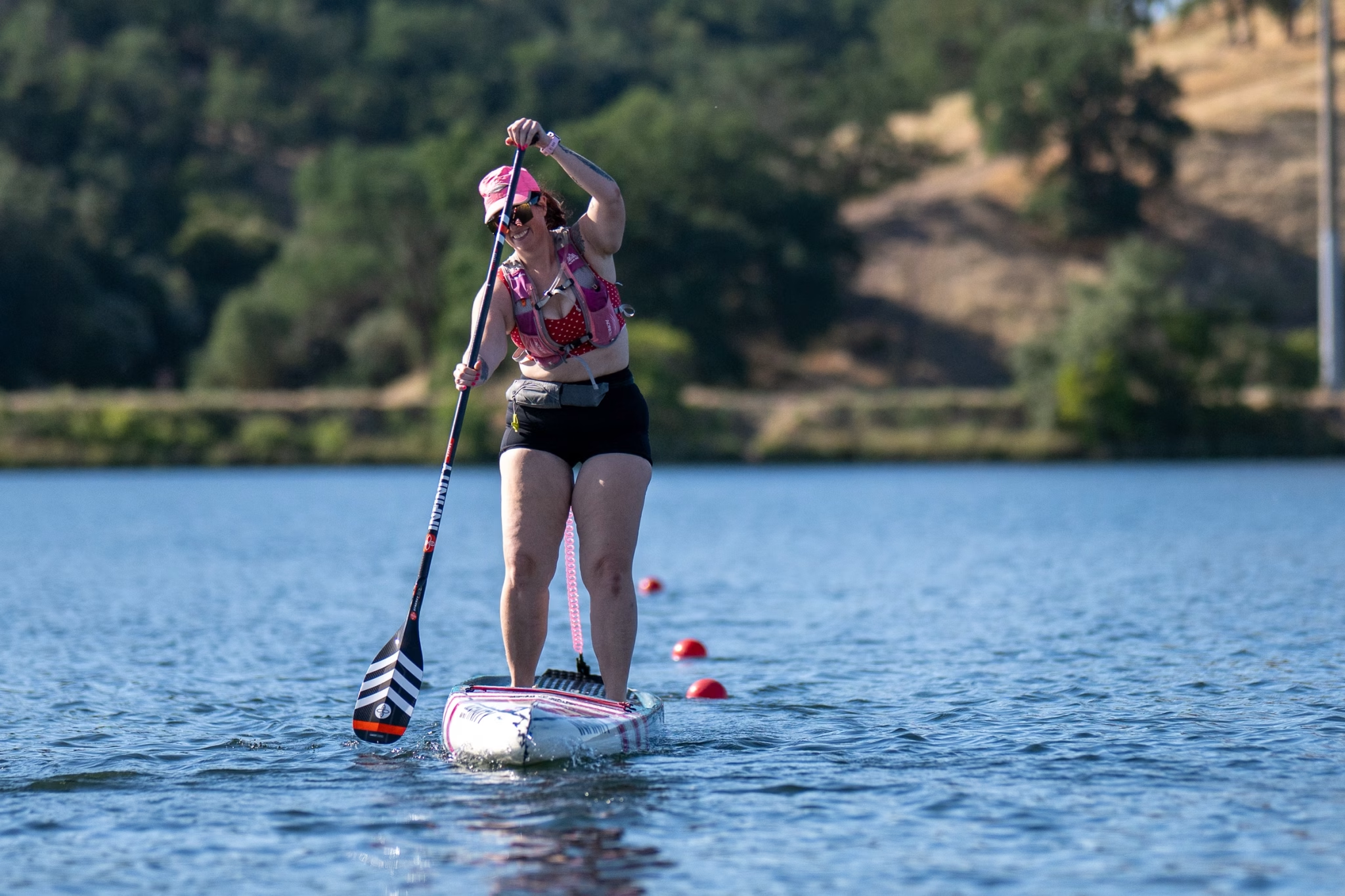
The Top Hand: Guide, Don’t Clench
Your top hand controls paddle angle and delivers the push that drives the blade through water. It does not need to be locked around the grip like a vise.
Place your palm over the T-grip with fingers draped loosely. During the catch phase, push down and forward with your palm, not your clenched fist. Between strokes, your fingers should be relaxed enough that someone could slip a piece of paper between your hand and the grip.
On a scale of 1-10 where 10 is maximum squeeze: your top hand should stay at 2-3.
The Bottom Hand: The Loose Fulcrum
This is where it goes wrong. The bottom hand acts as a pivot point, not a power generator. Your bottom hand creates a fulcrum around which the paddle rotates during each stroke. The power comes from your core rotation and shoulder engagement, channeled through the top hand push.
Hold the shaft with your fingers, not your full fist. Your thumb and index finger form a loose “O” around the shaft. The remaining three fingers rest against the shaft without squeezing. Think of holding a fishing rod, not a baseball bat.
Target grip pressure: 3-4 on the 1-10 scale. Enough to maintain contact. Not enough to turn your knuckles white.

The bird test: Imagine holding a small bird in each hand. Tight enough that it can’t escape. Loose enough that you won’t crush it. That’s approximately the grip pressure both hands should maintain throughout your paddle stroke. If your forearm muscles are visibly flexed while holding the paddle stationary, you’re squeezing too hard.
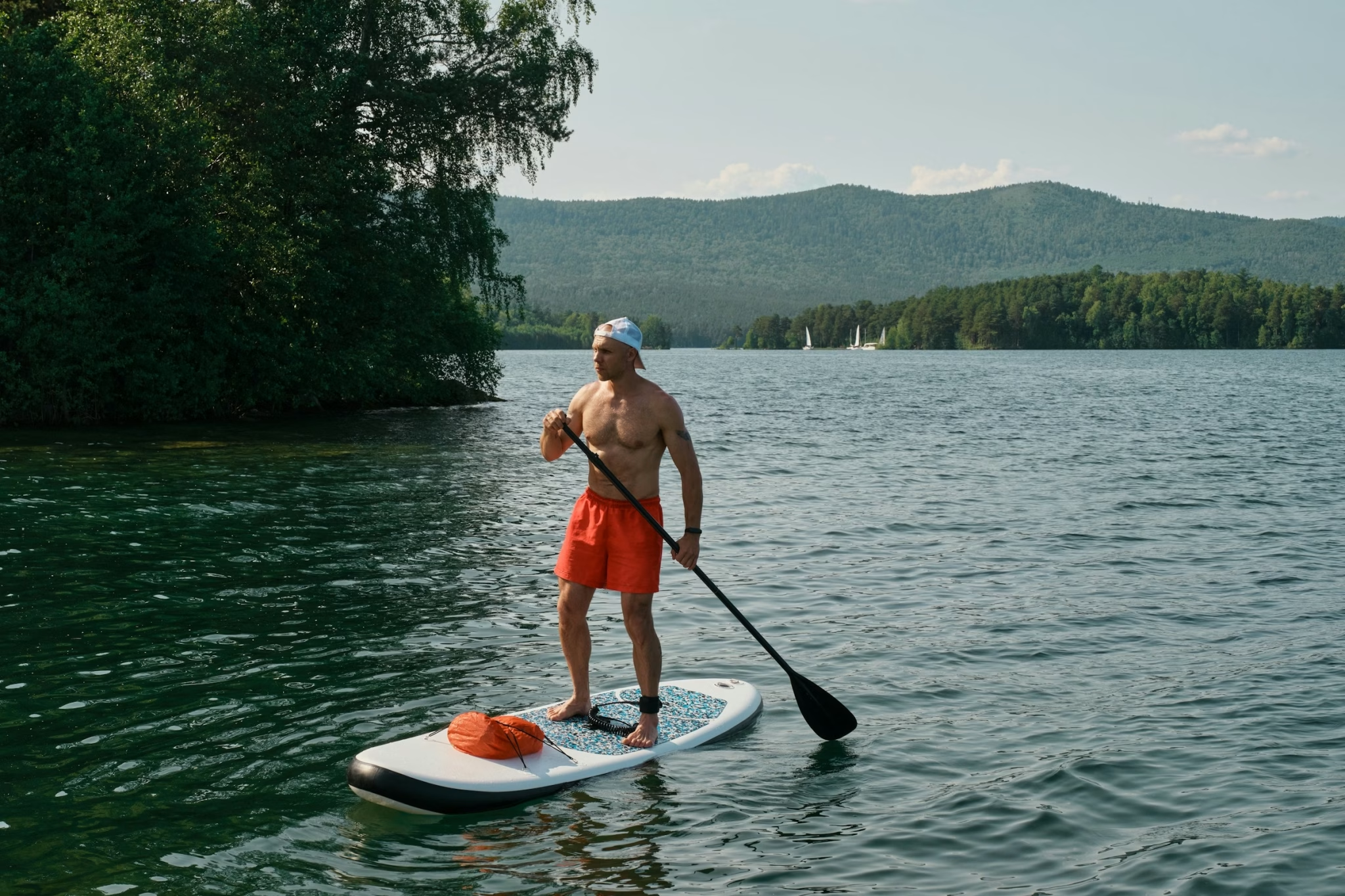
Finger Positioning and Shaft Contact
Wrap your fingers around the shaft so that your fingertips rest against the opposite side without overlapping your thumb. If your fingers press deeply into your palm, the shaft diameter may be too narrow for your hand size, forcing you to over-close your grip.
Keep your wrist in a neutral position. Not flexed, not extended, not deviated toward thumb or pinky. A neutral wrist minimizes tendon strain across all six extensor compartments. Every degree of wrist deviation increases the friction and compression forces on the tendons running through those compartments.
Paddle Shaft Diameter Considerations
Standard SUP paddle shafts range from approximately 28mm to 32mm in diameter. The research on grip ergonomics from tennis, rock climbing, and occupational health consistently shows that grip force requirements decrease as handle diameter approaches the optimal range for a given hand size.
For most adult hands, the optimal cylinder diameter for minimal grip force is between 33 and 40mm, which is roughly a D-cell battery or a thick marker, and about half the diameter of a soda can. Kong and Lowe (2005, International Journal of Industrial Ergonomics) used theoretical hand-geometry modeling and EMG measurements to nail down approximately 33mm as the diameter that minimizes cumulative-trauma risk on cylindrical handles for adult hands. Most paddle shafts fall below this range, which means your fingers must close further, your flexors work harder, and your extensors bear more stabilizing load. The standard 28-30mm diameter wasn’t designed for paddling ergonomics; it was inherited from other water-sport handles. The counter-evidence deserves a hearing, though, because it is real. Grant, Habes and Steward (NIOSH, International Journal of Industrial Ergonomics 10:199-206) measured the opposite pattern: grip strength was highest on their smallest handle, rising about 39% per centimetre of diameter reduction, and forearm EMG effort climbed as diameter grew. Those studies measured maximal force production on short tasks. Kong and Lowe were modelling cumulative-trauma risk over sustained use, which is the paddler’s problem. So treat 33mm as a reasonable target for long-haul comfort rather than a settled number, and change one variable at a time so you can tell whether it helped.
| Shaft Diameter | Grip Implication | Who Benefits |
|---|---|---|
| 28mm (standard narrow) | Higher grip force required; fingers close tightly | Smaller hands; sprint paddlers prioritizing light weight |
| 30mm (standard) | Moderate grip force; most common size | Average hand size; general-purpose paddling |
| 32mm (oversized) | Reduced grip force; more relaxed finger positioning | Larger hands; distance paddlers; those with grip pain |
| Oval/ergonomic shaft | Distributes pressure across palm; reduces rotation | Anyone with dorsal hand pain; long-distance paddlers |
If you’re experiencing chronic hand pain on a standard round shaft, adding a grip wrap (tennis overgrip tape, silicone sleeve, or neoprene wrap) can increase the effective diameter by 1-3mm while also improving surface friction. Better friction means less squeeze force needed to prevent slippage.
Hand Position Adjustments for Long Distance
Static grip position over 8+ miles creates localized tissue fatigue that no amount of relaxation technique can fully overcome. The solution is systematic variation.
Stroke rate sets how much tissue load a given distance costs you. At 45 strokes per minute a two-hour paddle is about 5,400 grip cycles. Let the rate drift to 60 under fatigue, which is what tired paddlers do, and the same two hours costs 7,200. That is 1,800 extra loading cycles for no additional distance, landing on tendons that are already fatigued. Research on SUP cadence points the same direction for reasons of economy: Castaneda-Babarro et al. (2020) found 45 spm more efficient than 55 or 65 in international racers. Slowing the rate and lengthening the pull is one of the few changes that reduces hand load and improves efficiency at the same time. The metronome protocol in my speed benchmarks piece covers how to train it.
Micro-Adjustments Every 15-20 Minutes
Shift your bottom hand position by 2-3 inches up or down the shaft. This redistributes pressure contact points on your palm and slightly changes the wrist angle, giving stressed tissue brief recovery windows. You won’t notice any performance difference. Your tendons will.
Side Switching and Its Effect on Grip
Every side switch forces a complete grip reset. Your hands change roles: the former top hand becomes the bottom fulcrum and vice versa. This is one of the strongest arguments for frequent switching (every 4-6 strokes in a touring cadence rather than paddling 20-30 strokes per side).
Frequent switching does two things for your hands. It prevents any single tendon crossover point from enduring continuous friction, and it gives each hand’s extensor muscles intermittent rest periods, keeping overall muscle fatigue below the threshold where involuntary grip tightening begins.
Widening and Narrowing Through a Long Paddle
In the first third of a long paddle, when you’re fresh, a slightly wider hand spacing generates efficient power with minimal perceived effort. As fatigue accumulates in the second third, narrowing your grip by 2-3 inches reduces the leverage (and thus the force) required from your arms, shifting more demand to core rotation. In the final miles, find whatever spacing allows you to maintain a loose grip without losing paddle control.
This isn’t weakness. It’s intelligent load management over distance.
Active Finger Releases
Every few minutes, consciously splay your fingers open on the shaft (one hand at a time, maintaining contact with the other). Hold the stretch for 3-5 seconds. This breaks the sustained flexor contraction pattern and allows momentary blood flow restoration to the forearm muscles. I started doing this after learning about the 15% MVC blood flow threshold and the reduction in cramping episodes was noticeable within one session.
Prevention Exercises
The goal of a grip-specific exercise program for paddlers is twofold: strengthen the extensor tendons to tolerate sustained load, and build grip endurance so the muscles fatigue more slowly. Two evidence-supported approaches dominate the contemporary literature: eccentric loading and heavy slow resistance (HSR). The 2012 randomized controlled trial in the American Journal of Sports Medicine established eccentric protocols (slow, controlled lengthening phase under load) as effective for extensor tendinopathy, with significant pain reduction and functional improvement at 6 to 12 weeks. More recent work, including Beyer et al. (2015, AJSM) on Achilles tendinopathy and Wang et al. (2024, Heliyon) on patellar tendinopathy in network meta-analysis, finds that heavy slow resistance training (controlled tempo in both directions, 3-second concentric and 3-second eccentric, with progressively heavier loads) produces equal or better outcomes than eccentric-only protocols, with arguably better adherence because the slower tempo feels less awkward than pure eccentric work. The honest update is that the field has moved from “eccentric is the gold standard” to “eccentric and HSR are both evidence-supported, pick the one you will actually do consistently.” For the wrist extensors specifically, the underlying principle holds across both protocols: load the tendon under controlled tension. The grip-specific work below complements the full off-water strength program covering core, balance, and shoulder resilience.
Source: Tyler, T.F. et al., “Eccentric Strengthening for Chronic Lateral Epicondylosis: A Prospective Randomized Study,” American Journal of Sports Medicine, 40(10):2351-2356, 2012. PMC Full Text.
1. Eccentric Wrist Extensions
Target: Extensor carpi radialis longus and brevis (second compartment tendons)
How: Rest your forearm on a table, hand hanging off the edge, palm facing down. Hold a light dumbbell (2-5 lbs) or a can of soup. Start with the wrist extended (raised). Slowly lower the weight by allowing your wrist to flex over 3-4 seconds. Use the opposite hand to lift the weight back to the starting position. The eccentric phase (lowering) is the therapeutic component.
Sets/Reps: 3 sets of 15 repetitions per hand | Frequency: Daily, or minimum 5 days per week | Progression: Increase weight by 1 lb when you can complete all sets pain-free
2. Finger Extensions with Rubber Band
Target: Extensor digitorum communis and intrinsic hand muscles
How: Place a thick rubber band (or purpose-made finger extensor band kit) around all five fingertips. Spread your fingers apart against the resistance, hold for 2 seconds, return slowly. The band should provide moderate resistance without causing pain.
Sets/Reps: 3 sets of 20 repetitions per hand | Frequency: Daily | Progression: Add a second rubber band or switch to a heavier resistance band
3. Wrist Circles
Target: Full wrist mobility and synovial fluid distribution across all six compartments
How: Extend your arm, make a loose fist, and slowly rotate your wrist in complete circles. 10 clockwise, 10 counterclockwise. Focus on smooth, full range of motion without forcing through any painful arcs.
Sets/Reps: 2 sets of 10 circles each direction, each hand | Frequency: Before and after every paddle session; daily on off-days | Progression: Hold a 1-2 lb weight for added resistance
4. Forearm Pronation/Supination
Target: Pronator and supinator muscles; reduces imbalance between forearm rotators
How: Hold a hammer or weighted bar at one end (the weight creates a rotational lever). Elbow bent 90 degrees at your side. Rotate your forearm so your palm faces up (supination), pause, then rotate so your palm faces down (pronation). Control the movement in both directions; don’t let gravity do the work.
Sets/Reps: 3 sets of 12 repetitions per arm | Frequency: 3-4 days per week | Progression: Move your grip further from the weighted end to increase the lever arm
5. Grip Endurance Holds (Farmer’s Carry Variation)
Target: Sustained grip endurance without maximal force; trains your forearm to maintain sub-maximal contraction over time
How: Hold a moderately heavy dumbbell or kettlebell in each hand (20-40 lbs depending on your baseline). Stand upright, shoulders back. Hold for time. The key is not maximum weight but maintaining a sustained hold at moderate load until your grip begins to fatigue.
Sets/Reps: 3 holds of 30-60 seconds | Frequency: 2-3 days per week (allow 48 hours between sessions) | Progression: Increase hold duration by 10 seconds before increasing weight
6. Isometric Thumb Abduction
Target: First dorsal compartment tendons (abductor pollicis longus, extensor pollicis brevis), loaded without taking the wrist to end range
How: Rest your hand on a table, thumb up and wrist straight. Press the thumb gently outward against two fingers of your other hand and hold, keeping the thumb still. The effort should be firm and comfortable, and the wrist should stay neutral throughout. Hold 20 to 30 seconds.
A note on what changed here. An earlier version of this article prescribed a thumb-in-fist stretch with the wrist bent toward the pinky side. That movement is the Eichhoff maneuver, which clinicians use to provoke and diagnose De Quervain’s, not to treat it. Loading the compartment isometrically with the wrist neutral gives the tendons work without taking them to the position that reproduces the pain.
Sets/Reps: 3 holds of 20-30 seconds per hand | Frequency: Daily for maintenance | Progression: Increase the pressure you press against, keeping the wrist neutral. Stop if it reproduces pain along the thumb side of the wrist and get it assessed.
| Exercise | Primary Target | Sets x Reps | Frequency |
|---|---|---|---|
| Eccentric Wrist Extensions | Second compartment extensors | 3 x 15 | Daily |
| Rubber Band Finger Extensions | Extensor digitorum; intrinsic hand muscles | 3 x 20 | Daily |
| Wrist Circles | Full wrist mobility | 2 x 10 each direction | Pre/post paddle; daily |
| Forearm Pronation/Supination | Forearm rotator balance | 3 x 12 | 3-4x per week |
| Grip Endurance Holds | Sustained grip endurance | 3 x 30-60 sec | 2-3x per week |
| Isometric Thumb Abduction | First compartment tendons | 3 x 20-30 sec | Daily |
When Pain Means Stop
Normal post-paddle fatigue feels like tiredness in your forearms and hands. It resolves within 24 hours, doesn’t wake you at night, and doesn’t worsen with normal daily activities like turning a doorknob or lifting a coffee mug.
Injury signals are different. Pay attention to these red flags:
Persistent numbness or tingling in your fingers. This suggests nerve compression, not tendon inflammation. The dorsal branch of the radial nerve runs directly over the first compartment tendons and can become entrapped by swollen tissue. Numbness that persists more than a few hours after paddling warrants medical evaluation. For preventive maintenance on the neurological side specifically, a daily routine of median, ulnar, and radial nerve glides takes about five minutes and addresses paddling-induced neural tension before it becomes a chronic problem.
Catching or locking sensation when moving your fingers. If a finger catches in a bent position and then snaps straight, that is trigger finger, a thickening of the flexor tendon sheath at the A1 pulley on the palm side. It is not a tear and it is not an emergency, though it does need a hand specialist rather than more paddling. A mechanical clunk on wrist extension is a separate problem and worth the same appointment.
Swelling that doesn’t resolve within 48 hours. Post-exercise puffiness is normal. A visible lump or persistent swelling on the dorsal wrist that remains after two days of rest, ice, and elevation suggests ongoing inflammatory pathology that needs imaging.
Pain at rest, especially at night. Tendon pain that wakes you up or persists when your hand is completely still indicates the condition has progressed beyond simple overuse. Night pain is a clinical hallmark of advancing tendinopathy.
Progressive weakness in grip strength. If you notice you’re dropping things, struggling to open jars, or your grip gives out unexpectedly during normal activities, the tendons may be structurally compromised. This requires professional assessment.
Pain that worsens despite rest. If a week of complete rest doesn’t improve symptoms, something beyond basic inflammation is occurring. Continued activity at this stage risks converting a treatable tendinitis into a chronic tendinopathy with structural tendon degeneration.
The 48-hour rule: If hand or wrist pain from paddling doesn’t improve meaningfully within 48 hours of rest, ice, compression, and elevation (RICE), treat it as a potential injury, not just soreness. Early intervention with a sports medicine physician or hand therapist makes the difference between two weeks off the water and two months.
The Bottom Line
Dorsal hand pain on long paddles comes from grip force, not mileage alone. It is a grip technique problem with a biomechanical solution. The tendons across the back of your hand and wrist are being compressed, rubbed, and overloaded by sustained excessive grip force applied without noticing. Relax your grip to 3-4 on a 10-point scale. Let your bottom hand act as a fulcrum. Switch sides frequently. Build extensor strength with daily eccentric exercises. Add forearm and pectoral stretching on rest days to keep the surrounding tissue from pulling everything back into the death-grip default. And if the pain persists beyond 48 hours of rest, put down the paddle and see a specialist. Your hands have to last longer than any single paddling season.
Sources
- Grundberg, A.B. & Reagan, D.S. (1985). “Pathologic Anatomy of the Forearm: Intersection Syndrome.” Journal of Hand Surgery, 10(2):299-302.
- Draghi, F. & Bortolotto, C. (2014). “Intersection Syndrome: Ultrasound Imaging.” Skeletal Radiology, 43(3):283-287.
- Rossi, C. et al. (2019). “Intersection Syndrome: An Acute Surgical Disease in Elite Rowers.” British Journal of Sports Medicine, 53(Suppl 1):A46. PMC Full Text
- Challoumas, D. et al. (2023). “Management of de Quervain Tenosynovitis: A Systematic Review and Network Meta-Analysis.” JAMA Network Open, 6(5):e2311372. Full Text
- De Quervain Tenosynovitis. StatPearls, NCBI Bookshelf, 2024. Full Text
- Intersection Syndrome. StatPearls, NCBI Bookshelf, 2024. Full Text
- Tyler, T.F. et al. (2012). “Eccentric Strengthening for Chronic Lateral Epicondylosis: A Prospective Randomized Study.” American Journal of Sports Medicine, 40(10):2351-2356. PMC Full Text
- Montechiarello, S. et al. (2011). “Forearm Pain, Diagnosed as Intersection Syndrome, Managed by Taping: A Case Series.” Journal of Orthopaedic & Sports Physical Therapy, 41(2). Full Text
- Kim, J.K. & Park, M.G. (2014). “Effects of eccentric control exercise for wrist extensor and shoulder stabilization exercise on the pain and functions of tennis elbow.” Journal of Physical Therapy Science. PMC Full Text
- Sjogaard, G. (1986). “Intramuscular changes during long-term contraction.” The Ergonomics of Working Postures, Taylor & Francis.
Frequently Asked Questions
Why does the back of my hand hurt after long paddle board sessions?
Pain on the dorsal (back) side of the hand and wrist after paddling is typically caused by overuse of the extensor tendons. Sustained overgripping forces the extensor muscles to work continuously as wrist stabilizers, creating inflammation at anatomical crossover points. The two most common diagnoses are intersection syndrome and De Quervain’s tenosynovitis, both involving tendons on the thumb side of the dorsal wrist.
What is intersection syndrome and how does it relate to paddling?
Intersection syndrome is a tenosynovitis where the first dorsal compartment tendons cross over the second compartment tendons, roughly 4-6 centimeters above the wrist. Repetitive gripping motions in paddling cause the first compartment muscles to hypertrophy and create friction at this crossover point. It presents as pain and sometimes a creaking sensation on the dorsal forearm just above the wrist.
How tight should I grip my SUP paddle?
On a scale of 1 to 10, your grip pressure should be 3-4. Your bottom hand acts as a loose fulcrum and should never exceed 4; your top hand stays at 2-3. A common test: imagine holding a small bird firmly enough to prevent escape but gently enough not to harm it. If your knuckles are white or your forearm muscles are visibly tensed, you are gripping too hard.
What’s the difference between De Quervain’s tendonitis and intersection syndrome?
Both involve first compartment tendons, but at different locations. De Quervain’s occurs where these tendons pass through a tunnel at the radial styloid (the bump on your thumb-side wrist). Intersection syndrome occurs further up the forearm, where first compartment tendons cross over the second compartment. De Quervain’s produces pain directly at the wrist; intersection syndrome pain is 4-6 cm proximal to the wrist.
Can paddle shaft diameter cause hand pain?
Yes. Shafts that are too narrow for your hand size force greater finger flexor contraction to maintain grip, which increases the opposing extensor tendon load. Research on grip ergonomics shows that optimal grip force occurs with a diameter of roughly 33-40mm. Most SUP paddle shafts are 28-32mm. Adding grip tape or a silicone sleeve can increase effective diameter by 1-3mm and reduce required squeeze force.
How often should I switch sides while paddling to prevent hand pain?
For hand health specifically, switching every 4-6 strokes is more beneficial than paddling 20-30 strokes per side. Each switch forces a complete grip reset, changes which tendons bear the primary load, and gives each hand’s extensor muscles intermittent recovery periods. Frequent switching prevents any single anatomical crossover point from enduring continuous friction.
What exercises prevent hand and wrist pain from paddle boarding?
The most evidence-supported exercises are eccentric wrist extensions (3 sets of 15, daily) or heavy slow resistance wrist extensions (3 sets of 8 at controlled 3-second tempo in both directions, 2-3 times per week), finger extensions with a rubber band (3 sets of 20, daily), and grip endurance holds (3 sets of 30-60 seconds, 2-3 times per week). Both eccentric and HSR protocols strengthen the extensor tendons under load with significant pain reduction documented within 6-12 weeks of consistent training. Beyer et al. 2015 (AJSM) and Wang et al. 2024 (Heliyon) network meta-analysis found the two protocols produce equal or HSR-favorable outcomes; pick whichever you will adhere to.
Should I use an ergonomic or oval paddle shaft?
Ergonomic and oval shafts distribute pressure more evenly across the palm and reduce the shaft’s tendency to rotate in your hand during strokes. This means less grip force is needed to maintain paddle orientation. If you experience chronic dorsal hand pain despite correcting grip technique, switching to an oval or ergonomic shaft is a worthwhile investment before the problem progresses.
When should I see a doctor about paddling-related hand pain?
See a medical professional if: pain persists more than 48 hours after rest, you experience numbness or tingling in your fingers, a finger catches or locks during movement, swelling doesn’t resolve with ice and elevation, you have pain at rest or pain that wakes you at night, or grip strength is progressively declining during everyday activities.
Is hand pain from paddle boarding permanent?
Usually no. Early-stage extensor tendinitis and intersection syndrome respond well to conservative treatment: rest, grip technique correction, and progressive eccentric strengthening exercises. A 2017 synthesis of evidence in Hand Clinics reported that non-surgical management resolved symptoms in the majority of intersection syndrome cases. However, continued paddling through worsening pain can convert treatable tendinitis into chronic tendinopathy with structural degeneration.
Does wearing a wrist brace help with paddle board hand pain?
A thumb spica splint can help during the acute inflammation phase of De Quervain’s tenosynovitis by immobilizing the first compartment tendons. For intersection syndrome, taping with nonstretch sports tape applied across the dorsal forearm has shown benefit in case studies. Braces and tape address the symptom while the grip force continues. Grip technique correction and extensor strengthening are essential for long-term resolution.
Can I paddle through mild hand pain or should I rest completely?
Mild post-paddle soreness that resolves within 24 hours is generally safe to paddle through, provided you actively correct your grip technique. Pain that persists into the next day, worsens during a session, or produces visible swelling requires rest. The standard guideline is 48 hours of complete rest from the aggravating activity. Paddling through escalating pain converts a minor overuse irritation into a clinical tendinopathy that takes weeks or months to resolve.
Affiliate disclosure: Some product links in this article are Amazon affiliate links. MK Library earns a small commission on qualifying purchases at no additional cost to you. Equipment recommendations are tied to the eccentric and finger-extensor exercises described above, not compensation.
Article Updates
- September 8, 2026: Added the relationship between stroke rate and grip loading: at 45 spm a two-hour paddle is about 5,400 grip cycles, and letting the rate drift to 60 adds roughly 1,800 more for no extra distance. Added a photograph showing hand placement on the shaft, replacing stock imagery as the article’s illustration of grip position.
- August 4, 2026: Replaced Exercise 6. The movement described was the Eichhoff maneuver, which clinicians use to provoke and diagnose De Quervain’s, and it was prescribed twice daily with a progression that increased the provocative angle. It is now an isometric hold with the wrist neutral. Corrected the trigger finger description, which called it a possible tear and told readers to stop paddling immediately; it is a thickening of the flexor tendon sheath and wants a hand specialist rather than an emergency room. Fixed two citations, removed one that could not be verified, and added the countervailing evidence on paddle shaft diameter.
- May 22, 2026: Original research and publication. All orthopedic and sports medicine sources current as of publication date.


