Seven miles into an August paddle on Lake Natoma, I pulled my hands off the shaft and tried to make a fist. My ring finger and pinky on the right hand wouldn’t fully close.
They felt thick, clumsy, like they belonged to someone else. The tingling had started around mile 5, a low-level buzzing I’d tried to shake out by switching grip positions. By mile 7, the numbness extended from my outer forearm into those two fingers, and my grip strength had dropped enough that I was genuinely worried about dropping the paddle.
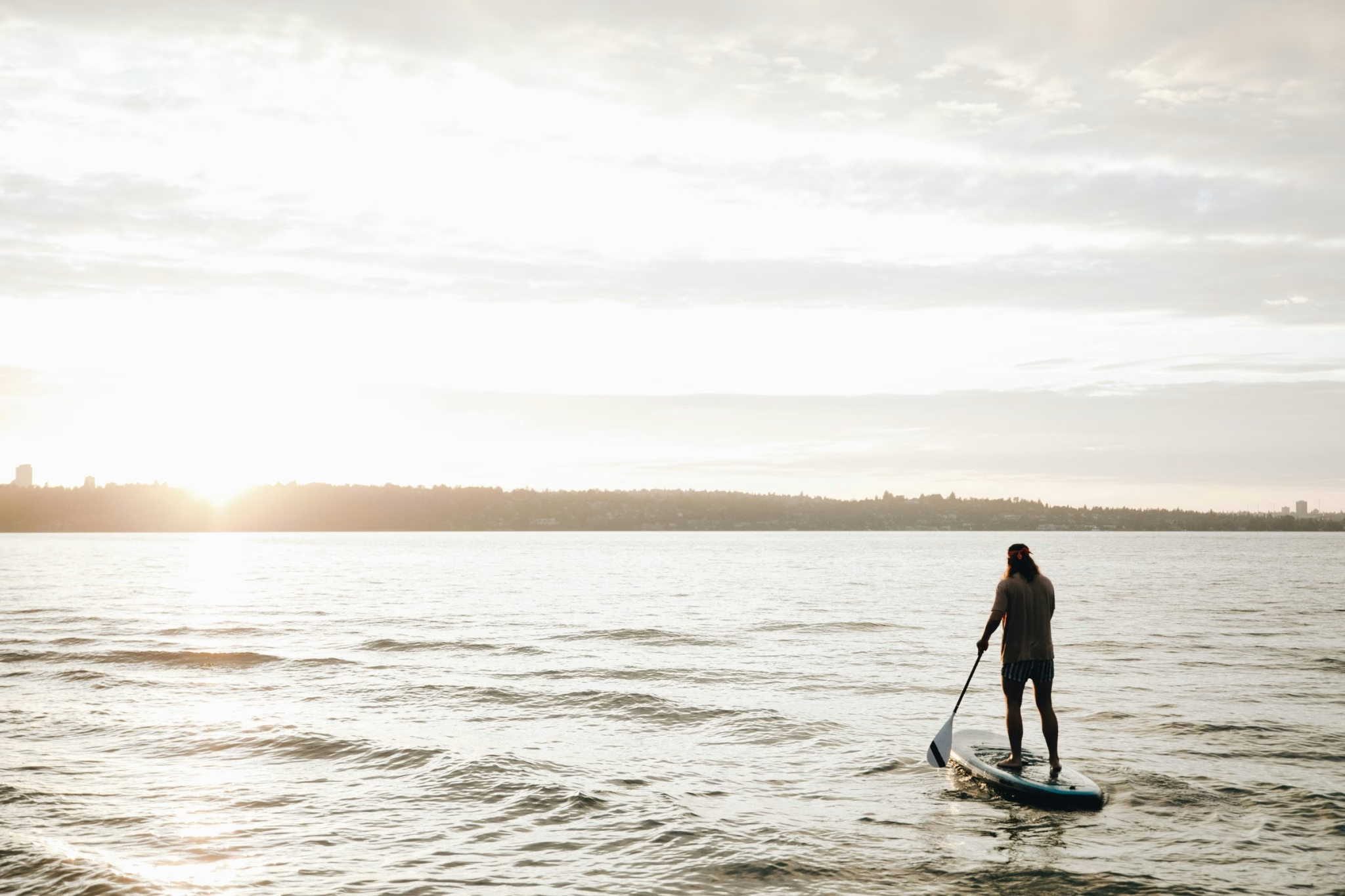
I’d been gripping a carbon fiber shaft for over two hours straight. Sustained wrist extension. Repetitive rotation through the catch and pull.
Elbows cycling between flexion and extension a few thousand times. My nervous system, it turned out, had opinions about all of this. (The muscular side of grip overuse, including intersection syndrome and dorsal wrist pain, is covered separately in my guide to preventing paddle grip hand pain. The neurological side works differently.)
To be completely transparent, I had no idea what a nerve glide was until a physical therapist friend watched me massaging my forearms after a session and said, “You don’t have a muscle problem. You have a nerve problem.” That conversation led me down a research rabbit hole into neurodynamics, neural mobilization, and a set of exercises so simple they feel almost too easy to work.
But the science is solid. And my hands don’t go numb anymore.
Key Takeaways
- Nerve glides (neural mobilization) are controlled movements that help peripheral nerves slide through surrounding muscles, bones, and fascia. They reduce adhesions and restore normal nerve mobility without stretching or straining the nerve itself.
- Paddleboarding loads three specific nerves: the median nerve (sustained grip), the ulnar nerve (elbow flexion posture), and the radial nerve (wrist extension during the stroke). Two or more hours of this creates measurable neural tension.
- Sliding techniques produce 12.6 mm of median nerve excursion at the wrist versus 6.1 mm for tensioning, with substantially less strain (0.8% vs. 6.8%), making them safer and more effective for maintenance (Coppieters & Butler, 2008).
- A 5-minute daily routine covering all three nerves can prevent the tingling, numbness, and grip weakness that plague long-distance paddlers. The exercises require zero equipment.
- Neural mobilization shows clinically meaningful benefits for pain reduction in nerve-related conditions, according to a 2017 systematic review of 40 randomized controlled trials (Basson et al., JOSPT).
- Post-paddle nerve glides within 15-30 minutes of finishing can accelerate neural recovery and prevent cumulative tension from building across training sessions.
- Persistent numbness, progressive weakness, or pain that worsens with nerve glides are red flags requiring professional evaluation. These exercises are maintenance tools, not treatments for diagnosed nerve compression.
What Are Nerve Glides?
Your peripheral nerves aren’t static cables bolted into place. They move.
Every time you bend your elbow, turn your head, or flex your wrist, the nerves running through those joints must glide through tunnels of muscle, bone, and connective tissue. David Butler, one of the foundational researchers in this field, described it eloquently in The Sensitive Nervous System (2000): the nervous system “continually glides and slides and stretches and angulates as it adapts to the movements it orchestrates.”
Nerve glides (also called neural mobilization, nerve flossing, or neurodynamic exercises) are controlled, specific movements designed to facilitate this natural sliding. They are not stretches. This distinction matters enormously. Stretching a nerve increases tension along its entire length. Gliding moves the nerve through its pathway while keeping overall tension low.
Michael Shacklock formalized this distinction in Clinical Neurodynamics (2005), categorizing neural mobilization into two primary techniques. Sliding techniques lengthen the nerve bed at one joint while simultaneously shortening it at another, producing large nerve excursion with minimal strain.
Tensioning techniques lengthen the nerve bed from multiple points simultaneously, producing less excursion but significantly more mechanical load. For self-management and prevention, sliding techniques are the appropriate choice.
Source: Butler, D.S. (2000). The Sensitive Nervous System. Noigroup Publications; Shacklock, M. (2005). Clinical Neurodynamics: A New System of Neuromusculoskeletal Treatment. Elsevier.
Nerves move more than you’d expect during these exercises. Coppieters and Butler (2008) compared the two techniques directly. Sliding produced 12.6 mm of longitudinal median nerve movement at the wrist, against 6.1 mm for tensioning, and the larger excursion came with far less strain (0.8% for sliding versus 6.8% for tensioning). More nerve movement, less mechanical load. Coppieters, Hough and Dilley (2009) later watched the same pattern happen in living tissue with dynamic ultrasound, measuring 10.2 mm of excursion for sliders against 1.8 mm for tensioners, though they tracked the nerve in the upper arm rather than at the wrist.
The 2025 evidence base for neural mobilization keeps building. A May 2025 systematic review and meta-analysis in Clinical Rehabilitation (Gillot et al.) pooled 20 studies and 953 patients with nerve-related neck and arm pain and found that neural mobilization, whether used alone or alongside conventional physiotherapy, produces significant positive effects on pain severity, range of movement, grip strength, and disability. Two things temper that. The review graded its own evidence low to very low certainty, and grip strength and range of movement were reported rather than pooled. Effect sizes swing widely between studies. Nerve glides help. They do not help everyone equally.
Source: Coppieters, M.W., Hough, A.D., & Dilley, A. (2009). “Different Nerve-Gliding Exercises Induce Different Magnitudes of Median Nerve Longitudinal Excursion.” Journal of Orthopaedic & Sports Physical Therapy, 39(3):164-171. JOSPT.
Why Paddlers Specifically Need Them
Every paddle stroke is a coordinated assault on your upper extremity nerves. That sounds dramatic. It isn’t dramatic enough.
Consider what your arms do during a two-hour touring session. Your dominant hand grips the shaft with sustained force, compressing the median nerve through the carpal tunnel at the wrist. Your top hand maintains wrist extension throughout the stroke cycle, loading the radial nerve where it wraps around the back of the forearm. Both elbows cycle through flexion during the catch phase, stretching the ulnar nerve across the medial epicondyle (the “funny bone” groove) thousands of times. All of this happens while your core and shoulders generate the rotational force that propels the board.

The research on repetitive motion and nerve compression is unambiguous. A comprehensive review in Cureus (2022) confirmed that carpal tunnel syndrome, the most prevalent focal mononeuropathy (constituting 90% of all entrapment neuropathy cases), is strongly associated with “prolonged and highly repetitious flexion and extension of the wrist, especially when allied with a forceful grip.” That description maps precisely to paddle sports.
Source: Genova, A. et al. (2020). “Carpal Tunnel Syndrome: A Review of Literature.” Cureus, 12(3):e7333. PMC.
The ulnar nerve is equally vulnerable. Unlike the median and radial nerves, the ulnar nerve sits in a shallow groove at the elbow with minimal soft tissue protection. Sustained elbow flexion (exactly the posture of a top hand on a paddle) increases intraneural pressure in the cubital tunnel by up to seven times compared to the extended position. Gelberman et al. measured this directly in 1998 in a cadaver study published in the Journal of Bone and Joint Surgery: minimum intraneural pressure sits at 30 to 60 degrees of flexion, and rises sharply past 90 degrees as the tunnel loses 30 to 41% of its cross-sectional volume. Translation for paddlers: a more open elbow angle at the top hand is mechanically protective. A 2025 study in the Journal of Hand Surgery Global Online demonstrated that ulnar nerve gliding exercises produced significant improvements in grip strength, pinch strength, and symptom severity for moderate cubital tunnel syndrome.
Source: “Clinical outcomes of ulnar nerve gliding exercise in the nonoperative treatment of cubital tunnel syndrome.” Journal of Hand Surgery Global Online, 2025. PMC.
Here’s the compounding factor specific to SUP: unlike cycling (where you can coast) or running (where you can walk), paddle boarding at touring pace requires continuous upper body engagement. You can’t rest your hands while maintaining forward momentum. On a 7-8 mile paddle, your grip never gets a true break. The neural tension accumulates without relief.
The Three Nerves Involved
Understanding basic anatomy helps you target the right exercises. You don’t need a medical degree. You need a map.
Median Nerve
The median nerve runs from your neck, through the front of your shoulder, down the center of your forearm, and through the carpal tunnel at the wrist into your thumb, index, middle, and half of your ring finger.
It controls grip strength and fine motor precision. When compressed or restricted, you get numbness in those first three and a half fingers, weakness when gripping, and that burning or tingling sensation across the palm.
On a paddle board, sustained grip compresses the median nerve at the carpal tunnel. Repetitive wrist flexion and extension during the stroke cycle creates friction where the nerve passes through the forearm muscles.
Ulnar Nerve
The ulnar nerve travels from your neck, behind the medial epicondyle of the elbow (that bony bump on the inside), and into the ring and pinky fingers. It controls the small muscles of the hand that manage fine dexterity and the power grip between your ring/pinky fingers and palm.
The numbness I experienced at mile 7, specifically in the ring and pinky fingers, was textbook ulnar nerve irritation. The top hand on a paddle maintains sustained elbow flexion, stretching the ulnar nerve across that bony groove for the entire session. The nerve has almost no padding there. Two hours of repetitive stretch is a lot to ask.
Radial Nerve
The radial nerve runs along the back of the upper arm, spirals around the humerus, and travels down the posterior forearm to the back of the hand and first three fingers. It controls wrist extension and finger straightening.
During the catch and pull phases of the paddle stroke, your wrists maintain extension against resistance. The radial nerve, already in a lengthened position from the extended wrist, gets loaded further by the pronation and supination that occurs during stroke mechanics. Irritation manifests as aching along the top of the forearm and the back of the hand.
Median Nerve Glide Exercises
Medical disclaimer: These exercises are for general mobility maintenance and prevention. They are not a substitute for professional diagnosis or treatment. If you have diagnosed carpal tunnel syndrome, cubital tunnel syndrome, or any peripheral neuropathy, consult your physician or physical therapist before performing nerve glides. Stop immediately if any exercise increases your symptoms.
Exercise 1: Median Nerve Slider (The Fist-to-Fan)
Target nerve: Median nerve
Starting position: Stand or sit tall. Extend your right arm out to the side at shoulder height, palm facing the ceiling. Make a loose fist with your thumb wrapped over your fingers. Your head should be in a neutral position, looking straight ahead.
Movement:
- Slowly open your hand, spreading all five fingers wide (like a fan). As you open the hand, simultaneously tilt your head toward the outstretched arm (right ear toward right shoulder).
- Hold the open position for 2 seconds.
- Slowly close back to a fist while simultaneously tilting your head away from the outstretched arm (left ear toward left shoulder).
- Hold the fist position for 2 seconds.
Why it works: Opening the hand lengthens the nerve bed at the wrist while the head tilt shortens it at the neck. Closing the fist shortens the wrist end while the opposite head tilt lengthens the neck end. The nerve slides back and forth without increasing total tension.
Sets/Reps: 10 repetitions per arm, 2 sets. Rest 30 seconds between sets.
Frequency: Daily. Before and after paddling sessions.
Key form cues: Keep your elbow straight but not locked. Move slowly and rhythmically. The head tilt and hand movement happen simultaneously. If you feel sharp pain or increased tingling, reduce the range of motion or stop.
Exercise 2: Median Nerve Slider (Progressive Wrist Extension)
Target nerve: Median nerve through the carpal tunnel
Starting position: Stand or sit upright. Extend your arm in front of you at shoulder height, elbow straight, palm facing the floor.
Movement:
- Begin with your wrist in a relaxed, slightly flexed position (fingers pointing toward the floor at about 45 degrees).
- Slowly extend your wrist so your fingers point straight ahead (neutral), then continue extending until your fingers point toward the ceiling, palm facing away from you.
- At the point of maximum comfortable wrist extension, gently spread your fingers apart.
- Hold for 3 seconds.
- Slowly return to the starting flexed position, closing your fingers together as you come back.
Sets/Reps: 8 repetitions per arm, 2 sets.
Frequency: Daily, and during paddle breaks.
Key form cues: The movement should be smooth, taking about 4-5 seconds in each direction. You should feel a gentle pulling sensation along the inner forearm and palm, never sharp pain. If you have existing carpal tunnel symptoms, limit the wrist extension to the point just before tingling begins.
Exercise 3: Seated Median Nerve Glide (Six-Position Sequence)
Target nerve: Full median nerve pathway from neck to fingertips
Starting position: Sit in a chair. Place your affected hand on your thigh, palm up, fingers relaxed.
Movement (6 progressive positions, hold each for 3 seconds):
- Position 1: Make a fist with wrist in neutral. (Baseline, no nerve tension.)
- Position 2: Straighten fingers and thumb, keeping wrist neutral. Palm flat, fingers extended.
- Position 3: Extend wrist back (bend hand backward) while keeping fingers straight.
- Position 4: Maintain wrist extension and extend the thumb out to the side, away from the palm.
- Position 5: Maintain all previous positions. Rotate your forearm so the palm faces the ceiling (supination).
- Position 6: Maintain everything. With your other hand, gently apply a light stretch to the thumb.
Sets/Reps: Move through all 6 positions as one sequence. Repeat 5 times per hand.
Frequency: Once daily. This is more intensive than the other two exercises. Not recommended immediately before paddling.
Key form cues: Progress only as far as comfortable. Expect a strong sensation at Position 4 or 5. That’s normal. Sharp, electric, or shooting sensations mean you’ve gone too far. Back off one position.
Source: Therapeutic exercise program adapted from AAOS guidelines. AAOS PDF.
Ulnar Nerve Glide Exercises
Exercise 1: Ulnar Nerve Slider (The Waiter’s Tray)
Target nerve: Ulnar nerve at the cubital tunnel
Starting position: Stand or sit tall. Bend your right elbow fully, bringing your hand toward your shoulder with your palm facing you. Your wrist should be flexed (curled toward you) with fingers pointing at your shoulder.
Movement:
- Slowly straighten your elbow out to the side while simultaneously extending your wrist (bending it backward) and spreading your fingers. Your arm moves outward like you’re presenting a tray.
- At full extension, your arm should be out to the side at approximately shoulder height, elbow straight, wrist extended, fingers spread, palm facing the ceiling.
- Hold for 2 seconds.
- Reverse the movement: bend the elbow back toward you while curling the wrist and closing the fingers.
Why it works: Flexing the elbow lengthens the nerve bed at the cubital tunnel, while wrist flexion shortens it distally. Straightening the elbow shortens the nerve bed at the elbow while wrist extension lengthens the pathway at the wrist. The nerve slides through the elbow groove rather than being stretched across it.
Sets/Reps: 10 repetitions per arm, 2 sets.
Frequency: Daily. Especially valuable after long paddles.
Key form cues: Move in a controlled, flowing rhythm. The elbow and wrist movements must be coordinated and simultaneous. If you feel “zingers” (electric shock sensations at the elbow), slow down and reduce the range of elbow extension.
Exercise 2: Ulnar Nerve Glide with Head Tilt
Target nerve: Full ulnar nerve pathway from neck to hand
Starting position: Stand upright. Place your right hand on the right side of your head, palm resting against your temple, elbow bent and pointing to the side (like you’re resting your head on your hand, but standing).
Movement:
- Begin with your elbow bent, hand on your head, wrist neutral.
- Slowly extend your wrist so your fingers peel away from your head and point toward the ceiling.
- Simultaneously, tilt your head gently toward the exercising arm (if right arm, tilt head right). Tilting away loads both ends of the nerve at once, which turns a slider into a tensioner.
- Hold for 3 seconds.
- Return wrist to neutral (hand back on head) while bringing head back to center.
Sets/Reps: 8 repetitions per arm, 2 sets.
Frequency: Daily. Good for pre-paddle warmup.
Key form cues: Keep your elbow position stable throughout. The movement comes from the wrist and neck. This targets the ulnar nerve along its full length.
A mild pulling sensation along the inside of the forearm is normal. Tingling in the ring and pinky fingers means you have gone too far, so reduce the range until it stops. Increased tingling or numbness that persists after the exercise is a sign to reduce intensity.
Exercise 3: Ulnar Nerve Slider (Arm Reach Variation)
Target nerve: Ulnar nerve with emphasis on forearm segment
Starting position: Stand with your right arm at your side, palm facing your thigh.
Movement:
- Raise your arm out to the side to shoulder height, palm facing up (supinated).
- Bend your elbow to bring your fingertips toward your shoulder, curling your wrist so fingers point at your face.
- Hold for 2 seconds.
- Slowly straighten the elbow, simultaneously rotating the forearm so the palm faces the floor (pronated) and extending the wrist backward.
- Hold for 2 seconds at full extension.
- Reverse back to the bent position.
Sets/Reps: 8 repetitions per arm, 2 sets.
Frequency: 3-4 times per week, or after every paddle session.
Key form cues: The forearm rotation adds a component that addresses the ulnar nerve where it passes through the Guyon’s canal at the wrist. Keep movements fluid. This is more aggressive than the other two ulnar exercises; start with smaller ranges and progress as tolerance allows.
Radial Nerve Glide Exercises
Exercise 1: Radial Nerve Slider (The Shoulder Drop)
Target nerve: Radial nerve along the posterior arm and forearm
Starting position: Stand tall with your right arm at your side. Make a loose fist. Your wrist should be in neutral.
Movement:
- Drop your right shoulder down, reaching toward the floor with your fist. Simultaneously flex your wrist (curl it inward) and rotate your forearm inward (pronation, thumb pointing toward your body).
- Tilt your head toward the right (toward the exercising arm) as you reach down.
- Hold for 2 seconds at the bottom.
- Slowly return to the starting position, uncurling the wrist to neutral and rotating the forearm back.
- Tilt your head away (to the left) as you return to center.
Why it works: Depressing the shoulder and pronating the forearm lengthens the radial nerve bed distally, while the ipsilateral head tilt shortens it proximally at the neck. The combination slides the nerve through the spiral groove of the humerus with minimal overall strain.
Sets/Reps: 10 repetitions per arm, 2 sets.
Frequency: Daily. Especially before paddling sessions where you anticipate extended wrist loading.
Key form cues: The shoulder drop should feel like you’re reaching for something on the ground, not shrugging aggressively. Coordinate the wrist curl and head tilt simultaneously with the shoulder depression. You may feel a stretch along the outside of the upper arm and back of the forearm.
Exercise 2: Radial Nerve Glide (Progressive Arm Sequence)
Target nerve: Full radial nerve pathway
Starting position: Stand with your arm at your side, palm against your thigh.
Movement (5 progressive positions, hold each for 5 seconds):
- Position 1: Thumb across your palm, make a fist around it. Wrist neutral. Arm at side.
- Position 2: Maintain the fist. Flex your wrist (curl it inward so knuckles point to the floor).
- Position 3: Maintain the fist and wrist flexion. Straighten your elbow completely.
- Position 4: Maintain everything. Rotate your entire arm inward (medial rotation at the shoulder, so your fist rolls to face behind you).
- Position 5: Maintain everything. Tilt your head away from the exercising arm.
Sets/Reps: Progress through all 5 positions as one sequence. Repeat 5 times per arm.
Frequency: Once daily. This is a progressive tensioning sequence; use it for maintenance, not pre-paddle warmup.
Key form cues: Each position adds more neural load. Significant tension shows up at Position 3 or 4.
Only progress to Position 5 if the previous positions produce no more than a mild stretch sensation. Shooting pain, sharp tingling, or radiating symptoms mean you’ve exceeded your current tolerance. Back off and work at the previous level for a week before trying again.
Exercise 3: Radial Nerve Quick Floss
Target nerve: Radial nerve with focus on forearm segment
Starting position: Extend your right arm in front of you at shoulder height, palm facing down, elbow straight.
Movement:
- Flex your wrist, letting your fingers drop toward the floor.
- While maintaining the flexed wrist, slowly rotate your forearm inward (pronation) then outward (supination).
- Complete 5 slow rotations.
- Return wrist to neutral.
Sets/Reps: 5 rotations in each direction, 2 sets per arm.
Frequency: Before and after paddling. Can also be done during on-water breaks.
Key form cues: The rotation should come from the forearm. Think of turning a doorknob while your upper arm stays fixed. This is gentle enough to perform between paddle sets without needing to kneel or sit on the board. Keep the motion slow and deliberate.
Daily Maintenance Routine: 5 Minutes, Three Nerves
If you’re only going to do one thing after reading this article, do this routine. Five minutes. No equipment. Covers all three nerve pathways that paddling compromises. I do it every morning while my coffee brews.
| Exercise | Nerve Targeted | Reps (each arm) | When |
|---|---|---|---|
| Median Nerve Slider (Fist-to-Fan) | Median | 10 reps x 1 set | Daily, morning |
| Ulnar Nerve Slider (Waiter’s Tray) | Ulnar | 10 reps x 1 set | Daily, morning |
| Radial Nerve Slider (Shoulder Drop) | Radial | 10 reps x 1 set | Daily, morning |
| Progressive Wrist Extension | Median | 8 reps x 1 set | Daily, morning |
| Radial Nerve Quick Floss | Radial | 5 rotations each direction | Daily, morning |
Total time: approximately 5 minutes for both arms. The entire sequence should feel like gentle mobilization, not aggressive stretching. If any exercise provokes symptoms that linger more than a few minutes after completion, remove it from the routine and consult a physical therapist.
Post-Paddle Nerve Glide Routine
The 15-30 minutes immediately after paddling are the most important window for neural recovery. Your nerves have been under sustained mechanical load for hours. Blood flow has been redistributed to working muscles. The tissues surrounding your nerves are warm and pliable. This is when nerve glides produce maximum benefit with minimal discomfort.
The Post-Paddle Sequence (Do This Within 30 Minutes of Getting Off the Water)
| Order | Exercise | Reps (each arm) | Notes |
|---|---|---|---|
| 1 | Radial Nerve Quick Floss | 5 rotations each way | Start here; gentlest exercise first |
| 2 | Median Nerve Slider (Fist-to-Fan) | 10 reps | Focus on full finger spread |
| 3 | Ulnar Nerve Slider (Waiter’s Tray) | 10 reps | Prioritize this if you had any ring/pinky numbness |
| 4 | Ulnar Nerve Glide with Head Tilt | 8 reps | Addresses full ulnar pathway |
| 5 | Median Progressive Wrist Extension | 8 reps | Finish with this; targets carpal tunnel area |
Total time: approximately 7-8 minutes for both arms. Start gentle. Your nervous system has been working hard. The goal is restoration, not aggressive mobilization.
Practical tip: I do this routine while sitting on my board at the launch ramp, feet in the water, before I even deflate or strap down. The warm tissues and post-exercise blood flow make the glides smoother and more effective. It takes less than ten minutes, and it’s the single biggest improvement I’ve made to my post-paddle recovery.
Integrating Nerve Glides Into Your Paddle Day
Pre-Paddle (10-15 Minutes Before Launch)
Your pre-paddle routine should include nerve glides alongside your regular warmup. After your dynamic stretching and shoulder circles, add:
- Median Nerve Slider (Fist-to-Fan): 10 reps each arm
- Ulnar Nerve Slider (Waiter’s Tray): 10 reps each arm
- Radial Nerve Quick Floss: 5 rotations each direction, each arm
Use only sliding techniques before paddling. Save the progressive sequences (the Six-Position Sequence, Progressive Arm Sequence) for non-paddle days or post-paddle recovery, when the goal is loading the nerve rather than warming it for two hours of mechanical stress.
During Paddle Breaks
If you take rest breaks on the water (and on paddles over 5 miles, you should), add quick nerve maintenance. While kneeling or sitting on your board:
- Radial Nerve Quick Floss: 5 rotations each arm (can be done while seated on the board)
- Wrist circles: 10 in each direction (mobilizes all three nerve pathways through the wrist)
- Finger spreads: Make a tight fist, then spread fingers as wide as possible. Repeat 10 times. (Activates median and ulnar nerve gliding through the carpal and Guyon’s canals.)
These micro-breaks take 60-90 seconds and can prevent the cumulative neural tension that leads to late-paddle numbness. I do them every 2-3 miles now. The tingling that used to start at mile 5 hasn’t returned since I added this practice.
Post-Paddle (Within 30 Minutes)
Complete the full Post-Paddle Sequence described above. This is non-negotiable for sessions exceeding 90 minutes.
Evening Recovery (Paddle Days Only)
On days when I’ve paddled more than 5 miles, I add one final round of gentle sliders before bed. Three exercises, one set each: Fist-to-Fan, Waiter’s Tray, Shoulder Drop.
Two minutes total. The theory (and my experience confirms it) is that neural tissues tighten as they cool and during prolonged periods of rest. A brief mobilization before sleep reduces the likelihood of waking with stiff, tight forearms.
Red Flags: When to See a Professional
Nerve glides are maintenance tools. They keep healthy nerves mobile and prevent irritation from developing into pathology. They are not treatments for diagnosed nerve conditions. The line between “normal post-paddle tingling that resolves in 20 minutes” and “something is actually wrong” matters. Here’s where it sits.
See a physician or physical therapist if you experience any of the following:
- Persistent numbness that does not resolve within 1-2 hours after paddling
- Progressive symptoms that worsen from session to session, even with nerve glide practice
- Grip weakness that affects your ability to hold objects in daily life (dropping cups, difficulty turning doorknobs)
- Night symptoms: numbness or tingling that wakes you from sleep, especially if it occurs in a specific nerve distribution
- Pain that increases with nerve glides rather than improving or staying neutral. Neural mobilization should never exacerbate symptoms
- Muscle wasting in the hand, especially the fleshy pad at the base of the thumb (thenar eminence) or between the knuckles (interosseous muscles)
- Symptoms in both hands simultaneously that are not clearly related to bilateral grip activity
- Electric shock sensations that shoot down the arm with normal movement (not during nerve glide exercises)
- Neck pain combined with arm symptoms, which may indicate cervical radiculopathy rather than peripheral nerve entrapment
I want to be direct about the limitations here. Nerve glides have demonstrated benefits for pain reduction and neural mobility in multiple systematic reviews. Basson et al. (2017) found clinically meaningful improvements in pain for back, neck, and nerve-related conditions across 40 randomized controlled trials. But for established carpal tunnel syndrome specifically, the evidence is mixed. Medina McKeon and Yancosek (2008) found a “trend towards the reduction of symptoms and improved sensation, function, and strength,” but noted the overall effectiveness was unclear due to limited study quality.
Source: Basson, A. et al. (2017). “The Effectiveness of Neural Mobilization for Neuromusculoskeletal Conditions: A Systematic Review and Meta-analysis.” JOSPT, 47(9):593-615. PubMed; Medina McKeon, J.M. & Yancosek, K.E. (2008). “Neural Gliding Techniques for the Treatment of Carpal Tunnel Syndrome: A Systematic Review.” Journal of Sport Rehabilitation, 17(3):324-341. Human Kinetics.
The bottom line on contraindications: if nerve glides are making things worse, stop. If symptoms persist or progress despite consistent practice, get evaluated. These exercises work best as prevention, not as a substitute for professional care.
The Bottom Line
After two hours of gripping a paddle shaft, your peripheral nerves need help recovering from the sustained mechanical load. Nerve glides are an evidence-backed tool that rarely comes up. The exercises take five minutes, require zero equipment, and address the three specific nerves that paddling compromises: median, ulnar, and radial.
The science supports their use for maintaining neural mobility and reducing nerve-related symptoms. A 2009 ultrasound study showed sliding techniques produce over 12 mm of nerve excursion with less than 1% strain. Multiple systematic reviews confirm benefits for pain reduction in nerve-related conditions. And a 2025 clinical trial demonstrated meaningful improvements in grip strength and symptom severity from ulnar nerve gliding alone.
I went from consistent numbness and tingling after every long paddle to zero symptoms by adding these exercises to my daily and paddle-day routines. Five minutes of maintenance has eliminated a problem I assumed was just “part of paddling long distances.” It isn’t. Your nerves are designed to move. You just have to help them do it.
For the broader recovery picture: pair nerve glides with the SUP stretching guide for obliques, shoulders, and chest and the vibrating foam roller comparison on harder paddle days.
Sources and Position Stands Referenced
- Butler, D.S. (2000). The Sensitive Nervous System. Noigroup Publications. ISBN: 0975091026. Amazon
- Shacklock, M. (2005). Clinical Neurodynamics: A New System of Neuromusculoskeletal Treatment. Elsevier. ISBN: 978-0750654562. Elsevier
- Coppieters, M.W., Hough, A.D., & Dilley, A. (2009). “Different Nerve-Gliding Exercises Induce Different Magnitudes of Median Nerve Longitudinal Excursion: An In Vivo Study Using Dynamic Ultrasound Imaging.” Journal of Orthopaedic & Sports Physical Therapy, 39(3):164-171. JOSPT
- Basson, A., Olivier, B., Ellis, R., Coppieters, M., Stewart, A., & Mudzi, W. (2017). “The Effectiveness of Neural Mobilization for Neuromusculoskeletal Conditions: A Systematic Review and Meta-analysis.” JOSPT, 47(9):593-615. PubMed
- Medina McKeon, J.M. & Yancosek, K.E. (2008). “Neural Gliding Techniques for the Treatment of Carpal Tunnel Syndrome: A Systematic Review.” Journal of Sport Rehabilitation, 17(3):324-341. Human Kinetics
- “Clinical outcomes of ulnar nerve gliding exercise in the nonoperative treatment of cubital tunnel syndrome.” (2025). Journal of Hand Surgery Global Online. PMC
- Genova, A. et al. (2020). “Carpal Tunnel Syndrome: A Review of Literature.” Cureus, 12(3):e7333. PMC
- Gillot, T. et al. (2025). “Effect of median nerve neural mobilisation and cervical lateral glide on pain, disability and function in patients with nerve-related neck and arm pain: A systematic review and meta-analysis.” Clinical Rehabilitation. SAGE
- Coppieters, M.W. & Butler, D.S. (2008). “Do ‘sliders’ slide and ‘tensioners’ tension? An analysis of neurodynamic techniques and considerations regarding their application.” Manual Therapy, 13(3):213-221. PubMed
- American Academy of Orthopaedic Surgeons. “Therapeutic Exercise Program for Carpal Tunnel Syndrome.” AAOS PDF
Frequently Asked Questions
What are nerve glides and how do they differ from stretching?
Nerve glides (also called neural mobilization or nerve flossing) are controlled movements that slide a nerve through its surrounding tissues by lengthening the nerve pathway at one joint while simultaneously shortening it at another. Unlike stretching, which increases tension along the nerve’s entire length, gliding produces large nerve excursion (12.6 mm at the wrist) with minimal strain (0.8%), according to Coppieters and Butler (2008). This makes them safer and more effective for maintaining nerve health.
Why do my hands go numb during long paddle board sessions?
Sustained grip on the paddle shaft compresses the median nerve through the carpal tunnel. Extended elbow flexion of the top hand stretches the ulnar nerve across the cubital tunnel. Repetitive wrist extension loads the radial nerve. After 90+ minutes of continuous paddling, the cumulative mechanical stress on these three nerves causes tingling, numbness, and reduced grip strength. The ulnar nerve is particularly vulnerable, producing numbness specifically in the ring and pinky fingers.
How often should I do nerve glides as a paddle boarder?
For prevention, perform the 5-minute daily maintenance routine every morning regardless of whether you paddle that day. On paddle days, add pre-paddle sliders (3-4 minutes) during warmup, micro-breaks every 2-3 miles, and the full post-paddle sequence (7-8 minutes) within 30 minutes of finishing. Frequency does more here than duration. Brief daily practice outperforms occasional long sessions.
Can nerve glides prevent carpal tunnel syndrome from paddling?
Research suggests nerve glides can help maintain neural mobility and reduce symptoms associated with nerve compression, though evidence specifically for carpal tunnel prevention is limited. Basson et al. (2017) found neural mobilization effective for pain in nerve-related conditions across 40 randomized controlled trials. As a preventive strategy, maintaining nerve mobility through regular gliding appears to be low-risk with potential benefit, though it is not a guaranteed prevention for established neuropathy.
What is the difference between a nerve slider and a nerve tensioner?
A nerve slider lengthens the nerve bed at one end while shortening it at the other, producing large nerve excursion with minimal strain. A nerve tensioner lengthens the nerve bed from both ends simultaneously, producing less excursion but significantly more mechanical load (6.8% strain versus 0.8% for sliders). For self-management, paddlers should primarily use sliding techniques. Tensioning is more aggressive and typically reserved for progressive rehabilitation under professional guidance.
Which nerve causes tingling in the ring and pinky fingers after paddling?
The ulnar nerve. It runs behind the medial epicondyle of the elbow and innervates the ring and pinky fingers. Sustained elbow flexion, which is the typical posture of the top hand during paddle strokes, increases intraneural pressure in the cubital tunnel by up to seven times compared to the extended position. This makes the ulnar nerve especially susceptible to compression and irritation during long paddle sessions.
Is it normal to feel tingling during nerve glide exercises?
Mild tingling or a gentle pulling sensation along the nerve pathway during glides is normal and expected, particularly in the early positions of progressive sequences. What is not normal: sharp pain, electric shock sensations, tingling that intensifies rather than staying mild, or symptoms that persist more than a few minutes after completing the exercise. If any exercise consistently increases symptoms, reduce the range of motion or discontinue that specific movement.
When should I see a doctor instead of doing nerve glides?
Seek professional evaluation for persistent numbness lasting more than 1-2 hours after paddling, progressive weakness in grip or hand dexterity, symptoms that wake you from sleep, muscle wasting in the hand, symptoms that worsen despite consistent nerve glide practice, or electric shock sensations during normal daily movements. Nerve glides are maintenance tools for healthy nerves. They are not treatments for diagnosed nerve compression conditions.
Can I do nerve glides on the water during paddle breaks?
Yes. The Radial Nerve Quick Floss, wrist circles, and finger spread exercises can all be performed while kneeling or seated on your board. These micro-breaks take 60-90 seconds and help prevent cumulative neural tension during long sessions. For safety, only perform exercises that keep you stable on the board. Save the full slider sequences requiring arm extension and head tilts for shore breaks.
How long does it take for nerve glides to reduce paddling-related numbness?
Individual response varies, with improvement reported within 2-3 weeks of consistent daily practice. The research shows neural mobilization produces immediate improvements in nerve excursion and blood flow, with cumulative benefits building over weeks of regular practice. If you have established nerve irritation, expect 4-6 weeks before significant symptom reduction. If symptoms do not improve within this timeframe, professional evaluation is warranted.
Do nerve glides work for kayakers and canoeists too?
Absolutely. Kayakers and canoeists experience similar neural tension patterns from sustained grip, repetitive wrist movements, and prolonged elbow positioning. Double-bladed kayak paddlers may experience more bilateral symptoms since both hands maintain active grip throughout the stroke cycle. The same three-nerve approach (median, ulnar, radial) applies, with identical exercise protocols.
Should I apply heat or ice before doing nerve glides?
Gentle warmth (a warm towel or brief hot water soak for 5-10 minutes) before nerve glides can improve tissue pliability and make the exercises more comfortable. The AAOS therapeutic exercise guidelines for carpal tunnel suggest applying heat before and ice after nerve gliding exercises. However, for daily maintenance routines in healthy individuals, neither is strictly necessary. Post-paddle nerve glides benefit from the natural warmth of recently exercised tissues.
Affiliate disclosure: The book link in the Sources section is an Amazon affiliate link. MK Library earns a small commission on qualifying purchases at no additional cost to you.
Article Updates
- August 4, 2026: Corrected the head tilt directions in the Fist-to-Fan glide. As written they turned this article’s flagship slider into a tensioner, the technique the article tells you to avoid for self-management. Reversed the tilt in the ulnar head tilt exercise for the same reason and removed a cue describing finger tingling as expected. Corrected the ulnar mechanism explanation, which had the elbow and wrist movements inverted. Re-attributed the nerve excursion and strain figures to Coppieters and Butler (2008), removed a citation that could not be verified, and gave the six-position median glide sequence its correct name.
- May 22, 2026: Original research and publication. All peer-reviewed sources and clinical guidelines current as of publication date.