
After an 8-mile paddle last Tuesday, my obliques filed a formal complaint. Both sides. The kind of deep, aching tightness that makes reaching for a coffee mug the next morning feel like a core workout.
My shoulders had locked into a forward hunch, my pecs had contracted into a permanent paddling position, and my posterior deltoids were sending sharp reminders every time I tried to reach behind my back.
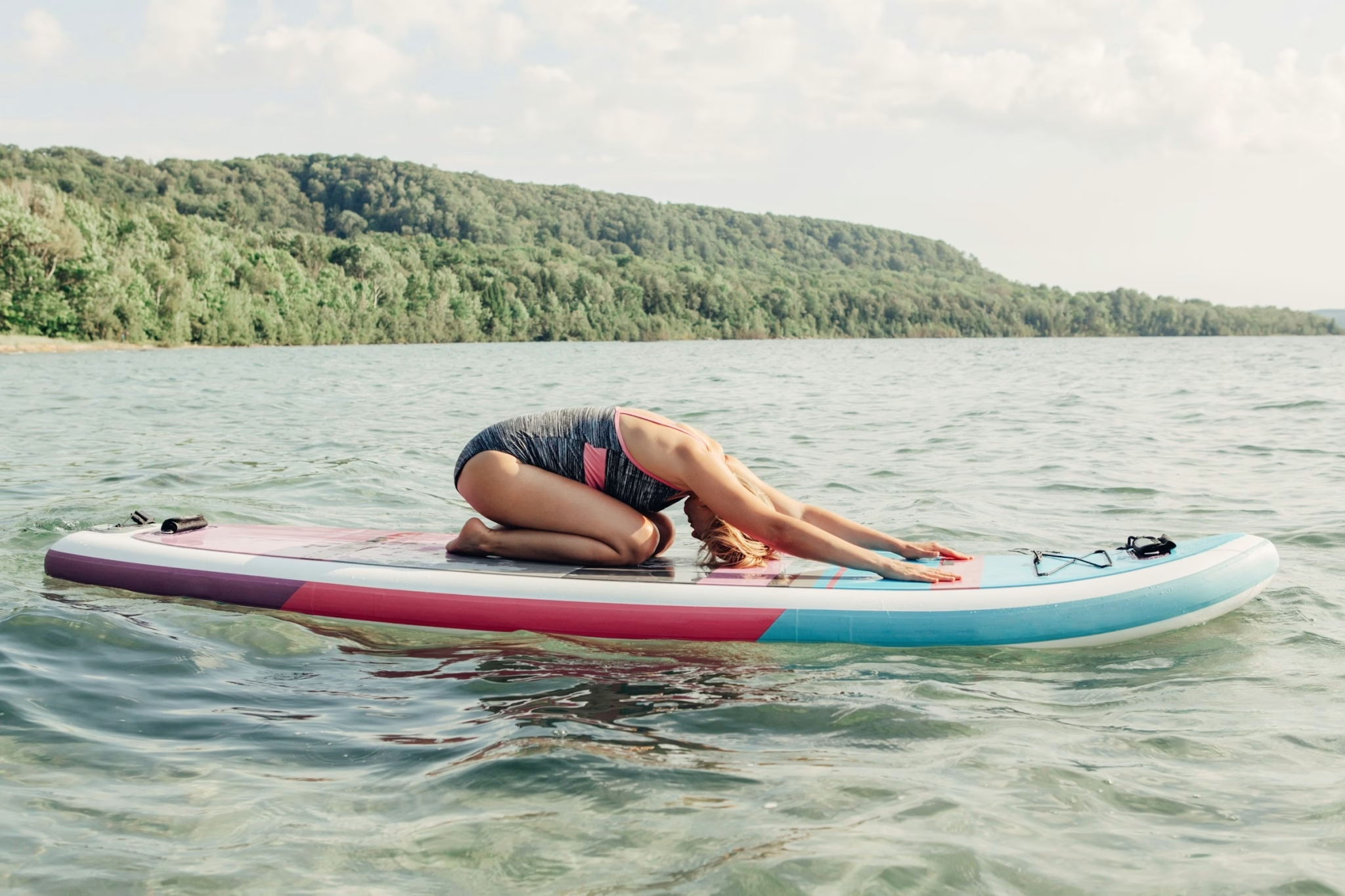
Two hours of sustained rotational paddling will do that to a body. The SUP stroke loads your obliques through continuous trunk rotation, hammers your shoulders through repetitive overhead reaching, and shortens your pectorals through the catch phase. Do that for 7 to 8.5 miles across consecutive days, and you’ll discover muscles you forgot existed.
They’ll make sure you remember.
So I went into the research. Not the “10 stretches for paddlers!” listicles written by someone who’s never touched a board. The peer-reviewed literature. Meta-analyses on static stretching and performance. Systematic reviews on PNF techniques. Studies on optimal hold durations.
What I found challenges some common assumptions about stretching, confirms others, and provides a clear, evidence-based protocol for keeping your body functional between long paddles.
Key Takeaways
- The pre-paddle static stretching warning has been walked back. The Kay & Blazevich 2012 finding (7.5% performance loss with holds of 60+ seconds) applied to lab-isolated maximum voluntary contraction tests, not field athletic tasks. A 2024 controlled meta-analysis (Warneke & Lohmann, Journal of Sport and Health Science) found trivial effects overall and no impairment on jumping or sprinting. Static holds under 60 seconds before paddling are fine; only long sustained holds risk performance impact.
- Dynamic stretching before, static stretching after: Dynamic warm-ups enhance performance and prepare muscles for activity, while static stretches are most effective for flexibility gains post-exercise.
- Hold each stretch under 60 seconds at 75-80% of perceived discomfort. The classic 30-second rule from Bandy & Irion 1997 has been refined: Longo et al. (2025, Sports Medicine – Open) frame the contemporary guidance as individual holds under 60 seconds, stretching to roughly 75-80% of the point of discomfort, with total session volume under 480 seconds. The 30-second default still works as a working number; just do not feel obligated to count exactly to 30.
- PNF stretching produces the greatest ROM gains: Contract-relax techniques outperform both static and dynamic stretching for increasing range of motion (Sharman et al., 2006).
- Stretching alone does not prevent injuries: A systematic review found no statistically significant association between stretching and reduced injury risk (Thacker et al., 2004). Flexibility is one component of injury resilience.
- The paddle stroke targets four muscle groups asymmetrically: Internal and external obliques, anterior and posterior deltoids, pectoralis major and minor, and the rotator cuff all require targeted post-paddle attention.
- Frequency beats intensity: Stretching once daily at moderate intensity produces better long-term results than aggressive, infrequent sessions.
The Evidence on Stretching: What Research Supports
Stretching science is more nuanced than most fitness content suggests. Some claims hold up under scrutiny. Others crumble.
Static Stretching Before Exercise: The Performance Problem
Kay and Blazevich (2012) conducted a systematic review of 106 studies examining the effect of acute static stretching on maximal muscle performance. Their findings were clear and dose-dependent. Static stretches held for fewer than 30 seconds showed no detrimental effect on strength, power, or speed. Holds of 30 to 45 seconds produced inconsistent results.
But stretches sustained for 60 seconds or longer per muscle group reduced maximal muscle performance by an average of 7.5%.
That finding has since been substantially refined. Warneke and Lohmann (2024, Journal of Sport and Health Science) re-ran the analysis using stricter inclusion criteria (controlled pre-post designs only, 83 studies) and concluded that the overall stretch-induced force deficit is trivial (effect size -0.21) and that static stretching produces no impairment on athletic tasks like jumping and sprinting. The 7.5% number from Kay and Blazevich came from lab-isolated maximum voluntary contraction tests, not from the kind of submaximal, sustained, technique-driven effort a paddle stroke requires.
Direct quote from the 2024 paper: “rigorous avoidance of any type of stretching before performance seems to be without evidence.”
The practical update: brief static stretching before paddling (holds under 60 seconds at moderate intensity) is fine. The original warning still holds for very long static stretches; a 90-second hamstring stretch before a hard paddle is the territory the lab studies flagged. For everything else, do the stretch if it helps you feel ready to paddle.
The post-paddle window remains the better place for the bulk of your stretching volume, but the panic about touching a quad stretch before launch is overcalled.
Source: Kay, A.D. & Blazevich, A.J. (2012). “Effect of acute static stretch on maximal muscle performance: A systematic review.” Medicine & Science in Sports & Exercise, 44(1):154-164. PubMed.
The mechanism involves reduced muscle-tendon stiffness and altered neuromuscular activation patterns. Long static holds before paddling make your muscles temporarily weaker and slower. Not what you want when you need sustained power output over two-plus hours.
Dynamic Stretching Before Exercise: The Evidence-Based Warm-Up
Dynamic warm-ups behave differently. A 2024 review published in Arthroscopy, Sports Medicine, and Rehabilitation confirmed that dynamic stretching enhances musculoskeletal, neurological, and cardiovascular readiness before performance. Unlike static holds, dynamic movements increase muscle temperature, improve neural drive, and enhance active range of motion without the force-production penalties.
Source: “Dynamic Warm-ups Play Pivotal Role in Athletic Performance and Injury Prevention,” Arthroscopy, Sports Medicine, and Rehabilitation, 2024. PMC Full Text.
The current consensus is straightforward: dynamic before, static after. This isn’t opinion. It’s the convergence of multiple systematic reviews and position stands.
Stretching and Injury Prevention: The Honest Assessment
Here’s where things get complicated. Thacker et al. (2004) systematically reviewed 361 articles and found that stretching was not significantly associated with a reduction in total injuries (OR = 0.93, CI 0.78-1.11). The authors concluded there was insufficient evidence to endorse or discontinue routine stretching for injury prevention.
Source: Thacker, S.B. et al. (2004). “The impact of stretching on sports injury risk: a systematic review of the literature.” Medicine & Science in Sports & Exercise, 36(3):371-378. PubMed.
To be completely transparent: I stretch after every paddle because it reduces my subjective stiffness and helps restore range of motion. The evidence supports those outcomes. But if someone tells you stretching will prevent paddling injuries, they’re making a claim the research hasn’t substantiated.
Pre-Paddle Dynamic Stretches
These six movements prepare the specific muscle groups that SUP loading demands. Perform them after a 3 to 5 minute walk or light jog to raise core temperature first. Cold muscles respond poorly to any type of stretching.
1. Standing Trunk Rotations
Target muscles: Internal and external obliques, erector spinae
Reps: 15 rotations per side (30 total)
Starting position: Stand with feet shoulder-width apart, knees slightly bent. Hold your paddle horizontally across the front of your chest at about sternum height, elbows down, with both hands gripping near the ends.
Keep it off your neck. The old gym version of this drill racks the bar behind the neck, which loads the cervical spine and parks the shoulders in abduction and external rotation, the position that provokes impingement. Holding the shaft in front gives you the same thoracic rotation without asking a tight, internally rotated shoulder to hold an end-range position for 30 reps.
Movement: Rotate your torso to the right, initiating the movement from your obliques, not your hips. Let your head follow naturally. Pause briefly at end range, then rotate through center to the left side. Maintain a steady rhythm, gradually increasing rotational range over the first 8 to 10 reps.
Common mistakes: Rotating from the hips instead of the thoracic spine. Allowing the feet to pivot. Jerking into end range rather than building progressively.
2. Arm Circles (Progressive)
Target muscles: Anterior, medial, and posterior deltoids; rotator cuff
Reps: 10 small circles forward, 10 small backward, 10 large forward, 10 large backward
Starting position: Stand tall with arms extended straight out to the sides at shoulder height, palms facing down.
Movement: Begin with small circles approximately 6 inches in diameter. After 10 reps forward and 10 backward, progressively widen to full arm circles. The final 10 reps in each direction should involve the largest range of motion your shoulders allow without discomfort.
Common mistakes: Starting with large circles before the joint is warm. Shrugging the shoulders toward the ears. Bending the elbows to compensate for limited mobility.
3. Dynamic Chest Opener
Target muscles: Pectoralis major, pectoralis minor, anterior deltoid
Reps: 12 to 15
Starting position: Stand with feet hip-width apart. Extend both arms in front of your chest at shoulder height, palms together.
Movement: Pull both arms back horizontally, squeezing the shoulder blades together as your arms open wide. Your palms should rotate to face forward at the end position. Hold the open position for one count, feeling the stretch across the chest, then return to the starting position. Each rep should reach slightly farther as the tissue warms.
Common mistakes: Arching the lower back to compensate for tight pectorals. Moving too quickly without reaching full horizontal abduction. Letting the arms drop below shoulder height.
4. Lateral Trunk Bends with Reach
Target muscles: External obliques, quadratus lumborum, latissimus dorsi
Reps: 10 per side (20 total), alternating
Starting position: Stand with feet slightly wider than shoulder-width. Raise your right arm overhead, fully extended.
Movement: Bend laterally to the left, reaching your right arm over and past your head in the direction of the bend. You should feel the stretch along the entire right side of your torso, from hip to fingertips. Return to center, switch arms, and bend to the opposite side.
Perform these as controlled, rhythmic movements, not static holds.
Common mistakes: Bending forward instead of strictly lateral. Rotating the torso during the lateral bend. Not extending the overhead arm fully.
5. Paddle Stroke Simulation (Slow Motion)
Target muscles: Obliques, deltoids, pectorals, latissimus dorsi, rhomboids
Reps: 10 strokes per side
Starting position: Stand in your normal paddling stance, staggered feet, holding your paddle in paddling position.
Movement: Perform the complete paddle stroke cycle at approximately one-quarter speed. Exaggerate the rotation phase, reaching further forward on the catch and rotating more deeply through the pull. At the top of each recovery, pause for a half-second with your arms fully extended overhead.
This rehearses the exact movement pattern while dynamically stretching every muscle involved in the stroke.
Common mistakes: Moving at normal speed, which defeats the purpose. Neglecting to exaggerate the rotational component. Forgetting to perform equal reps on both sides, even if you primarily paddle on one.
6. Cross-Body Shoulder Swings
Target muscles: Posterior deltoid, infraspinatus, teres minor
Reps: 15 swings per arm
Starting position: Stand with feet shoulder-width apart. Let one arm hang relaxed at your side.
Movement: Swing your arm horizontally across your body at chest height, then swing it back out to the side and slightly behind you. Let momentum carry the arm through each arc, but maintain control. Gradually increase the range of the swing over the first 5 to 6 reps.
This movement targets the posterior deltoid and rotator cuff musculature that stabilizes the shoulder during the pull phase of the paddle stroke.
Common mistakes: Rotating the entire trunk with the arm swing. Using too much force, which can irritate the shoulder joint. Allowing the swinging arm to travel above shoulder height on the backswing.
Post-Paddle Static Stretches for Obliques
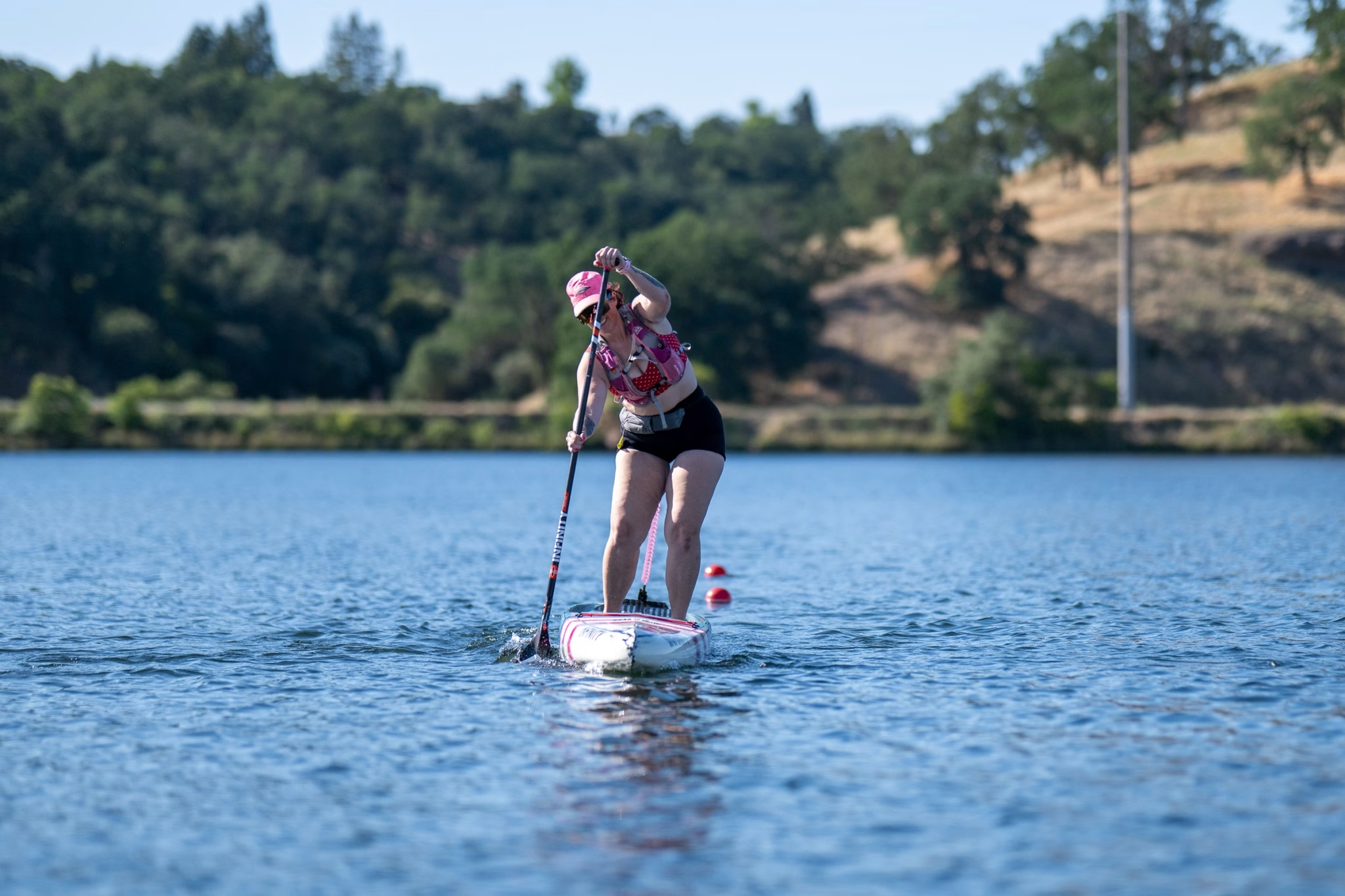
The obliques absorb enormous rotational load during paddling. Every stroke involves concentric contraction on the pulling side and eccentric loading on the opposite side. After 2,000-plus strokes across an 8-mile paddle, these muscles will be shortened, fatigued, and resistant to lengthening. These stretches address both the internal and external oblique fibers.
1. Standing Side Bend Stretch
Target muscles: External obliques (stretched side), quadratus lumborum
Hold time: 30 seconds per side | Sets: 2 per side
Frequency: After every paddle session; daily during high-volume training weeks
Starting position: Stand with feet hip-width apart. Raise your right arm overhead and grasp your right wrist with your left hand.
Movement: Using your left hand, gently pull your right arm to the left while bending your torso laterally. Keep both feet flat on the ground and avoid rotating. You should feel a deep stretch along your entire right side, from the hip crest through the ribcage. Breathe steadily. After 30 seconds, return to center and switch sides.
Form cues: Keep the hips level and stationary. Think about creating space between each rib on the stretched side. If you can’t feel the stretch in your obliques, widen your stance slightly and push your hip toward the stretched side.
2. Supine Trunk Rotation Stretch
Target muscles: Internal and external obliques, spinal rotators, lower back
Hold time: 30 seconds per side | Sets: 2 per side
Frequency: After every paddle session
Starting position: Lie on your back with both knees bent, feet flat on the ground, and arms extended out to the sides in a T position, palms facing up.
Movement: Keeping your shoulder blades pinned to the ground, slowly lower both knees to the left until they reach the floor or until you feel a significant stretch through the right obliques and lower back. Your right hip will lift off the ground. Turn your head to the right to increase the rotational stretch. Hold for 30 seconds, breathing deeply. Return knees to center and repeat on the opposite side.
Form cues: The stretch should feel like a gentle wringing of the trunk, not a sharp pull. If your knees don’t reach the floor, place a pillow underneath them. The key is keeping both shoulders grounded.
3. Seated Spinal Twist
Target muscles: Internal obliques (opposite side), external obliques (same side), erector spinae, piriformis
Hold time: 30 seconds per side | Sets: 2 per side
Frequency: After paddles; also effective as a standalone morning stretch on recovery days
Starting position: Sit on the ground with both legs extended in front of you. Bend your right knee and cross your right foot over your left thigh, placing it flat on the ground outside your left knee.
Movement: Place your left elbow on the outside of your right knee. Place your right hand on the ground behind your right hip for support. Inhale and lengthen your spine tall, then exhale and rotate your torso to the right, using your left elbow against your knee as gentle leverage. Look over your right shoulder. Hold for 30 seconds. This stretch addresses the deeper rotational muscles that static side bends miss.
Form cues: Sit up tall before rotating. The rotation should come from the mid-back (thoracic spine), not the lower back. Avoid rounding forward to chase more rotation.
Post-Paddle Static Stretches for Shoulders & Deltoids
The deltoid has three distinct heads, and paddling loads each one differently. The anterior deltoid works during the catch and initial pull phase. The medial deltoid stabilizes during the overhead recovery. The posterior deltoid decelerates the arm at the end of each stroke. After a long paddle, all three will be tight, but the posterior head tends to get the worst of it because eccentric deceleration creates more muscle damage than concentric contraction.
1. Cross-Body Posterior Deltoid Stretch
Target muscles: Posterior deltoid, infraspinatus, teres minor
Hold time: 30 seconds per arm | Sets: 2 per arm
Frequency: After every paddle; also beneficial on rest days
Starting position: Stand or sit upright. Bring your right arm across your body at chest height.
Movement: Using your left hand, gently pull your right arm further across your chest until you feel a stretch in the back of your right shoulder. The stretch should be felt deep in the posterior deltoid and the connective tissue behind the shoulder joint. Keep the stretching arm straight, elbow locked. Do not elevate the shoulder toward your ear.
Form cues: Drop the shoulder of the arm being stretched away from your ear. If you feel pinching in the front of the shoulder, lower the arm position slightly. The pull should be steady and moderate, never sharp.
2. Overhead Triceps and Medial Deltoid Stretch
Target muscles: Medial deltoid, triceps long head, latissimus dorsi
Hold time: 30 seconds per arm | Sets: 2 per arm
Frequency: After every paddle
Starting position: Raise your right arm overhead, then bend the elbow so your right hand drops behind your head toward your upper back.
Movement: Using your left hand, gently press down on your right elbow, deepening the stretch through the triceps and along the outer shoulder. Simultaneously, lean slightly to the left to add a lateral component that targets the medial deltoid and the latissimus dorsi. Hold for 30 seconds, breathing steadily.
Form cues: Keep your head upright; don’t let it push forward. Avoid arching the lower back. If you can’t reach your elbow with the opposite hand, use a towel draped behind your back to bridge the gap.
3. Reverse Prayer (Internal Rotation Stretch)
Target muscles: Anterior deltoid, subscapularis, pectoralis minor
Hold time: 20 to 30 seconds | Sets: 2
Frequency: After paddles; skip if you have existing shoulder impingement
Starting position: Stand tall. Reach both arms behind your back and press your palms together in a prayer position between your shoulder blades, fingertips pointing upward.
Movement: Once your palms are together, gently slide them upward along your spine as far as comfortable. You’ll feel a stretch through the front of both shoulders and across the chest. If you cannot bring palms together, clasp your hands behind your back and straighten your arms instead, lifting them slightly away from your body.
Form cues: This stretch requires significant internal rotation. If it causes any pinching or sharp discomfort in the shoulder joint, stop. It’s not appropriate for everyone. The modified version (clasped hands) provides a gentler alternative.
4. Wall-Assisted Shoulder Flexion Stretch
Target muscles: Posterior deltoid, latissimus dorsi, teres major
Hold time: 30 seconds | Sets: 2
Frequency: After paddles; excellent for restoring overhead range of motion
Starting position: Stand facing a wall at arm’s length. Place both palms on the wall at shoulder height.
Movement: Slowly walk your hands up the wall as high as you can comfortably reach. Once at maximum height, step forward slightly and drop your chest toward the floor, allowing your torso to descend between your arms. You should feel a deep stretch through the shoulders, lats, and upper back. Hold this position for 30 seconds. Walk your hands back down to release.
Form cues: Keep your core engaged to prevent excessive lumbar extension. The stretch should feel like your shoulders are opening, not like your lower back is compressing. If you feel lower back discomfort, don’t drop your chest as far.
Post-Paddle Static Stretches for Pectorals
Paddling pulls your shoulders forward and internally rotates your humeri. Do enough of it, and your pectorals adaptively shorten, contributing to the rounded-shoulder posture that plagues endurance paddlers. I noticed this after three consecutive paddle days: my resting shoulder position had visibly shifted forward. These stretches counteract that pattern.
1. Doorway Pectoral Stretch (High and Low Positions)
Target muscles: Pectoralis major (sternal and clavicular heads), anterior deltoid
Hold time: 30 seconds per position, per side | Sets: 2 per position (4 total per side)
Frequency: After every paddle; also recommended as a daily maintenance stretch
Low position (sternal head): Stand in a doorway. Place your right forearm against the door frame with your elbow at shoulder height, forearm vertical. Step your right foot forward through the doorway. Shift your weight forward until you feel a stretch across the middle and lower chest. Keep your forearm and elbow firmly against the frame.
High position (clavicular head): Raise your elbow above shoulder height, approximately 120 degrees from your torso, forearm still against the frame. Lean forward again. With the arm elevated, the stretch shifts to the upper pectoral fibers and the pectoralis minor underneath. This position most directly counteracts the forward shoulder pull from paddling.
Form cues: Do not twist your body away from the stretched arm. The torso should remain square to the doorway. If you feel tingling in your hand or fingers, reduce the stretch intensity. Never stretch through nerve-type symptoms. If those symptoms keep returning after paddles, the underlying issue is usually neurological tension rather than muscle tightness, which is exactly what median, ulnar, and radial nerve glides are designed to address.
2. Corner Wall Stretch (Bilateral)
Target muscles: Pectoralis major and minor (both sides simultaneously), anterior deltoids
Hold time: 30 seconds | Sets: 3
Frequency: After paddles; also effective as a mid-day posture reset
Starting position: Stand facing the corner of a room. Place one forearm on each wall, elbows at shoulder height, forearms vertical.
Movement: Lean your entire body forward toward the corner, keeping your feet back. Your chest should advance between your arms. You’ll feel a bilateral stretch across both pectorals simultaneously. Because both sides are engaged, this version prevents the compensatory trunk rotation that can occur with single-arm doorway stretches.
Form cues: Engage your core to prevent your lower back from arching excessively. Your head should remain in neutral alignment, not poking forward. Adjust elbow height between sets: lower for sternal fibers, higher for clavicular fibers.
3. Supine Floor Stretch with Foam Roller
Target muscles: Pectoralis major and minor, anterior deltoids, biceps (long head)
Hold time: 60 to 90 seconds (passive, gravity-assisted) | Sets: 1
Frequency: After paddles; excellent for end-of-day recovery
Starting position: Place a foam roller lengthwise on the floor. Lie on it so it runs along your spine from head to pelvis. Both knees should be bent, feet flat on the floor for stability.
Movement: Let both arms fall out to the sides with elbows bent at 90 degrees, palms facing the ceiling. Gravity will pull your arms toward the floor, opening the chest. Allow your arms to sink progressively lower over the duration of the hold. This is a passive stretch; the only effort required is relaxation. For a deeper variation, slowly extend your arms overhead along the floor while maintaining the open chest position.
Form cues: If your arms don’t touch the floor, that’s normal. Don’t force them down. The foam roller elevates your spine above your arms, allowing gravity to do the work. Breathe deeply into the stretch. This one doubles as a thoracic spine mobilization. For more information on foam roller selection and technique, see our guide to foam roller science for paddlers.
Hold Times and Frequency: What the Research Says
This is where anecdote meets data, and the data is surprisingly definitive.
Optimal Hold Duration
Bandy and Irion (1997) conducted a controlled study with 93 subjects, comparing 15-second, 30-second, and 60-second static stretch holds performed five days per week over six weeks. Their finding: 30 seconds produced the same flexibility gains as 60 seconds. No additional benefit accrued from doubling the hold time.
Source: Bandy, W.D. & Irion, J.M. (1997). “The effect of time and frequency of static stretching on flexibility of the hamstring muscles.” Physical Therapy, 77(10):1090-1096. PubMed.
That 30-second rule has since been generalized. Longo, Cè, Toninelli, Esposito, and Coratella (2025, Sports Medicine – Open) synthesized the modern stretching literature and offered a more flexible framework: hold individual stretches under 60 seconds, stretch to 75 to 80% of the point of discomfort (not to your absolute end-range), and keep total session volume under 480 seconds (8 minutes of accumulated stretching). The 30-second default Bandy and Irion identified still works fine in practice, but the rigid count is not required; what matters is staying inside the under-60 window and not pushing into pain. For chronic ROM gain, weekly volume does more than per-bout duration. The exercises below use 30 seconds as the working default; treat that as a recommended target.
A review published in the International Journal of Sports Physical Therapy (Page, 2012) corroborated this, noting that most authors suggest 10 to 30 seconds as sufficient for improving flexibility, with the greatest change in range of motion occurring between 15 and 30 seconds.
Source: Page, P. (2012). “Current concepts in muscle stretching for exercise and rehabilitation.” International Journal of Sports Physical Therapy, 7(1):109-119. PMC Full Text.
Older adults appear to be the exception. Research suggests 60-second holds produced greater hamstring flexibility improvements in adults over 65 compared to 30-second holds. In the general adult population, though, 30 seconds is the target.
Frequency and Volume
Bandy and Irion also found that stretching once per day produced the same results as stretching three times per day. More isn’t necessarily better. The tissue responds to consistent, moderate stimulus over time, not to aggressive, marathon stretching sessions.
| Variable | Research Finding | Practical Recommendation |
|---|---|---|
| Hold duration | 30 seconds = 60 seconds for flexibility gains | 30 seconds per stretch |
| Daily frequency | 1x/day = 3x/day for flexibility gains | Once daily, post-paddle or evening |
| Weekly frequency | 5 days/week produced significant improvements | At minimum after every paddle; ideally 5 days/week |
| Sets per stretch | 2 to 4 sets per muscle group | 2 sets for maintenance; 3 to 4 for active ROM recovery |
| Time to see results | Measurable gains within 3 to 4 weeks of consistent practice | Commit to a minimum 4-week protocol before evaluating |
PNF Stretching for Advanced Recovery
If static stretching is the reliable sedan of flexibility training, PNF is the sports car. More effective, slightly more complex, and requiring a bit more understanding to operate properly.
What PNF Is and How It Works
Proprioceptive neuromuscular facilitation (PNF) stretching involves alternating between muscle contraction and passive stretching. The most common and well-studied technique is contract-relax: you stretch a muscle to its comfortable end range, then contract that same muscle isometrically for 3 to 6 seconds, then relax and stretch further into the new range.
Sharman, Cresswell, and Riek (2006) conducted a systematic review of PNF mechanisms and concluded that PNF techniques produce the greatest gains in range of motion compared to other stretching methods. The improvement was attributed not to the traditional explanation of autogenic inhibition (your muscle reflexively relaxing after contraction) but rather to an increased stretch tolerance. PNF trains your nervous system to accept a greater range of motion.
Source: Sharman, M.J., Cresswell, A.G., & Riek, S. (2006). “Proprioceptive neuromuscular facilitation stretching: mechanisms and clinical implications.” Sports Medicine, 36(11):929-939. PubMed.
Key findings from Sharman et al.: The static contraction phase should last approximately 3 seconds at no more than 20% of maximum voluntary contraction. The greatest range of motion gains occur after the first repetition. For lasting changes, PNF stretching should be performed once or twice per week.
PNF Protocol for the Cross-Body Shoulder Stretch
This is the stretch that benefits most from PNF technique because the posterior deltoid and rotator cuff are notoriously resistant to passive lengthening.
- Bring your right arm across your body at chest height. Use your left hand to pull it into a stretch. Hold at comfortable end range for 5 seconds.
- Contract: Push your right arm outward against your left hand (trying to move it away from your body) at roughly 20% effort for 3 seconds. Your arm should not actually move. This is an isometric contraction.
- Relax: Immediately stop the contraction and gently pull the arm further across your body. You’ll find you can move deeper into the stretch.
- Hold the new end range for 20 seconds.
- Repeat 2 to 3 times per arm.
PNF Protocol for the Doorway Pectoral Stretch
- Set up in the doorway stretch position (forearm against frame, elbow at shoulder height). Lean forward to comfortable end range.
- Contract: Press your forearm into the door frame as if trying to bring your arm forward (horizontal adduction) at 20% effort for 3 seconds. The door frame provides the immovable resistance.
- Relax: Release the contraction and immediately lean further forward through the doorway, deepening the pectoral stretch.
- Hold the new position for 20 seconds.
- Repeat 2 to 3 times per side.
When to Use PNF
PNF is most appropriate after exercise, when muscles are warm and pliable. It’s overkill for daily maintenance. Reserve it for: after particularly long or intense paddles (7+ miles), when you’ve noticed reduced range of motion over consecutive paddle days, or as a once-weekly deep flexibility session. For routine post-paddle stretching, standard static holds at 30 seconds remain the efficient choice.
Common Mistakes
I’ve made most of these. Learn from my research so you don’t need to learn from my mistakes.
Static stretching before paddling. The original Kay and Blazevich panic on this has been softened by Warneke and Lohmann 2024. Brief static holds (under 60 seconds, moderate intensity) before paddling are not the performance killer the older literature implied. That said, dynamic warm-ups still beat static-only warm-ups for getting your stroke firing; static work is best used as a brief tune-up of any specific tight area rather than as your primary warm-up tool.
Bouncing (ballistic stretching). Rhythmic bouncing at end range triggers the muscle spindle stretch reflex, causing the muscle to contract against the very lengthening you’re trying to achieve. Controlled movement is fine. Bouncing is counterproductive.
Overstretching. If a stretch produces sharp pain, burning, or tingling, you’ve exceeded the tissue’s current tolerance. Back off. Stretching should produce tension and mild discomfort. Pain is not the goal and will provoke protective guarding that reduces your range of motion.
Stretching through nerve symptoms. Tingling, numbness, or shooting pain in the arm during shoulder or pectoral stretches indicates nerve involvement, not muscle tightness. These symptoms require a different approach, not more aggressive stretching. If you regularly experience nerve symptoms, consult a physical therapist.
Ignoring the less-dominant side. If you paddle predominantly on the right, your left obliques and right shoulder may be tighter than their counterparts. Stretch both sides equally, but pay attention to asymmetries. They’ll tell you where your stroke mechanics are creating imbalanced loading.
Expecting stretching to fix everything. Stretching addresses tissue extensibility. It doesn’t fix strength deficits, poor stroke mechanics, or inadequate recovery between sessions. It’s one important tool among several. For a comprehensive recovery approach, pair this guide with our vibrating foam roller comparison for paddlers, the SUP strength program for core, balance, and shoulder resilience, and the guide to preventing dorsal hand pain from paddle grip overuse if forearm and wrist tightness is part of the picture.
The Bottom Line
The research is clear on the fundamentals: dynamic stretching before paddling, static stretching after, 30-second holds, and consistent daily practice. PNF techniques offer the most potent flexibility gains for stubborn areas like the posterior deltoid and pectorals. But the most important finding might be the simplest. Stretching works when you actually do it, not when you bookmark an article about it, and not when you tell yourself you’ll stretch after the next paddle. Now. After this paddle. Thirty seconds per stretch, two sets, both sides. That’s 12 minutes for a complete post-paddle routine targeting every muscle group that paddling loads. Twelve minutes to preserve the range of motion that lets you paddle again tomorrow without your obliques threatening legal action.
Sources
- Kay, A.D. & Blazevich, A.J. (2012). “Effect of acute static stretch on maximal muscle performance: A systematic review.” Medicine & Science in Sports & Exercise, 44(1):154-164. PubMed
- Sharman, M.J., Cresswell, A.G., & Riek, S. (2006). “Proprioceptive neuromuscular facilitation stretching: mechanisms and clinical implications.” Sports Medicine, 36(11):929-939. PubMed
- Bandy, W.D. & Irion, J.M. (1997). “The effect of time and frequency of static stretching on flexibility of the hamstring muscles.” Physical Therapy, 77(10):1090-1096. PubMed
- Thacker, S.B. et al. (2004). “The impact of stretching on sports injury risk: a systematic review of the literature.” Medicine & Science in Sports & Exercise, 36(3):371-378. PubMed
- Page, P. (2012). “Current concepts in muscle stretching for exercise and rehabilitation.” International Journal of Sports Physical Therapy, 7(1):109-119. PMC Full Text
- “Dynamic Warm-ups Play Pivotal Role in Athletic Performance and Injury Prevention.” (2024). Arthroscopy, Sports Medicine, and Rehabilitation. PMC Full Text
- Behm, D.G. & Chaouachi, A. (2011). “A review of the acute effects of static and dynamic stretching on performance.” European Journal of Applied Physiology, 111(11):2633-2651. PubMed
- Opplert, J. & Babault, N. (2018). “Acute effects of dynamic stretching on muscle flexibility and performance: an analysis of the current literature.” Sports Medicine, 48(2):299-325. PubMed
- Konrad, A. et al. (2024). “Revisiting the stretch-induced force deficit: A systematic review with multilevel meta-analysis of acute effects.” Journal of Sport and Health Science. ScienceDirect
Frequently Asked Questions
Should I stretch before or after paddle boarding?
Both, but with different techniques. Before paddling, lean on 5 to 10 minutes of dynamic stretches (trunk rotations, arm circles, chest openers) to warm the tissue and prime range of motion. Brief static holds under 60 seconds before paddling are also fine; the older “7.5% performance loss” panic from Kay and Blazevich 2012 has been walked back by Warneke and Lohmann 2024, who showed no impairment on athletic tasks. After paddling, target the obliques, shoulders, and pectorals the paddle stroke loads. A 2025 meta-analysis (Zhang et al., Frontiers in Physiology) found that post-exercise stretching shows no significant effect on lower-limb recovery, so the post-paddle work is best framed as ROM maintenance and personal comfort rather than as a recovery accelerator.
How long should I hold a stretch after paddling?
Thirty seconds per stretch is optimal for most adults. Research by Bandy and Irion (1997) demonstrated that 30-second holds produce the same flexibility gains as 60-second holds. Perform 2 sets of each stretch. The exception is passive, gravity-assisted stretches (like lying on a foam roller) where 60 to 90 seconds is appropriate because the stretch intensity is lower.
Why are my obliques so tight after paddle boarding?
The SUP paddle stroke is fundamentally a rotational movement. Each stroke involves concentric contraction of the obliques on your pulling side and eccentric loading of the obliques on the opposite side. Over an 8-mile paddle at roughly 2,000 or more strokes, both the internal and external obliques accumulate significant fatigue and adaptive shortening. If you paddle primarily on one side, the asymmetry compounds the tightness.
What is PNF stretching and should paddlers use it?
PNF (proprioceptive neuromuscular facilitation) stretching involves alternating between isometric muscle contraction and passive stretching. The contract-relax technique produces the greatest range of motion gains compared to any other stretching method, according to Sharman et al. (2006). Paddlers should use PNF for stubborn tightness in the posterior deltoid and pectorals, but standard static stretching is sufficient for routine post-paddle flexibility work.
Does stretching prevent paddle boarding injuries?
The evidence is surprisingly weak. Thacker et al. (2004) systematically reviewed the literature and found no statistically significant association between stretching and reduced injury risk. Stretching improves range of motion and reduces subjective stiffness, which are valuable outcomes. But claiming it prevents injuries goes beyond what the current research supports. A comprehensive approach including proper warm-up, progressive training load, and adequate recovery between sessions provides better injury resilience.
Can static stretching before paddling hurt my performance?
Only if held very long. Kay and Blazevich (2012) found that static stretches of 60 seconds or more per muscle group reduced maximal muscle performance by 7.5%, but that finding came from lab-isolated maximum voluntary contraction tests. A 2024 controlled meta-analysis by Warneke and Lohmann (Journal of Sport and Health Science) found no impairment on athletic tasks like jumping and sprinting and concluded that rigorous avoidance of pre-exercise stretching is “without evidence.” Brief static holds under 60 seconds before paddling are fine. Dynamic warm-ups still tend to feel better as the primary pre-paddle ritual, but the panic about touching a quick static stretch is overcalled.
How often should I stretch for paddle boarding recovery?
At minimum, perform the full post-paddle stretching routine after every session. Research shows that stretching five days per week for at least three to four weeks produces measurable flexibility improvements. Stretching once daily is as effective as three times daily for flexibility gains, so a single post-paddle session is sufficient. On rest days, a shortened routine focusing on your tightest areas maintains the progress.
What stretches help with forward shoulder posture from paddling?
The doorway pectoral stretch at both high and low arm positions directly counteracts the forward shoulder pull. The corner wall stretch targets both sides simultaneously. Lying on a foam roller lengthwise with arms open addresses the pectoralis minor, which is the deeper muscle primarily responsible for pulling the scapula forward. Combine these with posterior deltoid work to restore balanced shoulder positioning.
Is it normal for my shoulder range of motion to decrease after consecutive paddle days?
Yes. Repeated loading of the shoulder through the paddling stroke causes adaptive shortening of the pectorals and anterior deltoid while fatiguing the posterior stabilizers. This combination pulls the shoulder forward and limits overhead and behind-the-back range of motion. Consistent post-paddle stretching and at least one full rest day per week help counteract this cumulative effect.
What is the best stretch for tight pectoral muscles after SUP?
The doorway stretch performed at two angles (elbow at shoulder height for the sternal fibers, elbow above shoulder height for the clavicular fibers) provides the most targeted relief for paddle-shortened pectorals. Hold each position for 30 seconds, 2 sets per position, per side. For deeper release, the PNF contract-relax technique applied in the doorway position produces greater range of motion gains than static holding alone.
Should I stretch on rest days between paddles?
A shortened stretching routine on rest days helps maintain range of motion gains between sessions. Focus on your 3 to 4 tightest areas rather than the complete protocol. The research supports daily stretching for optimal flexibility outcomes, and rest days are an opportunity to stretch without the preceding muscle fatigue that can limit stretch tolerance after a long paddle.
How long before I notice flexibility improvements from stretching?
Research indicates measurable flexibility improvements within three to four weeks of consistent stretching performed five days per week. Subjective improvements in post-paddle stiffness and range of motion typically appear sooner, often within the first one to two weeks. PNF stretching may accelerate initial gains because the greatest range of motion improvement occurs after the first contract-relax repetition.
Article Updates
- August 4, 2026: Moved the paddle from behind the neck to the front of the chest in the standing trunk rotation warm-up. Held behind the neck it loads the cervical spine and parks the shoulder in the position that provokes impingement, for 30 reps, in a routine written for paddlers with tight shoulders.
- May 22, 2026: Original research and publication. All peer-reviewed sources current as of publication date.


