

Juniper Lake sits at 6,800 feet in the southeast corner of Lassen Volcanic National Park, the largest body of water in the park and the most remote of its drive-in lakes. After five seasons closed, you can drive to it again, though you cannot camp there yet.
Juniper Lake Road from Chester, closed after the 2021 Dixie Fire, is open again under a National Park Service alert posted July 24, 2026. Juniper Lake Campground and the day use area remain closed for maintenance and campground improvement projects, with no announced opening date.
Mt. Harkness Fire Lookout, a 1930 stone-and-wood structure listed on the National Register of Historic Places in 2017 and rehabilitated by HistoriCorps volunteers in 2019, was destroyed in August 2021. Seven of the eight cabins on the northwest shore burned in the same fire.
This guide tells you what Juniper Lake is, what was lost in the Dixie Fire, what survived, what you can reach in 2026, and which Lassen lakes have open campgrounds instead. Sources are NPS, USGS, recreation.gov, the Lassen Park Foundation, and CDFW.
If you arrived here looking for the Florida Juniper Lake near DeFuniak Springs, that is a different lake managed by Walton County and is not covered here.
Key Takeaways
- Road open, campground closed. An NPS alert dated July 24, 2026 reopened Juniper Lake Road for access to the lake and trailheads. Juniper Lake Campground and the day use area remain closed, and there is no potable water.
- Mt. Harkness Fire Lookout was destroyed in the Dixie Fire in early August 2021. The 1930 structure was on the National Register of Historic Places. NPS has closed its remnants at the 8,046-foot summit.
- Seven of eight cabins on the northwest shore burned, including the one owned by NPS. The park credits fuel clearing for sparing Juniper Lake Ranger Station.
- The lake holds no game fish per NPS. Bring a kayak; do not bring a fishing rod.
- Park entrance is now $30 per vehicle April 16 through November 30 ($10 winter). Lassen Volcanic went cashless on April 8, 2023. Bring a card; envelopes and exact change are no longer accepted.
- The road is 13 miles from Chester per NPS, and the last six miles are rough dirt with steep sections. NPS recommends high-clearance vehicles and calls the road not suitable for buses, motorhomes, or trailers.
- Mt. Harkness Trail is 3.8 miles round-trip with 1,250 feet of elevation gain per NPS, which rates it strenuous. Adding the Juniper Lake outlet section extends a hike to roughly 5.7 miles.
- Open Lassen lakes for 2026 include Manzanita (May 23 to October 7), Butte (May 30 to September 1), and Summit North and South (June 27 to September 8). Use the comparison table below to choose.
What Is Juniper Lake?
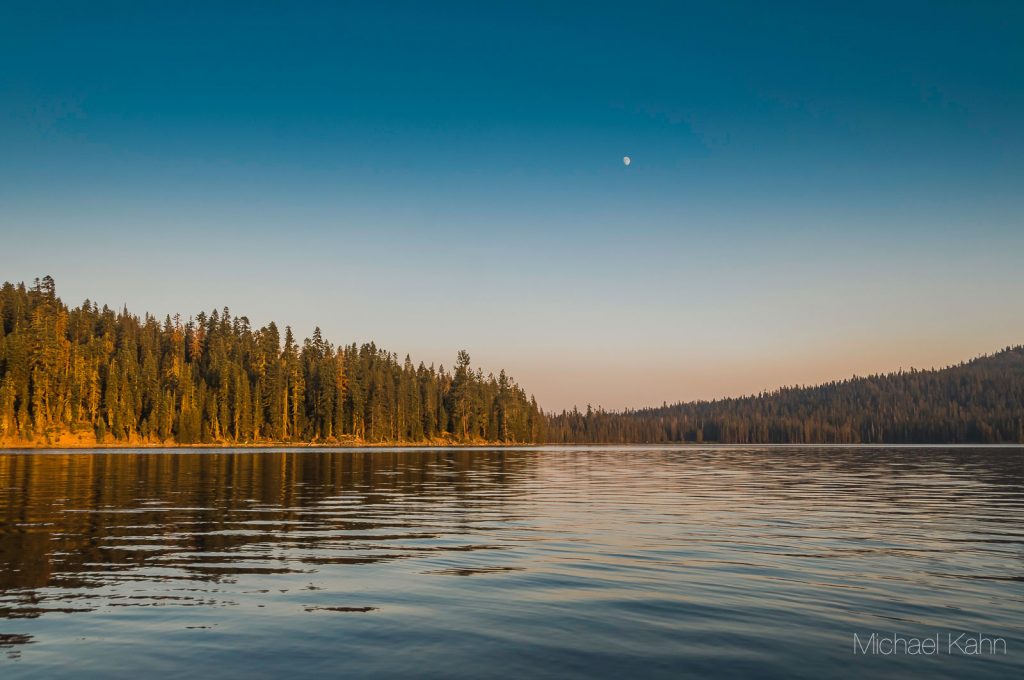
Juniper Lake is a 6,800-foot mountain lake in Lassen Volcanic National Park, California, named for the western juniper that grows on the surrounding volcanic flanks. Roughly 590 acres of cold deep water, it is the largest lake in the park and sits at the foot of Mt. Harkness, a basaltic shield volcano with a summit cinder cone. Access is via a 13-mile rough road from Chester. The lake holds no game fish and allows non-motorized boats only.
Current Status, 2026
An NPS alert posted July 24, 2026 reads: “The Juniper Lake Road (access to lake and trailheads) is open. Please drive with caution as road crews and contractors may be actively working along the roadway.” The same alert says the Juniper Lake Campground and day use area are closed for maintenance and campground improvement projects, and that potable water is not available.
NPS pages have not caught up with each other. Operating Hours, last updated May 22, 2026, still lists Juniper Lake Campground and the group sites as closed with work in progress to re-open, which matches the alert. The Trail Conditions page, last updated for this area June 12, 2026, still says the road is closed. Operating Hours directs visitors to the alerts for road information, so the alert is the current word.
NPS has not said whether a kayak or paddleboard can be carried to the water while the day use area is closed. Email lavo_information@nps.gov before hauling a boat up; NPS warns that the main visitor line, (530) 595-6100, has been working only intermittently.
Recovery work on this side of the park is slower than on the Warner Valley side. Drakesbad Guest Ranch and Warner Valley Campground reopened for the 2025 season after their own multi-year closures.
Juniper Lake did not.
The Juniper Lake side took more direct fire damage, sits at the end of a longer rough road, and serves a smaller volume of visitors than the front-country lakes.
Entrance Fee, 2026
Per NPS Lassen Fees and Passes (checked September 15, 2026):
- $30 per private vehicle, April 16 through November 30, valid 7 consecutive days
- $10 per vehicle, December 1 through April 15
- $25 motorcycle (Apr 16 to Nov 30); $10 winter
- $15 per person on foot or bicycle (Apr 16 to Nov 30); $10 winter
- Lassen Annual Pass: $55, for US citizens and residents, also covers Crater Lake, Whiskeytown, and Lava Beds
- America the Beautiful passes: $80 resident annual, $250 non-resident annual
Cash and checks are no longer accepted at entrance stations. Lassen Volcanic transitioned to a cashless fee system on April 8, 2023. Bring a credit or debit card, an Annual Pass, or an Interagency Pass.
Eight fee-free days in 2026, open to US citizens and residents, include Presidents Day (February 16), Memorial Day (May 25), the Independence Day weekend (July 3 through 5), Constitution Day (September 17), Theodore Roosevelt’s birthday (October 27), and Veterans Day (November 11).
The Road from Chester
NPS describes Juniper Lake Road (County Road 318) as a 13-mile, partly unpaved route from Chester, and says “the last six miles is rough dirt road with steep sections.” Recreation.gov’s facility listings describe seven miles of gravel and six roughly paved without saying which comes first, and its directions agree with NPS that the last six miles are dirt.
The pavement does not end at a clean transition. It thins to gravel patches first, then commits.
Sources disagree on what kind of vehicle should make the trip. NPS is firm: the road is “not suitable for cars with low clearance, buses, motorhomes, or trailers,” and high-clearance vehicles are recommended. Plumas County softens this to “passenger cars can make this route and many choose to do so” while still warning against buses, RVs, and trailers.
Honor NPS in any decision that matters. Standard sedans do make the trip when the road is open, slowly and with attention to washboarding and pothole lines, but a sedan owner who scrapes a transmission pan on a rock at mile 11 has no recourse.
Drive 10 to 15 mph on the dirt section. Total travel time runs about an hour for the 13 miles. Plumas County puts the last cell service about five miles back toward Chester, and NPS lists no cell service at the lake, so download offline maps before you go. The park’s 2026 compendium bars vehicles wider than 8.5 feet and vehicle-trailer combinations longer than 45 feet from the road.
Operational season when the road is open is roughly June through October, weather permitting. Snow and post-melt mud close the route earlier and later than the lake itself ices over and clears. The road reopened under the July 24, 2026 alert, with crews and contractors still working along it.
The Lookout We Lost
From 1930 until August 2021, the Mt. Harkness Fire Lookout sat 8,046 feet above sea level on the basaltic shield that rises south of Juniper Lake. Battered native stone rose from the ground to the upper-floor windows, and a wooden staircase climbed 12 feet to the catwalk circling the single-room cab.
Inside was an Osborne fire finder and a panoramic photograph mounted to enable a lookout to map a smoke column to a real ridgeline in seconds. NPS Rustic Style architecture, locally quarried stone, milled timber. More than 90 years as a working lookout.
National Register of Historic Places listing came in 2017. By then the cab had been weathered by nine decades of high-elevation winters and needed work.
Between September 15 and 27, 2019, HistoriCorps volunteers worked with park staff repointing the failing mortar, replacing deteriorated catwalk boards, and repairing window trim and door frames. Photographs of that 2019 crew are still on the Lassen Park Foundation site.
They became a different kind of photograph two years later.
On August 5, 2021, the Dixie Fire crossed into Lassen Volcanic National Park at the southeast corner near Juniper Lake.
National Parks Traveler reported the trajectory clearly: “Flames from the northern tip of the fire climbed up and over Mount Harkness and claimed the fire lookout tower there on its way towards Juniper Lake.” NPS confirmed the destruction in subsequent updates.
A 1930 structure that had survived nine decades of lightning, blizzards, and the occasional rifle round from a confused hunter was gone in a single August day.
What is at the summit now are remnants, and NPS has closed them to visitors. Stone is harder to burn than wood.
As of September 2026, NPS has not posted a formal damage assessment of the lookout footprint, and no rebuild project has been funded or announced by either the agency or the Lassen Park Foundation.
If you hike to the top, expect a scorched cinder cone summit, closed lookout remnants, and the same panoramic view that justified building a lookout there in the first place. On clear days, NPS says, it runs from the Three Sisters in Oregon to the north, to the Coast Range in the west, the Sierra Nevada to the south, and Nevada to the east.
The view is what was always free. Everything else has to be rebuilt or grieved.
The Lake Itself
Juniper Lake is not a glacial cirque. The famous cirque feature in this park sits on the northeastern flank of Lassen Peak. Juniper Lake instead occupies a basin shaped by Pliocene-to-Pleistocene andesite flows known to USGS mapping as the Juniper lavas, which moved roughly four miles westward from their source area approximately two million years ago.
Mt. Harkness, the basaltic shield rising to the south, is one of four shield volcanoes at the corners of the Lassen central plateau (the others are Prospect Peak, Red Mountain, and Raker Peak). Each developed a cinder cone on its summit during a final eruptive stage. Mt. Harkness, Red Mountain, and Prospect Peak all erupted basalt; Raker Peak erupted andesite.
Glaciers in the Pleistocene reshaped the surrounding terrain without quite carving Juniper Lake’s basin into a textbook glacial form. Ice from Mt. Harkness and nearby Sifford Mountain fed downvalley to Warner Valley.
What remained at Juniper Lake’s elevation is a basin walled on the south by the basaltic shield and on the north by the historic cabin shore, the lake’s outlet feeding eventually into the Feather River system.
Elevation: 6,800 feet at the standard NPS-cited figure. Some secondary sources cite 6,700 or 6,792, but NPS uses 6,800 across multiple pages and that is the figure the rewrite honors. The lake surface itself sits a few feet below the trailhead and ranger station bench.
Surface area: roughly 590 acres, the largest lake in Lassen Volcanic National Park. Specific surface-area and depth figures appear in regional historical and angling sources but were not directly verified against USGS National Hydrography Dataset records during this update; treat the 590 figure as approximate.
The much-quoted “234 feet maximum depth” comes from regional secondary sources rather than USGS or CDFW lake records, so it stays here without a hard number attached.
Shoreline: roughly five miles around per Plumas County. The Juniper Lake Loop trail, which does not hug the water, runs 6.8 miles around the basin per the NPS map. The article’s older “4.7-mile kayaking perimeter” figure is a tighter line that excluded coves; five miles is the better total.
Fishery: none. NPS Lassen Fishing is unambiguous: Juniper Lake “does not contain any game species.” The Day Use page agrees: “There are no sport fish in the lake.” Plumas County concurs and warns against planning a fishing trip here.
Whatever planting history or wild-trout rumor surfaces in older online forums is not supported by current CDFW stocking schedules or NPS guidance.
If you want to fish in Lassen, head to Manzanita (a catch-and-release fly fishery for rainbow and brown trout that NPS says the state rates “blue ribbon,” single barbless hooks, lures and flies only), Butte, Snag, Horseshoe, or Summit.
Skip Juniper Lake for any rod-and-reel trip.
Water clarity and temperature: NPS says the lake “remains cool year-round.” NPS swimming guidance for the park applies in full: there are no lifeguards in the park; even in summer, immersion in cold water can cause hypothermia.
Boats: Juniper is one of the park’s popular non-motorized boating lakes, and NPS bans motors of any kind on park waters, even ones not in use. California law requires a Coast Guard approved life jacket for each person aboard, and anyone under 13 must wear one while underway. NPS also asks paddlers to clean, drain, and dry boats and gear and, if possible, allow five days of drying time before entering new waters.
The Cabins on the Northwest Shore
One of the threads that the Mt. Harkness Lookout obscures, because the lookout was the photograph everyone took, is that Juniper Lake had a cabin culture before it had a national park.
According to local historian Tim Purdy, San Francisco speculator Elbert Dodge filed a 475-acre claim on the northwest shore in 1889. J.P. Frenna later acquired that claim, and in 1892 he bought the land from the state at $1.25 an acre.
Starting in 1908, Thomas A. Bragg and then Justice Young filed water-rights claims for hydroelectric development at the lake, with Alexander Thorne succeeding Young; the scheme failed because no major streams supplied enough flow to be useful.
Cabins went up over the decades that followed. Lassen Volcanic National Park was established in 1916, but park boundaries grew to incorporate land that already had private structures on it.
Eight cabins stood on the northwest shore in 2021. Most were private in-holder cabins, passed down through families, and the park owned one. Park Superintendent Jim Richardson described the private cabins that year as “very important to the history of those families.”
Seven of the eight burned. One survived.
One of the seven was the NPS-owned cabin, which “had a vital function as it accommodated crews that worked in that area of the park.” The fire did not burn Juniper Lake Ranger Station, and Richardson credited fuel clearing for sparing it.
The fire moved up over Mt. Harkness, took the lookout, and burned along the east side of Juniper Lake.
A national park that contains private cabins is rarer than a national park that does not. A national park that contains burned private cabins, with the ash now five years old, is rarer still.
Mt. Harkness Trail
NPS canonical numbers for the standard out-and-back to the summit:
- Distance: 3.8 miles round-trip
- Elevation gain: 1,250 feet
- Trailhead: parking area on the north side of Juniper Lake Ranger Station, on the road into the campground
- Difficulty: strenuous, per NPS Trail Conditions
Older trip reports and at least one regional hiking site describe a longer 5.5- to 6-mile loop that combines the Mt. Harkness summit with portions of the Juniper Lake outlet trail back to the campground.
Both versions are real. NPS describes the out-and-back as the standard hike. The longer combined loop adds about two miles and lets you finish at the lake instead of retracing the climb.
Climbing through what used to be a healthy red fir forest, you now climb through a Dixie Fire burn scar. NPS post-fire visitor guidance is direct about the hazards: falling trees and limbs, hidden stump holes, loose or falling rock, and standing dead trees that “will remain to fall naturally.”
Expect standing snags across the trail’s middle section. Wind events drop them. Hike on calm-weather days, and watch the canopy and the ground.
At 1.7 miles, a junction offers a left-turn ascent toward the Mt. Harkness summit and a right-turn route that drops toward Warner Valley or the Juniper Lake outlet.
Going left, you climb the cinder cone that sits on top of the basaltic shield and reach the summit at 8,046 feet. The cone’s slope is loose and steep. NPS has closed the remnants of the 1930 lookout.
Summit views, on clear days, reach Nevada to the east, the Coast Range to the west, and the Three Sisters to the north, per NPS. Lake Almanor sits in the basin south of the park.
Look down and west to see Lassen Peak’s lava domes; look north and east to see Prospect Peak, Cinder Cone, and the Fantastic Lava Beds.
With Juniper Lake Road open again, the trailhead can be reached by car. NPS’s Trail Conditions page still lists it as not accessible by vehicle, a note last updated in June, so confirm with the park before driving up.
For an Osprey-quality day pack to carry water, layers, and a first-aid kit on this hike, the Osprey Talon 22L is the current version of the pack that ran with me on the original 2018 trip.
Pair it with a Black Diamond Spot 400-R rechargeable headlamp if there is any chance you will be on the cinder cone in fading light.
Juniper Lake Loop, Snag Lake, and Horseshoe Lake
Juniper Lake Loop Trail
This 6.8-mile loop circles the basin without hugging the shoreline, gaining and losing roughly 1,100 feet of elevation across the day. The trail meanders along a creek section, climbs through mixed conifer and red fir, and offers a spur into Horseshoe Lake.
NPS does not feature the loop on its official day-hiking page (that page leans toward Manzanita-area trails), so the 6.8-mile and 1,100-foot figures are widely cited from regional trail guides rather than directly verified against an NPS publication. Treat them as close approximations.
Trailhead parking sits on the north side of Juniper Lake Ranger Station on the road into the campground, the same lot used for Mt. Harkness Trail. Heading toward Snag Lake first lets you tackle the slope before fatigue sets in.
NPS lists Inspiration Point and Crystal Lake as separate trails in the Juniper Lake area; mileages for those hikes are not posted on accessible NPS pages.
Snag Lake and the 1666 Cinder Cone Eruption
Snag Lake is roughly four to five miles from the Juniper Lake area as a backcountry day or overnight trip. Its origin story is the most quotable in the park. Around 1666, the Painted Dunes lava flows from Cinder Cone (the volcano just north of Snag Lake itself) blocked Grassy Creek.
A radiocarbon age from a quaking aspen caught in the lava helped USGS scientists place the eruption between A.D. 1630 and 1670, and tree-ring evidence points to 1666. USGS Fact Sheet 023-00 lays out the dating chain.
Butte Lake, two miles north, is a remnant of a larger lake that the Cinder Cone lava flows partly filled. Water flows underground from Snag through the porous Fantastic Lava Beds to Butte; there is no surface stream connection.
Unlike Juniper, Snag Lake has fish. NPS names Butte Lake, Snag Lake, and Horseshoe Lake among the park’s lakes with rainbow, brown, and brook trout. Backcountry permits are required for overnight trips into the Snag Lake basin, and you should consult the Lassen Wilderness Permit office for current bear-canister and food-storage requirements before heading in.
Horseshoe Lake (The Lassen One, Not Mammoth)
Lassen’s Horseshoe Lake is a backcountry lake reached as a short spur off the Juniper Lake Loop or via a longer approach from Summit Lake. It also holds rainbow, brown, and brook trout per NPS Fishing.
This is a different Horseshoe Lake from the better-known one at Mammoth Mountain in the Eastern Sierra, where the U.S. Geological Survey has documented carbon dioxide seeping from the ground and killing trees around the lake.
That phenomenon is not happening at Lassen’s Horseshoe Lake. They are different geologic situations at different lakes with the same name. If a trip report or guidebook page about Horseshoe Lake mentions tree die-off and toxic gas, it is talking about Mammoth, not Lassen.
Wildlife, Wildflowers, and the Red Fir Belt
At 6,800 feet, Juniper Lake sits at the transition between the mixed conifer belt below 6,500 feet and the red fir (Abies magnifica) belt above 7,000. Red fir is the climax conifer here.
Mt. Harkness Trail, before the Dixie Fire, climbed through red fir on its lower mile, and through a more open subalpine community as it gained the cinder cone. The Dixie Fire burned through that forest in 2021.
The lake is named for western juniper (Juniperus occidentalis), a hardy conifer that thrives in rocky, open volcanic soils on the lower flanks of Mt. Harkness and along the south shore. Juniper is fire-resilient compared to red fir.
Wildflower Bloom Timing
NPS Lassen Wildflowers publishes bloom timing by area of the park. Its Juniper Lake row covers 6,800 to 8,000 feet, with blooms from late June through early August.
That single window covers Mt. Harkness Trail from the 6,800-foot trailhead to the 8,046-foot summit. NPS assigns its later late-July-through-September window to the Lassen Peak area, not to Juniper Lake.
Species named by NPS for the park as a whole include silverleaf lupine, mountain mules ear, snow plant, western wallflower, and California corn lily.
At 6,800 feet, Juniper Lake sits in California’s late-spring and summer wildflower belt, well after the lower-elevation desert bloom has wrapped up. For the full statewide bloom calendar by region and elevation, see the California Super Bloom & Wildflower Guide.
Wildlife
NPS lists approximately 57 mammal species and approximately 216 bird species in the park, though specific Juniper Lake basin counts are not separately published. Black bears are present throughout the park, and every NPS campsite, Juniper Lake’s included, comes with a bear-resistant locker for food and scented items.
Backcountry trips into Snag, Horseshoe, or Echo Lake currently require following the Wilderness Permit office’s bear-canister rules; check current requirements before each trip.
Mule deer are common at the lake’s edge in summer evenings; sleeping near the shore in the campground (when it operated) meant being woken by hoof-fall in the shallows.
No specific osprey or bald eagle nesting record at Juniper Lake is published in NPS or CDFW sources I could verify; treat any third-party mention of confirmed raptor nesting as unverified.
Mountain Maidu Country
NPS Lassen Volcanic’s tribal acknowledgment is specific about which side of the park sits within which traditional territory. The Mountain Maidu “made the southern and eastern portion of the Lassen region their home, including Warner Valley and Juniper Lake.”
That is a different affiliation from the Atsugewi (north and northwest of the park, in the Hat Creek drainage) and the Yana and Yahi (west of the park, in the Mill Creek drainage).
The Lassen area as a whole was, per NPS, “a meeting point for at least four Native American Indian groups: Atsugewi, Yana, Yahi, and Maidu.”
Lassen Peak itself carries the Mountain Maidu name Kohm Yah-mah-nee, “Snow Mountain,” which is also the name of the park’s main visitor center. Modern affiliated tribes for the Mountain Maidu include the Greenville, Enterprise, and Susanville Indian Rancherias.
This matters for a trip report on Juniper Lake because the basin sits squarely in Mountain Maidu seasonal use territory. Higher elevations were used in summer for hunting and gathering before descent to lower-elevation winter villages. The land is still spiritually significant to descendant communities.
Visit accordingly: stay on trails, leave artifacts where you find them (federal law and respect both apply), and approach the place as a guest in someone else’s enduring homeland rather than as a discoverer.
Lassen Lake Comparison
If the question is “which Lassen lake should I visit,” and Juniper Lake Campground is closed, this table answers the next several follow-up questions at once. Source data is NPS Lassen Operating Hours, Boating, Fishing, and Swimming pages, checked May 5, 2026, with Juniper Lake’s status and the boating column updated September 15, 2026.
| Lake | Elevation | Access | Camping (2026) | Boating | Fishing |
|---|---|---|---|---|---|
| Juniper Lake | 6,800 ft | 13 mi rough road from Chester | Closed (since 2021; road reopened July 2026) | Non-motorized only | None (no game fish) |
| Manzanita Lake | 5,890 ft | Front-country, paved | Open May 23 to Oct 7 | Non-motorized | Catch-and-release fly fishery (rainbow, brown) |
| Butte Lake | 6,060 ft | East entrance, paved | Open May 30 to Sept 1 | Non-motorized | Rainbow, brown, brook trout |
| Summit Lake (N+S) | 6,695 ft | Central, on Hwy 89 | Open Jun 27 to Sept 8 | Non-motorized | Has trout |
| Snag Lake | 6,070 ft | Backcountry hike-in | Permit required | Not practical | Rainbow, brown, brook |
| Horseshoe Lake | 6,500 ft | Backcountry hike-in | Permit required | Not practical | Rainbow, brown, brook |
| Echo Lake | ~7,000 ft | Backcountry hike-in | Permit required | Not practical | Not listed by NPS |
| Lake Helen | 8,200 ft | Roadside (Hwy 89) | None | Prohibited | Not stocked |
| Boiling Springs Lake | 5,990 ft | Hike-in (Warner Valley) | None (hydrothermal) | Prohibited | None |
Decision Guide
- If you want roadside lake access with full services: Manzanita Lake. Reservable campground, paved access, closest to the northwest entrance, blue-ribbon catch-and-release fly fishery.
- If you want a quieter front-country lake with good trout: Butte Lake on the east side, with Cinder Cone and the Painted Dunes a short hike away.
- If you want a centrally-located base camp: Summit Lake (north or south loops) on Highway 89.
- If you want backcountry trout lakes with effort: Snag or Horseshoe Lake. Permit required for overnight trips.
- If you want the largest lake in the park, in remote silence, with no fishing: Juniper Lake. The road reopened in July 2026, but the campground and day use area are still closed.
- If you want to see hydrothermal features: Boiling Springs Lake in Warner Valley, from the marked trail only. NPS puts the lake around 125 degrees and warns that the unstable ground around it can cause severe injury. Bathing in hydrothermal water is prohibited.
Where to Go Instead in 2026
Until Juniper Lake Campground reopens, three alternatives in Lassen Volcanic itself capture portions of the experience.
Manzanita Lake is the front-country answer. Open May 23 through October 7, 2026, it has reservable sites, a paved approach, the Loomis Plaza ranger services, and a catch-and-release rainbow and brown trout fishery that the state rates “blue ribbon,” per NPS. Single barbless hooks, lures and flies only. Boats go in and out at the designated launch only.
It is busier. It is also accessible to almost any vehicle.
Butte Lake on the east side, open May 30 through September 1, captures the “lesser-known drive-in lake” character better than Manzanita. The east entrance road is paved but quiet. Cinder Cone and the Painted Dunes hike from Butte Lake is one of the best two-hour walks in California. Rainbow, brown, and brook trout are present, and boats use the designated launch.
Summit Lake on Highway 89 sits closest to the geometric center of the park. Open June 27 through September 8 in 2026, it has both north and south loops with reservable sites. From Summit Lake you can day-hike Lassen Peak, Bumpass Hell, and the Cluster Lakes basin without long drives.
If you want to paddle a Lassen lake in 2026 with a packable boat, the Intex Explorer K2 inflatable kayak packs into a duffel and inflates with a high-output hand pump in about ten minutes. It is not a sea kayak; it is a slow tandem cruiser appropriate for non-motorized lakes like Manzanita and Butte.
Pair it with a USCG-approved Onyx MoveVent Dynamic Type III paddle vest and a Sea to Summit Big River 20L dry bag for camera, layers, and a sandwich.
A Night Paddle in 2018
The trip below predates the Dixie Fire. It records what this place was, and what it might be again.
I first found Juniper Lake in 2017. No kayaks that trip; just a quiet place to camp at the end of a long dirt road.
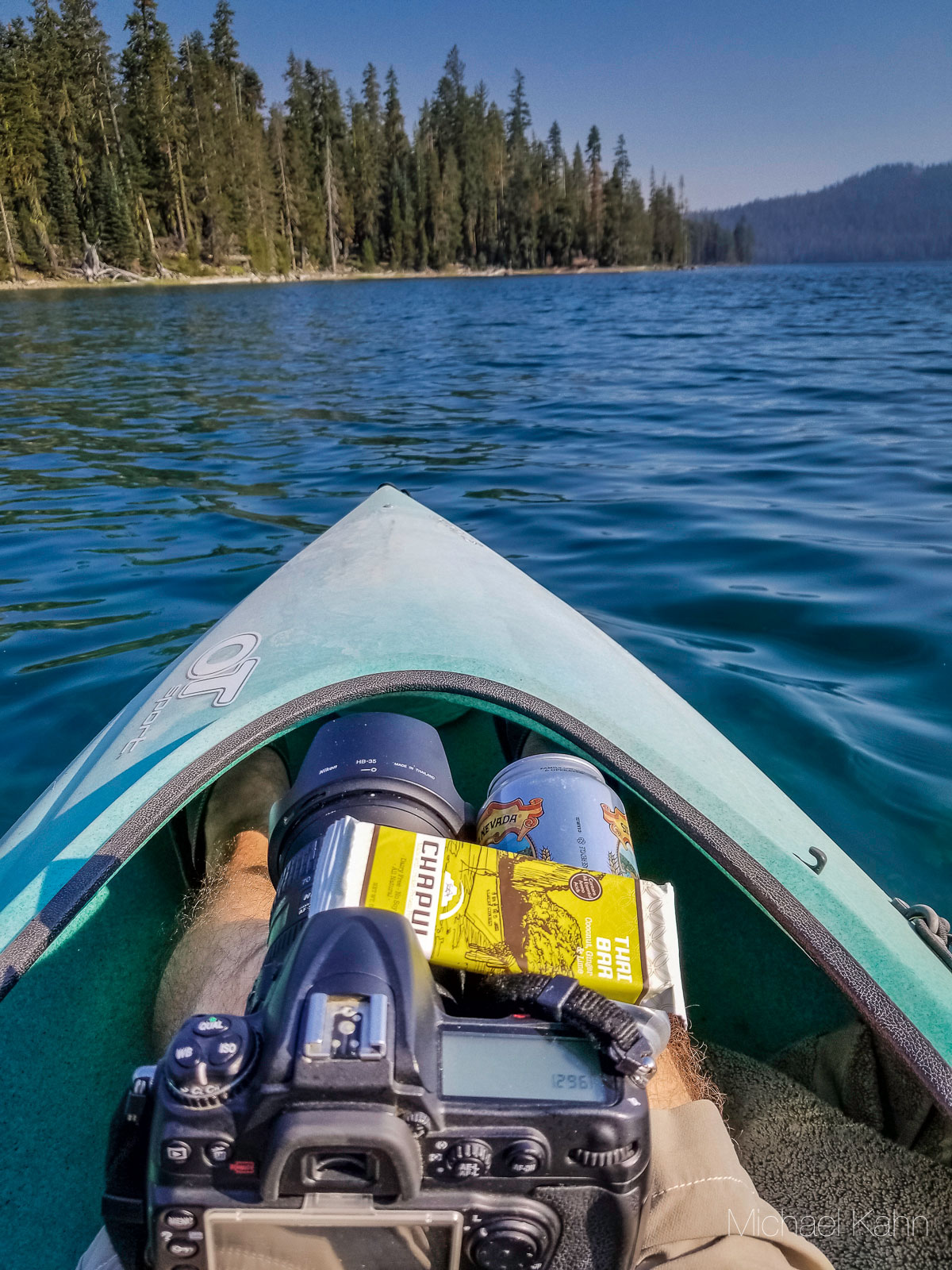
Returning the next summer over Labor Day weekend, I came prepared with a friend, kayaks, and a cooler heavy with aluminum cans and snacks. (Glass stays at home for places like this.)
Scoring the last available campsite on a holiday weekend at a first-come, first-served campground was its own small miracle. Plans for the trip were no plans.
We made sure our only plans were to have no plans…
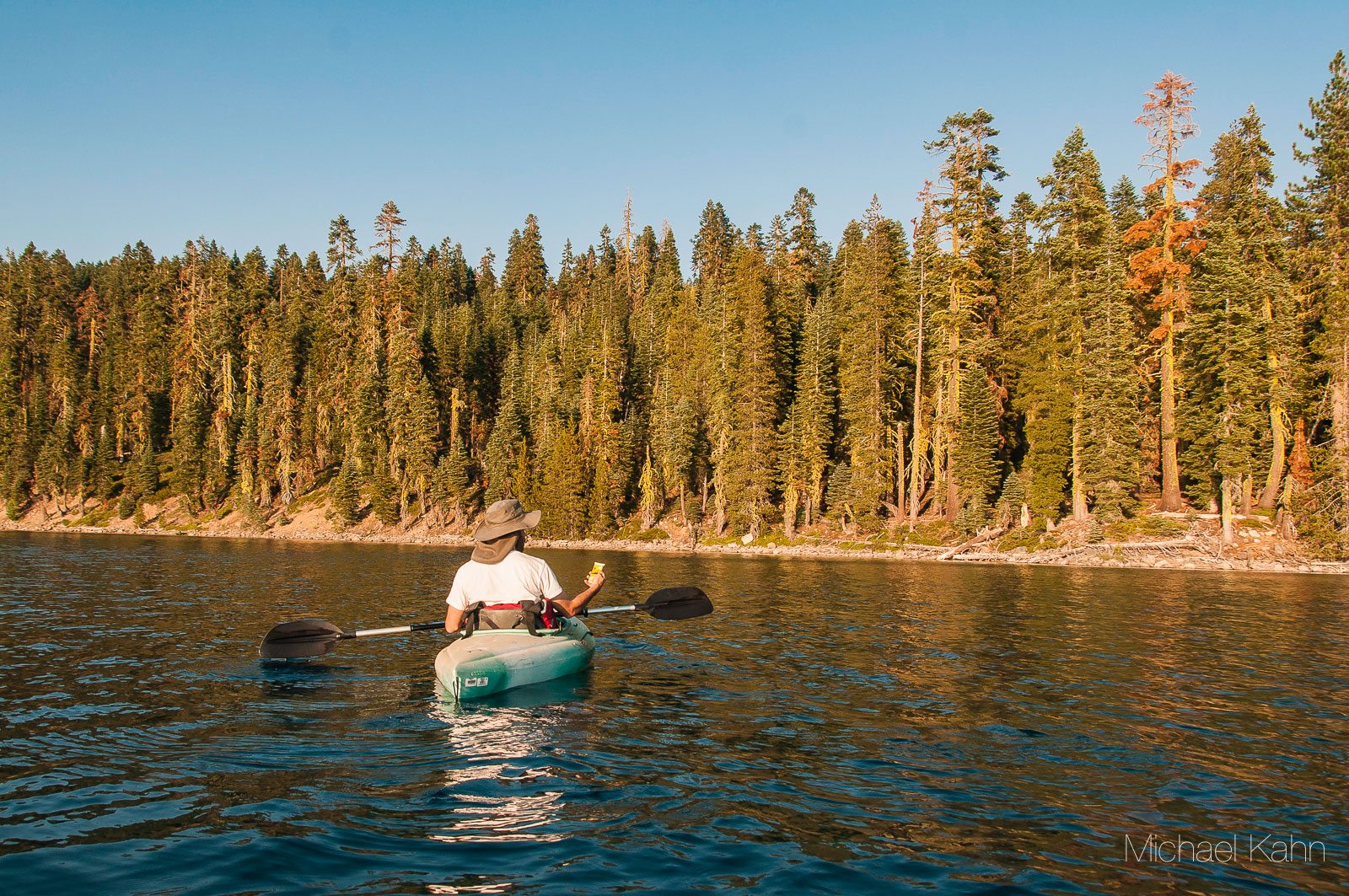
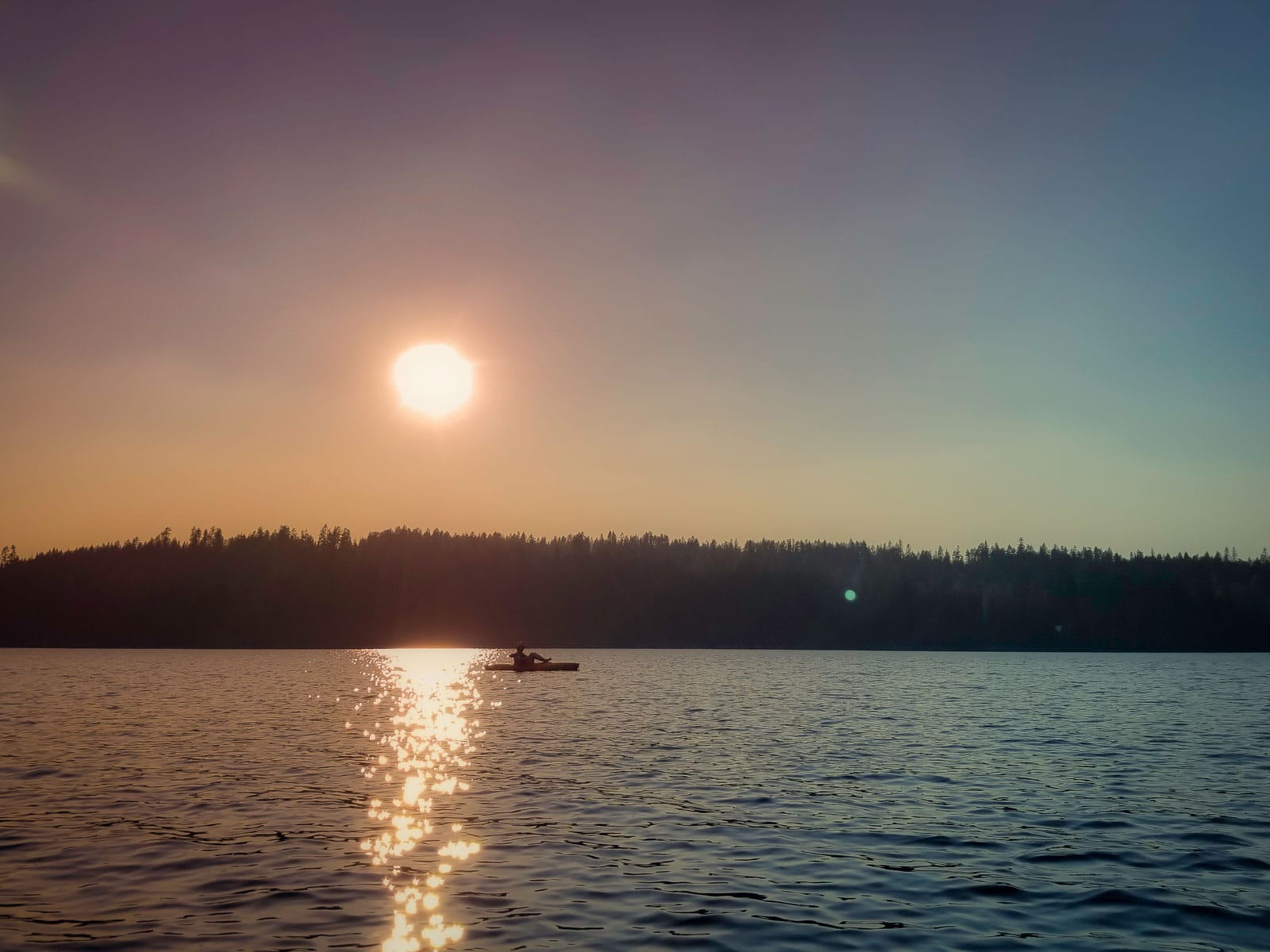
An hour before sunset, we launched. Watching deer running along the rocky edge while waves lapped against the kayak hulls turned the basin into something unreasonably calm.
Despite a full campground, the lake was big enough that we found a stretch of water to ourselves. Water clarity was striking; the bottom stayed visible at depth, then shifted to a sapphire blue as we paddled toward the center.
Reaching the middle of the lake just as the sun dropped behind the trees, we floated and ate dinner with our feet still in the boats. Time disappeared. Stars came out unobstructed by city light.
Night kayaking on a small, motorless mountain lake is one of the few situations where I feel comfortable on water in the dark; you cannot get lost, no boats can come at you, and the moon is enough light to see the bottom from the surface.
Sleeping a few feet from the water meant being woken at intervals by mule deer hoofing through the shallows. One stood close enough that when I sat up, I startled it more than it startled me.
Sunrise was the second-best paddle of the day: glassy water, smoke from coffee fires drifting across the campground, the campground itself still mostly asleep.
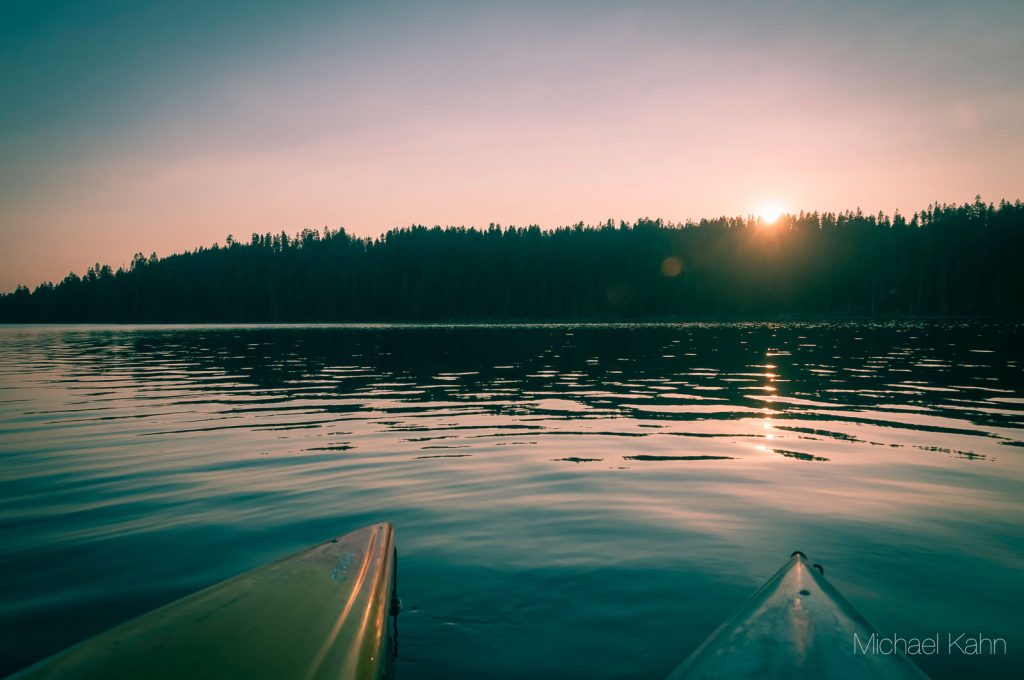
By the end of the weekend we were tired in the right way and quietly convinced that Juniper Lake might be one of the best lakes in Northern California to kayak.
Three years after that trip, the Dixie Fire crossed Mt. Harkness, took the lookout, burned the cabins on the northwest shore, and closed the road for five seasons.
Whether that 2018 trip remains the best Juniper Lake experience I will ever have, or whether it ends up being a memory I tell my kids about before bringing them to a recovered lake in 2030, depends on the road, the campground reopening, and a forest’s slow return.
Frequently Asked Questions
Is Juniper Lake in Lassen Volcanic National Park open in 2026?
Partly. An NPS alert posted July 24, 2026 says Juniper Lake Road is open for access to the lake and trailheads, while Juniper Lake Campground and the day use area remain closed for maintenance and campground improvement projects, with no potable water. Older NPS pages, including Trail Conditions, still describe the road as closed, so email lavo_information@nps.gov before you go. The closures date back to the 2021 Dixie Fire, which destroyed the Mt. Harkness Fire Lookout and seven of the eight cabins on the lake’s northwest shore.
What happened to the Mt. Harkness Fire Lookout?
The 1930 stone-and-wood lookout was destroyed by the Dixie Fire in early August 2021, days after the fire entered the park on August 5. Listed on the National Register of Historic Places in 2017 and rehabilitated by HistoriCorps volunteers in 2019, the structure stood for more than 90 years before the fire crossed Mt. Harkness on its way toward Juniper Lake. NPS has closed the remnants at the 8,046-foot summit and has not announced a rebuild plan as of September 2026.
How long is Juniper Lake Road from Chester?
NPS describes the road as 13 miles from Chester, with the last six miles a rough dirt road with steep sections. NPS recommends high-clearance vehicles and says the road is not suitable for buses, motorhomes, or trailers. Travel time is roughly an hour at 10 to 15 mph on the dirt section. The road reopened in July 2026 after closing for the Dixie Fire.
Is there fishing at Juniper Lake?
No. NPS Lassen Fishing states that Juniper Lake “does not contain any game species.” The Day Use page agrees: “There are no sport fish in the lake.” Plumas County also warns visitors not to plan a fishing trip here. For trout fishing in Lassen, head to Manzanita (catch-and-release fly fishery only), Butte, Snag, Horseshoe, or Summit Lake.
What is the Lassen Volcanic National Park entrance fee in 2026?
$30 per private vehicle from April 16 through November 30, valid for seven consecutive days. $10 in the winter season (December 1 through April 15). Motorcycle: $25 summer, $10 winter. Per person on foot or bicycle: $15 summer, $10 winter. Lassen Annual Pass costs $55. The park transitioned to a cashless fee system on April 8, 2023, so credit or debit card payment is required at entrance stations.
How long is the Mt. Harkness Trail and how much elevation gain?
NPS-canonical figures are 3.8 miles round-trip with 1,250 feet of elevation gain for the standard out-and-back. A longer combined loop pairing Mt. Harkness with the Juniper Lake outlet trail back to the campground extends the day to roughly 5.5 to 6 miles. The trailhead sits on the north side of Juniper Lake Ranger Station, and NPS rates the hike strenuous. Juniper Lake Road reopened in July 2026, but NPS’s Trail Conditions page still lists the trailhead as closed to vehicles, so confirm with the park first.
Did the Dixie Fire reach Juniper Lake?
Yes. The Dixie Fire entered Lassen Volcanic National Park on August 5, 2021 in the southeast corner near Juniper Lake. National Parks Traveler reported that “Flames from the northern tip of the fire climbed up and over Mount Harkness and claimed the fire lookout tower there on its way towards Juniper Lake.” The fire burned 73,240 acres in the park, its footprint covers 69% of the park per NPS, and it reached 963,309 acres overall, making it the largest single fire in California history at the time.
Are the cabins at Juniper Lake still there?
Seven of the eight cabins on the northwest shore were destroyed in the August 2021 Dixie Fire, including the one owned by the National Park Service. One cabin survived. NPS credited fuel clearing for sparing Juniper Lake Ranger Station. The private cabins were owned before that part of the park became federal land.
Is the Florida Juniper Lake the same as the one in Lassen Volcanic National Park?
No. There is a Juniper Lake near DeFuniak Springs in Walton County, Florida, managed by the county at Juniper Lake Park. That lake is unrelated to Lassen Volcanic National Park’s Juniper Lake in Plumas County, California. If a search result for “Juniper Lake” returns Florida visitor information, it is not describing this place.
What is the elevation of Juniper Lake?
NPS cites 6,800 feet for Juniper Lake. Some secondary sources use 6,700 or 6,792 feet, but NPS uses 6,800 across multiple official pages, including the Mt. Harkness Trail page (which describes the trail running from 6,800 feet at the trailhead to 8,046 feet at the summit). The lake surface itself sits a few feet below the trailhead bench.
What kind of volcano is Mt. Harkness?
USGS-mapped Mt. Harkness is a basaltic shield volcano with a summit cinder cone. It is one of four shield volcanoes at the corners of the Lassen central plateau (with Prospect Peak, Red Mountain, and Raker Peak). Mt. Harkness, Red Mountain, and Prospect Peak erupted basalt; Raker Peak erupted andesite. Each of the four developed a cinder cone on its summit during a final eruptive stage.
Whose traditional territory is Juniper Lake on?
Per NPS Lassen Volcanic, the Mountain Maidu made the southern and eastern portion of the Lassen region their home, including Warner Valley and Juniper Lake. Modern affiliated tribes for the Mountain Maidu include the Greenville, Enterprise, and Susanville Indian Rancherias. NPS describes the Lassen area as a meeting point for at least four groups: Atsugewi, Yana, Yahi, and Maidu.
Affiliate Disclosure: Some links in this article are affiliate links to Amazon. Purchases made through these links may earn a small commission at no additional cost to you. I only recommend gear I have used or would use for this kind of trip.
Article Updates
September 15, 2026: Updated the access status. An NPS alert dated July 24, 2026 reopened Juniper Lake Road, while the campground and day use area stay closed. Corrected the road surface against NPS: the last six miles are rough dirt, not gravel after pavement, and NPS recommends rather than requires high clearance. Corrected the cabin count: seven of eight cabins burned in total, and the NPS-owned cabin was one of the seven. The lookout was destroyed in early August 2021, not on August 5, the day the fire entered the park. Rewrote the Boiling Springs Lake entry to lead with its roughly 125-degree water and unstable ground. Replaced invented wildflower elevation bands with NPS’s Juniper Lake window, corrected the Butte Lake formation and the Mountain Maidu quotation, removed a 7,500-year figure NPS does not publish, and replaced “Crystal Cliffs” with Crystal Lake. Mt. Harkness is rated strenuous, boating is prohibited on Lake Helen, and NPS says the fire footprint covers 69% of the park. Removed unsourced red fir, cyanobacteria, Manzanita depth, and CO2 figures. Added life jacket, launch, and drying rules, pass tiers, and the park’s contact email.
May 5, 2026: Full Mike-byline rewrite reflecting post-Dixie Fire reality. Added current 2026 closure status (Juniper Lake Road, Campground, group sites, and stock corral all closed with no announced reopening). Updated entrance fee from $20 to $30 (cashless since April 8, 2023). Corrected road length from 12 to 13 miles per NPS. Documented destruction of Mt. Harkness Fire Lookout (1930, NRHP-listed 2017) in the August 5, 2021 Dixie Fire. Documented loss of seven of eight historic family cabins on the northwest shore. Added Mt. Harkness geologic profile (basaltic shield with summit cinder cone, USGS-mapped). Added Lassen Volcanic National Park lake comparison map and table covering nine lakes with 2026 access status. Corrected Mt. Harkness Trail figures to NPS-canonical 3.8 miles RT / 1,250 feet gain. Removed framing of Juniper Lake as a fishing destination per NPS (no game species). Added Mountain Maidu cultural context. Added 12-question FAQ with FAQPage JSON-LD schema. Added SimpleTOC. Refreshed gear recommendations to current Amazon ASINs. Personal first-person 2018 kayak narrative preserved as historical context. Sources: NPS Lassen, USGS, recreation.gov, Lassen Park Foundation, Plumas County, NOAA. Original publish date May 9, 2018 preserved.
Save this pin for your next adventure!




I’ve never actually been kayaking before. It looks like fun. That lake looks so peaceful too. Love the underwater clip in one of your videos!
Beautiful kayaking spot! My favorite kayaking trip has been in the sea caves in La Jolla, CA. Such a cool experience.
The photos just speak for themselves such a beautiful place would love to visit one day.
What a beautiful spot to go kayaking!
These photos look amazing! I am going to add this to our family bucket list, we love a good adventure!
Ahh this looks so beautiful! I can’t get over those views! Not sure if I’d be able to take the plunge kayaking because I’m not the most confident swimmer, if anything were to happen (lol) but other than that, this looks like it’d be an incredible experience!
-Madi | http://www.everydaywithmadirae.com
I was just saying the other day how would I would love to go kayaking. But I do not know how to swim. This looked like a wonderful trip, the views are beautiful.