The only kinesiology tape I have worn went on at the USA SUP National Championships in Gig Harbor, Washington, on September 20, 2026, after my right elbow gave out in the finishing sprint of a technical race. The event medical team laid pink strips across the front of the elbow and built a rigid splint and an elastic wrap over it.
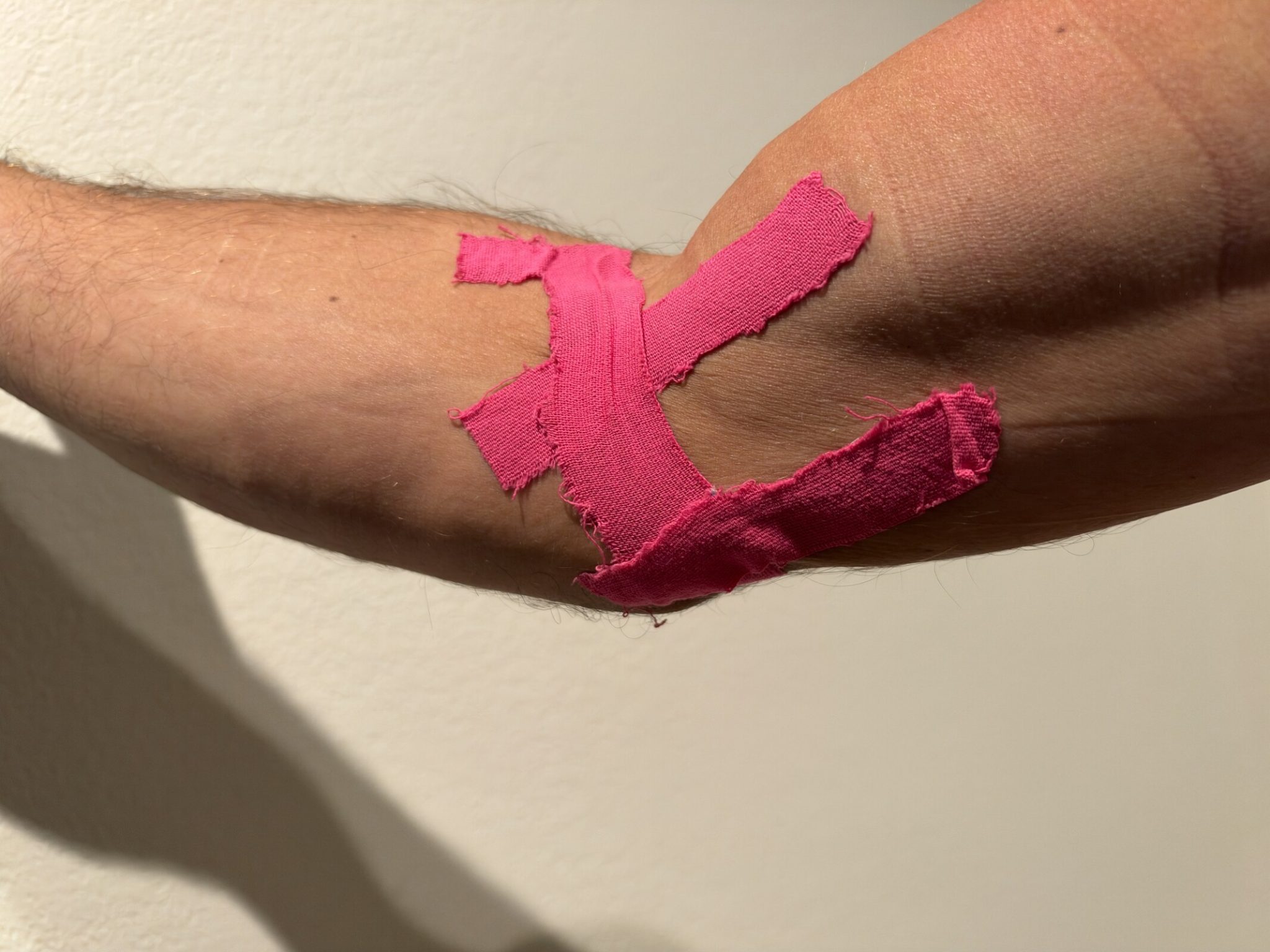
The tape was borrowed from a friend. I wore the tape for several days, and it gave the elbow support and kept things in place better, though it sat under the splint and the wrap.
The injury, the X-ray and what it could be are in my SUP elbow injury write-up.
Key Takeaways
- KT tape on the elbow: trials on tennis elbow split. Some found less pain than sham tape (Cho et al., 2018; Tayyab et al., 2025), and a deceptive crossover trial found no difference (Au et al., 2017).
- Application: published elbow protocols anchor the tape with no stretch and lay the tails at about 15% to 30% tension, with the elbow straight and the wrist bent down (Cho et al., 2018; Akkurt et al., 2025).
- Blood flow: three controlled studies found no increase in blood flow under the tape (Stedge et al., 2012; Woodward et al., 2015; Banerjee et al., 2020).
- Strength: meta-analyses found no strength gain in healthy adults or athletes (Csapo and Alegre, 2015; Stocco et al., 2024).
- Injury prevention: no trial measuring injury rates with kinesiology tape turned up in the research for this guide.
- Overall evidence: a 2026 umbrella review covering 310 randomized trials rated the evidence on kinesiology tape “very low certainty” (Mo et al., 2026).
- Wear time: trials left tape on for 3 to 5 days, a 2020 editorial says no more than a day, and KT Tape markets its Pro tape for 4 to 7 days.
Medical disclaimer: I am a paddler reporting published research, listed under Studies Cited. None of it is medical advice. An acute elbow injury needs a physician before any tape goes on.
What Kinesiology Tape Is
“Chiropractor, Dr Kenso Kase, developed KT taping techniques in the 1970s,” Williams and colleagues write in a 2012 meta-analysis in Sports Medicine. “It is claimed that KT supports injured muscles and joints and helps relieve pain by lifting the skin and allowing improved blood and lymph flow.”
The original design, as a 2014 case report in Przegląd Menopauzalny describes it, allows “30-40% longitudinal stretch” and is “composed of 100% cotton fibers and acrylic heat sensitive glue.” KT Tape sells its Pro version as “100% synthetic,” with an adhesive “formulated to remain in place for 4-7 days,” and calls it “water-resistant.”
What the Trials Found
| Claim | What peer-reviewed research found | Source |
|---|---|---|
| Increases blood flow | No change in calf blood flow, forearm skin blood flow, or resting skin microcirculation | Stedge 2012; Woodward 2015; Banerjee 2020 |
| Activates or relaxes muscle | “Neither facilitatory nor inhibitory effects were observed” in a deceptive grip trial | Cai 2016 |
| Builds strength | No strength gain across 19 studies in healthy adults, or in athletes | Csapo and Alegre 2015; Stocco 2024 |
| Reduces pain | No better than sham tape across 12 trials; pain reduction “may not be clinically meaningful” | Parreira 2014; Montalvo 2014 |
| Prevents injury | No trial measuring injury rates found; an ankle-sprain mechanism judged “unlikely” | Briem 2011 |
| Tennis elbow | Less pain than sham in some trials, no difference in a deceptive crossover | Cho 2018; Tayyab 2025; Au 2017 |
| Shoulder pain | 16.9 degrees more pain-free abduction right after taping, no lasting benefit | Thelen 2008; Celik 2020 |
| Paddle sports | One rowing study, with 5 of 18 rowers responding; no stand-up paddleboarding study | Wator 2024 |
An umbrella review by Mo and colleagues in BMJ Evidence-Based Medicine in 2026, pooled 128 systematic reviews covering 310 unique randomized trials. It rated the evidence “very low certainty” and put skin irritation at one extra case for every 173 people taped.
Pamuk and Yucesoy imaged taped legs with MRI in 2015 and titled their Journal of Biomechanics paper “MRI analyses show that kinesio taping affects much more than just the targeted superficial tissues.” Yildiz and colleagues found that tape applied with a facilitation technique still produced “increased muscle stiffness and a reduced muscle rate of force production” in a 2022 study.
The Elbow Trials
Cho and colleagues taped 15 people with tennis elbow in a double-blind crossover published in BMC Musculoskeletal Disorders in 2018. Pain during resisted wrist extension dropped 2.1 points with kinesiology tape against 0.7 with sham tape (P = 0.030).
Au and colleagues ran a deceptive crossover on 33 tennis elbow patients who knew nothing about the tape, 30 of whom were successfully deceived. They found no significant difference in pain intensity (p = 0.321) across facilitatory tape, inhibitory tape, sham tape and no tape.
Tayyab and colleagues, in Cureus, pooled 7 trials of tape plus exercise against sham tape plus exercise and found 1.71 points less pain than sham, with grip strength up 3.96 kg in the tape plus exercise group. Li and colleagues, in Heliyon, called the improvement one that “might be clinically significant.” For the inside of the elbow, Chang and colleagues found in 2012 that forearm tape did not change maximal wrist flexor strength in baseball pitchers, and absolute force sense errors fell with both kinesiology tape and placebo tape.
How to Apply KT Tape to the Elbow
The medical team’s tape at Nationals, in the photo at the top, anchors on the forearm below the elbow crease and runs up across the front of the elbow onto the upper arm. The tennis elbow protocols below tape the wrist extensors on the outside of the forearm.

Skin Prep
Raza and colleagues shaved the skin, “cleansed with alcohol swab,” cut the strips with “each of the four corners rounded,” and “activated by rubbing it for 10 s” in a 2023 trial in Heliyon. Ataullah and colleagues had the skin “cleaned with an alcohol swab, and dried” before taping. Cho’s team “applied pressure to the tape surface to initiate adhesion.”
A 2020 editorial by Andrýsková and Lee in Healthcare adds two rules: lay “2–3 cm of the starting and ending point” of each strip with no stretch, and allow “at least 10 min for the body to adapt to the taping before any activity.”
Two Y-Strips for the Outside of the Elbow
Cho’s team used the first strip “to inhibit the targeted muscles” and the second to “correct the fascia.”
- Straighten the elbow and bend the wrist down and toward the little-finger side.
- Cut two strips into a Y shape.
- Stick the uncut end of the first strip to the wrist. Stretch the strip to about 30% of its available tension toward the tails, then lay the tail ends down with no tension.
- Anchor the second strip 1 inch below and toward the front and inside of the bony point on the outside of the elbow, the lateral epicondyle, with no tension. Lay each tail across the wrist extensors at about 30% tension and finish the ends at the ulnar border of the forearm with no tension.
- Press the tape surface to start the adhesive.
A Three-Day Y-Strip From Hand to Elbow
Akkurt and colleagues split 42 tennis elbow patients between kinesiology tape and sham tape in a 2025 trial in the Journal of Orthopaedic Surgery and Research, using 5 cm Kinesio Tex Gold and a Y-strip of about 30 cm cut to the length of each forearm.
- Anchor the uncut end on the back of the hand with no tension, with the split of the Y at the base of the first three metacarpals.
- Straighten the elbow and bend the wrist down with slight ulnar deviation.
- Lay both tails up the forearm at 15% to 25% tension, to 4 to 5 cm above the lateral epicondyle.
- Finish the upper anchor with no tension.
- Add two small web-cut strips across the painful spot, “applied radially with a very light stretch of less than 10%.”
The tape “remained on the skin for three days” and came off one day before the next application, six times over three weeks. It detached early three times in the kinesiology tape group and eight times in the sham group.
None of the patients “reported any side effects.”
The Diamond Method
Bilgin and colleagues used a “diamond taping method” in a 2025 trial in Medical Science Monitor: four pieces of tape about 7 to 10 cm long, laid in a diamond from below the elbow upward while pulling the soft tissue toward the lateral epicondyle, with the elbow slightly bent. The tape was “renewed every week by the same person.”
How Long to Wear It and What Water Does
Trial wear times ran from 15 minutes in Cho’s acute test to 72 hours in Raza’s, three days in Akkurt’s, five days per application in a 2025 trial by Alshehri and colleagues, and weekly renewal in Bilgin’s.
Andrýsková and Lee’s editorial says “subjects should never wear kinesiology tapes for more than a day” and recommends removing the tape “immediately after showering as the wet tape can provoke undesirable skin effects.”
KT Tape markets the Pro version for the shower, the pool and “riding waves.”
No peer-reviewed study I found measured adhesion after immersion, sweat or a session on the water.
De Ru and Mikołajewska recorded reactions in 9.38% of 160 neurological patients, visible for 1 to 28 days, and listed ways to lower the risk that include “very little to no stretch” and clean skin.
Where Tape Fits on a Paddleboard
For rowers, Wator and colleagues applied tape “to the skin superficial to the paraspinals bilaterally with 60% pre-strain” for one of two 2,000 m rowing trials and wrote that “variable responses suggest that further work is necessary.” Schram and colleagues found in 2019 that inexperienced paddlers keep the elbow more bent and “rely heavily on the shoulder and possibly the biceps and forearm musculature” during the entry and drive.
The elbow and shoulder load in the stroke is covered in my isometric exercises for paddleboarding, and forearm load from the shaft in paddle grip and hand pain.
Frequently Asked Questions
Does KT tape work for elbow pain?
The trials split. A 2018 double-blind crossover found pain dropped 2.1 points with kinesiology tape against 0.7 with sham tape in tennis elbow, and a 2025 meta-analysis of 7 trials found less pain than sham. A 2017 deceptive crossover of 33 patients found no significant difference in pain.
How do you apply KT tape to the elbow?
Published tennis elbow protocols straighten the elbow, bend the wrist down, anchor a Y-strip with no stretch at the wrist or back of the hand, and lay the tails up the forearm at 15% to 30% tension toward the outside of the elbow. The ends go down with no stretch, and the tape is pressed or rubbed to start the adhesive.
How does KT tape work?
The claimed mechanism is that the tape lifts the skin and improves blood and lymph flow. Three controlled studies found no increase in blood flow under the tape. MRI does show the tape deforming tissue beneath it, and one 2022 study measured increased muscle stiffness.
Does KT tape make you stronger?
No. A 2015 meta-analysis of 19 studies found kinesiology tape “does not promote strength gains in healthy adults,” and a 2024 meta-analysis found it “does not contribute to muscle strength gain in athletes.”
Can KT tape prevent injuries?
No trial measuring injury rates with kinesiology tape turned up in the research for this guide. A 2012 meta-analysis found “little quality evidence” for its use in managing or preventing sports injuries, and a 2011 ankle study judged a sprain-prevention mechanism “unlikely.”
How long can you leave KT tape on?
Trials have left it on for 72 hours to five days per application, and a 2025 tennis elbow trial used three days on and one day off. A 2020 editorial recommends no more than a day. KT Tape says its Pro tape is formulated to stay on for 4 to 7 days.
Can you wear KT tape while paddleboarding?
KT Tape markets its Pro tape as water-resistant and suitable for the pool and waves. No peer-reviewed study I found measured adhesion after water exposure, and a 2020 editorial recommends removing tape immediately after showering because wet tape can irritate skin.
Does KT tape cause skin irritation?
Sometimes. A 2026 umbrella review put skin irritation at one extra case per 173 people taped, and a 2017 study of 160 neurological patients recorded reactions in 9.38%, lasting 1 to 28 days.
How much should you stretch KT tape?
In the elbow trials, the anchors went down with no stretch and the tails at about 15% to 30%. Small web-cut strips over the painful spot used less than 10%, and a rowing study used 60% along the lower back.
Studies Cited
- Akkurt HE et al. Kinesio taping in lateral epicondylitis, sham-controlled trial. J Orthop Surg Res. 2025. doi:10.1186/s13018-025-05658-7
- Alshehri NA et al. Healthcare (Basel). 2025. doi:10.3390/healthcare13233035
- Andrýsková A, Lee JH. The Guidelines for Application of Kinesiology Tape for Prevention and Treatment of Sports Injuries (editorial). Healthcare (Basel). 2020. doi:10.3390/healthcare8020144
- Ataullah MG et al. J Rehabil Med. 2021. doi:10.2340/16501977-2845
- Au IPH et al. Effects of Kinesio tape in individuals with lateral epicondylitis: A deceptive crossover trial. Physiother Theory Pract. 2017. doi:10.1080/09593985.2017.1359871
- Banerjee G, Briggs M, Johnson MI. The immediate effects of kinesiology taping on cutaneous blood flow in healthy humans. PLoS One. 2020. doi:10.1371/journal.pone.0229386
- Bilgin Y, Birişik F, Guler SB. Med Sci Monit. 2025. doi:10.12659/MSM.947642
- Briem K et al. Effects of kinesio tape compared with nonelastic sports tape and the untaped ankle. J Orthop Sports Phys Ther. 2011. doi:10.2519/jospt.2011.3501
- Cai C et al. Facilitatory and inhibitory effects of Kinesio tape: Fact or fad? J Sci Med Sport. 2016. doi:10.1016/j.jsams.2015.01.010
- Celik D et al. The clinical efficacy of kinesio taping in shoulder disorders. Clin Rehabil. 2020. doi:10.1177/0269215520917747
- Chang HY et al. Could forearm Kinesio Taping improve strength, force sense, and pain in baseball pitchers with medial epicondylitis? Clin J Sport Med. 2012. PMID 22584958
- Cho YT et al. Kinesio taping reduces elbow pain during resisted wrist extension in patients with chronic lateral epicondylitis. BMC Musculoskelet Disord. 2018. doi:10.1186/s12891-018-2118-3
- Csapo R, Alegre LM. Effects of Kinesio taping on skeletal muscle strength: a meta-analysis. J Sci Med Sport. 2015. doi:10.1016/j.jsams.2014.06.014
- de Ru E, Mikołajewska E. Skin irritation incidence. Ann Acad Med Siles. 2017. doi:10.18794/aams/65322
- Li Y et al. The efficacy of kinesio tape in patients with lateral elbow tendinopathy. Heliyon. 2024. doi:10.1016/j.heliyon.2024.e25606
- Mo Q et al. Effectiveness and clinical relevance of kinesio taping in musculoskeletal disorders. BMJ Evid Based Med. 2026. doi:10.1136/bmjebm-2025-114067
- Montalvo AM, Cara EL, Myer GD. Effect of kinesiology taping on pain in individuals with musculoskeletal injuries. Phys Sportsmed. 2014. doi:10.3810/psm.2014.05.2057
- Pamuk U, Yucesoy CA. MRI analyses show that kinesio taping affects much more than just the targeted superficial tissues. J Biomech. 2015. doi:10.1016/j.jbiomech.2015.10.036
- Parreira PC et al. Current evidence does not support the use of Kinesio Taping in clinical practice. J Physiother. 2014. doi:10.1016/j.jphys.2013.12.008
- Raza A et al. Heliyon. 2023. doi:10.1016/j.heliyon.2023.e23230
- Schram B et al. A biomechanical analysis of the stand-up paddle board stroke. PeerJ. 2019. doi:10.7717/peerj.8006
- Stedge HL, Kroskie RM, Docherty CL. Kinesio taping and the circulation and endurance ratio of the gastrocnemius muscle. J Athl Train. 2012. doi:10.4085/1062-6050-47.5.15
- Stocco MR et al. Does kinesio tape alter muscle strength in athletes? J Bodyw Mov Ther. 2024. doi:10.1016/j.jbmt.2023.11.023
- Taradaj J et al. Prz Menopauzalny. 2014. doi:10.5114/pm.2014.41082
- Tayyab M et al. Kinesio Taping Plus Exercise Versus Sham Taping Plus Exercise and Exercise Alone for Lateral Epicondylitis. Cureus. 2025. doi:10.7759/cureus.100228
- Thelen MD, Dauber JA, Stoneman PD. The clinical efficacy of kinesio tape for shoulder pain. J Orthop Sports Phys Ther. 2008. doi:10.2519/jospt.2008.2791
- Wator J et al. The acute effects of kinesio-taping on movement kinematics and muscle co-activation in rowers. J Back Musculoskelet Rehabil. 2024. doi:10.3233/BMR-230216
- Williams S et al. Kinesio taping in treatment and prevention of sports injuries: a meta-analysis. Sports Med. 2012. doi:10.2165/11594960-000000000-00000
- Woodward KA, Unnithan V, Hopkins ND. Forearm Skin Blood Flow After Kinesiology Taping in Healthy Soccer Players. J Athl Train. 2015. doi:10.4085/1062-6050-50.9.08
- Yildiz S et al. Effects of Kinesio Taping on Muscle Contractile Properties. J Sport Rehabil. 2022. doi:10.1123/jsr.2020-0495
Affiliate Disclosure: Some links in this article are affiliate links. If you buy through them, I may earn a small commission at no extra cost to you.
Article Updates
- September 24, 2026: Replaced the stock lead photo with the pink tape the medical team applied at Nationals, photographed three days later, and described its placement.
- September 23, 2026: Article published. Added Amazon links for KT Tape Pro, Kinesio Tex Gold and alcohol prep pads, with an affiliate disclosure.