
The first time a recipe asks for butter the size of an egg, you stop cold. Which egg? Whose egg? The card in my hand, copied out in someone’s looping cursive and stained at one corner, did not care to explain. It also wanted a moderate oven and a teacup of sugar, and it assumed I had stood in a kitchen long enough to know what both of those meant.
For most of cooking history, this was how it worked. People measured by the lump, the splash, the pinch, and the handful, and they trusted the cook to have the feel for it. Then in 1896 a Boston woman named Fannie Farmer published The Boston Cooking-School Cook Book and insisted that a cupful be measured level. She is the reason your measuring cups have a line on them. She is also the reason these older words can read like a foreign language today.
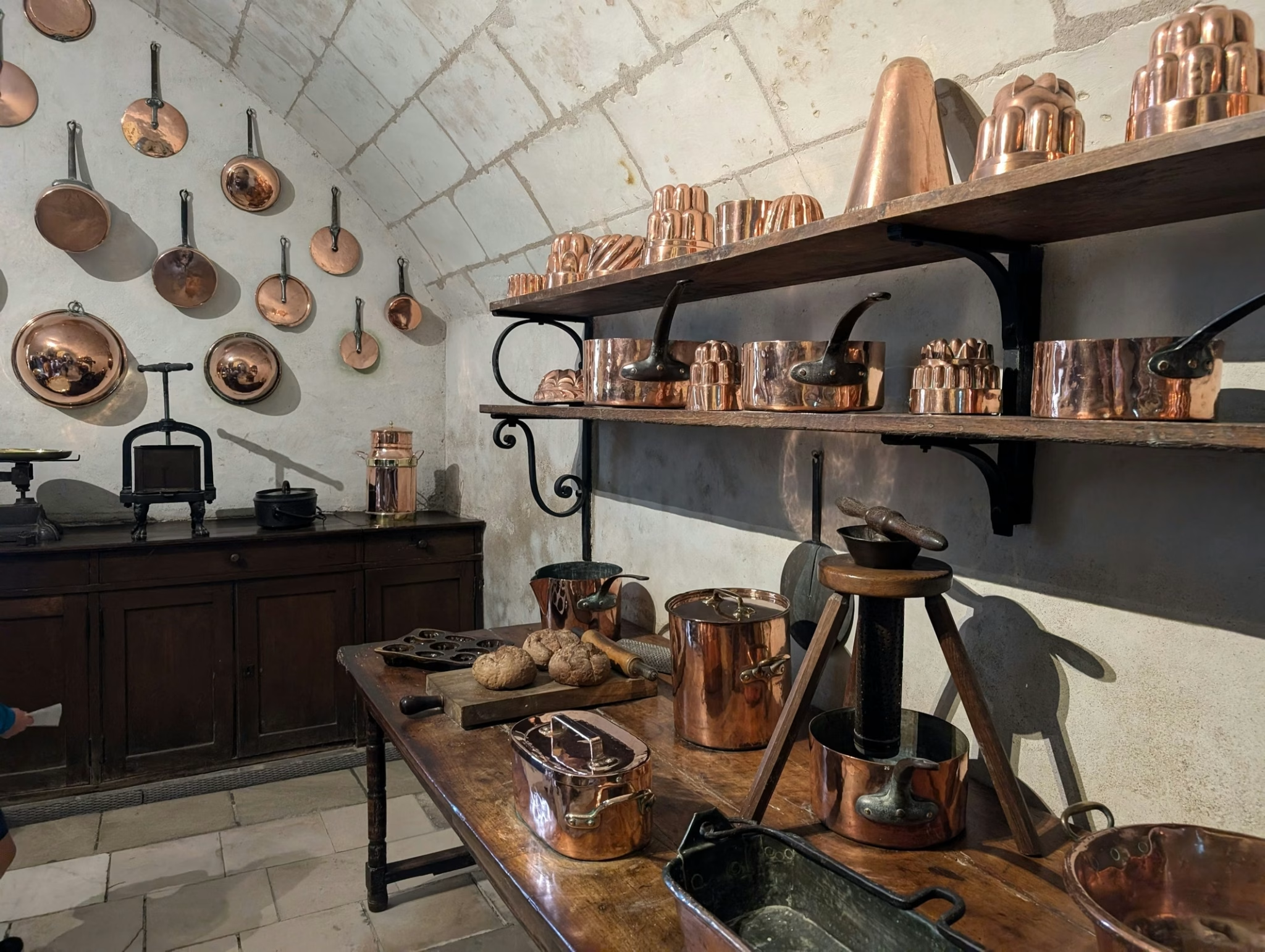
Some have real modern equivalents, and I will hand those to you straight. Others are pure feel, and you will know it when you taste it. I have collected these over years of cooking from old books and older recipe cards.
Key Takeaways
- Most of these predate 1896, when Fannie Farmer standardized the level cup, tablespoon, and teaspoon and ended the era of measuring by feel.
- Some have firm modern equivalents. A pat of butter is about a teaspoon, a gill is a quarter pint, and a jigger is 1.5 ounces. The cheat sheet below lays them out.
- Some are deliberately imprecise. A knob, a glug, a mess, and a good handful were never meant to be exact, and pretending otherwise misses the point.
- The “tiny spoon” set is a novelty. Smidgen, pinch, and dash carry stamped values (1/32, 1/16, and 1/8 teaspoon) only because a spoon maker decided so.
- A few words are not measurements at all. A rasher is one slice of bacon, and a spider is a frying pan, not an amount of anything.
The quick conversion cheat sheet
If you came here mid-recipe with flour on your hands, start here. These are the measurements that translate cleanly into something you can scoop.
| Old measurement | Closest modern amount | Worth knowing |
|---|---|---|
| Drop | 1/64 teaspoon | The smallest spoon in the novelty set |
| Smidgen (smidge) | 1/32 teaspoon | Less than a pinch |
| Pinch | 1/16 teaspoon | What you grab between thumb and forefinger |
| Dash | 1/8 teaspoon | Originally just one shake of the bottle |
| Tad | 1/4 teaspoon | The largest of the tiny-spoon set |
| Saltspoon | 1/4 teaspoon | The little spoon from the salt cellar |
| Fluid dram | About 3/4 teaspoon | An apothecary unit that slipped into recipes |
| Dessertspoon | 1.5 to 2 teaspoons | Standardized at 10 ml in the UK |
| Pat of butter | About 1 teaspoon (1/3 ounce) | Packed 48 to the pound in restaurants |
| Knob of butter | 1 to 2 tablespoons | Never precise, never meant to be |
| Walnut of butter | 1 to 2 tablespoons (about 1 ounce) | Sized to the nut |
| Pony | 1 fluid ounce | The small end of a jigger |
| Wineglass | About 2 ounces (1/4 cup) | In old American cookbooks |
| Egg of butter | 1/4 cup (4 tablespoons) | The big one, common in 1930s books |
| Gill | 4 ounces (US), 5 ounces (Imperial) | A quarter pint; say it “jill” |
| Jigger | 1.5 fluid ounces | The standard cocktail pour |
| Moderate oven | 350 to 375°F | Slow runs 300 to 325, hot runs 400 to 450 |
Butter, measured by the lump
Before butter came in sticks with tablespoon marks printed on the wrapper, cooks measured it by comparing it to things they could picture. The results climb in size: a pat is smaller than a walnut, a walnut is smaller than a knob, and an egg is the biggest of the lot.

Pat
The pat is the one you have held. It is the foil-wrapped square that lands on the bread plate at a diner, roughly a teaspoon, or about a third of an ounce. Restaurants buy them packed 48 to the pound. The name comes from the butter pat, a small ridged wooden paddle cooks once used in pairs to work the buttermilk out and shape the block into neat pieces.
Knob
A knob of butter is whatever you would casually break off the end of a stick to finish a sauce or slick a pan, somewhere between one and two tablespoons. British recipes lean on it constantly. It was never precise. Add a knob, taste, add another knob.
Walnut
A walnut of butter is exactly that: a piece about the size of a shelled walnut, close to an ounce, or one to two tablespoons. Old cookbooks use “knob the size of a walnut” as if those were two separate clues to the same answer. They more or less are.
Egg of butter
“Butter the size of an egg” turns up all through early-1900s cooking, and it is the lump that stops modern readers. Picture a large egg and you land at about a quarter cup, four tablespoons, two ounces. It is imprecise by nature, since eggs vary. This is the measurement that sent me down this entire rabbit hole.
Pinches, smidgens, and the very small stuff
This is the family of measurements for “a little, but not nothing.” A spoon company will sell you a set stamped with exact fractions, and I have listed those values because they are handy. Nobody in 1890 owned a 1/32-teaspoon spoon. These were finger measurements first.

Pinch
The classic. A pinch is the amount of salt or spice you can hold between your thumb and forefinger, which the novelty spoon set pins at 1/16 teaspoon. It changes with the size of your hand, so a pinch from me is not a pinch from my daughter. It is the right tool when over-measuring would wreck the dish, the way it does with a strong aromatic like a pinch of lavender in compound butter.
Smidgen
A smidgen, usually shortened to a smidge, is less than a pinch. The spoon set calls it 1/32 teaspoon. In practice it means “I know this needs a touch more, but barely.” It is the seasoning equivalent of nudging a picture frame a quarter inch to the left.
Dash
A dash got its 1/8-teaspoon value from the same spoon maker, but it started life as a liquid term: however much came out of the bottle in one quick shake. Bartenders still work this way. The reason a Manhattan is built on two dashes of bitters rather than a measured amount is that the dash was always about the gesture.
Tad and drop
The same novelty sets often round out with a tad (1/4 teaspoon, the biggest of the small spoons) and a drop (1/64 teaspoon, the smallest). A tad is what you reach for when a recipe is close but flat. A drop is barely a rumor of an ingredient, which is about right for something like rosewater.
Scant
Scant is not an amount so much as an instruction to under-fill. A scant cup means you stop a hair below the line. Bakers use it constantly, because the difference between a full cup and a scant cup of flour is the difference between tender and tough.
Snuf
If a Dutch recipe asks for a snuf, or more often a snufje, it wants a pinch. The word is the diminutive of snuf, related to sniffing or snuffing, so een snufje zout is literally a little sniff of salt. It is the most charming way I know to ask for a pinch.
Skosh
A skosh is a little bit, somewhere between a pinch and a spoonful. The word came home with American servicemen stationed in Japan, who borrowed the Japanese sukoshi, meaning a small amount. Merriam-Webster dates its English debut to 1952. Add a skosh more salt and you are speaking postwar GI.
Glugs, splashes, and pours
These are liquids measured by sound, by time, or by the simple confidence of the cook. There is no spoon for any of them, and there was never meant to be.
Glug
A glug is measured by the noise the bottle makes when you tip it: that throaty glug as air rushes back in. Call it roughly a tablespoon per glug if you need a number, but the truer measurement is the sound. Two glugs of olive oil into the pan and you are cooking.
Splash
A splash is a fast, short pour, about a second of liquid. It is deliberately casual. When you finish a pan with a splash of bourbon and let it flare, precision is not the goal and would only get in the way.
Lashing
A lashing is a generous one, almost always of something rich and pourable. Cream over a pudding, custard over a crumble. The old British phrase “lashings of cream” carries the whole idea: more than enough, on purpose, with no apology.
Dollop
A dollop is a soft, spoonable mound that holds its shape: sour cream on a baked potato, whipped cream on a slice of pie, yogurt on top of a curry. It is bigger than a spoonful you would level off and smaller than a serving. The word sounds exactly like what it describes, which is most of why I love it.
Seconds
Some recipes and most bartenders measure liquid by time. Pour for a three-count and you have moved about an ounce and a half. Free-pouring by seconds is a real skill, and it is how a good bartender hits the same drink fifty times a night without ever touching a jigger.
The cocktail measures
The bar kept its old units long after the kitchen standardized, which is why these still appear on cocktail recipes today. If you stock a two-sided jigger at home, you already own two of them.

Jigger
A jigger is 1.5 fluid ounces, and it is also the name of the hourglass-shaped tool itself. The word traces back to the jiggermast, the smallest mast on a sailing ship, and to the daily rum ration measured in the small metal cup sailors called by the same name.
Pony
The pony is the jigger’s little sibling, one fluid ounce, the smaller cup on a double-ended jigger. The name dates to the late 1800s and meant “small,” the same way a pony is a small horse. Be warned that the word wandered: a pony in old Glasgow ran closer to four and a half ounces, and an Australian pony was a small beer glass.
Fluid dram
The fluid dram came over from the apothecary’s bench, where it equaled about three quarters of a teaspoon. For a stretch in the 1800s a teaspoon and a dram were treated as the same thing, until the household teaspoon quietly grew and broke the match. It is why old medicinal “doses” in recipes do not map cleanly to your kitchen spoons.
Finger
Pour whiskey to the height of a finger held against the glass and you have poured a finger, give or take, depending on how wide the glass is. “Two fingers of bourbon” is the same idea stacked. Call it roughly an ounce per finger if you need a number, but the whole point is that you are measuring by eye, not by jigger.
Tot
A tot is a small allowance of liquor, and in the Royal Navy it was the sacred one. From 1740 sailors drew a daily tot of rum, watered down into grog, settling in its final years at an eighth of an imperial pint, about two and a half ounces. The ration ended on July 31, 1970, a date the fleet still remembers as Black Tot Day.
Nip
A nip is a sip, or the little bottle that holds one. The word is short for “nipperkin,” from an old Dutch word for sipping. Nobody ever pinned the historical nip to a firm volume, which feels about right, but today a nip is the 50 milliliter miniature you meet in a hotel minibar or on a plane.
Vessels that became measurements
Before standardized cups, people measured with whatever sat in the cupboard. The vessel was the unit, which is exactly why two cooks following the same recipe could end up with two different cakes.
Gill
A gill is a quarter pint, and you say it with a soft G, “jill.” A US gill is 4 ounces, but an Imperial gill is 5. In Ireland the legal pub measure for spirits was once a quarter gill, which is where a lot of generous Irish pours quietly began.
Noggin
A noggin is also a quarter pint, the same as a gill, and in old London it specifically meant a quarter pint of spirits. Yes, it is the same noggin that means your head. The National Institute of Standards and Technology keeps it on its list of delightfully obsolete units, which is the kind of government document I did not expect to enjoy.
Teacup, coffee cup, and breakfast cup
Old recipes name the actual china. A teacup ran about 4 to 6 ounces, a coffee cup 6 to 8, and a breakfast cup, the big morning one, 8 to 10. None of it was fixed, which was the problem. A modern rocks glass holds 10 to 13 ounces on its own, so a recipe’s “teacup” assumed something much smaller than what you would grab today.
Wineglass
A wineglass in an 1800s recipe meant about 2 ounces, a quarter cup, because the wineglasses of the day were small. If you measured brandy for a recipe in a modern stemless pour, you would roughly double what the author intended.
Tumbler
A tumbler was the everyday drinking glass, so a tumblerful meant 8 to 16 ounces depending on the household. Useful as a rough pour, useless for a cake.
Cupful versus cup
Before 1896, “a cupful” meant whatever cup you owned, heaped or level as you saw fit. Then Fannie Farmer drew the line: a cupful is measured level, full stop. That single sentence is why “cup” today is a fixed 8 ounces and why everything above this point reads as quaint. She earned the nickname “the mother of level measurements.”
By the barrel: cask measures
Brewers and vintners measured in casks, and beer and wine used two different gallons that happened to share the same names. In the beer system the ladder runs firkin, kilderkin, barrel, hogshead, butt, tun, mostly doubling at each rung. Wine ran on its own smaller gallon, so a wine hogshead and a beer hogshead are not the same size at all.
Firkin
The little one, 9 imperial gallons of beer, a quarter of a barrel. The name comes from a Middle Dutch word meaning “little fourth.” Cask-ale pubs still tap firkins, which is why the word survives at all. Two firkins make a kilderkin.
Kilderkin
Eighteen gallons, two firkins, half a barrel. The word came out of Middle Dutch as well, and it is far and away the most enjoyable thing on this list to say out loud.
Barrel
The anchor of the beer system at 36 imperial gallons. A US beer barrel is 31 US gallons, a different unit wearing the same name.
Hogshead
A beer hogshead is 54 imperial gallons. A wine hogshead is 63 wine gallons, which works out to about 52 and a half imperial.
Butt
Two hogsheads. A beer butt is 108 imperial gallons; a wine or sherry butt is 126 wine gallons. The sherry butt, around 500 liters, is still the cask a lot of Scotch quietly ages in. And yes, it is where “buttload” comes from.
Tun
The giant, and the root of the word “ton.” A beer tun is 216 imperial gallons. The old statutory wine tun, fixed under Henry VIII, held 252 wine gallons.
The Victorian flatware measures
For a stretch in the 1800s, the table setting was the measuring set. The spoons that came with the silverware doubled as units, which means these survive on old recipes as a kind of fossil record of how people ate.
Saltspoon
The saltspoon was the tiny spoon that lived in the open salt cellar before shakers took over. As a measurement it means about 1/4 teaspoon. Its even smaller cousin, the pepperspoon, came in around 1/8 teaspoon.
Dessertspoon
A dessertspoon sits between a teaspoon and a tablespoon, about 1.5 to 2 teaspoons, and the UK still standardizes it at 10 milliliters. The apothecaries had their own version at two fluid drams. If a British recipe asks for a dessertspoon of jam, two teaspoons will not steer you wrong.
From the medicine chest: apothecary units
Before the pharmacy and the kitchen fully parted ways, old recipes and home remedies borrowed the apothecary’s weights. They hinge on the fluid dram from the cocktail measures above: by weight, 60 grains make a dram and 20 grains make a scruple; by volume, 60 minims make a fluid dram.
Grain
The base of the whole system, and once exactly what it sounds like: the weight of a single dry grain of wheat taken from the middle of the ear. It settled at 64.8 milligrams, one seven-thousandth of a pound. A measure of saffron or a leavening agent in an old formula might be counted in grains.
Scruple
Twenty grains, a third of a dram, about 1.3 grams. The word comes from the Latin for “a small sharp stone,” which is also why having scruples means being weighed down by small, nagging doubts.
Minim
The smallest liquid measure the apothecaries kept, one sixtieth of a fluid dram, around six hundredths of a milliliter. It lands close to a single drop, though the people who defined it pointedly refused to call it one.
By the hand, the eye, and the wallet
This is the catch-all drawer: measurements taken from your own body, your own judgment, or the price of groceries the year the recipe was written. None of them survive translation cleanly.
First finger joint
Stand your finger upright in the pot and add liquid to the first knuckle. Cooks still measure water over rice this exact way, and it works because it scales with the pot. The flaw is that the size of the vessel changes everything, so the same knuckle gives you wildly different amounts in a teacup and a stockpot.
Heaping
A heaping spoon or cup is piled above the rim until it threatens to spill. It is the exact opposite of scant, and a heaping tablespoon of flour can hold half again as much as a level one. When a recipe specifies heaping, it usually wants the extra.
Scoop
A scoop is whatever scoops. A cupped hand, a coffee mug, the lid of a jar, an actual ice cream scoop. It assumes you and the recipe writer share a kitchen, which you do not, which is why a scoop is the least helpful word on this list and somehow still common.
Handful
A handful, or a good handful, is exactly what it sounds like and has no fixed value at all. It bends to the size of your hand and the shape of the ingredient. A handful of spinach and a handful of rice are not remotely the same volume. I have made peace with it; you should too.
Mess
In the American South, a mess is a satisfying portion, most often of greens. “A mess of collards” means enough to feed the table, gathered by eye and experience rather than weighed. It is one of the warmest food words we have, and you cannot put a number on it without ruining it.
Money’s worth
Older recipes happily call for fifteen cents of dried coconut or fifty cents of butter, pricing the ingredient instead of measuring it. The trouble is that those amounts assumed a specific store in a specific year, ignoring inflation, region, and supply. A nickel of nutmeg in 1925 is a guess today.
Package
The 1960s and 1970s gave us recipes built around “a package of” something branded: a packet of onion soup mix, a box of a certain gelatin. It is precise only if that product still exists at the size it once did, which it frequently does not.
Enough, to taste, and the desired result
“Salt to taste,” “add enough to bind,” “cook until you get the desired result.” They put the judgment back on the cook, which can feel like a cop-out until you realize it is the only instruction that respects that your tomatoes are not the writer’s tomatoes. Season, taste, adjust, repeat.
Q.B.
Open an Italian cookbook and you will hit q.b. next to the salt. It stands for quanto basta, “as much as is enough.” Portuguese cooks use the same two letters for quanto baste, which means the same thing. Both are just an elegant European way of writing “to taste.”
Un chin
In the Dominican Republic and Puerto Rico, un chin means a little bit. Dame un chin de café is “give me a little coffee.” Its origin is debated, with some sources pointing to a West African root and others to Taíno, so I will not pretend to settle it.
Peck and bushel
These two still cling to the produce stand. A peck is 8 dry quarts, a quarter of a bushel; a bushel is four pecks, 32 dry quarts. If you have ever bought “a peck of apples” at an orchard, you have used a measurement older than the country. The ratios are exact even if the absolute volume shifts slightly between the US and Imperial systems.
Oven language, before the thermostat
Moderate oven and its siblings
Old recipes describe heat in words because ovens did not have dials. A slow oven is 300 to 325°F, a moderate oven is 350 to 375, and a hot or quick oven runs 400 to 450, with a very hot oven climbing to 500. Custards wanted slow, bread wanted moderate, pastry wanted hot.

With no thermometer, you held a hand inside and counted how many seconds you could stand it, or you laid a sheet of white paper or a dusting of flour on a pan and timed how fast it turned golden. Quick browning meant a hot oven. Slow browning meant a moderate one. People read heat the way a blacksmith reads the color of iron.
Words that sound like measurements but aren’t
⚠️ Heads up: two terms get filed under “old cooking measurements” all the time and do not belong there at all. I am including them precisely because of that confusion.
Rasher
Not an amount, a single slice of bacon. “Eight rashers” means eight slices, not eight ounces. The word likely comes from the old verb rash, meaning to slice or cut, and it stayed alive mostly in British and Irish kitchens. If a recipe wants three rashers, count, do not weigh.
Spider
A pan, not a portion. It was a cast-iron frying pan with three legs and a long handle, built to stand over hearth coals so the body sat up off the floor. The earliest American print mention shows up in Lydia Maria Child’s The Frugal Housewife in 1833. When the iron cookstove arrived and pans no longer needed legs, the name slid over to the flat skillet, which is why some old cooks still call a frying pan a spider.
What did I miss?
This list grows every time I open a cookbook older than I am. Regional terms, family shorthand, the unit your grandmother used that nobody outside your kitchen would recognize. Those are the ones I want. Tell me the measurement that stopped you cold mid-recipe in the comments, and I will run it down and add it.
Frequently Asked Questions
How much is a pinch of salt?
A pinch is the amount you can hold between your thumb and forefinger. The common measuring-spoon set fixes it at 1/16 teaspoon, though the real amount changes with the size of your hand. For most savory dishes, a pinch is somewhere between 1/16 and 1/8 teaspoon.
How much butter is “the size of an egg”?
About a quarter cup, which is four tablespoons or roughly two ounces. The measurement is approximate because eggs vary, but a quarter cup is the standard modern reading and works in nearly any old recipe that calls for it.
What temperature is a moderate oven?
A moderate oven is 350 to 375°F, about 180°C. For the rest of the scale, a slow oven runs 300 to 325°F, a hot or quick oven runs 400 to 450°F, and a very hot oven reaches 500°F.
What is the difference between a smidgen, a pinch, and a dash?
On a standard novelty measuring-spoon set, a smidgen is 1/32 teaspoon, a pinch is 1/16 teaspoon, and a dash is 1/8 teaspoon. So a dash is double a pinch, and a pinch is double a smidgen. These values come from spoon manufacturers, not any official standard.
How many ounces is a jigger?
A jigger is 1.5 fluid ounces. The smaller cup on a double-ended jigger tool, called the pony, holds 1 fluid ounce. Together they cover most cocktail measurements.
What is a gill?
A gill is a quarter pint, pronounced “jill.” A US gill is 4 fluid ounces and an Imperial gill is 5, so the system matters when you convert. It shows up in old British and Irish recipes and in historical pub-measure laws.
How much is a knob of butter?
A knob of butter is roughly one to two tablespoons, whatever you would casually break off a stick to finish a sauce or coat a pan. It was never an exact measurement, so there is no need to treat it as one.
Why are old recipe measurements so vague?
Most of them predate 1896, when Fannie Farmer popularized the level cup, tablespoon, and teaspoon in The Boston Cooking-School Cook Book. Before that, cooks measured by feel, by the vessel on hand, and by experience, and recipes were written for people who already knew how a dish should look and taste.
Is a dash an official unit of measurement?
No. The 1/8-teaspoon value comes from measuring-spoon manufacturers, not from any standards body. Historically a dash just meant however much liquid came out of the bottle in one quick shake, which is still how most bartenders use it.
What does “to taste” actually mean?
It means add a little, taste the dish, and adjust until it is right, repeating as needed. It puts the decision on the cook because no two batches of ingredients are identical. It is vague on purpose, and it is also the most honest instruction in cooking.
Affiliate Disclosure: Some links in this article are affiliate links. If you buy one of these vintage cookbooks through them, I may earn a small commission at no extra cost to you.
Article Updates
- May 31, 2026: Expanded the glossary well past the original list and illustrated it. Added the cocktail and bar measures (jigger, pony, finger, tot, nip), the vessel and flatware measures (gill, noggin, teacup, wineglass, dessertspoon, saltspoon), the cask and barrel sizes (firkin through tun), the apothecary units (grain, scruple, minim), and the produce measures (peck, bushel). Built a quick conversion cheat sheet for the measurements that have real modern equivalents, and added illustrated guides to butter sizes, the pinch-to-tad spoon set, vintage oven temperatures, and the jigger and pony. Folded in the Fannie Farmer 1896 history that ties the whole list together.


