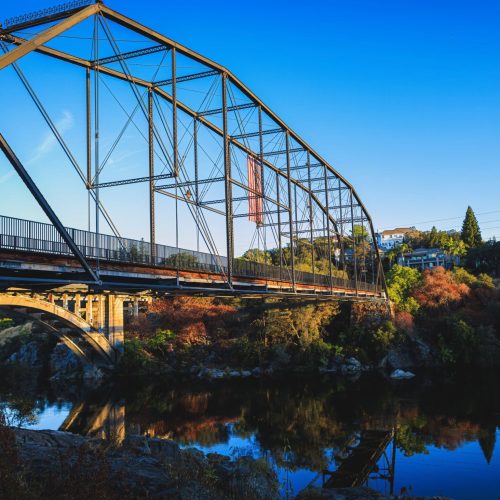
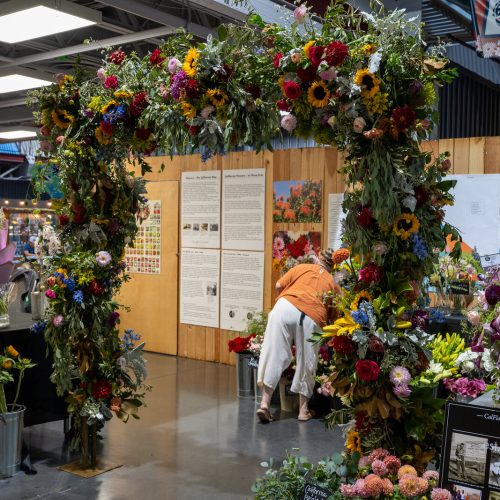
Sacramento officially became “America’s Farm-to-Fork Capital” in October 2012, when Mayor Kevin Johnson unveiled its logo at Cesar Chavez Plaza during the season’s last farmers market. Its farms were shipping food down the river 160 years earlier. In August 1852 the steamer New World carried ten tons of watermelons and cantaloupes on one trip, most of them grown “on the banks of the American river, and in Yolo county.”
SacFM is my guide to the Sacramento restaurants that print their farms’ names on the menu, with a page for each of those farms that shows where it is and how to visit it. Most of these figures come from its Roots history pages, which I built from county crop reports, agency records and UC research, and from old newspapers as far back as the August 1852 Daily Alta California.
✦ Key Takeaways
- America’s Farm-to-Fork Capital dates to October 2012, when Mayor Kevin Johnson unveiled its logo; restaurateur Josh Nelson created the logo and donated its web addresses to the city.
- Florin strawberries: on one day in May 1914 the district loaded 5,000,000 berries into rail cars in two hours.
- “The Big Tomato” appears in print as early as September 23, 1979, in a Santa Rosa columnist’s diary of his first week in Sacramento.
- Rice: California’s first commercial rice crop, by the USDA’s account, was 1,400 acres near Biggs in 1912. Growers planted 533,000 acres in 2025, and 7 to 10 million ducks and geese winter in the fields.
- The Apple Hill Growers formed in 1964 after pear decline cut El Dorado County’s pear crop from 52,000 tons in 1958 to 19,000 in 1962.
- Almonds: Esparto’s festival on September 4, 1915, was billed as the first almond festival in the United States, and Blue Diamond was organized in Sacramento in 1910.
- Caviar: California’s sturgeon catch peaked at 1.65 million pounds in 1887. Farmed caviar grew out of UC Davis sturgeon research that began spawning wild fish in 1980.
How Sacramento Became America’s Farm-to-Fork Capital
Restaurateur Josh Nelson, a co-founder of Selland Family Restaurants, came up with the “America’s Farm-to-Fork Capital” logo, a fork sprouting from the ground, after setting out to play off the “I Love New York” slogan. He trademarked the logo and bought several web addresses for it before donating them to the city, Comstock’s reported in 2013. Nelson also gathered the statistics for the mayor’s proclamation.
Visit Sacramento has run annual Farm-to-Fork events since 2013. By the visitors bureau’s figures, 1.5 million acres of farms and ranches surround the region and grow more than 160 crops.
Florin Strawberries and the Five-Million-Berry Day
Florin, a farm district south of downtown, sent six to seven carloads of strawberries out every day in June 1903. On a single day in May 1914 it loaded 5,000 crates, or 5,000,000 strawberries, into waiting cars in two hours.
When Secretary of State William Jennings Bryan toured Florin with Governor Hiram Johnson on May 1, 1913, the Fresno Bee counted “1500 Japanese farmers and 400 Americans” in the district’s 25 or so square miles. The state senate was then taking up the Alien Land Act, a bill the paper said was “designed to restore Florin and similar communities once more to Caucasian owners.”
In 1942 the federal government removed Florin’s Japanese American families to assembly centers and then incarceration camps. Densho counts about 1,200 people from Elk Grove and Florin sent to the Jerome camp. Leo Uchida’s family sold its 50-acre farm, with the buildings and equipment, for $5,000 to a couple from Oklahoma.
Sacramento County grew 45 acres of strawberries in 2025, worth $860,000, against 126 acres in 2000.
Why Sacramento Is Called the Big Tomato
No one is on record as having coined “the Big Tomato.” The earliest use I found is from September 23, 1979, when Santa Rosa Press Democrat columnist Pete Golis, newly arrived, kept a diary of his first week in “Sacramento the Big Tomato.” A 1988 McClatchy News Service story traced the related nickname, Sacratomato, to the years when the city’s canneries “ran seven days a week in July and August.”
In 1964 machines picked only “about 3 per cent” of California’s tomatoes. The bracero farm-labor program ended that December, and in 1965 machines picked one-third of the crop. Harvest labor fell 90 percent afterward, while production climbed from 2.5 million tons a year in the early 1960s to 10 to 12 million.
Campbell’s soup plant on Franklin Boulevard began production on 146 acres on September 8, 1947, and closed in 2013. Yolo County alone harvested 1,546,000 tons of tomatoes from 30,227 acres in 2024, worth $173,152,000 and second only to almonds there.
Rice Fields That Feed Millions of Ducks
California imported more than 50 million pounds of rice in 1876, most of it from China. The first commercial crop, by a 1920 USDA bulletin’s account, was 1,400 acres near Biggs in 1912, and it paid well. By 1919 rice covered 142,000 acres and was worth “more than $21,000,000.”
In 1918 the Weekly Colusa Sun credited a Japanese farmer, K. Ikuta, with raising “near Biggs the first commercial crop” and called him “the real pioneer of commercial rice growing in California.”
Growers once burned the straw left after harvest, because burning cost about $2 an acre against about $36 to work it into the soil. In 1992 they burned 303,103 of 401,807 planted acres. Since fall 2001 burning has been capped at 125,000 acres a year and allowed only for disease control.
Between 7 and 10 million ducks and geese winter in the rice fields, which supply “more than 60%” of their diet, according to the California Rice Commission.
In the 2022 drought growers planted 254,000 acres, which AgAlert called the fewest since 1958. In 2025 they planted 533,000, the most since 2016.
Lundberg Family Farms grew its first organic crop, 76 acres of brown rice, in 1969, and in 1973 Homer Lundberg and 53 other farmers founded California Certified Organic Farmers.
Salmon Canning Began Across From K Street
Hapgood, Hume & Co. opened the first salmon cannery on the Pacific Coast in the spring of 1864 at Washington, now West Sacramento, “opposite the foot of K street, Sacramento city.” R. D. Hume, who was there, put the first pack at “about 2,000 cases” and wrote that “at least fifty per cent of the product spoiled.”
The federal Baird Station hatchery on the McCloud River opened in 1872. Within a decade it shipped “nearly 14,000,000 salmon eggs” in one season to several countries, “of which New Zealand was the most remote.”
The river’s winter run fell to “a low of approximately 200 spawners by the 1980s” and was listed as endangered on January 4, 1994.
In 2026 the Sacramento River reopened to salmon fishing for the first time in three years. The forecast called for 392,349 fall Chinook, up from 165,655 the year before, and commercial boats, back off California for the first time since 2022, reached their 83,000-fish limit on August 19.
Sturgeon and Sacramento Caviar
California’s commercial sturgeon catch peaked at 1.65 million pounds in 1887. It fell to 0.3 million pounds in 1895 and 0.2 million in 1901, when the fishery was closed, and commercial sturgeon fishing ended in 1917.
In January 1899 more than 84 pounds of spawn from one big sturgeon, sent to San Francisco from Black Diamond in Contra Costa County, sold for caviar at 25 cents a pound. The San Francisco Call blamed the caviar trade for the scarcity: “To-day comparatively few are caught, owing to the slaughter of past years by those who followed the manufacture of caviar.”
Farmed caviar grew out of UC Davis, where researchers spawned wild sturgeon broodstock in 1980. Sterling Caviar says its Elverta and Wilton farms were the first in the world to produce tank-raised caviar in commercial quantities, in 1993, while UC Davis dates American caviar production to 1994.
Wild white sturgeon have been catch-and-release only since August 2024.
State surveys in July 2025 put the fish between 40 and 60 inches long at about 6,500, down from about 30,000 in the 2016-2021 survey average.
Delta Pears, Locke and the Asparagus Canneries
Between 1860 and 1880, three to four thousand Chinese laborers reclaimed 88,000 acres of Delta wetland, cutting ditches, building floodgates and piling up levees by hand. By 1890 a county history described “the famous thirty-five miles of orchard along the left banks of the Sacramento River.”
Locke was built in 1915, after fire destroyed Walnut Grove’s Chinatown, on “roughly nine acres” leased from pear farmer George Locke. The town grew to “about 600” residents, with “as many as 1000” seasonal farmworkers, and became a National Historic Landmark in 1990.
The river district grows about two-thirds of California’s pears.
Sacramento County’s pears covered 4,307 acres in 2025 and were worth $36.7 million, against 6,382 acres in 2000.
Robert Hickmott opened his first Bouldin Island asparagus cannery in 1892 with a crew of nineteen Chinese men, seven white girls and five white boys. By 1902 his two canneries there were “the largest in the world devoted exclusively to asparagus,” with “upwards of 500 hands” inside and “more than 1000” in the fields over a season of about 100 days.
On April 7, 1939, at the height of the harvest, 4,000 Filipino asparagus cutters walked out to restore their 1938 wages, by the Associated Press tally; United Press put the number at 3,000. That night the union’s president said all but two of 150 growers had agreed.
San Joaquin County grew 54,873 acres of asparagus in 1959, and its 2024 crop report lists “less than 100.” USDA put California at 2,200 acres for 2022, its last estimate, and stopped estimating the crop in 2024.
Apple Hill Began With a Pear Disease
In October 1855, seven years into the Gold Rush, El Dorado County had 1,608 apple trees and 34 pear trees. In 1913 an acre of El Dorado Bartletts netted $900, and by 1959 the county had 3,734 bearing acres of pears.
Pear decline, a tree disease, cut the county’s crop from 52,000 tons in 1958 to 19,000 in 1962. UC’s Thomas Shalla said it could kill a healthy, bearing tree in three days, and a 1966 UC survey tallied 87,800 pear trees lost in El Dorado County, “the highest county loss in the state.”
Twenty-five growers formed the Apple Hill Growers in 1964, by the Sacramento Union’s count; the association itself says 16 apple ranches. In 2024 El Dorado County picked 3,186 tons of fresh apples from 764 acres, and with juice, cider and other products the crop was worth $12.4 million, second only to livestock.
Esparto’s Almond Festival and Blue Diamond
Esparto, in Yolo County, held what the county supervisors called “the first almond festival ever held in the United States” on Saturday, September 4, 1915, and three thousand visitors came.
The California Almond Growers Exchange, now Blue Diamond, was organized in Sacramento on May 6, 1910, with nine local associations, 230 growers and $1,000 of borrowed capital the directors guaranteed themselves. By June 1, 1918, it had about 2,000 growers and controlled about three-fourths of the crop.
In June 2025 Blue Diamond, with nearly 3,000 members, said it would leave its midtown Sacramento plant, a site of more than 50 acres, and move most manufacturing to Turlock and Salida over 18 to 24 months, with layoffs phased through September 2026. About 600 workers would be affected, and the corporate office would stay in Sacramento.
Lodi Grapes and Valley Watermelons
In 1879 E. W. Hilgard of the University of California examined seven melons sent from Lodi for a proposed melon-sugar industry. He reported that “only 2.66%, or not quite one-third by weight, is cane sugar,” which disposed of watermelon sugar “in the negative.” The melons would still make syrup: “A 25-pound melon will, on the average, make about a pint of good syrup.”
Lodi’s first Tokay Carnival opened on September 19, 1907, with close to twenty tons of grapes in the decorations. Governor Gillett spoke to 10,000 people, and Lodi’s Japanese residents built a tea garden for the carnival at a cost of $1,200. In 1914 northern San Joaquin County shipped 2,980 carloads of grapes east, 2,287 of them from Lodi.
The Lodi Winegrape Commission calls Lodi the Zinfandel Capital of the World and says it grows “nearly 40 percent of California’s premium Zinfandel.” In 2024 San Joaquin County’s grapes covered 83,400 bearing acres and brought $319,310,000, the county’s third-ranked commodity.
Colusa County grew watermelon seed on 2,024 acres in 2024, 506,000 pounds worth $8,587,000. In 2017 the Davis Enterprise reported that Syngenta breeder Matt Kinkade said nearly every seedless watermelon grown in North and South America was developed at the company’s 150-acre Woodland site.
Placer County Mandarins
Moses Andrews of Auburn planted orange seed in 1860 on a ridge “fully 1,300 feet above the level of the sea” and saw his first oranges in 1871.
In 1889, the year of the first interstate shipment, 176 railcars left Newcastle, and W. J. Wilson & Son was the largest fruit shipper in California. Newcastle shipped 1,054 carloads in 1900, “with over 27 million pounds of fruit.”
Placer County picked 930 tons of mandarins from 280 bearing acres in 2024, worth $3,253,600. The Mountain Mandarin Festival began as a one-day event in November 1993 and grew from about 1,000 visitors to more than 30,000 by 2013.
The 2026 festival runs November 20-22 at The Grounds in Roseville.
Yolo Olive Oil, From Campus Trees to Séka Hills
UC Davis started making olive oil because the olives dropping from the Russell Boulevard trees made bike tires slip. Dan Flynn calculated that oil could save the $60,000 a year the campus paid for cleanup and accidents, and the first 1,200 hand-filled bottles sold out at Picnic Day 2005.
In 2010 UC Davis researchers bought “extra virgin” oils in Sacramento County, the Bay Area and Los Angeles County. Of those, 69 percent of the imported samples and 10 percent of the California ones failed the sensory standard, with flavors such as “rancid, fusty, and musty.” The report warns that its results should not be used to judge olive oil on shelves now.
The Yocha Dehe Wintun Nation writes that by the early 20th century its people had fallen from thousands to “about twenty adult citizens,” living in six homes in Rumsey “on the bank of Cache Creek.” The Nation planted its first olive orchard, 82 acres of high-density Arbequina, in 2008. Its mill began pressing in fall 2012, and its Séka Hills tasting rooms opened in Brooks in 2014 and in Midtown Sacramento in 2024.
Yolo County’s oil olives came to 24,400 tons from 8,076 acres in 2024, worth $13,713,000.
Sacramento Food History at a Glance
| Year | What happened | Where |
|---|---|---|
| 1852 | The steamer New World carries ten tons of melons in one trip | Sacramento River |
| 1864 | First salmon cannery on the Pacific Coast | West Sacramento |
| 1887 | Sturgeon catch peaks at 1.65 million pounds | California |
| 1892 | Hickmott opens an asparagus cannery | Bouldin Island |
| 1907 | First Tokay Carnival | Lodi |
| 1910 | Almond Growers Exchange, now Blue Diamond, organized | Sacramento |
| 1912 | First commercial rice crop, 1,400 acres | Biggs |
| 1914 | 5,000,000 strawberries loaded in one day | Florin |
| 1915 | Almond festival billed as the first in the United States | Esparto |
| 1915 | Locke built on land leased from a pear farmer | Sacramento River Delta |
| 1947 | Campbell’s plant begins production | Sacramento |
| 1964 | Apple Hill Growers formed | El Dorado County |
| 1979 | “The Big Tomato” first found in print | Santa Rosa Press Democrat |
| 1993 | First Mountain Mandarin Festival | Placer County |
| 2005 | First UC Davis olive oil sells out at Picnic Day | Davis |
| 2008 | Yocha Dehe Wintun Nation plants its first olive orchard | Yolo County |
| 2012 | America’s Farm-to-Fork Capital proclamation | Sacramento |
| 2026 | Sacramento River reopens to salmon fishing | Sacramento River |
Frequently Asked Questions
Why is Sacramento called the Farm-to-Fork Capital?
Sacramento officially took the title “America’s Farm-to-Fork Capital” in October 2012, when Mayor Kevin Johnson unveiled its logo at Cesar Chavez Plaza. Restaurateur Josh Nelson of Selland Family Restaurants created the logo and gathered the statistics for the city’s proclamation. Visit Sacramento says 1.5 million acres of farms and ranches surround the region, growing more than 160 crops.
What food is Sacramento known for?
The region is known for rice, processing tomatoes, Delta pears, almonds, Apple Hill apples and Placer County mandarins. The river district grows about two-thirds of California’s pears, and growers planted 533,000 acres of rice in 2025. Farmed sturgeon caviar, which dates from the 1990s, is a newer specialty, and Yolo County has pressed olive oil since the 1880s.
What does farm to fork mean?
Farm to fork describes efforts to deliver local food to local consumers, and restaurants publicizing their use of locally grown food, as Comstock’s put it in 2013. In Sacramento the phrase became an official city title in 2012, and Visit Sacramento has held annual Farm-to-Fork events since 2013.
Why is Sacramento called the Big Tomato?
No one is on record as having coined it, and the earliest printed use found so far is a Santa Rosa Press Democrat column from September 23, 1979. A 1988 news story traced the related nickname Sacratomato to the tomato canneries, which “ran seven days a week in July and August.”
What are some fun facts about Sacramento food?
Florin once loaded 5,000,000 strawberries onto rail cars in two hours, in May 1914. The first salmon cannery on the Pacific Coast opened across the river from K Street in 1864. UC Davis began making olive oil in 2005 because fallen olives made bike tires slip on campus.
How did Apple Hill start?
Pear decline cut El Dorado County’s pear crop from 52,000 tons in 1958 to 19,000 in 1962, and growers formed the Apple Hill Growers in 1964. Apple Hill is the growers’ association, a group of farms around Camino. In 2024 the county’s apple crop was worth $12.4 million.
Is caviar produced near Sacramento?
Yes. Sterling Caviar, which merged with Tsar Nicoulai in 2024, farms sturgeon in Elverta, Wilton, Elk Grove and Ione, and says its Elverta and Wilton farms produced tank-raised caviar in commercial quantities in 1993. Farmed caviar in California grew out of UC Davis research that first spawned wild sturgeon in 1980. Wild white sturgeon have been catch-and-release only since August 2024.
When is the Mountain Mandarin Festival?
The 2026 Mountain Mandarin Festival runs November 20-22 at The Grounds in Roseville. It began as a one-day event in November 1993 and drew more than 30,000 visitors by 2013.
Where can I find Sacramento restaurants that name their farms?
SacFM, my Sacramento farm-to-fork guide, lists restaurants that print their farms’ names on the menu and maps each farm. It also covers the region’s certified farmers markets and what is in season each month.
Article Updates
November 7, 2026: Original publication.