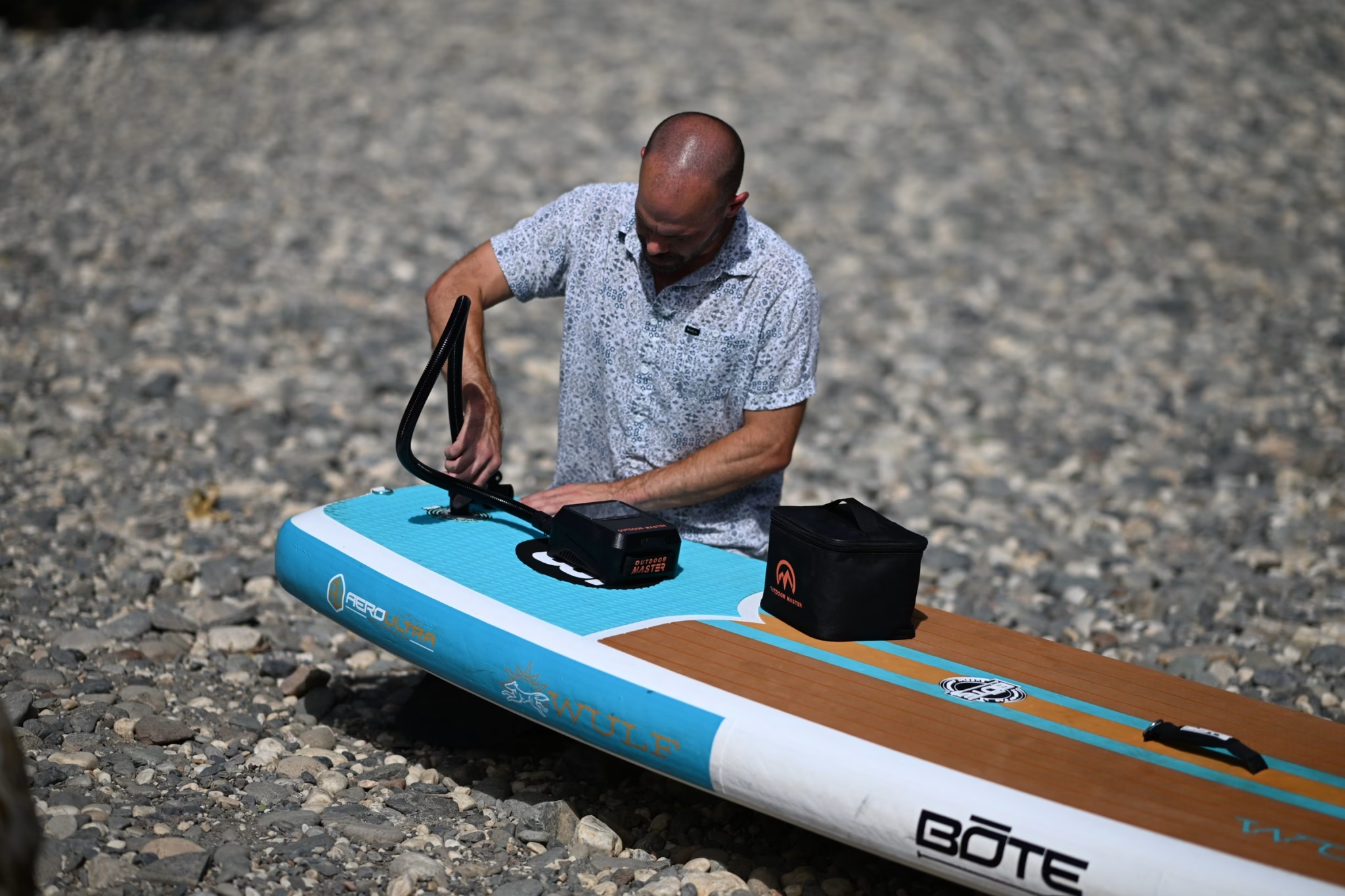
The paddle board pump I carry is the OutdoorMaster Shark 3, a cordless electric that takes a board to 15 PSI in about five minutes. It is big, loud, and not cheap. Over the past couple of years I have bought, borrowed, and flat worn out electric, cordless, corded, and manual pumps, hauled all of them down to the water, and grilled every paddling friend I have about theirs.
Some pumps quit on the second board. Some overheat in the sun and shut off a hair short of done. One of mine died cold at altitude, stage two grinding, the needle frozen, on an otherwise perfect morning at Lake Tahoe.
SUP California, the paddle shop in Folsom next to Lake Natoma, stocks several of these products, and its links sit beside the Amazon ones. Jaime Johnson, who owns it, is a friend. Her shop has sponsored my race entries and provided gear, and I earn a commission on purchases made through links to her store.
Key Takeaways
- Pick a paddle board pump by type. A cordless electric pump gives go-anywhere speed, a corded electric pump gives all-day runtime at a lower price, and a manual hand pump is the silent, unkillable backup.
- Buy more PSI ceiling than your board needs. Most inflatable SUPs want 12 to 15 PSI. A pump capped at 15 has zero headroom and will labor at the top of its range. Get a 20 PSI pump for a 15 PSI board.
- Heat is the number one reason a pump quits early. Thermal cutoff trips in the high-pressure stage, usually on the second or third board or in direct sun, leaving you just short of target.
- Altitude cuts a pump’s margin. Thinner air means less mass per stroke and less cooling, so the high-pressure stage can stall before it finishes. I have watched it happen at Tahoe.
- Inflation time runs from about 5 to 12 minutes for a standard board to 15 PSI. The cordless Shark 3 is roughly twice as fast as typical corded pumps, but the last few PSI always crawl.
- Cordless works away from the car, and corded runs all day. A battery pump gives you about 3 to 4 boards per charge and weighs more. A corded pump runs off 12V for as long as you need it but tethers you to a parking spot.
- These pumps are loud. OutdoorMaster rates the Shark 3 at up to 88 dB during high-pressure inflation. A manual pump is silent at a 6 a.m. launch.
- Keep a hand pump in the bag. It never overheats, never cares about elevation, and finishes the board when the electric one gives up.
How an Electric SUP Pump Works
Almost every electric pump worth owning runs two stages.
Stage one is a high-volume, low-pressure blower. It moves a lot of air fast and builds almost no pressure, which is what fills the board from flat in the first minute or two. On the Shark 3 that stage moves somewhere around 350 to 450 liters per minute, depending on whose number you trust. The board firms up and the panels pop into shape.
Stage two is a different machine bolted into the same case. It is a low-volume, high-pressure compressor that moves only about 70 liters per minute and does the slow work of forcing the last several PSI in. The pump switches over automatically somewhere between 1 and 4 PSI, and the exact crossover point varies by model, so do not anchor on a single number.
This is the stage that takes the time, makes the noise, and generates the heat. A single-stage pump tries to do both jobs with one motor, which is why cheaper single-stage units struggle past 10 to 12 PSI and overheat doing it.
A pressure sensor watches the internal pressure the whole time and cuts the motor when you hit your set target, typically within about half a PSI. Some readouts advertise resolution down to 0.01 PSI, which describes the display. The sensor behind it is still good to about half a PSI.
On the valve side, the standard is the Halkey-Roberts valve found on nearly every modern inflatable SUP. The large twist-lock nozzle on your pump is built to match it.
Max PSI Versus Your Board
Most inflatable boards ask for 12 to 15 PSI. Stiffer race layups run higher, into the 18 to 22 range, though the stiffness gains above 15 PSI fall off fast, something I dug into in the SUP speed benchmarks piece.
Your pump’s maximum rating has to clear your board’s target with room to spare.
A pump rated to a 15 PSI maximum, asked to take a board to 15 PSI, spends its final minutes pinned at the top of its ability. That is when it runs hottest and is most likely to trip its overheat protection before it finishes. A 20 PSI pump finishing the same board at 15 has margin in hand, runs cooler, and reaches target.
The cheap corded Sevylor caps at 15 PSI, which leaves nothing in reserve. A good dual-action hand pump tops out around 29 PSI, higher than every electric pump here except the 50 PSI Niphean.
How Long It Takes, and How Many Boards a Pump Can Fill
The Shark 3 takes a 10’6″ board to 15 PSI in just under four minutes by OutdoorMaster’s own clock, and independent testers see around five on a bigger board.
Among the corded pumps, the OutdoorMaster Shark second generation lands around seven to eight minutes, the iROCKER about ten, and the NIXY Ventus closer to twelve. The Shark 3 is roughly twice as fast as a typical corded pump because it is two pumps working in sequence.
The last few PSI cost the most. By NIXY’s own data, its pump took a 12’6″ touring board to 15 PSI in 11 minutes 15 seconds, then needed another 3 minutes 19 seconds to add 5 more PSI, with stage two grinding away at 70 liters per minute.
Pumps also have duty-cycle limits. The Seamax SUP20D, for one, auto-stops after 20 continuous minutes.
Manufacturers quote how many boards you can do in a row, and the real number is fewer than the box claims. The Shark second generation is rated for about three boards back to back thanks to its cooling fan. NIXY advertises ten in a row, which I would treat as a lab number. In my use, and on one vendor’s own troubleshooting page, overheating tends to show up on the second board.
A cordless pump adds a second ceiling on top of that: the charge runs out. Plan for about 3 to 4 boards from a full Shark 3 charge at 15 PSI. OutdoorMaster says four, independent tests see three to four, and the older “up to six” figure assumed a softer 12 PSI target. A NIXY with its add-on pack manages about three before low-voltage cutoff, and an iROCKER on its small battery roughly two.
Battery-Powered Versus Corded: Cordless Freedom or All-Day Runtime
The Shark 3 carries a 74 Wh battery, charges in about an hour and forty minutes on a 45W USB-C charger, and its port doubles as a power bank for a dead phone. I can carry it down a trail to a put-in with no car in sight, which is why I paddle the places I do.
The battery is the heaviest single component, it degrades over years, and when the charge is gone, it is gone.
Plug a corded pump into a 12V car socket and the iROCKER, the NIXY, the Dolphin, or the Sevylor will run as long as you let them, board after board, no charge to manage. They also tend to be lighter and a good deal cheaper.
A corded pump inflates within a cord’s length of your vehicle, which rules out the walk-in spots, and in cold weather a 12V pump draws hard on a small battery.
If you always launch from a paved lot, corded is the rational, cheaper pick. If you wander, cordless is worth the weight.
What Makes a Good Battery-Powered Pump
In a battery-powered pump, look for a stated capacity of around 70 Wh or more and a boards-per-charge figure measured at 15 PSI. Three to four boards is realistic.
USB-C fast charging turns a top-up into a lunch break, a 12V car input keeps the pump running after the battery is flat, and a port that doubles as a power bank is a bonus. Like any good pump it needs two stages, a 20 PSI ceiling, and active cooling. The Shark 3 covers all of it, which is why it is the cordless one I trust.
What Makes a Good Manual Pump
Almost every inflatable board ships with a hand pump, and almost every one of them is merely okay. They tend to be tall, flexy, single-chamber units with a vague gauge and no real base, fine for a first season and frustrating by the third board of a long day.
A good manual paddle board pump is dual action. It moves air on both the push and the pull, so you hit 6 to 8 PSI fast. Once it gets hard, you flip a valve to single action and grind out the last high-pressure stretch. The best ones top out around 27 to 29 PSI, past every electric pump here except the 50 PSI Niphean, and they add a wide foot plate for stability, an accurate gauge, and a hose that does not crack after a summer in the sun.
Even with the Shark 3 in my truck, a dual-action hand pump lives in my bag. It needs no power, never overheats, and does not care how high the lake sits. It is the tool that finishes the board the morning the electric pump throws an error, and at altitude that morning comes around more often. A good one runs about forty dollars, which makes it the least expensive insurance in paddling.
SUP California stocks two dual-action pumps: the Spinera Premium High Volume ($69, to 20 PSI) and the Duotone Multi Pump ($89, 3 to 19 PSI).
Attachments, Valves, and Whether Pumps Are Universal
For paddle boards, pumps are close to universal. The Halkey-Roberts valve is the near-universal SUP standard, and every pump here ships the matching twist-lock nozzle plus a kit of smaller adapters, usually seven or eight pieces. Those extra nozzles cover kayaks, air beds, kites, pool floats, and inflatable tents.
A different valve type, the two-piece Boston valve found on some kayaks and boats, needs its own adapter. Pumps like the Sevylor include one for it.
A household air-mattress pump cannot inflate a paddle board. It moves volume but tops out far below the 12 to 15 PSI a board needs.
Despite the kit of adapters, most SUP pumps are not tire inflators. They cap at 20 PSI and lack the Schrader fitting a car tire needs. A few high-pressure exceptions exist, like the 50 PSI Niphean with a dedicated car-tire mode, but on a standard SUP pump, treat your minivan as out of scope.
When a hose cracks or a nozzle goes missing, SUP California sells OutdoorMaster’s replacement hose with seven nozzles ($29.99), which fits the Shark II, 2S, and 3. SOL board owners can fill up at a gas station or with a bike pump using the SOL Schrader valve adapter ($20).
Heat Is Why Pumps Quit Early
Two things heat an electric pump: the motor spinning at high RPM, and the simple physics of compressing air, which warms it. Once you are pushing past 12 to 15 PSI in stage two, the motor is working its hardest and shedding the most heat. That is when overheat protection is most likely to cut in.
The triggers stack: a second or third board in a row, direct sun on a dark plastic case, hot ambient air, and sand clogging the cooling vents.
The Shark 3 has a dedicated error for it. An E5 on the display means the battery temperature is too high and the pump needs to cool down. It usually shows up mid-inflation on a hot afternoon, and it is the pump protecting itself.
Sources disagree on the right cooldown, from three to five minutes between boards on the low end to ten minutes for every thirty of use on the high end. Park the pump in shade, keep the vents clear of grit, and do not bury it in the sand while it runs.
Pumps with an active cooling fan, like the Shark line and the NIXY, are built to take consecutive boards better. No one has published a clean temperature comparison, though, so I would not oversell “runs cooler” as proven.
The Altitude Problem: Why Pumps Stall at Lake Tahoe
At Sand Harbor, my corded OutdoorMaster finished stage one fine and stalled in stage two a few PSI short.
Lake Tahoe sits around 6,225 feet, where atmospheric pressure is roughly 80 percent of what it is at sea level. Your board’s PSI is gauge pressure, meaning pressure above the surrounding air, so the pump has to compress thin mountain air all the way up to ambient plus 15.
Each intake stroke pulls in less air by mass because the air is less dense, so the pump moves less per cycle and has to run longer and hotter to do the same work. There is also less air around the motor to carry heat away, so it warms faster.
Put those together and the high-pressure stage, already the hardest part at sea level, hits its thermal limit before it reaches target. Stage one looked perfect because moving volume is easy in thin air.
A pump can still reach 15 PSI at altitude. The margin is gone, and one with no headroom gives up.
Buy the 20 PSI pump so the work happens in the middle of its range. Let it cool between attempts. Inflate in the shade at dawn before the case bakes. Carry a manual pump, because the last two PSI by hand at altitude is a minute of effort.
The cordless Shark 3 handles Tahoe better than the corded pump that quit there, which is part of why it became my pick. The Sand Harbor guide covers paddling that shoreline.
A board you fill to 15 PSI down in the valley will read higher once you drive it up the hill, since the outside pressure drops. Check it before you assume it lost air.
Longevity: How Long They Last and How to Tell Yours Is Dying
The failure that ends most pumps is motor burnout, and quality varies wildly. Some bargain units reportedly cook themselves within a handful of uses, which is the gamble you take at the bottom of the price range.
On cordless models the battery is the other clock, losing capacity over the years whether you paddle or not. Seals and O-rings at the nozzle wear and start leaking, and the pressure sensor can drift so the readout no longer matches reality.
A new grinding or rattling note from the motor is the clearest warning sign. That is usually a bearing on its way out and a trip to warranty service.
You stretch the life out of one by treating the heat seriously. Store it cool and dry, keep the vents clean, do not leave a cordless unit on the charger forever, inspect the O-rings now and then, and respect the cooldowns rather than driving the motor into repeated overheat.
OutdoorMaster backs the Shark line for two years, while iROCKER covers one. Nobody offers a credible lifespan figure in years. Several seasons with decent care is the ceiling.
The Pumps Compared
I listed only specs I could verify and wrote “Not published” where a brand gives no figure. Times are to roughly 15 PSI on a standard board, and prices are what I saw at publication and will drift.
| Pump | Type | Max PSI | Time to 15 PSI | Noise | Weight | Price |
|---|---|---|---|---|---|---|
| OutdoorMaster Shark 3 | Cordless + 12V/USB-C | 20 | ~5 min | Up to 88 dB | ~7 lb | $169.99 |
| OutdoorMaster Shark 2S Replaces the Shark 2nd Gen. Unavailable on Amazon as of October 2026 | Cordless + 12V/USB-C | 20 | ~8.7 min | Not published | ~3.6 lb | Unavailable |
| iROCKER 12V Unavailable on Amazon as of August 2026; still sold direct by iROCKER | Corded 12V (+ optional battery) | 20 | ~10 min | Not published | ~3.7 lb | $129.00 |
| NIXY Ventus | Corded 12V (+ optional battery) | 20 | ~12 min | Not published | ~3.9 lb | $89.00 |
| OutdoorMaster Dolphin Unavailable on Amazon as of August 2026 | Corded 12V | 20 | ~10 min | Not published | ~2 lb | $49.99 |
| Sevylor 12V | Corded 12V | 15 | Not published | Not published | Compact | $59.99 |
| Niphean Paddle Board Pump | Cordless (rechargeable) | 50 | ~9.5 min | Not published | 3.9 lb | $120 direct / $89.99 Amazon |
| Gymax dual-action hand pump Unavailable on Amazon as of October 2026 | Manual | 29 | Several min of effort | Silent | ~2 lb | $45.99 |
Sources: manufacturer product pages (OutdoorMaster, NIXY, iROCKER, Sevylor); tested reviews from SUPBoardGuide and InflatableBoarder for measured inflation times, noise, and weights; live Amazon pricing at publication. “Not published” means the manufacturer does not list that figure and no independent test was found.
My Pick, and the Alternatives
My pick is the OutdoorMaster Shark 3.
It is the fastest pump I have used. It goes anywhere because it is cordless, it carries enough charge for about four boards, and it tops out at 20 PSI so it has headroom. The port charges my phone in a pinch, and the two-year warranty backs the whole thing.
It is the biggest and heaviest pump in this field at around seven pounds, OutdoorMaster rates it at up to 88 dB in its high-pressure stage, and the screen washes out in bright sun. I knew all of that going in and I still grab it for every paddle. If you want one pump that handles altitude, walk-in launches, and a group, this is the pump.
If you always launch beside your car and want to save money, go corded. The NIXY Ventus at $89 gives you the same 20 PSI ceiling, active cooling, and deflation, tied to a 12V socket. The OutdoorMaster Shark 2S, which replaced the Shark second generation I originally recommended here, is a battery pump with an 88.8 Wh pack, and it is unavailable on Amazon as of October 2026. The iROCKER 12V is a reliable workhorse if you are already in that brand’s ecosystem, though its warranty is only a year and it has left Amazon, so you would be buying direct.
For the tightest budgets, the NIXY Ventus at under ninety dollars runs a touch slow but takes consecutive boards well. The tiny OutdoorMaster Dolphin packed 20 PSI into a two-pound case for fifty, though it inflates only and cannot deflate. It has since been discontinued, so it stays in the comparison above as a reference point. I would skip the Sevylor as your only pump, since its 15 PSI ceiling leaves no headroom for a 15 PSI board.
The Niphean Paddle Board Pump is the cordless alternative below the OutdoorMaster price. Its ceiling is 50 PSI, and its preset modes cover tents, boards, and car tires, which a 20 PSI pump cannot fill. At 3.9 pounds it is lighter than the Shark 3, with dual-stage inflation, auto shut-off, deflation, and a cooling system. It is slower, around 9.5 minutes to 15 PSI, and rated for two to three boards per charge. It runs about $120 direct from Niphean or about $90 on Amazon.
Niphean does not publish a noise figure, and I have not bench-tested one myself, so I cannot vouch for how loud it runs or how it holds up over seasons the way I can for the Shark 3. On paper, it is the most versatile pump here. Buy from a seller with an easy return window.
Whatever electric pump you land on, keep a dual-action hand pump in the bag. Mine has rescued more than one launch at Tahoe.
The Lake Natoma guide and the first paddle board race guide cover where to take the board once inflated.
The products linked above are collected in the Paddle Board Gear and Accessories list on the MK Library Amazon storefront.
Affiliate Disclosure: Some links in this article are affiliate links. If you buy through them, I may earn a small commission at no extra cost to you. I only recommend gear I have used or researched thoroughly, and the OutdoorMaster Shark 3 is the pump I paddle with.
Frequently Asked Questions
Can you inflate a paddle board with an electric pump?
Yes, and it is usually the better way. A two-stage electric pump fills a standard board to 15 PSI in roughly five to twelve minutes with no effort, and shuts off automatically at your set pressure. Just match the pump’s max rating to your board with headroom to spare.
Are all paddle board pumps the same?
No. They split by power source (manual, corded 12V, or cordless battery), by staging (single versus two-stage), and by max pressure (15 to 50 PSI among the pumps compared here). Those differences decide inflation speed, how many boards you can do in a row, and whether the pump survives heat and altitude.
What is a battery-powered paddle board pump?
It is a cordless electric pump with a built-in rechargeable battery, so it inflates your board with no car or outlet nearby. A good one does three to four boards per charge at 15 PSI, recharges over USB-C, and often takes a 12V car cord as a backup. It trades some weight and runtime for the freedom to launch anywhere.
Is the pump that came with my paddle board good enough?
For a first season, usually. The bundled hand pump will get a board to pressure, just slowly and with more effort than you want. Most are single-chamber units with a flexy base and a rough gauge. If you paddle often, upgrade to a dual-action manual pump or an electric one, and keep the bundled pump as a spare.
Are paddle board pumps universal?
For SUPs, mostly yes. Nearly all inflatable boards use the Halkey-Roberts valve, and pumps ship the matching nozzle. The bundled smaller adapters cover kayaks, air beds, and pool toys, but a different valve standard like the Boston valve needs its own adapter.
Can you use an air mattress pump on a paddle board?
No. An air-mattress pump moves plenty of volume but cannot build the 12 to 15 PSI a board needs. It will get the board to take shape and then stall far short of usable pressure. You need a pump rated for high-pressure inflatables.
How long does it take to pump up a paddle board?
With an electric pump, about five minutes for the fast cordless units and ten to twelve for typical corded ones, to reach 15 PSI on a standard board. The final few PSI take the longest because the high-pressure stage moves the least air. By hand, budget several minutes of real work.
What PSI should I inflate my paddle board to?
Check the board, but most inflatable SUPs call for 12 to 15 PSI, with 15 a common target for stiffness. Stiffer race boards go higher, into the high teens or low twenties. Going well past your board’s rating adds little stiffness and more stress on the seams.
Why does my pump stop before reaching the set pressure?
Almost always heat. The high-pressure stage runs hottest, and overheat protection cuts in when you are inflating a second or third board, working in direct sun, or running at high altitude where there is less air to cool the motor. Let it rest a few minutes in the shade and it will usually finish.
Do electric pumps work at high altitude?
They can, but with less margin. Thinner air means each stroke moves less air mass and the motor cools poorly, so the high-pressure stage may stall short of target, as mine did at Lake Tahoe. Choose a 20 PSI pump for headroom, allow cooldowns, and keep a hand pump as backup.
How do I tell if my paddle board pump is broken?
Warning signs include a new grinding or rattling motor note, a unit that no longer reaches or holds your set pressure even after cooling, a readout that disagrees with a known-good gauge, or visible leaking at the nozzle seals. Grinding usually points to a failing bearing and a warranty claim.
Can a hand pump back up an electric pump?
Yes, and it is the smartest cheap insurance you can carry. A dual-action hand pump reaches up to about 29 PSI, never overheats, and ignores altitude. When an electric pump quits a couple PSI short, a minute of hand pumping finishes the job.
Bottom Line
A year into owning the OutdoorMaster Shark 3, a heavy, loud, expensive brick that goes anywhere and finishes the board at elevation, I would buy it again. A hand pump stays in the bag beside it.
Article Updates
October 10, 2026: Reworked the opening to lead with my pick, the OutdoorMaster Shark 3, shortened the Bottom Line, and edited the rest for clarity. Corrected three pressure comparisons to account for the 50 PSI Niphean. Re-checked prices and stock against Amazon on October 10, 2026: the Shark 3 is $169.99, the NIXY Ventus $89, and the Niphean $89.99, and the Shark 2S and the Gymax hand pump are unavailable. Corrected the Shark 2S, which is a battery pump, and replaced it as the corded pick with the NIXY Ventus. The only published noise figure is OutdoorMaster’s 88 dB for the Shark 3.
October 2, 2026: Added two dual-action pumps, the OutdoorMaster replacement hose, and a Schrader valve adapter from SUP California, the Folsom paddle shop, with a note near the top on my connection to the shop.
- August 6, 2026: Repaired three dead product links found on a re-check of the live Amazon catalogue. The OutdoorMaster Shark second generation now points to its direct successor, the Shark 2S, at about $126. The iROCKER 12V and the OutdoorMaster Dolphin are no longer purchasable on Amazon, so their links are removed and their names left as plain text; both stay in the comparison table as reference points, with the Dolphin noted as discontinued. The measured figures in the table and charts are unchanged.
- August 5, 2026: Re-checked every pump against Amazon’s live catalogue and corrected the pricing table. The Sevylor 12V was listed at $34.63 and actually sells for $59.99. The OutdoorMaster Shark 3 came down to $152.99, the NIXY Ventus to $79, and the Gymax hand pump rose to $45.99. Flagged three pumps that no longer convert on Amazon: the iROCKER 12V and OutdoorMaster Dolphin are both unavailable, and the Shark 2nd Gen has no new stock. Removed the noise figures in decibels, which none of the manufacturers publish and which should not have been stated as measurements.
- June 2, 2026: Initial publication. Comparison covers eight pumps with verified specs and live pricing, plus firsthand notes on altitude failures at Lake Tahoe and long-term use of the OutdoorMaster Shark 3.