A dry creek bed that drains a yard is two builds in one trench. A perforated pipe runs through crushed stone at the bottom, and a channel of boulders and river rock on top looks like a streambed through a Sacramento August, months after any water last moved through it. Low-voltage fixtures on the banks light the stone after dark.
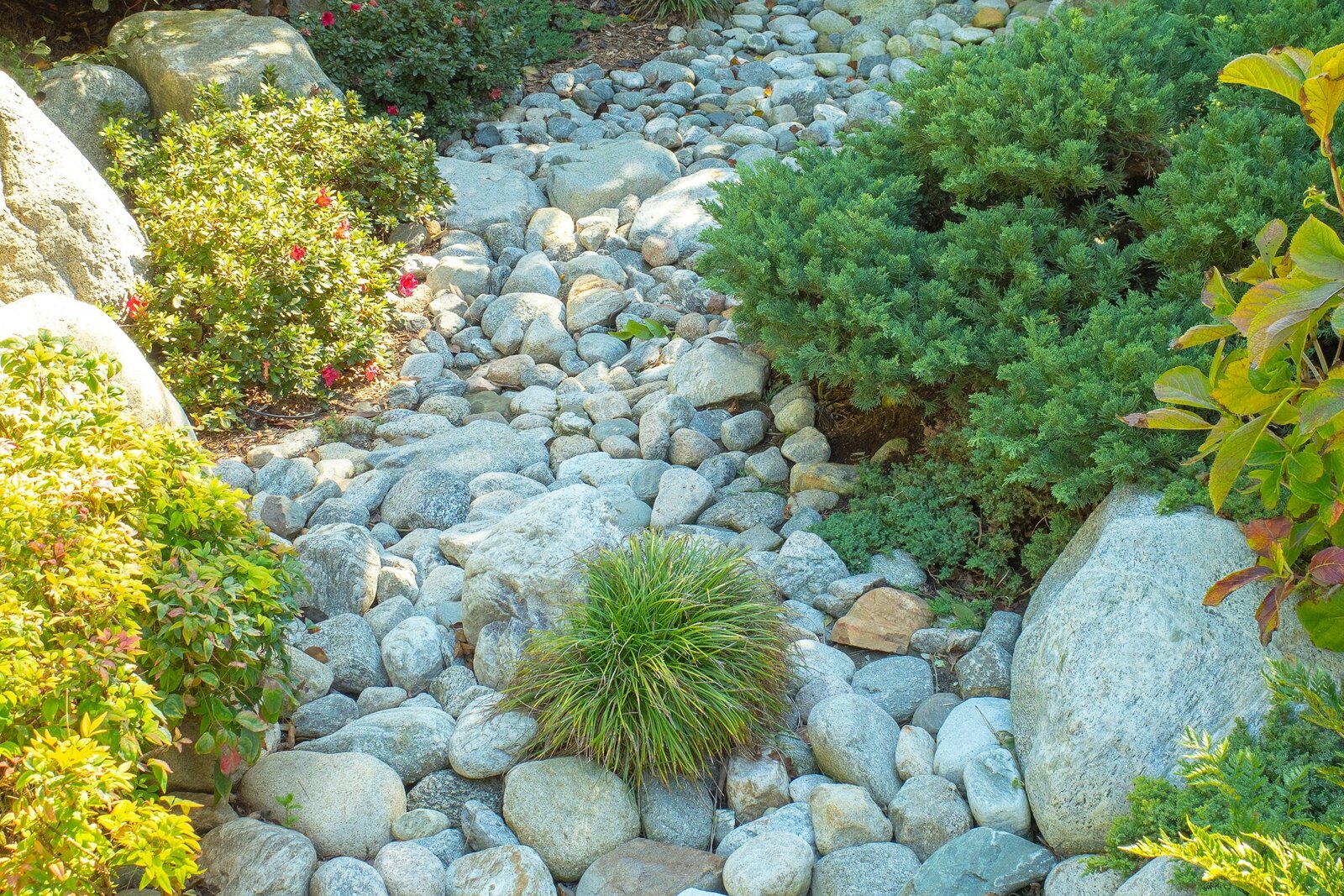
I’m planning a curving bed over a drain in my own yard, on Sacramento clay, and worked through every layer before ordering stone: the channel’s width and fall, the pipe and its fabric, where the water goes, and where each light and wire can sit without ending up in the water.
✦ Key Takeaways
- Two layers, two grades. The creek channel drops about 1 inch per foot at designer Jay Sifford’s 5-degree minimum; the perforated pipe beneath it can run at 1/8 inch per foot.
- Size the bed for the water. A bed that carries runoff runs about 3 feet wide and 2 feet deep; Sunset’s decorative version is 1 to 3 inches deep.
- Separate the cobble from the drain stone. A nonwoven geotextile or a choke layer of finer gravel keeps silt out of the pipe, and a cleanout at the upper end lets you flush it.
- Mind Sacramento’s setbacks. The regional stormwater manual keeps soaking basins 20 feet from a house and pop-up emitters at least 5 feet away, and wants standing water gone within 48 hours.
- Fixtures stay on the banks. Elite’s instructions say well lights are not underwater lights, and FX Luminaire’s mirroring technique lights the stone beside water rather than in it.
- Specify color quality. CRI 90 with R9 of 50 or more, one color temperature from one fixture series, and a TM-21 life rating of 50,000 hours.
- Size the transformer by Kichler’s LED rule. Divide the fixture watts by 0.7 and multiply by 1.25; my 63-watt plan needs about 113 VA.
How the Creek Bed and the Drain Stack
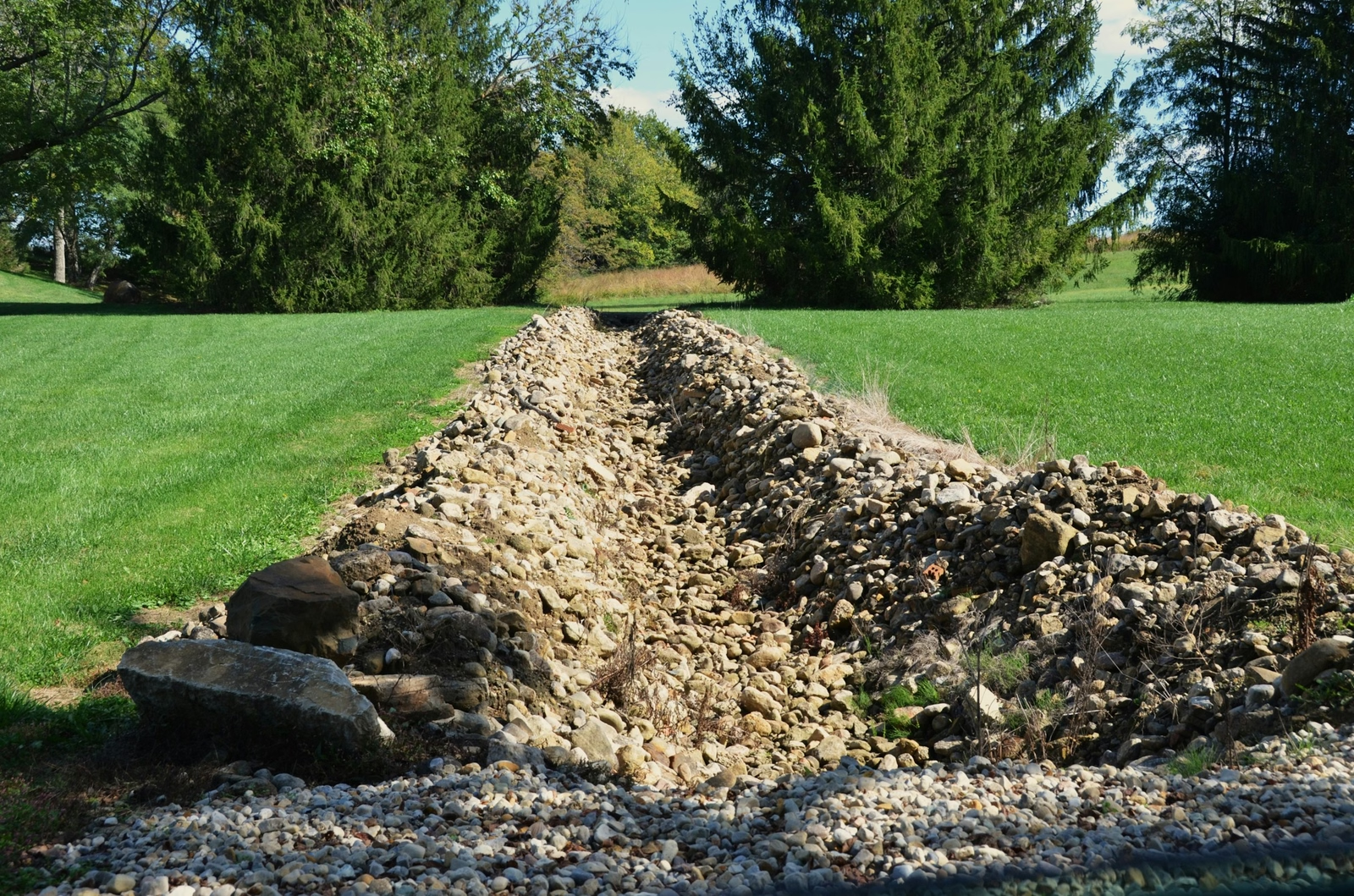
Rain soaks through the surface rock, passes a separator layer, drops into 3/4-inch crushed stone and enters a perforated pipe that carries it to daylight or a pop-up emitter. In a heavy storm the channel takes the overflow on the surface, the way a seasonal wash does.
Caltrans reserves “French drain” for a rock-filled trench with no pipe and calls that version unreliable; with a pipe inside, its Highway Design Manual calls it an underdrain.
Garden designer Jay Sifford, writing in Fine Gardening, slopes the creek bottom at least 5 degrees toward the outflow, about 1 inch of drop per foot. UC ANR Publication 8531 sets 2 percent, 1/4 inch per foot, as the minimum for a rock-lined channel.
This Old House pitches its drain pipe at 1 inch per 8 feet, about 1/8 inch per foot. Caltrans prefers more than 0.5 percent for underdrains, so the pipe can run several times flatter than the bed above it.
| Layer, Top Down | Material | Spec | Source |
|---|---|---|---|
| Surface | Boulders plus 5- to 8-inch and 3- to 5-inch river rock | Small stones low, large stones high on the banks | Jay Sifford |
| Separator | Nonwoven geotextile or a choke layer of finer gravel | Stops silt from reaching the drain stone | WisDOT, NRCS 620 |
| Drain stone | 3/4-inch crushed stone | At least 12 inches over the pipe | This Old House |
| Trench lining | Nonwoven drainage geotextile | AASHTO M288 Class 2 or 3; opening size 0.30 mm or smaller in clay | Caltrans |
| Pipe | 4-inch perforated, with a cleanout at the upper end | Two-row PVC goes holes down | This Old House, WisDOT |
| Outlet | Daylight or pop-up emitter | Emitter lower than the inlet; 5 feet or more from the house | NDS, Sacramento manual |
A 4-inch pipe with 2 inches of stone beneath it and the 12 inches This Old House wants over it puts the bottom of the trench about 18 inches below the channel floor.
Open cobble dropped straight onto drain stone is a path for silt, and Wisconsin DOT’s drainage manual says the top of a stone drain “shall always be impervious to avoid infiltration of silty surface water.” The NRCS standard for gravel-filled inlets requires them to “prevent soil particle movement into the conduit.”
A nonwoven geotextile there still passes water, and with a cleanout the drain can be flushed rather than dug up.
Fabric and Pipe Specs
Fabric weight in ounces is a retail label. The Caltrans geosynthetics manual specifies drainage geotextile by AASHTO M288 class, opening size and permittivity, and for clay soils like Sacramento’s the apparent opening size is 0.30 millimeters or smaller. The fabric lines the trench walls around the stone; it is not a sock on the pipe.
None of the 4-ounce landscape rolls I checked on Amazon publishes an opening size. Erosion-control suppliers sell engineered nonwovens with data sheets, such as Mirafi 160N, which meets M288 Class 2 with a 0.212-millimeter opening.
Two- or three-row perforated PVC goes holes down, per This Old House and WisDOT. Standard ADS corrugated pipe is slotted all the way around and has no up side.
Clay, Infiltration and Setbacks
The NDS installation sheet says, in capitals, “DO NOT BACKFILL WITH SOIL WITH HIGH CLAY CONTENT,” so nothing dug from the trench goes back over the pipe.
UC IPM’s percolation test decides where the water ends up: dig a 12-inch hole, fill it, let it drain for 24 hours, refill it and time it. “An optimal rate of soil drainage for many landscapes is about 1 to 2 inches per hour.”
The Stormwater Quality Design Manual for the Sacramento Region rates clay soils at 0.17 to 0.27 inches an hour for group C and 0.02 to 0.10 for group D, and wants 0.5 to 2.0 for an infiltration basin. On C and D clay the pipe should go to daylight or a pop-up emitter.
The same manual keeps infiltration devices 20 feet from buildings unless a geotechnical engineer approves less, and says a pop-up emitter “must daylight no closer than five feet from the building with positive drainage away from building foundations and slabs for another five feet.” The California Residential Code wants the grade to fall at least 6 inches in the first 10 feet from the foundation.
NDS’s pop-up emitter has to sit lower than the point where water enters the system, or the system will not drain.
A creek bed usually begins where a downspout or a low spot hands it water, so the gutter and downspout tasks in my home maintenance checklist come first. A trench this deep also means calling 811 at least two working days before digging, with the area marked in white paint.
Designing the Curve

Natural streams widen on the bends, and the Clark County Master Gardeners build the whole bed from that observation: “boulders that are too large for the current to move remain in the middle of the stream, while smaller ones are washed to the sides.” Sifford wants the bends wide and gentle, because “tight, squiggly curves can impede flow.”
Width and Depth
| Source | Width | Depth | Purpose |
|---|---|---|---|
| Jay Sifford, Fine Gardening | At least 3 feet | At least 2 feet | Carries runoff |
| Clark County Master Gardeners | 4 feet (example) | 2 feet, a 2:1 ratio | Carries runoff |
| Sunset, design by Gay Bonorden Gray | 1 foot widening to 5 over 17 feet | 1 inch at the edges, 3 at the center | Decorative |
The gap between 2 feet and 3 inches is the job each bed does. A bed over a drain takes water, so it belongs with the 2-foot figures, and Sifford’s advice is to dig it “slightly larger than you think you need.” The Sunset version is purely decorative.
Rock Sizes and Placement
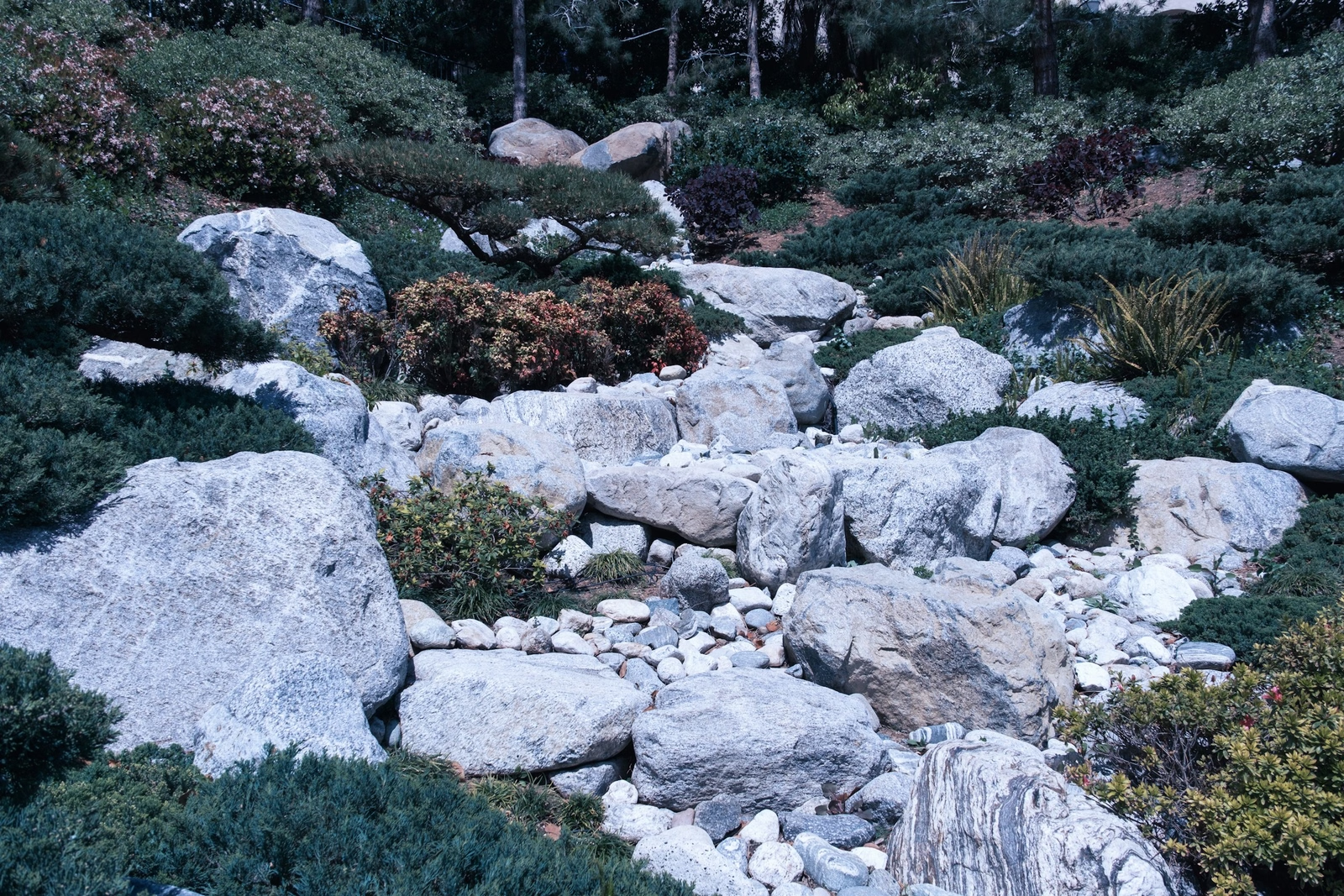
Sifford uses at least four sizes: three-to-four-man boulders, two-man boulders about the size of a basketball or a watermelon, smooth river rock 5 to 8 inches across, and smaller river rock 3 to 5 inches across. Smaller stones go low and larger ones high, and the biggest boulders sit at the start and midpoint of each curve, on stepped shelves dug at different heights.
“Ignoring nature’s own layering is the main reason that most streambeds look artificial and contrived,” Sifford writes.
The Master Gardeners mix smooth river rock with sharper-edged pieces, keep small and medium stones along the center, bury some rocks partway and set nothing in a pattern. The Federal Highway Administration’s HEC-15 channel-lining manual rates angular stone as the stronger lining; rounded river rock needs a filter beneath it and side slopes of 1 vertical to 3 horizontal or flatter.
Mortar is out on Sacramento clay. The NRCS lined-waterway standard limits mortared stone to soils with low shrink-swell.
In Valley sun, UC IPM notes that white rock reflects enough light to damage sensitive plants and dark rock holds heat that stresses them. I’m choosing tan and buff stone.
Where It Starts and Where It Ends
The Master Gardeners hide the headwaters behind a large boulder or a group of plants, so the bed appears to come from somewhere, and spread fine gravel at the lower end “to create the appearance of naturally deposited sediment.”
One of Sifford’s five naturalistic designs widens at the end into a basin where runoff pools and soaks into the planting. On clay, that basin belongs well away from the house, and UC ANR wants an overflow route out of it.
The Sacramento-Yolo Mosquito and Vector Control District puts the summer life cycle at as little as 4 to 7 days, in as little as 1/2 inch of water. The Sacramento manual sets 48 hours as the limit for ponding, and the California Department of Public Health sets four days.
NDS drills holes in its basin bottoms against standing water; CDPH advises against weep holes “due to rapid clogging.”
Dry Creek Bed Design Ideas
- Flagstone set on end. Sifford stands flagstone on edge in polymeric sand so the bed reads as moving water.
- Plinths against river rock. Rectangular stone plinths set beside rounded stones give one of his designs a modern line.
- A beach on the bend. The Master Gardeners add a promontory or a small beach of fine gravel where a real stream would drop sediment.
- A basin at the end. The bed widens into a shallow pool of rock where runoff sinks into the planting.
- Oversized stones on a slope. Sifford’s woodland design uses larger-than-normal stones to slow water and turn it.
In Sacramento, the WPA Rock Garden in Land Park is where I’m studying meandering stone and native planting at full scale before staking out the curve.
Landscape Fabric Under a Dry Creek Bed
Under the surface rock, UC IPM recommends landscape fabric, because it keeps rock from sinking and stops soil from rising through it with weed seed. Its Pest Note adds that thin or open-mesh fabrics let more weeds through than closely woven or nonwoven ones, that “weeds will grow through any gap,” and that yellow nutsedge grows through most geotextiles.
Sifford skips the cloth in clay and sets the rocks directly into it. Penn State Extension’s Lee Stivers spent two days and 40 bags of mulch pulling up fabric that had been down about 20 years, and the piece quotes Washington State University’s Linda Chalker-Scott: “Landscape fabrics are not effective weed control solutions for permanent landscapes.” That fabric sat under organic mulch, which broke down on top of it.
The center of my channel gets the separator fabric regardless, since it protects the drain. On the banks I’m using fabric only where the soil is loose, with every seam overlapped, because field bindweed grows sideways to reach the edge of the fabric.
Lighting a Dry Creek Bed
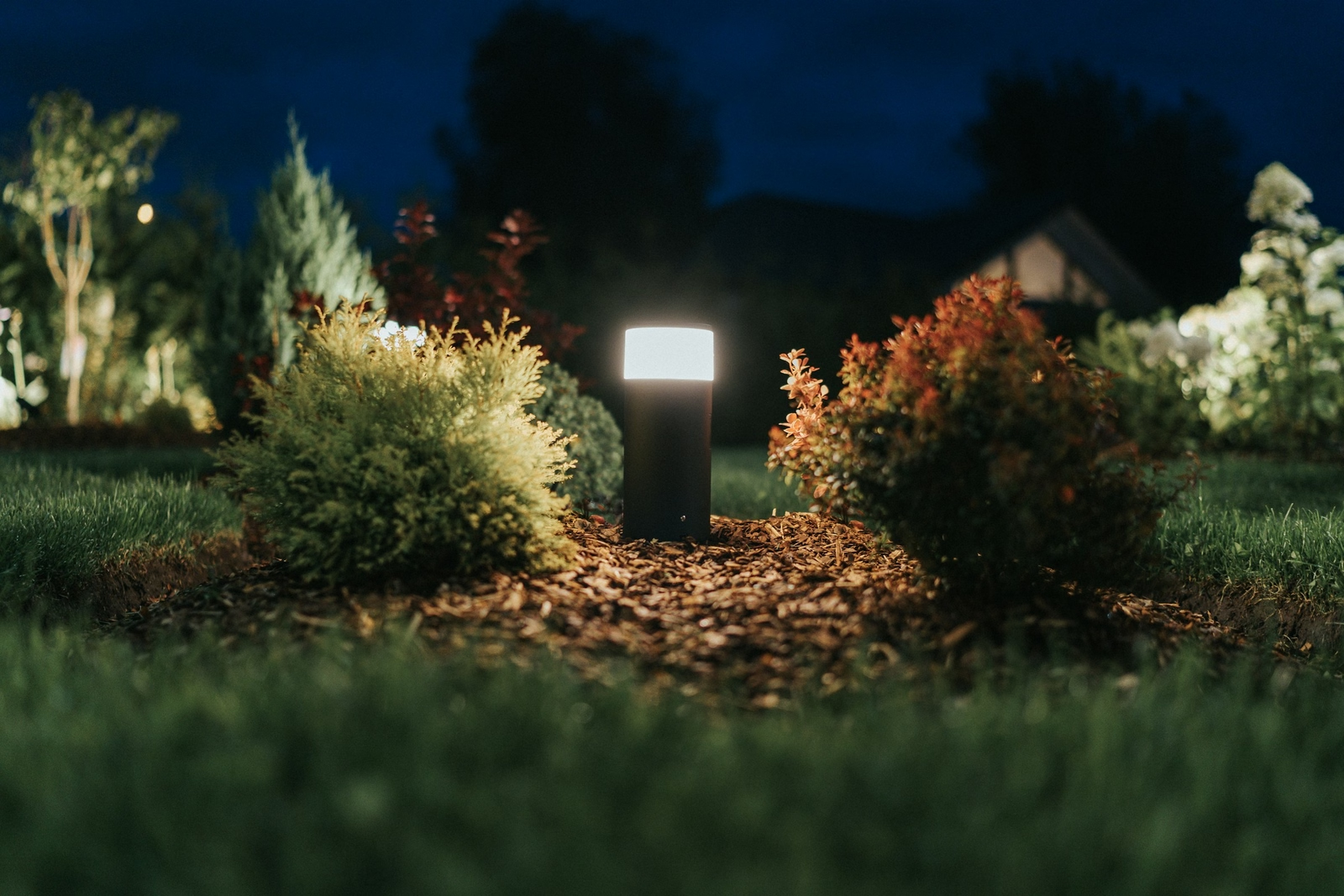
“You don’t need water to suggest its presence in the garden,” Sunset wrote in 2005.
The lighting designer Richard Kelly named the three effects every plan balances: focal glow, ambient luminescence and the play of brilliants, which Architect magazine calls the core theoretical statement on lighting design. In a creek bed, focal glow is the lit boulders at the bends, ambient light is the soft wash of the path lights, and the channel itself stays dim enough to read as depth.
FX Luminaire has a name for keeping fixtures out of the water: mirroring, “casting light on subjects adjacent to a body of water rather than placing fixtures in the water feature.”
Uplight the Boulders at the Bends
Kichler’s design rule is to match the beam to the width of what you light. A 10- to 15-degree spot suits a narrow column and a 35-degree flood covers something the width of a small tree.
Kichler uses grazing, a beam set close and aimed across the surface, “to add depth and dimension to stucco, brick, stonework.” FX cross-lights a feature “from multiple angles,” because one fixture risks “a flattened ‘hot spot.'” Two narrow beams on each bend boulder is my plan.
For the boulders I’d pay for brass. VOLT says brass and copper “will generally outlast aluminum fixtures” even inland, and that cheap recycled aluminum can start to pit within a year. The VOLT Fat Boy is solid brass at $44.97, sold lamp-ready, so budget an MR16 LED lamp rated for enclosed fixtures for each one. Gardencoin’s six-pack of brass spotlights is $143.99, also without lamps.
Path Lights Along the Curve
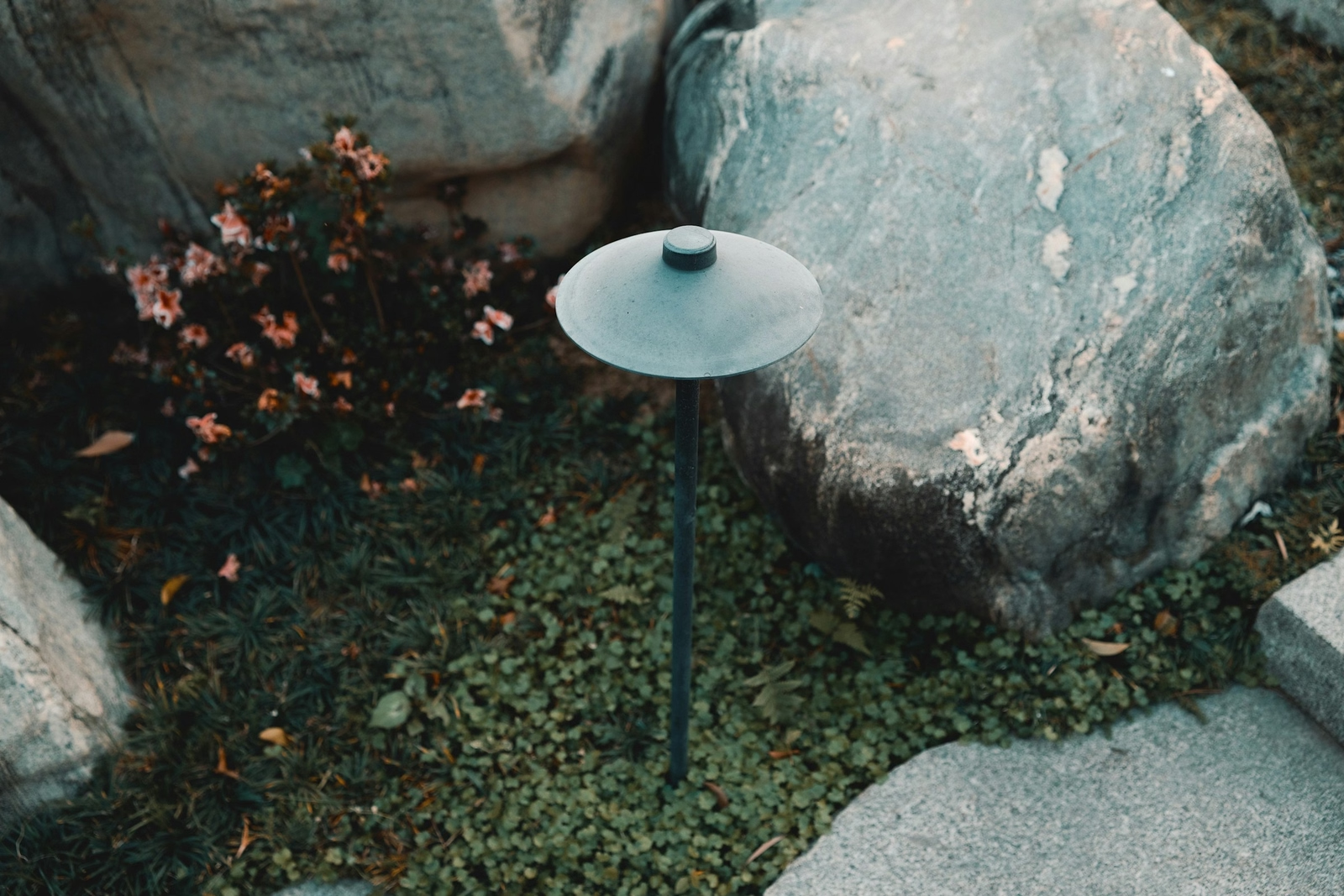
Roger Cook spaces path lights about 8 to 10 feet apart in This Old House’s low-voltage guide, and FX staggers them from side to side with even spacing. The right spacing for a specific fixture depends on its beam spread, which is on the spec sheet.
GKOLED’s solid brass path light runs a 3-watt 2700K lamp at $94.99 a pair; VOLT’s Max Spread six-pack is $919.97.
Well Lights Belong on the Banks
“Well Lights are NOT underwater lights. Do NOT install in low grade areas where water will gather.” That line from Elite’s installation sheet rules out the channel, which is the lowest ground in the yard by design. In-ground fixtures go on the dry shelves behind the boulders, aimed up.
In heavy clay, VOLT digs at least 10 to 12 inches, sets a 4-inch PVC sleeve 10 to 12 inches long, packs it in pea gravel so water drains away and leaves the top about 3 inches above the soil. Grit stays off the gasket and the screws are snugged by hand, since there is “absolutely no need to over-tighten.”
The LEONLITE 4-inch well light comes six to a box for $119.96: 6 watts, IP67, die-cast aluminum and CRI 90, with a selectable color temperature. LEONLITE rates it at 580 lumens at 3000K and publishes no figure for the 2700K setting. Department of Energy testing of tunable products found warmer settings less efficient, so expect less output at 2700K.
Edge Light for Stone Walls and Steps
Where a bank turns into a stone wall or a step, light can sit under the cap. VOLT’s LED Garden Edge Light runs 2700K at 50 lumens per foot, in 25- and 50-foot lengths, from $399.99.
COB tape works too, if the power matches. Most outdoor COB tape with CRI 90 runs on 24 volts DC and needs its own wet-rated driver, while a landscape transformer puts out 12 to 15 volts AC. WAC’s 12VAC Landscape Tape is built for that AC input and runs straight off the transformer.
Light Quality: CRI, Color Consistency and COB
| Spec | What to Ask For | Source |
|---|---|---|
| Color rendering | CRI 90 or higher, with R9 (saturated red) of 50 or higher; TM-30 Rf where published | California JA8, DOE |
| Color temperature | 2700K for warm-toned stone; one CCT on every fixture | Kichler |
| Color consistency | Same maker and series, 3-step binning or tighter | PNNL |
| Rated life | L70 of 50,000 hours or more, projected per IES TM-21 | DOE |
| Water | IP67 or better for in-ground fixtures | IEC 60529 |
| Glare | Cowl, hex louver or baffle so the LED is never visible from the patio | Kichler, FX |
California’s JA8 standard sets CRI 90 and R9 of 50 as its benchmark for high-quality LED light. R9 measures saturated red, which the standard CRI average leaves out, and it shows up in red bark, rust-toned stone and California fuchsia.
A Pacific Northwest National Laboratory study found that a single nominal ANSI color bin spans a range wide enough to see, so two “2700K” fixtures from different companies can sit side by side and not match. One series from one maker, binned to 3 steps, avoids it.
My Amazon picks mix three makers to show prices; for the finished bed I’d buy one series.
The Department of Energy’s LED lifetime guide says “lumen depreciation is not a proxy for luminaire lifetime”; drivers, moisture and corrosion usually end an outdoor fixture before its LEDs dim out, and in DOE’s long-term testing color shift was the dominant early failure. Sealed, potted drivers with surge protection matter as much as the L70 number.
What COB Means
COB stands for chip-on-board: per DOE, “a large array of small die mounted onto a metal-core printed circuit board or a ceramic substrate,” used for “high lumens from a small optical source.” Bridgelux describes the result as “clean white light without pixilation” with tight beam control.
That tight beam suits a narrow grazing light on a boulder, and in tape form COB gives a continuous line with no dots. No DOE, PNNL or national-lab study I found shows COB lasting longer or running more efficiently than other LED packages, so I judge a COB fixture by the same specs as any other.
Warm Color and Dark Skies
Kichler recommends 2700K for natural-colored stonework. DarkSky’s Approved Luminaires guidelines cap color at 3000K and limit light above horizontal to 50 lumens. Adjustable fixtures that tilt up more than 5 degrees are not eligible, and neither are selectable-color products with any setting above 3000K.
By those rules no boulder uplight can be DarkSky Approved, including the well lights on my list. I’m following DarkSky’s five lighting principles instead (useful, targeted, low-level, controlled and warm-colored), with a timer that turns the uplights off late at night.
Wiring the Low-Voltage System
Transformer Size
Kichler’s current 12217 instruction sheet tells you to “total the wattage of all LED bulbs/fixtures, divide by .7 & multiply that subtotal by 1.25.” VOLT loads a transformer to no more than 80 percent of its rating.
| Fixture | Count | Watts Each | Total |
|---|---|---|---|
| LEONLITE well light | 6 | 6 | 36 W |
| VOLT Fat Boy with a 5-watt MR16 | 3 | 5 | 15 W |
| GKOLED path light | 4 | 3 | 12 W |
| Total | 13 | 63 W |
The 200-watt Kichler 12217 is capped at 180 watts of load, so it covers 113 VA with room to add fixtures. My pick is the Kichler Pro Series 15PR300SS, $269.99 for a 300-watt transformer in a stainless case with timer and photocell outlets. The Kichler 12217 is a 200-watt multi-tap with a digital timer for $91.95.
Kichler mounts the transformer at least 12 inches off the ground, close to its outlet with no extension cord, and at least 5 feet from a pool, spa or fountain. The outlet needs GFCI protection and, under NEC 406.9, an extra-duty in-use cover.
Code and Safety
Under NEC Article 411, as IAEI summarizes it, low-voltage lighting tops out at 30 volts AC, or 15 volts AC where wet contact is likely, and the system must be listed or assembled from listed parts. Sacramento enforces the 2025 California Electrical Code, which is based on the 2023 NEC.
UL says landscape power units present “no risk of electric shock under wet conditions.”
The hazard at a nicked cable is a short. A low-voltage circuit can carry up to 25 amps, enough to heat a damaged splice, which is why a listed transformer has a breaker on its secondary side.
Wire Gauge and Voltage at the Last Light
VOLT multiplies watts by feet of run. Up to 10,000 calls for 12-gauge wire, and 10,001 to 15,000 calls for 10-gauge or a second run. The 63-watt plan on 100 feet of cable comes to 6,300, so 12/2 direct-burial wire such as this 250-foot Elite spool ($145.00) covers it.
That rule assumes fixtures spread along the run. On Kichler’s 12-gauge constant, 6,300 watt-feet drops 0.84 volts with the lights spread out and 1.68 volts with them bunched at the far end.
Kichler wants LED fixtures to see 10 to 14 volts on the 12217 and 12 to 15 on its Pro Series, and puts the spread plainly: “one volt difference is optimum, two volts is too much.” A multi-tap transformer’s 13-, 14- and 15-volt taps make up the drop on longer runs.
VOLT counts 8 splices for eight fixtures daisy-chained and 2 for the same eight on two hubs, and groups fixtures in zones within about a 40-foot circle, with one wire from the transformer to the center of each. Every splice is a place for water to get in, and This Old House says connection quality “is what separates a system that lasts from one that fails.”
NEC 110.14 requires direct-burial splices to be listed for that use. DryConn 62225 connectors ($16.99 for 20) are UL listed as sealed wire connectors, and nVent’s spec sheet approves them “for use in direct bury applications when operating at 30 volts or less,” on one to three 12-gauge wires.
Where the Cable Runs
The cable stays out of the trench and the channel, on the dry bank behind the boulders with the well lights.
The 2023 NEC’s Table 300.5(A) puts landscape lighting cable at 6 inches deep, and allows less only where a listed system’s instructions say so. Kichler’s instructions say 6 inches minimum. I’m laying the wire after the planting is done, so no planting hole crosses it.
Plants for the Banks
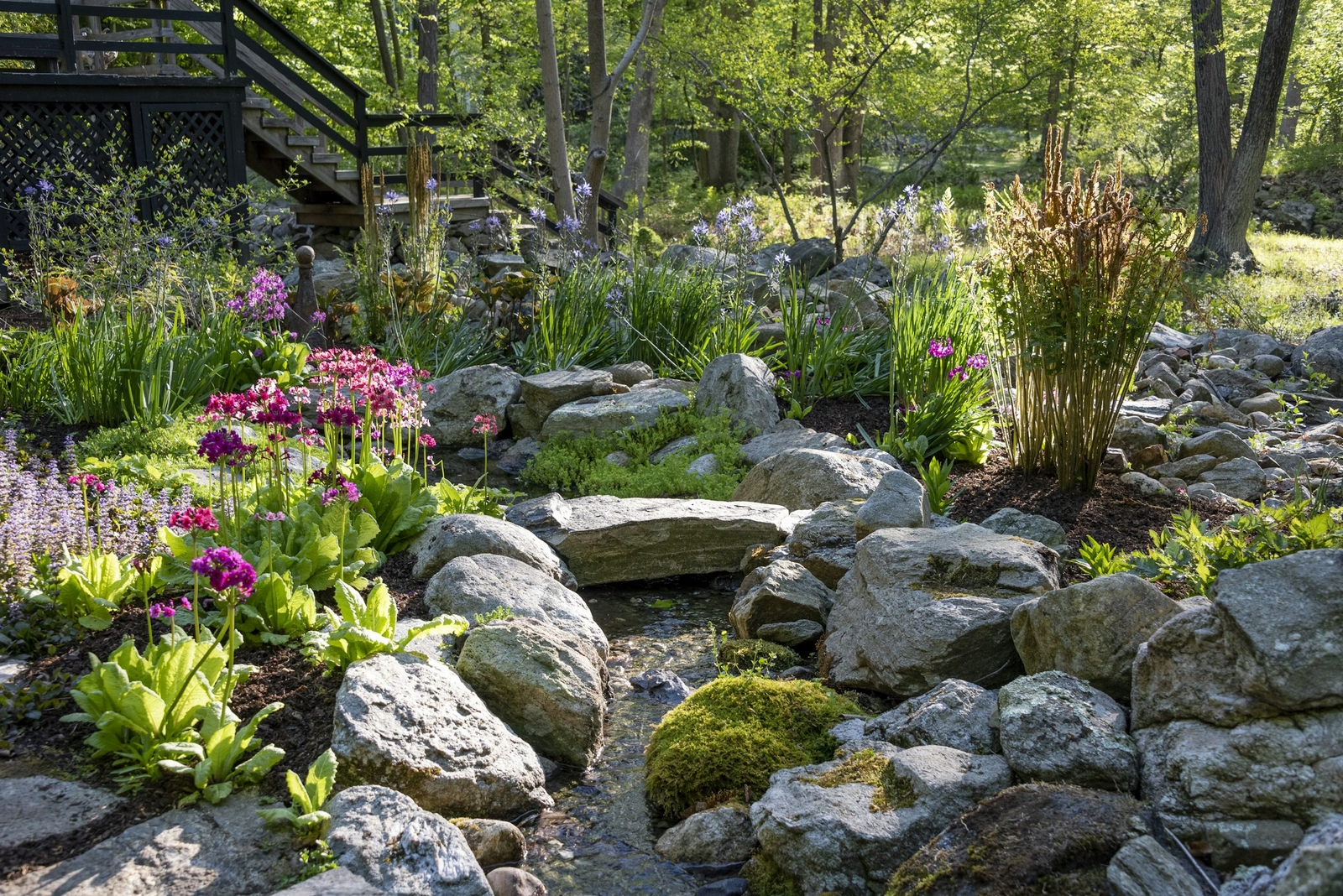
Four California natives from Calscape handle clay and dry summers, each at a different height on the bank.
| Plant | Size | Water Once Established | Where It Goes |
|---|---|---|---|
| Deergrass (Muhlenbergia rigens) | 4-5 ft tall, 4 ft wide | At most once a month | Upper banks; tolerates sand and clay; used for bank stabilization |
| California fuchsia (Epilobium canum) | 3-18 in tall, 2-3 ft wide | Very low to low | Sunny edges; red flowers summer into fall |
| Common yarrow (Achillea millefolium) | 1-3 ft tall | At most weekly in summer | Between boulders; can spread |
| Common rush (Juncus patens) | 1-3 ft tall, 3 ft wide | Moderate to high | Outfall area; tolerates standing water |
Calscape lists California fuchsia as a draw for Anna’s, Allen’s and Black-chinned hummingbirds. For more color on a dry slope, my guide to California native hummingbird plants covers woolly blue curls and other natives that want fast-draining soil.
What It Costs
This Old House, citing Angi’s 2024 data, puts a professionally installed French drain at $10 to $100 per linear foot for materials and about $9,000 on average, against under $1,000 to do it yourself. Its estimate for a DIY low-voltage lighting system starts at $500.
| Lighting Item | Price |
|---|---|
| Kichler Pro Series 300-watt transformer | $269.99 |
| VOLT Fat Boy spotlight, 3 | $134.91 |
| GKOLED brass path light 2-pack, 2 | $189.98 |
| LEONLITE well light 6-pack | $119.96 |
| Elite 12/2 cable, 250 feet | $145.00 |
| DryConn connectors, 20-pack | $16.99 |
| Total | $876.83 |
I found no credible installed price per linear foot for the creek bed itself. Stone yards sell boulders and river rock by the ton, so the bed’s cost follows its length and the size of the boulders.
Sacramento Rebate Rules for a Creek Bed
The City of Sacramento’s River Friendly grass conversion rebate pays $1.50 per square foot, up to $3,000 for 2,000 square feet, under its May 2024 single-family application. Weed barrier, mulch, planting and irrigation materials are reimbursable.
Each converted area needs at least 60 percent plant cover at maturity. Rock counts as mulch only at 6 inches across or less, spread 2 to 5 inches deep, and any rocks beyond that must be “integrated as part of the converted area’s landscape.”
The city requires a pre-inspection before work starts, the rebate is not retroactive, the project has 120 days to finish, and the landscape has to stay for five years. The Sacramento County Water Agency’s Cash for Grass program is on hold, and it processed applications submitted through June 30, 2026.
Frequently Asked Questions
How deep should a dry creek bed be?
A dry creek bed that carries runoff should be about 2 feet deep and at least 3 feet wide, according to garden designer Jay Sifford in Fine Gardening. The Clark County Master Gardeners use a 2:1 width-to-depth ratio, so a 4-foot bed is 2 feet deep. A purely decorative bed can be 1 to 3 inches deep.
Can you put a French drain under a dry creek bed?
Yes. Run a 4-inch perforated pipe in 3/4-inch crushed stone beneath the channel floor, line the trench with a nonwoven drainage geotextile, and put a separator layer between the drain stone and the creek cobble so silt stays out of the pipe. Add a cleanout at the upper end, and never backfill over the drain with clay.
Do you need landscape fabric under a dry creek bed?
Over a drain, yes: a nonwoven geotextile separates the creek cobble from the drain stone. Under bank rock it is a choice. UC IPM recommends fabric under rock mulch, while designer Jay Sifford sets rocks directly into clay.
Which way should French drain holes face?
It depends on the pipe. Two- or three-row perforated PVC goes holes down, per This Old House and Wisconsin DOT. Standard corrugated drain pipe is slotted all the way around, so it has no up side.
Can you put landscape lights in a dry creek bed?
Put them on the banks. Elite’s well light instructions say well lights are not underwater lights and should not go in low areas where water gathers, and the channel is the lowest point in the yard. FX Luminaire calls this mirroring: lighting what sits beside the water rather than placing fixtures in it.
Is low-voltage landscape lighting safe near water?
UL describes listed landscape power units, limited to 15 volts AC, as presenting no risk of electric shock under wet conditions. The transformer still plugs into a GFCI outlet and mounts at least 5 feet from a pool, spa or fountain, and the electrical code keeps the lights themselves 10 feet from a pool’s edge.
What color temperature is best for lighting rocks?
Kichler recommends 2700K for natural-colored stonework. DarkSky’s approval criteria cap fixtures at 3000K, so 2700K also keeps the bed on the warm side of that line.
What is the difference between COB and regular LED landscape lights?
COB (chip-on-board) packs many small LED chips onto one board, giving a single compact light source with tight beam control and, in tape form, a continuous line with no dots. No national-lab study shows COB lasting longer or running more efficiently, so compare CRI, R9, color binning and rated life instead.
How deep should low-voltage landscape wire be buried?
Six inches. Table 300.5(A) of the 2023 National Electrical Code sets 6 inches for landscape lighting cable, and allows less only where a listed system’s instructions specify it. Kichler’s instructions call for a 6-inch minimum.
What size transformer do I need for landscape lighting?
Kichler’s method divides total LED wattage by 0.7 and multiplies by 1.25, while VOLT loads a transformer to 80 percent of its rating. Thirteen LED fixtures drawing 63 watts need about 113 VA by Kichler’s method, which a 200-watt transformer covers.
How much does a French drain cost?
This Old House, citing 2024 Angi data, puts professional installation at $10 to $100 per linear foot for materials and about $9,000 on average. A DIY French drain usually costs under $1,000.
Does a dry creek bed qualify for the Sacramento lawn rebate?
Partly. The City of Sacramento’s grass conversion rebate pays $1.50 per square foot up to $3,000, but each area needs 60 percent plant cover at maturity and rock counts as mulch only at 6 inches across or less. The city requires a pre-inspection before any digging.
Affiliate Disclosure: Some links in this article are affiliate links. If you make a purchase through these links, I earn a small commission at no extra cost to you. This helps support MK Library and allows me to keep creating honest, experience-driven content.
Article Updates
- October 18, 2026: Original publication