
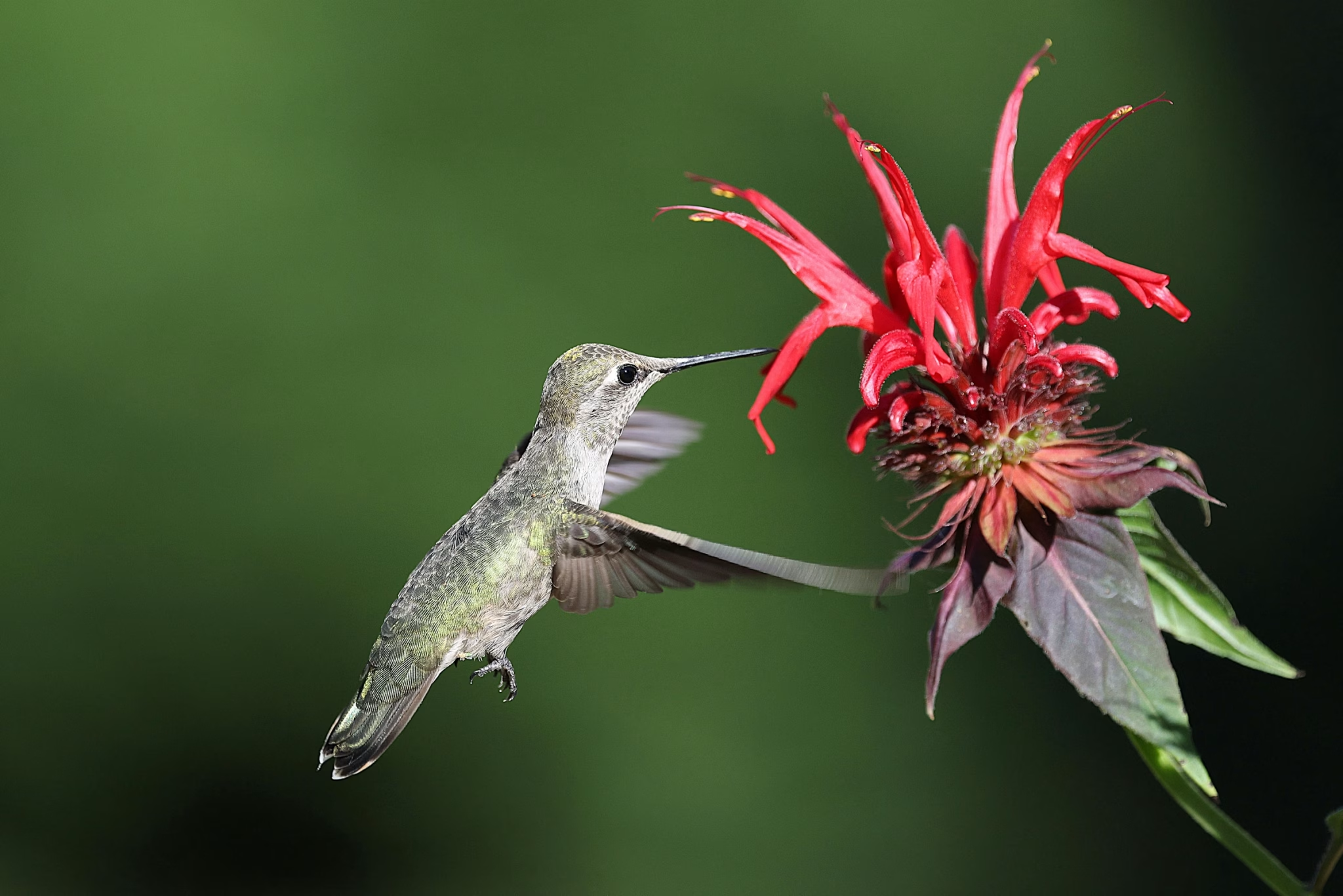
The first morning a male Anna’s hummingbird discovered the Salvia spathacea next to my back fence, he sat on a porch nail twelve feet above the patch and ran the perimeter for the next three hours. Every time another hummer crossed the air column over the sage, he launched. The dive ended in that explosive tail-feather pop that sounds, the first time you hear it, like someone snapped a bottle cap with their teeth. He owned it. The sage had been in the ground a week.
That was February. Anna’s hummingbirds in Northern California start nesting in December, sometimes earlier, and a single male will hold a small territory until his hatchlings fledge. The pink-and-magenta whorls of hummingbird sage open right when those nestlings are demanding the most calories from their mother. It’s not decorative timing. It’s the reason that plant exists in that place at that time of year, evolved into existence by the bird that pollinates it, and the reason a California gardener who plants it is doing something more useful than they might realize.
Half of California’s six hummingbird species are doing fine. The other half are in measurable trouble. The twenty-five California natives below help both groups, but they help the troubled ones in ways that show up in actual peer-reviewed numbers.
Key Takeaways
- Allen’s hummingbird has declined 88% since 1970 per peer-reviewed Breeding Bird Survey data. Rufous has dropped 65%. A California-native garden west of the Coast Range is doing measurable conservation work, not just decoration.
- Anna’s hummingbirds are the only species in NorCal during winter and begin nesting in December. The single most important plant decision for them is having winter and early-spring food: manzanita, fuchsia-flowered gooseberry, and pink-flowering currant close the January-February nectar gap.
- California fuchsia (Epilobium canum) is what saves the August-September stretch, when almost nothing else native is blooming. Calscape’s own line: there’s probably no better California native plant for attracting hummingbirds.
- The “red flowers only” rule has documented exceptions: white sage, woolly blue curls, Cleveland sage, and foothill penstemon all attract hummingbirds despite non-red blooms. Tubular shape and accessible nectar matter more than color.
- California buckeye is toxic to non-native honeybees but safe for native bees and hummingbirds, per UC Agriculture and Natural Resources. If you keep European honeybees, the buckeye is a no.
- Hummingbird sage (Salvia spathacea) is the marquee plant on this list. Theodore Payne introduced it into California horticulture in the 1940s. It thrives in deep shade, blooms during Anna’s nesting peak, spreads by rhizomes into a true groundcover, and gets visited by every hummingbird species that passes through.
- Plant taxonomy is moving: Galvezia is now Gambelia, Mimulus split into Diplacus and Erythranthe, Lavatera into Malva, Isomeris into Cleomella. Half the names in this article have changed since people started growing these things, and they’ll probably change again.
- Skip red food coloring in feeders, never use honey or brown sugar, and clean every two to three days in summer. Sugar-water ratio is one part white sugar to four parts water. Audubon’s own guidance.
What Native Plants Attract Hummingbirds in California?
California native plants that attract hummingbirds share three structural traits: tubular flowers shaped to fit a hummingbird’s bill, accessible nectar held at the base of the flower tube, and a bloom period that overlaps with at least one of the state’s six hummingbird species.
The strongest performers are Epilobium canum (California fuchsia), Salvia spathacea (hummingbird sage), several manzanitas, two Ribes species, multiple penstemons, and California’s two native monkeyflowers. Most are drought-tolerant. A handful are riparian and need regular water. Two are toxic to honeybees but safe for hummingbirds.
The Six Hummingbirds You’re Actually Feeding
California hosts six species of hummingbird across the year, and a serious garden plan needs to know which species is present in which month. That’s what determines whether a plant matters or not. A spring bloomer feeds the migrants moving through. A winter bloomer feeds the Anna’s that are already incubating eggs in your neighbor’s olive tree. A summer bloomer feeds the breeding birds that stayed.
Anna’s Hummingbird (year-round)
Anna’s is the species you see in winter. It’s also the species that’s winning. English et al., publishing in Scientific Reports in 2021, documented a long-term population increase of 2.7% per year between 1970 and 2019, accelerating to 3.5% per year more recently. At the northern edge of the expanding range in British Columbia, the increase hits 20% per year. The driver, according to Audubon’s analysis of 80 years of Christmas Bird Count data, is suburban gardens and feeders. The species has even evolved measurably longer beaks better suited to nectar feeders.
Anna’s nest in December. Sometimes earlier. By February, when most California gardens look like nothing’s going on, that female has a clutch of two eggs in a thumb-sized cup of plant down and spider silk and is feeding herself on whatever winter nectar she can find. If your yard has manzanita and a fuchsia-flowered gooseberry, you’re directly subsidizing her.
Allen’s Hummingbird (the conservation case)
Allen’s is the reason this article isn’t just a list of pretty plants.
The peer-reviewed long-term decline is 88% from 1970 through 2019, at a rate of 4.3% per year, accelerating to 7.9% per year over the last decade of that window. Audubon’s climate models project a loss of up to 90% of Allen’s current breeding range by 2080. The species splits into two subspecies: a non-migratory population on the Channel Islands and the adjacent mainland, and a migratory population that moves up the Pacific Coast every spring. The migratory subspecies breeds in coastal scrub and chaparral from southern California north into Oregon. That’s a band of habitat that runs through every NorCal coastal town.
I am not a wildlife biologist. I’m a homeowner who put native plants in my yard. The biologists are the ones counting. What they keep finding is that residential plantings of California natives, scaled across thousands of yards, function as habitat. Allen’s needs that habitat. The math says so.
Rufous, Black-chinned, Calliope, Costa’s
Rufous is in similar trouble: down 65% since 1970, IUCN classifies it as Near Threatened, climate models say it could lose 100% of its non-breeding US range by 2080. It doesn’t breed in California. It migrates through, fast and angry. A male Rufous in March will dominate one nectar patch and beat up everything that approaches it. That’s why the California Native Plant Society recommends planting in multiple separated groupings rather than one big flower bed.
Black-chinned arrives in spring, breeds along Central Valley waterways and Sierra foothill canyons, departs in fall. Population is stable, around 8.8 million. The species avoids high desert but thrives in the low-elevation suburbs where most California gardeners actually live.
Calliope is the smallest bird in North America, three inches long, weighing about a tenth of an ounce. It breeds in the high Sierra, above 4,000 feet. If you garden at altitude, you might see one. If you garden in Sacramento, almost certainly not.
Costa’s is the desert species. Mojave, Colorado, the eastern fringe of Anza-Borrego. It’s the early-breeding hummingbird in California after Anna’s, with nesting starting in late winter. If you live in the Inland Empire or San Diego, your Justicia californica is feeding Costa’s.
A Year-Round Bloom Calendar
NorCal is the baseline below; bloom timing in Southern California runs roughly two weeks earlier. The shaded band marks Anna’s nesting season, when winter and early-spring food matters most.

California fuchsia blooms when nothing else does. Manzanita and the two Ribes species cover Anna’s nesting peak. Penstemons and sages handle the migrants. One plant from each band gives you a year-round nectar garden.
The Plant Directory: 25 California Natives for Hummingbirds
Winter to Early Spring: Closing the Anna’s Nesting Gap
These are the plants that matter most for the bird that’s already in your yard in February.
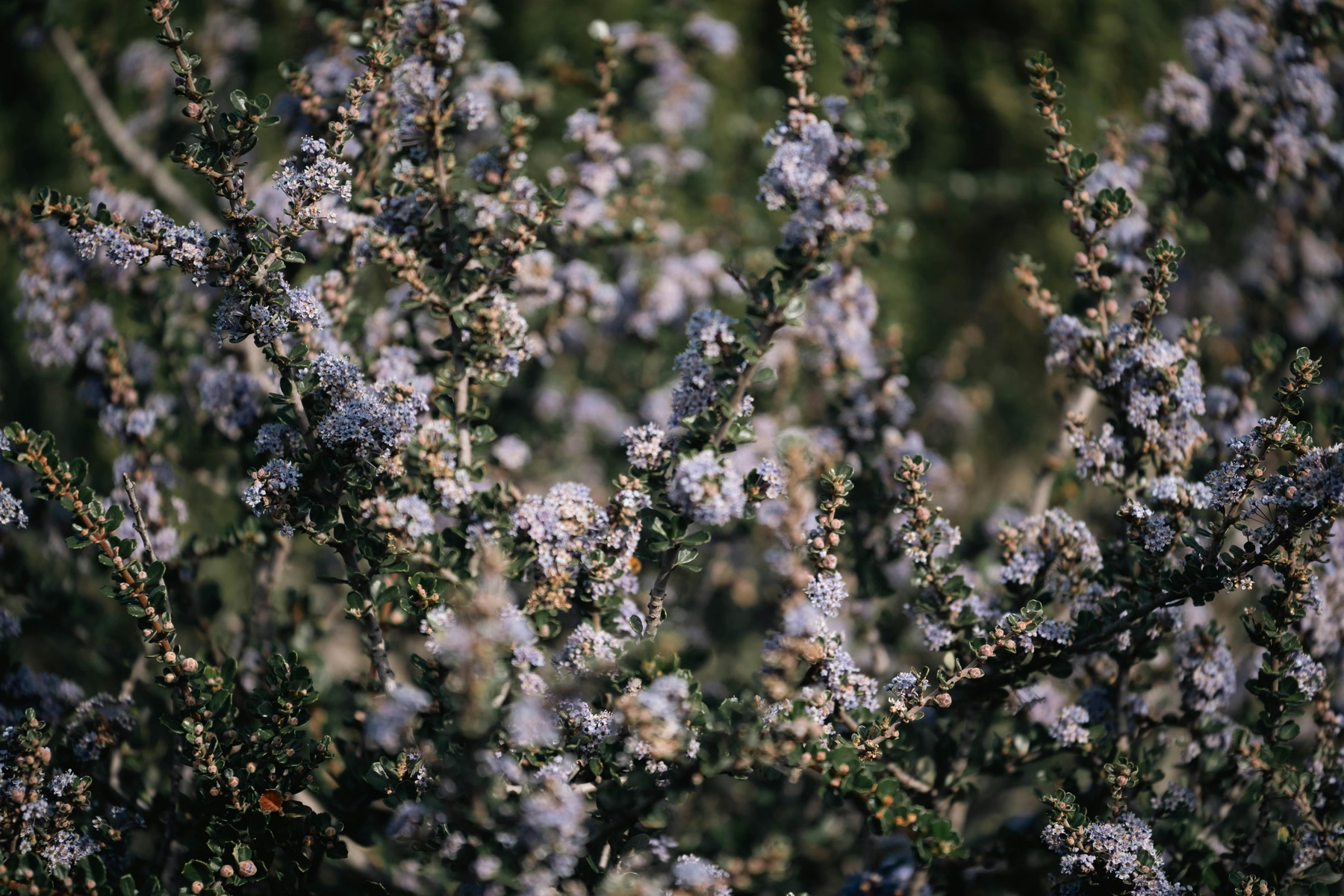
Arctostaphylos spp. (Manzanita). California has dozens of native manzanitas, urn-flowered, evergreen, and central to chaparral ecology. The California Native Plant Society lists manzanita first among winter hummingbird plants. Flowers are tiny and white-to-pink, and they appear from December through March. Calscape’s A. densiflora ‘Howard McMinn’ is the most forgiving cultivar I’ve grown. It tolerates summer water and shearing, which makes it the manzanita that survives a homeowner who doesn’t quite trust the no-summer-water rule yet. Combine it with one earlier species (A. glauca, A. franciscana) and you’ll have manzanita bloom from December through April.
Ribes speciosum (Fuchsia-flowered gooseberry). CNPS specifies that this one peaks in bloom in February. February is the heart of Anna’s nesting season. Pendant red tubular flowers with stamens that protrude past the petal mouth, hanging from arching shade-tolerant branches. It’s the plant version of the bird it feeds. Cold tolerance to 20°F. Goes summer-deciduous, drops its leaves entirely, then leafs back out with fall rain.
One warning. It’s thorny. Don’t put it next to a path you’ll be walking past in shorts.
Ribes sanguineum var. glutinosum (Pink-flowering currant). Pink racemes that appear before the leaves, late winter into spring. Light shade to part sun, regular but not heavy water during establishment. The flowers are far more substantial than the related R. speciosum, hanging in clusters from bare gray branches. Berries follow the bloom and feed songbirds. CNPS lists it as a hummingbird plant; cultivation specifics on Calscape were temporarily unavailable when this article was researched, so check a local nursery directly for varietal recommendations.
Ribes malvaceum (Chaparral currant). The other side of the same coin. Endemic to California, blooming winter into spring, partial shade or full sun, very low water. Native from Baja north into the inner Coast Ranges and the San Francisco Bay area. Fast-growing, deciduous, five to eight feet tall. Prune during the dry season after fruiting. The cultivar ‘Dancing Tassels’ is widely sold.
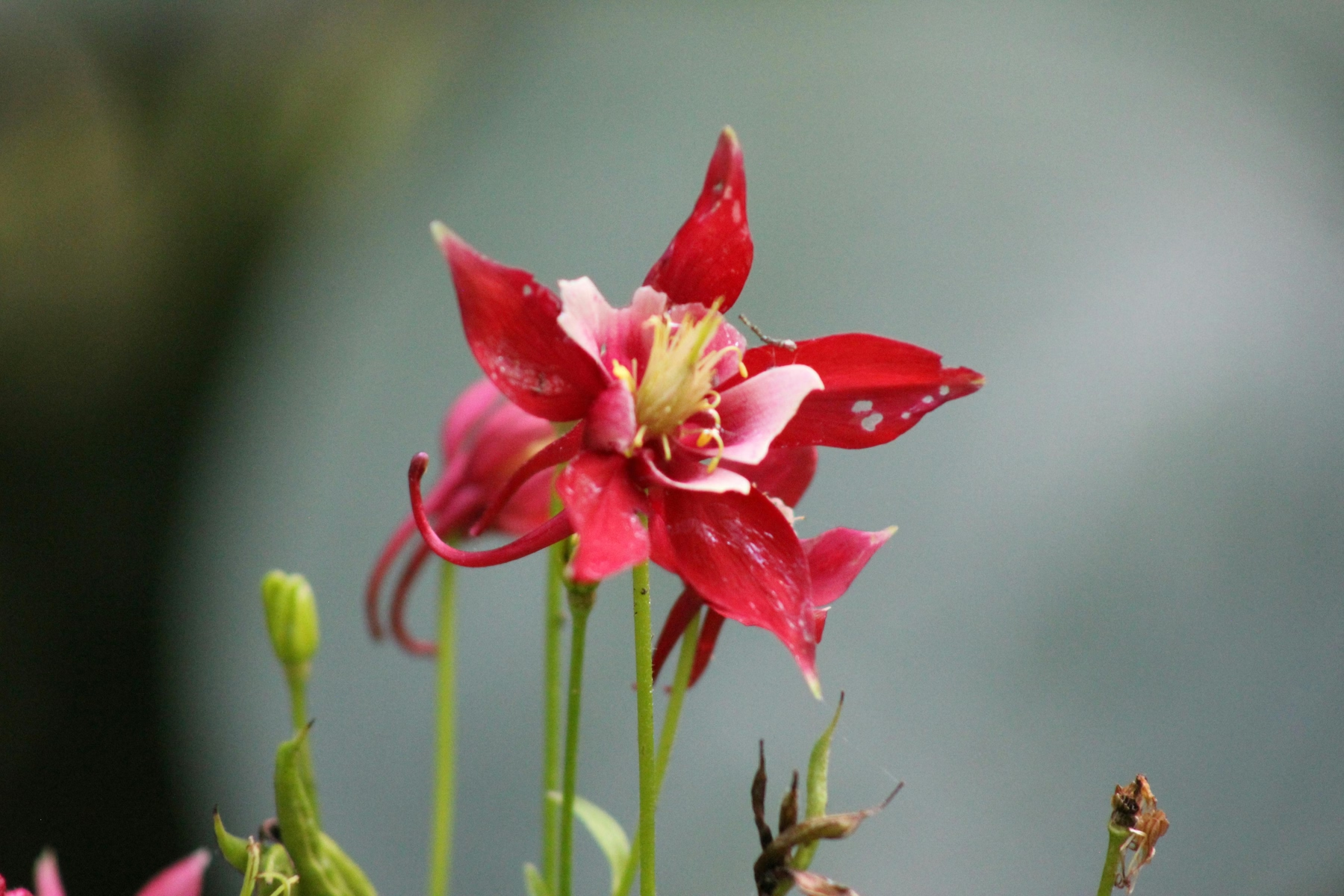
Aquilegia formosa (Western columbine). The flower that taught me what spurred nectar holders look like. Red-and-yellow tubular flowers held above ferny foliage on a slender stalk. Native across most of California from sea level into the Sierra. Adapts to almost any sun exposure. Short-lived as an individual plant, three to five years. Self-seeds readily if you leave the seedheads, which means a single plant becomes a self-sustaining patch. Don’t deadhead unless you want a single specimen.
Spring: When the Migrants Arrive
Allen’s, Rufous, and Black-chinned start showing up in March. The plants that bloom now feed birds that are flying eight to fifteen miles a day on stored fat and whatever they can find along the way.
Salvia spathacea (Hummingbird sage). If I had to pick one plant from this list, this is it.
Whorled magenta-and-pink flower spikes on two-foot stalks rising out of large, soft, intensely fragrant green leaves. Spreads by rhizomes into a slow but steady groundcover. Tolerates everything from deep shade to full sun. Deer-resistant. Theodore Payne introduced this species into California horticulture in the 1940s, describing it then as “a robust growing plant with large handsome leaves” that “does best in shade or partial shade.” Eighty-some years later, that’s still the right description.
Sources disagree on cold-hardiness. Calscape says it survives to 0°F. Theodore Payne lists 20°F. Treat 20°F as the conservative working number for unprotected garden specimens.
Diplacus aurantiacus (Sticky monkey flower). Until recently this was Mimulus aurantiacus, but the genus split following genetic work and most California species moved into Diplacus.
The orange-red form is the strongest hummingbird draw. Coastal full sun, inland part shade. Deadhead through the bloom season for continued flowering. Pinch back new growth in spring for a more compact shape. Survives 15°F. Native broadly across chaparral, coastal scrub, redwood understory, and pine forest, which means it works in almost every NorCal microclimate.
Heuchera maxima (Island alum root). Channel Islands endemic, rare in the wild but widely available in nurseries. Tiny pink-white flowers held on slender two-foot scapes above evergreen rosettes of broad leaves.
Hummingbirds visit the small flowers despite their modest size, because the nectar reward is concentrated. Full sun coastal, full shade inland. Cold tolerance to 12°F. Hybrid Heuchera cultivars (‘Wendy’, ‘Santa Ana Cardinal’, ‘Old La Rochette’) are widely sold but verify provenance, since some hybrids are bred from non-native parents.
Penstemon spectabilis (Showy penstemon). Late winter into summer bloom, full sun only, very low water. The flowers are wide-mouthed tubular, violet-purple to blue-purple. Calscape confirms hummingbird visitation despite the non-red color, because the tubular shape wins. Lifespan is five to ten years. Self-seeds. Native to chaparral and coastal sage scrub on rocky slopes.
Penstemon heterophyllus (Foothill penstemon). Same pattern, different geography. Blue to magenta tubular flowers, May through early summer, three to five feet tall in fountain form. The cultivar ‘Margarita BOP’ is the easiest California-native penstemon for home gardens because of its compact form and tolerance of slightly more water than other species. Cold-hardy to 10°F. Supports hummingbirds, native bees, bats, and butterflies.
Cirsium occidentale (Cobweb thistle). A California native thistle, which sounds like a contradiction until you remember that “thistle” describes a flower morphology, not a status. The crimson-red flower form is the one that matters here. Calscape directly confirms it attracts bees, butterflies, and hummingbirds. Forms a basal rosette in year one and flowers in year two. Larval host for Painted Lady and Mylitta Crescent butterflies, which is a bonus pollinator bargain. Worth a single specimen for the visual texture alone, white-haired filaments laced inside unopened heads, like cobwebs in a stage prop.
Note: do not confuse with Cirsium vulgare (bull thistle), which is invasive and noxious. The natives have a sticker shock to gardener eyes; the invasives spread. Buy from a native nursery and you won’t get the wrong one.
Late Spring and Summer: Peak Diversity
Penstemon centranthifolius (Scarlet bugler). Calscape’s verbatim line on this species: bright red to orange-red tubular flowers irresistible to hummingbirds. That’s the flower morphology textbook reading. Two to four feet tall, full sun to partial shade, low water. Cold to 15°F. If you want a single penstemon that delivers the textbook hummingbird-flower experience, this is it.
Salvia clevelandii (Cleveland sage). Native to San Diego County, fragrant beyond description, blue-violet flowers in whorled spikes, blooms through early summer. Theodore Payne’s 1941 catalog described it as “a charming little shrub” that “blooms profusely in early summer,” noting that both flowers and foliage remain “delightfully fragrant even after drying.” Hummingbirds adore the nectar, per Calscape. Important honesty: the most-sold cultivars (‘Pozo Blue’, ‘Allen Chickering’) are hybrids with S. leucophylla. They’re called “Cleveland sage” in the trade. They’re not pure S. clevelandii. The hybrids are excellent garden plants. Just call them what they are.
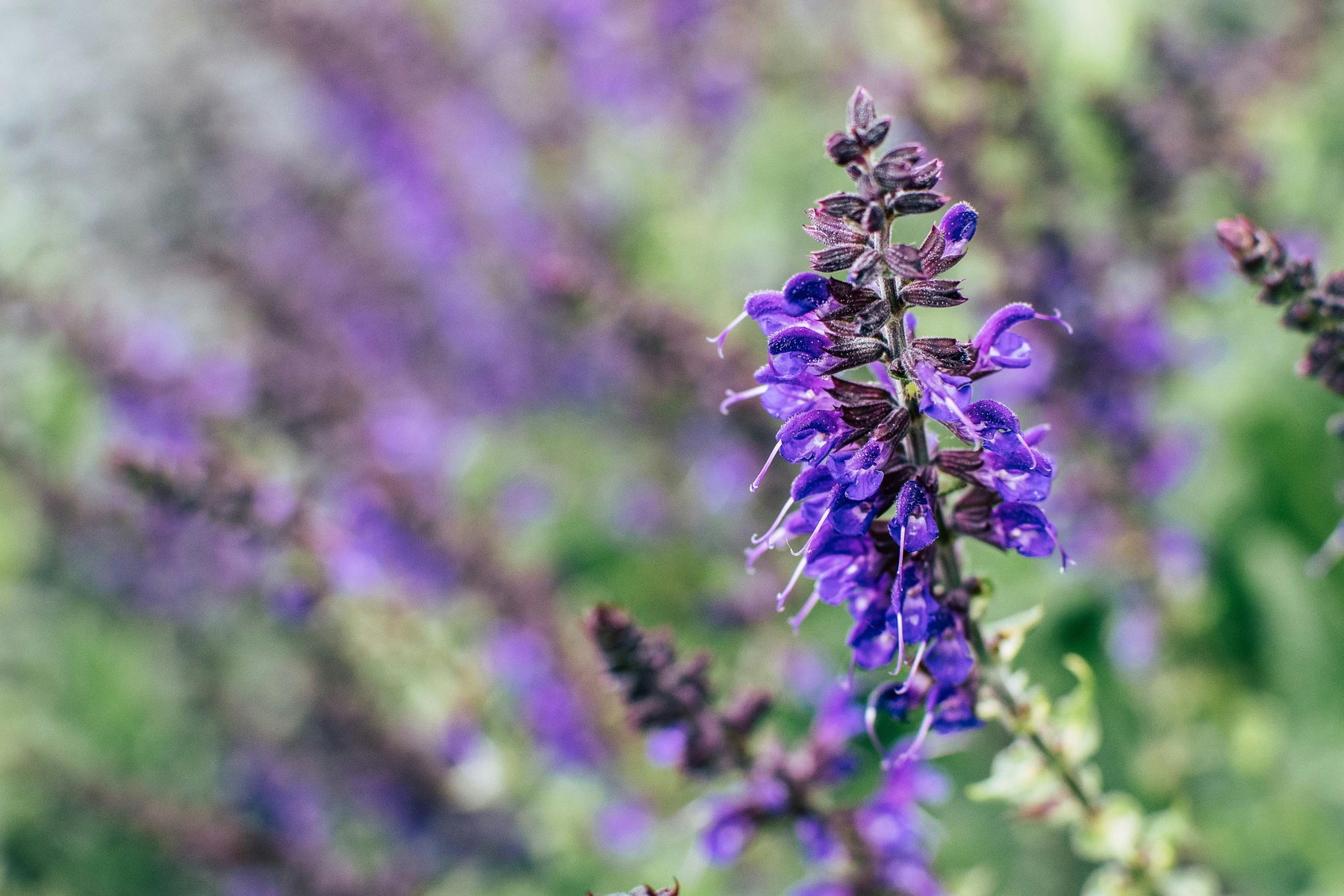
Salvia apiana (White sage). Spire-form white flowers held on tall flowering stalks above silvery-white foliage. Blooms spring, summer, even into winter in coastal SoCal. Hummingbirds visit despite the white flower color, alongside carpenter bees and bumble bees. Native only to coastal sage scrub in southern California and northern Baja, “the only place this species naturally occurs globally,” per Calscape.
This is the conservation moment for the article.
White sage is deeply rooted in the cultures and lifeways of Indigenous communities of southern California and northern Baja. Wild populations face serious threats from poaching, climate change, and development.
If you grow it, buy nursery-propagated stock only. Don’t harvest from wild populations. Don’t accept “wildcrafted” white sage from anywhere that can’t tell you exactly which licensed grower produced it. The plant will reward you with thirty years of bloom; the practice rewards the people whose plant this was first.
Salvia mellifera (Black sage). Spring, summer, and winter bloom depending on the year, full sun, very low water (never irrigate once established). White-to-pale-blue flower whorls spaced along upright stems. An important food source for bees, butterflies, and hummingbirds, despite the non-red color. Three to six feet tall, evergreen or summer semi-deciduous depending on the rainfall year.
Salvia sonomensis (Sonoma sage). One of the few California natives that genuinely functions as a lawn alternative. Will form a mat up to fifteen feet wide while remaining about a foot high. Spring and summer bloom, lavender-to-violet flower spikes. Sensitive to direct heat and intense sun. Leaf drop in summer indicates too much sun, in which case more shade fixes it. Sunset Zones 7 and 14-24, which covers most populated NorCal.
Delphinium cardinale (Cardinal larkspur). Spurred scarlet flowers with yellow markings on stalks three to seven feet tall. Spring into summer. Full sun to partial shade. The cultivation rule per Calscape is unambiguous: never irrigate once established, keep dry during dormancy. Cold to 10°F. Native from Monterey south through Baja. Tall enough that it may need staking, especially in windy gardens.
Toxicity flag: Delphinium alkaloids are famously toxic to livestock and humans. Calscape doesn’t lead with this, but it’s worth knowing if you have curious pets or kids.
Aesculus californica (California buckeye). A small tree with cream-pink candelabra flower spikes in spring and early summer, hummingbirds working the spikes alongside native bees and butterflies. Endemic to California, found in the Coast Ranges and Sierra foothills, summer and winter deciduous (drops leaves twice a year). Tolerates clay and serpentine soils.
Here’s the detail most generic gardening content gets wrong. UC Agriculture and Natural Resources documents that California buckeye is toxic to non-native European honeybees: about a week after honey bees work the blossoms, symptoms of buckeye poisoning appear in the hive, with many young larvae dying and the queen’s egg-laying rate decreasing or stopping.
Native bees and hummingbirds are unaffected. UC ANR’s verdict: native pollinators relish the collection of nectar without side effects. If you keep European honeybees, the buckeye is a no. If you don’t, plant it.
Keckiella cordifolia (Heart-leaved keckiella, climbing penstemon). Pale-orange to deep-scarlet tubular flowers, sprawling vine-like shrub three to seven feet tall and as wide. Coastal full sun, inland part shade, very low water. Cold tolerance to 0°F or 5°F below zero, which makes it one of the harder species on this list. Excellent for slopes and over walls. Larval host for the Variable Checkerspot butterfly.
Silene laciniata (Indian pink, cardinal catchfly). Bright red starburst flowers with deeply fringed petals. Looks exotic. Two California subspecies cover the state, one south of San Luis Obispo, one in central and northern California. Partial shade preferred, low to moderate water. The plant develops a deep taproot that gets it through summer drought, then it goes mostly dormant. Sticky glandular hairs on the stems trap insects, which has earned it the alternate common name catchfly.
Malva assurgentiflora (Mission mallow, malva rosa). Until recently this was Lavatera assurgentiflora; the genus Lavatera got synonymized into Malva in recent botanical work. Five to ten feet tall, fast-growing, blooming much of the year with rose-pink mallow flowers. Channel Islands endemic, naturalized on the coastal mainland. Spring-summer bloom attracts hummingbirds, songbirds, and butterflies, per Calscape.
Justicia californica (Chuparosa). “Chuparosa” is Spanish for hummingbird. The plant is named for the bird. Multi-stemmed shrub, two to four feet tall, with red-orange tubular flowers from late winter into summer. Usually leafless while in bloom, which gives it a striking sculptural form. Full sun, very low water. Native to the Colorado Desert, including the Anza-Borrego region. If you live in NorCal, this is a SoCal plant; if you live in the Inland Empire or San Diego, it’s the species at the top of your list. (For more on its desert habitat, see our guide to Anza-Borrego wildflowers.)
Summer to Fall: When California Fuchsia Saves Everything
August in California is a desert month for native bloom. Most of the spring and early-summer plants have shut down, fire weather has set in, and almost nothing native is flowering. Then this happens.
Epilobium canum (California fuchsia). Formerly known as Zauschneria, which is the name your grandmother probably used. Calscape’s own line, verbatim: there’s probably no better California native plant for attracting hummingbirds. And: frequently the only native California plant in an area flowering at the height of summer. The flowers are scarlet trumpets borne on gray-green stems. Cold to 0°F. Cut or mow to base in fall or early winter to stimulate next year’s growth, which most retail-channel guides skip and which is the difference between a plant that thrives and one that gets ratty after three years.
Las Pilitas Nursery’s deep cultivar list is the best resource for this species. The ‘Catalina’ selection, per Las Pilitas, “holds its flowers longer and still has considerably more ‘hummingbird power’ than most of the fuchsias in the trade, and is a great deal hardier.” ‘Bert’s Bluff’ is a smaller mound. Pink and white forms exist for gardeners who want the flower architecture without the red. All container-suitable, all good in hanging baskets, all visited by Anna’s and Allen’s at peak bloom.
Clinopodium mimuloides (Monkey-flower savory). Formerly Satureja mimuloides. Calscape’s vivid line: tubular flowers are red-orange and grow to 1-2 inches. Hummingbirds love them. Summer and fall bloom, a critical shoulder-season plant. Mounding form one to six feet tall. Native to Coast Ranges from Monterey south, with most of its range inside Los Padres National Forest, so this is a slightly underused central-coast species. Moderate water (one of the thirstier plants on this list). Cold to 25°F.
Erythranthe cardinalis (Scarlet monkey flower). Formerly Mimulus cardinalis. The genus Mimulus got split across Diplacus and Erythranthe in recent work, and the cardinal monkey flower moved into Erythranthe.
Strongly reflexed nectar-rich red tubular flowers, summer bloom into fall. Riparian preference.
This is the one species on this list that will not survive in a drought-tolerant bed: it wants moist soil through summer, ideally near a water feature or seasonal seep. Pair it with a drip line, not a desert garden.
Chilopsis linearis (Desert willow). Belongs to the bignonia family, not the willow family despite the leaf shape. Trumpet-shaped flowers in lavender and pink, fragrant, on a small tree. Spring through fall bloom, a long window for a California native. Full sun and very low water. Cold to 15°F, native to SoCal deserts. Inland Central Valley summers approach its native niche; coastal NorCal fog does not. If you live in Sacramento, it’ll work. If you live in Fort Bragg, it won’t.
Lonicera involucrata (Twinberry honeysuckle). Two California varieties, yellow-flowered in the Sierra and red-orange along the coast and Coast Ranges from Santa Barbara north. So this is the NorCal-relevant native honeysuckle.
Tubular flowers in pairs, hence the common name. Naturally riparian, prefers moist places, max one-per-week irrigation once established. Tolerates -20°F, the cold-hardiest plant on this list. Sea level to 9,500 feet in elevation range. Black berries follow the bloom, edible to birds, bitter to humans.
Fall through Spring and Year-Round: Bridge Plants
Trichostema lanatum (Woolly blue curls). Note that the original draft of this article had the genus spelled “Trichostemma.” There’s only one m. Five feet tall and ten feet wide at maturity, fountain form, fall-through-spring bloom of fuzzy purple-blue curled flower spikes with a minty fragrance. Fast-growing and short-lived, four to five years. A fire-following plant that wants drainage and sun and absolutely no summer water.
I have killed this plant twice. Both times by giving it a sympathy water during a hot July week.
Calscape’s verbatim warning is unambiguous: overwatering, even occasional summer water, can damage or kill them. Once mature, maximum irrigation is one-per-month established. The plant also doesn’t like mulch. Plant it on a slope in fast-draining soil, point a drip line somewhere else entirely, and walk away. The propagation route is stem cuttings; seed propagation is hard. Cold to 0°F.
If this is the species that finally teaches you that California natives are not generic shrubs, the lesson cost was worth it.
Cleomella arborea (Bladderpod). The single most-renamed plant on this list. It’s been Isomeris arborea, then Peritoma arborea, then Cleome isomeris, then Cleome arborea, and Calscape currently lists it as Cleomella arborea. Pick one and move on. The plant doesn’t care.
Bright yellow flowers stay on the plant most of the year. Atypical color for a hummingbird plant, but Calscape confirms it attracts bees, butterflies, and hummingbirds, and the small flower morphology is structurally accessible. Native to coastal sage scrub, Joshua Tree woodland, Creosote Bush scrub. Full sun, very low water. This is a plant on a hummingbird list because it bridges shoulder seasons, not because hummers prefer it over the redder options.
The Red-Flower Rule and Why It’s Wrong
Every gardening blog repeats the same line: hummingbirds love red flowers. Plant red. The line is true and it’s not the whole story.
CNPS quotes Arvind Kumar’s actual rule: hummingbirds will in fact feed on flowers of any color, but will go to red ones first. Audubon’s deeper analysis goes further: the preference is learned rather than hard-wired. Hummingbirds have warm-hue eye filters, the bee-competition theory holds that red flowers are less crowded by bee pollinators, but the bird itself learns by trial which flowers reward and returns to those.
Tubular shape and accessible nectar matter more than color. White sage attracts hummingbirds despite the white blooms. Showy penstemon and foothill penstemon are blue-magenta and purple, Cleveland sage is blue-violet, and woolly blue curls is, obviously, blue. All five host hummingbird visitation despite breaking the red rule. Plant for the flower architecture, not for what looks photogenic.
Hanging Baskets and Containers: Patios and Apartments Count
Not every garden has open ground. The species below all do well in containers or hanging baskets, which makes them practical for patio gardens, balconies, and rentals.
Gambelia speciosa (Island bush snapdragon). Until recently Galvezia speciosa, then phylogenetic work moved the California species into Gambelia. Trumpet-shaped red flowers nearly year-round, sprawling vine-like form, “good in containers” per Calscape’s own line. The single most container-friendly hummingbird native. Cold-tender at 30°F, so in inland NorCal treat as a microclimate or container plant that gets dragged into a garage on freeze nights. Cultivar ‘Firecracker’ is the dominant horticultural form.
Epilobium canum cultivars (California fuchsia). Las Pilitas confirms all listed varieties as container-suitable. The smaller mounding selections work best: ‘Bert’s Bluff’, the pink groundcover form, the white form, and ‘Mexicana’. A single specimen in a 14-inch terracotta pot will still bloom in August.
Diplacus aurantiacus (Sticky monkey flower). Compact when pinched back, and tolerates container constraints. Pinch new growth in spring for tighter form. Deadhead through bloom for continued flowering.
Salvia spathacea (Hummingbird sage). Spreads by rhizomes, which means in a container it eventually fills the pot, but it works as a wide shallow shade-pot focal point. Theodore Payne suggests it for container cultivation.
Plants that don’t work in containers: woolly blue curls (root-rots), California buckeye and desert willow (trees), and fuchsia-flowered gooseberry (long-term shrub). Tell these to readers directly so they don’t kill a plant trying.
“But What About Fuchsia? Lavender? Lantana?”
Reasonable questions. People plant what’s at the box store. Honest answers below.
Hardy fuchsia (the non-native ornamental): hummingbirds visit it, full stop. Fuchsia hybrida and F. magellanica were documented drivers of Anna’s hummingbird range expansion when planted in suburban gardens. The California-native substitute is Epilobium canum, which shares the common name “California fuchsia” but is structurally unrelated. The native does the same job and survives California summers without supplemental water.
Lantana: visited reliably by Western hummers. The native substitute for tubular orange-red color and form is sticky monkey flower or scarlet bugler.
Foxglove: hummingbirds visit it. The native substitute is showy penstemon or foothill penstemon, which give you the same tubular flower architecture without the toxicity to pets. (Foxglove is famously toxic.)
Lavender: mostly a bee plant. Hummingbirds occasionally visit but it’s not a reliable nectar source. The native substitute for fragrance and visual texture is Cleveland sage, which is bee-attractive and also gets measurable hummingbird visitation.
Hibiscus: yes, the large trumpet flowers are hummingbird-pollinated. The native substitute is Mission mallow, same mallow family, similar flower form, drought-tolerant.
Honeysuckle: the non-native Japanese honeysuckle (Lonicera japonica) is invasive in California. Don’t plant it. The native substitutes are twinberry honeysuckle and heart-leaved keckiella.
Mandevilla and bougainvillea: both visited, both non-native, both common box-store options. The native vining substitute is Gambelia. For a true vine, Lonicera ciliosa (orange honeysuckle) works in coastal NorCal.
Geraniums (Pelargonium): some hummingbird visitation, not a reliable nectar source. Substitute with island alum root or hybrid Heuchera if you want similar flower presentation.
One more name to flag. Lobelia laxiflora, sold as “Mexican cardinal flower,” shows up on a lot of “California native plants” lists. Calflora is unambiguous: it’s not native to California. The California native that fills the same red-tubular riparian niche is scarlet monkey flower (Erythranthe cardinalis).
What Not to Do
Failure modes I’ve made or watched friends make:
- Don’t summer-water woolly blue curls. Even occasional. The plant tolerates none. Don’t mulch under it either.
- Don’t put fuchsia-flowered gooseberry near a path. Thorny.
- Don’t plant scarlet monkey flower on a drought-tolerant slope. It’s riparian. Pair it with water, or skip it.
- Don’t use red food coloring in feeders. Audubon: completely unnecessary, potentially harmful. The feeder body is already red.
- Don’t use honey, brown sugar, raw sugar, organic sugar, or artificial sweeteners in feeders. Honey promotes fungal growth that’s lethal to hummingbirds. Brown and raw sugars contain iron levels that can be lethal. White sugar only.
- Don’t let feeders go more than two to three days without cleaning in summer. Twice a week in winter. Mold and fermentation cause black tongue, an oral fungal infection that kills hummingbirds.
- Don’t use neonicotinoid-treated nursery stock. The American Bird Conservancy has documented neonic residues in hummingbirds. Ask your nursery directly whether their stock has been treated. CNPS-affiliated and small-volume California native nurseries are the safer source.
- Don’t plant California buckeye if you keep European honeybees. The flowers are toxic to Apis mellifera. Native bees and hummingbirds are fine.
- Don’t poach white sage. Buy nursery-propagated stock only. The wild populations are threatened, and the cultural significance to Indigenous communities of southern California is real.
- Don’t expect western columbine to be a long-lived perennial. Three to five years per individual. Self-seeds if you leave the seedheads.
The Drought Reality
California’s 2020-2022 drought was, per the U.S. Drought Monitor, the driest three-year period on record. As of May 2026, the state is still in a precipitation deficit: this March was the driest on record (since 1895), and 54.6% of California is in some level of drought designation as I write this.
Drought-tolerant California natives are the only responsible long-term answer for residential landscaping in the Central Valley and most of NorCal. The plants on this list are almost all drought-tolerant once established. The two exceptions are Erythranthe cardinalis (riparian, wants regular water) and Lonicera involucrata (prefers moist places). For those two and any container plantings, a basic Rain Bird drip irrigation kit handles seasonal supplemental watering without flooding the rest of the bed.
For the rest of the list: deep watering during the first summer, then nothing. The plants want to be left alone. Calscape, CNPS, Theodore Payne, and Las Pilitas all converge on this: California natives evolved here. They don’t need irrigation in summer; they need to be allowed to go dormant and rest.
Tools and Books Worth Owning
Three pieces of equipment have earned their place after a decade of California native gardening.
California Native Plants for the Garden by Bornstein, Fross, and O’Brien. The canonical reference. If you only own one book on this subject, this is it. Detailed cultivation profiles, regional plant communities, and design ideas across hundreds of species. About $18.
Reimagining the California Lawn by Carol Bornstein, David Fross, and Bart O’Brien (the same trio). The companion volume on lawn replacement. Drought-aware design, plant communities organized by use case, water-budget realism. Roughly $22.
Felco F-2 hand pruners are the working-gardener standard. Swiss-made, replaceable parts (blades, springs, anvils), about $72. I’ve had mine eleven years and replaced the blade once. The smaller F-6 fits a medium hand, and the F-5 is the steel-handled budget option, but the F-2 is the one most professional gardeners I know are using.
For the feeder question: the Aspects HummZinger Ultra ($26) is a 12-ounce dish-style feeder with built-in ant moat and bee guards on the four ports. Dish-style feeders are easier to clean than the inverted-bottle types, which means readers actually keep them clean and don’t end up serving fermented sugar water. Real white sugar at one-to-four ratio with water. No dye. Wash every two to three days in summer.
Frequently Asked Questions
What native plants attract hummingbirds in California?
Top performers are California fuchsia (Epilobium canum), hummingbird sage (Salvia spathacea), manzanita species, fuchsia-flowered gooseberry (Ribes speciosum), pink-flowering currant, scarlet bugler (Penstemon centranthifolius), sticky monkey flower (Diplacus aurantiacus), and scarlet monkey flower (Erythranthe cardinalis). All have tubular flowers, accessible nectar, and bloom periods that align with at least one of California’s six hummingbird species.
What is a hummingbird plant?
A hummingbird plant is one whose flowers have evolved structural traits that match a hummingbird’s feeding anatomy: tubular shape, accessible nectar at the flower base, and frequently (but not always) red color. Many California natives qualify, including manzanita, sage, currant, columbine, penstemon, and monkey flower species.
Are California native plants for hummingbirds perennial?
Most are. Hummingbird sage, California fuchsia, manzanitas, currants, penstemons, sages, and monkey flowers are all perennial. Western columbine is a short-lived perennial that lasts three to five years per individual but self-seeds for long-term presence. Cobweb thistle is biennial, flowering in year two from a basal rosette.
What native plants for hummingbirds bloom in winter in California?
Manzanita species (especially Arctostaphylos densiflora ‘Howard McMinn’, Arctostaphylos glauca, and Arctostaphylos franciscana), fuchsia-flowered gooseberry (Ribes speciosum, which peaks in February), pink-flowering currant (Ribes sanguineum var. glutinosum), and chaparral currant (Ribes malvaceum). These cover the December-to-March nesting window for Anna’s hummingbird, which is the only species in NorCal during winter.
Will hummingbirds visit non-native plants like fuchsia, lantana, or hibiscus?
Yes. Non-native fuchsia, lantana, hibiscus, mandevilla, foxglove, and bougainvillea all attract hummingbirds. Suburban gardens planted with non-native nectar species were a documented driver of Anna’s hummingbird range expansion through the mid-1900s. The California native versions (or substitutes) generally use less water, support more native pollinators, and survive the climate without coddling.
What’s the best California native plant for hummingbirds in shade?
Hummingbird sage (Salvia spathacea) thrives in deep shade and is the strongest shade hummingbird plant in the California native palette. Fuchsia-flowered gooseberry (Ribes speciosum) and island alum root (Heuchera maxima) also work well in shade. For dappled shade, western columbine and pink-flowering currant fit the profile.
Are there hanging-basket native plants that attract hummingbirds?
Yes. Island bush snapdragon (Gambelia speciosa) is the strongest container choice, with sprawling growth and near-year-round red trumpet flowers. California fuchsia (Epilobium canum) cultivars are container-suitable across the board, with smaller mounding forms working best. Sticky monkey flower (Diplacus aurantiacus) tolerates containers when pinched back. Hummingbird sage (Salvia spathacea) works as a wide shallow shade-pot focal point.
Do California native plants need supplemental water once established?
Most don’t. The drought-tolerant majority on this list (manzanita, sages, penstemons, California fuchsia, woolly blue curls, scarlet bugler, currants, columbine) need deep watering through the first summer to establish, then no irrigation thereafter. The exceptions are scarlet monkey flower (riparian, wants moisture year-round) and twinberry honeysuckle (prefers moist places). Container plantings of any species need regular water because the root zone is constrained.
When should I plant California natives for hummingbirds?
Fall (October through December) is the ideal planting window for California natives, including hummingbird-attracting species. Winter rains establish the root system before summer drought stress arrives. Spring planting works for container-grown stock if irrigation is provided through the first summer. Avoid summer planting; the heat stress on a freshly transplanted root system rarely justifies the impatience.
Should I keep my hummingbird feeder up year-round in NorCal?
Yes. Anna’s hummingbird is year-round in Northern California, and Audubon’s guidance is that feeders can be maintained continuously in year-round species regions. Clean every two to three days in summer, twice weekly in winter. Keeping feeders up does not delay migration; hummingbirds rely on day length, not food availability, to trigger movement.
Are California native hummingbird plants safe for pets?
Most are. Two flags. Cardinal larkspur (Delphinium cardinale) contains alkaloids toxic to livestock and humans. California buckeye (Aesculus californica) is toxic to non-native honeybees but the seeds are also toxic to humans and livestock if ingested in quantity. Both have other reasons to be planted (pollinator value, native ecology), but plant placement matters in households with curious pets or kids.
What pollinators besides hummingbirds visit these plants?
Native bees, butterflies, moths, and (where present) bats also use most of these species. Cobweb thistle is a larval host for Painted Lady and Mylitta Crescent butterflies. Heart-leaved keckiella hosts the Variable Checkerspot. The sages, manzanitas, and currants support broad insect communities that in turn feed nesting hummingbirds the protein their hatchlings require. A native garden is rarely a single-species feeding station; it’s a small ecosystem.
Related Coverage on MK Library
For more on California’s native bloom ecology and the regional context for the plants on this list:
- California Super Bloom: A Guide to Where, When, and How to See It: the wildflower analog at scale, including the 2026 season status and the regions where the species above grow wild.
- Anza-Borrego Wildflowers: A Closure-Aware Guide to the 2026 Season: chuparosa, ocotillo, and desert lily in their native habitat, with closure context after Tropical Storm Hilary.
- California Fire Followers: Native Wildflowers After the Burn: the post-fire bloom ecology that includes scarlet bugler, woolly blue curls, and several penstemons.
Affiliate Disclosure: Some links in this article are affiliate links. If you buy something through them, I may earn a small commission at no additional cost to you. I only recommend products I’d buy myself or have already used in my own garden. Recommendations are based on independent research from Calscape, CNPS, Theodore Payne Foundation, Las Pilitas Nursery, UC Agriculture and Natural Resources, Audubon, and peer-reviewed literature including English et al. (2021).
Article Updates
- May 8, 2026: Original article published. Twenty-five California native plant profiles with current accepted taxonomy (post-2020 botanical updates including Galvezia→Gambelia, Mimulus→Diplacus/Erythranthe, Lavatera→Malva, Isomeris→Cleomella, Satureja→Clinopodium, Cynoglossum→Adelinia). Hummingbird species background based on English et al. 2021 (Scientific Reports) population trends and Audubon climate models. Year-round bloom calendar with Anna’s nesting season highlighted. FAQ schema deployed for AI Overview eligibility. Bidirectional cross-links to the California Super Bloom hub, Anza-Borrego Wildflowers, and California Fire Followers articles.


