
The California Automobile Museum lives at 2200 Front Street, tucked under the interchange where Interstate 5 meets Interstate 80, a couple of miles from downtown and a short walk from the wooden sidewalks of Old Sacramento.
Roughly 120 cars fill the floor at any given moment. About half the collection belongs to private owners who lend their cars for anywhere from a month to five years.
✦ Key Takeaways
- Where: 2200 Front Street, on the Old Sacramento riverfront under the Interstate 5 and 80 interchange, about two miles from downtown.
- The floor rotates. About half of the roughly 120 cars are private loans that stay a month to five years, so the collection changes through the year.
- Cars with a past: Rita Hayworth’s Cadillac, Linda Ronstadt’s Porsche, Governor Jerry Brown’s Plymouth, a DeLorean, the General Motors EV1, and the Shelby Cobra replica from Ford v Ferrari.
- Sunday Drives: a free classic-car ride with admission on the third Sunday of each month, 10 a.m. to 2 p.m.
- Admission: $14 adult, $12 senior, veteran, or student, $8 youth, free for ages 5 and under.
- Hours: Wednesday through Monday, 10 a.m. to 5 p.m. Closed Tuesdays.
- History: opened in 1987 as the all-Ford Towe Ford Museum and became the California Automobile Museum in 2009.
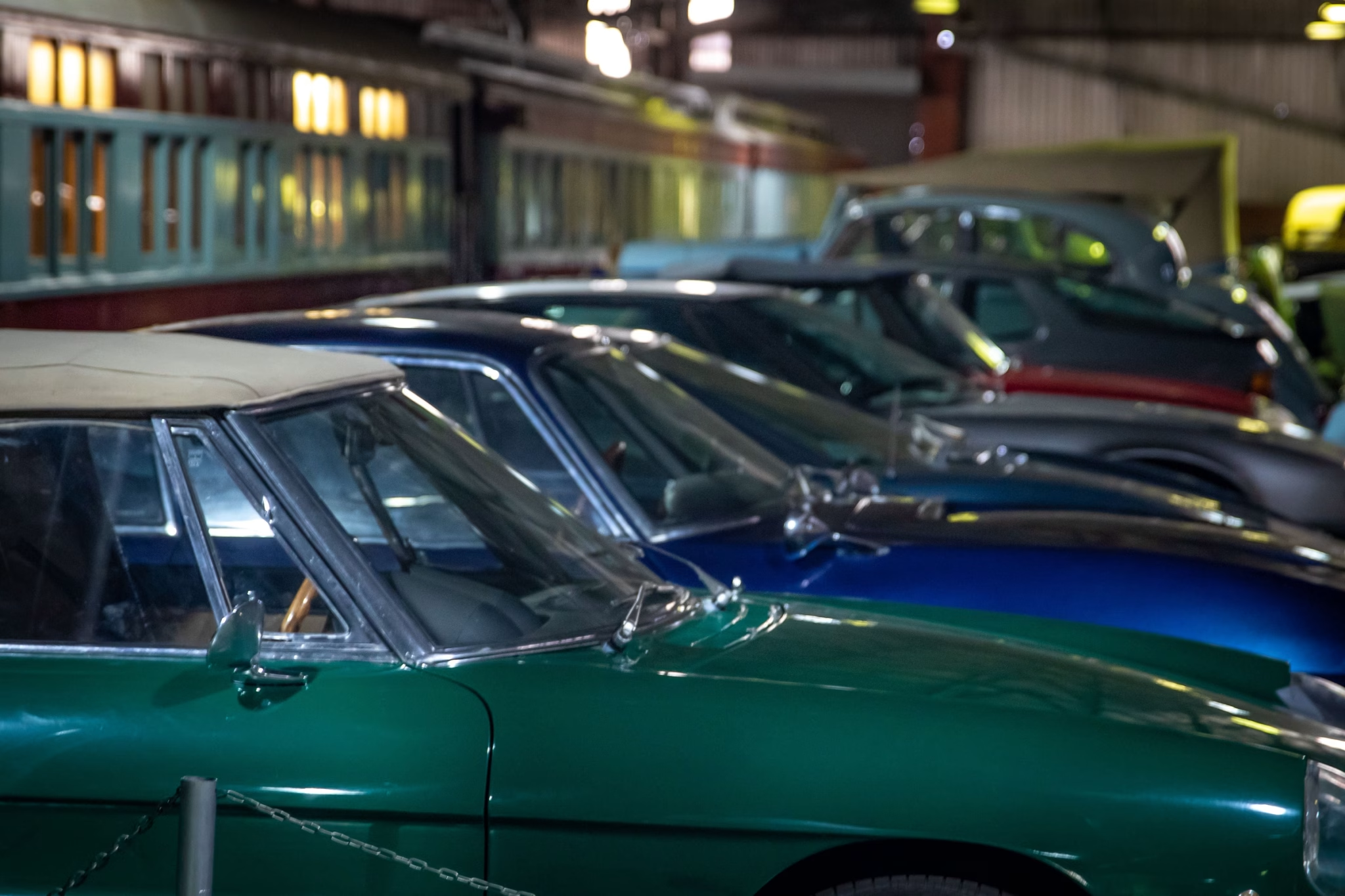
Walk the hall and Rita Hayworth’s 1956 Cadillac Eldorado turns up a short stroll from the General Motors EV1, the electric coupe a documentary once accused its own maker of killing. A DeLorean waits with its doors flipped up. Malcolm Forbes’s Lamborghini Countach throws its wedge shadow across the concrete. Somewhere nearby sits the Shelby Cobra replica that earned screen time in Ford v Ferrari.
Seventy-two thousand square feet of old warehouse hold about a century of the machines Americans actually drove. You can walk right up to nearly all of them.
The Montana banker who started it all
The museum opened on May 1, 1987, and it was not called the California Automobile Museum. It was the Towe Ford Museum, and every car in it wore a blue oval.
Edward Towe was a banker from Montana who had assembled something close to the impossible: an example of almost every car Ford ever built, from the spindly machines that predated the Model T all the way up to the Pinto.
By the mid-1980s the collection had outgrown its home in Deer Lodge, and Towe went looking for somewhere to keep it whole. Sacramento’s nonprofit California Vehicle Foundation, founded in 1983, took it on, and the Fords rolled west in 1986.
In 1997 the IRS placed a lien on Towe’s collection over a tax fight, and when no buyer stepped up to keep it together, the most complete run of Fords ever gathered went under the auctioneer’s hammer and scattered across the country.
The museum threw its doors open to every make and model, renamed itself the Towe Auto Museum, and in 2009 settled on the name it carries now.
What’s on the floor
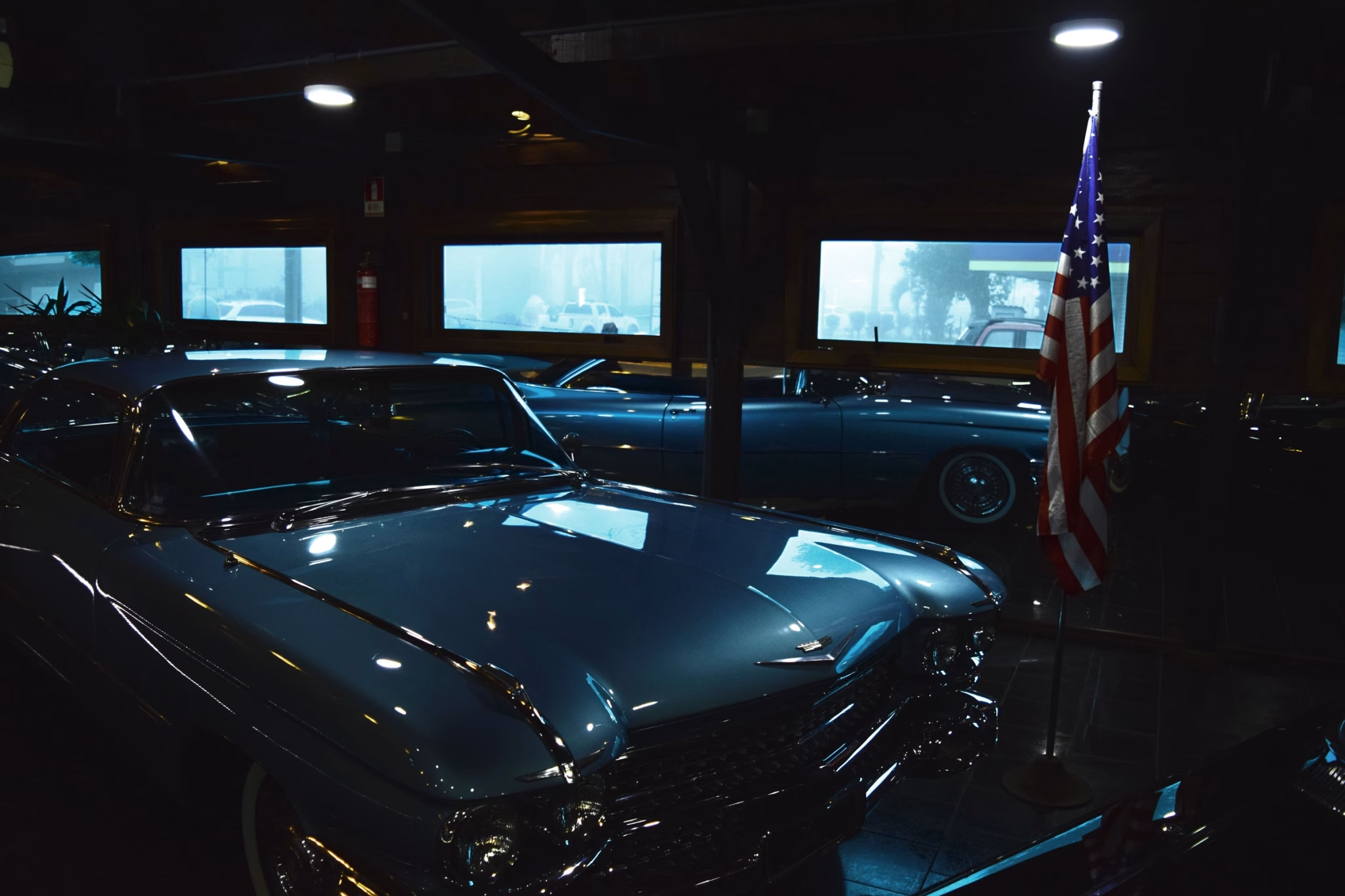
Start at the deep end of history. A replica of the 1886 Benz Patent-Motorwagen marks the moment the automobile stopped being an idea and started being a thing, and a copy of Henry Ford’s 1896 Quadricycle sits nearby looking like a bicycle that swallowed a lawnmower. A 1900 Locomobile shows how seriously people once took steam as the engine of the future.
The provenance corner reads like a scavenger hunt through American fame. There is a 1956 Cadillac Eldorado that belonged to Rita Hayworth and a 1982 Porsche 911 Targa once owned by Linda Ronstadt. Forbes’s scissor-doored Countach sits not far off, and a 1933 Lincoln here belonged to A.P. Giannini, the man who founded Bank of America.
The collection also holds a 1974 Plymouth Satellite that former governor Jerry Brown actually drove, which is about as Sacramento as a car gets, and the 1978 Kawasaki police motorcycle used in the filming of CHiPs.
The race cars claim their own stretch of concrete. A 1932 Miller ran the old Ascot dirt track. The Kurtis midget racers include one still wearing its Burgermeister beer livery, and a Douglas Offy turned laps at the Indianapolis 500.
There is a Ford that A.J. Foyt drove, and even a NASCAR stocker from the sport’s short-lived “Car of Tomorrow” experiment.
A 1963 Jaguar E-Type stands nearby, the car Enzo Ferrari supposedly called the most beautiful ever made. Shelby Cobras fill in around it, real and replica, including the one that earned its keep on a movie set.
The American corner holds a 1969 Mustang Boss 302 and a Camaro Z-28 with the cross-ram intake, along with a Firebird Trans Am that needs no introduction to anyone who ever watched Burt Reynolds outrun a sheriff.
Nearby, a bare Model T chassis and an assembly display show how Ford turned the car from a rich man’s toy into something a farmer could buy.
A themed space near the center changes every few months, running through subjects like a Route 66 tribute one season and something entirely different the next.
The electric wing nobody expects
Tucked into the collection is an exhibit called Alternative Propulsion.
The centerpiece is a 1997 General Motors EV1, the lease-only electric coupe that General Motors recalled and crushed, an act that launched a thousand arguments and one famous documentary. Around it sit the cars that came next: a Toyota RAV4 EV from 2003, the strange narrow-track Tango T600 that seats two people single file, an early Nissan LEAF, and a Honda Clarity that ran on hydrogen.
Read the room left to right and it becomes a timeline of how the state kept trying to electrify the road, decade after decade, long before anyone called it inevitable. I spend most of my weeks writing about that exact question over at The Weekly Driver, the car publication I run, and the museum’s electric wing plays like the opening chapter of the story I cover now.
Sunday Drives and the ride you can take
On the third Sunday of every month the staff fires up some of the running cars and takes visitors along for a ride. They call it Sunday Drives, and it comes free with admission. There is no sign-up sheet and no reservation. You show up, you wait your turn, and you climb into something like a 1943 Army Jeep or a 1951 Ford Crestliner for a loop around the neighborhood.
Heads up on the ride: Rain cancels Sunday Drives, because these cars are too good to soak. And a classic car has nowhere to anchor a modern child seat, so infants and toddlers who need one sit this part out.
A local car club takes over a rotating display every month in what the museum calls the Car Club Cavalcade, so the lineup gains a fresh personality on a regular schedule.
Cruises and community events fill the calendar through the year. And when the cars get pushed aside, the main hall turns into an event venue, which means somewhere in Sacramento there are wedding photos with a Model T in the background.
Admission, hours, and getting there
The museum sits on the Old Sacramento waterfront side of the freeway, with parking on site and more along the riverfront district.
It opens Wednesday through Monday, 10 a.m. to 5 p.m., with last admission at 4. It closes on Tuesdays. Hours tighten near the end of the year, with early closes on Christmas Eve and New Year’s Eve and full closures on the holidays themselves.
| Ticket | Price |
|---|---|
| Adult | $14 |
| Senior (65+) | $12 |
| Veteran or Student | $12 |
| Youth (6–17) | $8 |
| Child (5 & under) | Free |
Several programs cut the price further. Active military and up to five family members get in free through Blue Star Museums each summer. Households on SNAP or WIC pay five dollars a head through Museums For All. Bank of America cardholders get in free the first full weekend of every month.
Tickets are sold at the front desk the day of, the floor is wheelchair accessible, and the number for anything else is 916.442.6802.
Is it worth it
For fourteen dollars, this is one of the better afternoons in Sacramento.
The floor holds provenance and oddities that most regional museums cannot touch, and it traces the last hundred years through the machines people actually drove to work, to war, and to the drive-in.
There is no official figure for how long a visit takes. The collection sits in one large hall, so an hour to ninety minutes covers it at an unhurried pace, longer if you read every card and lose an afternoon in the electric wing.
Aim for a third Sunday if you can, take the ride, and let the rotating loaner cars hand you a reason to come back once the floor has quietly rearranged itself again.
It also slots neatly into a bigger Sacramento outing. Make it one stop among a roster of day trips from Sacramento, or pair the riverfront with a full day in Folsom a short drive up the American River.
Frequently Asked Questions
Where is the California Automobile Museum?
At 2200 Front Street, Sacramento, CA 95818, on the Old Sacramento riverfront beneath the Interstate 5 and 80 interchange, about two miles from downtown.
How much is admission?
Adults are $14, seniors 65 and older are $12, veterans and students are $12, youth ages 6 to 17 are $8, and children 5 and under are free.
What are the hours?
Wednesday through Monday, 10 a.m. to 5 p.m., with last admission at 4 p.m. The museum is closed on Tuesdays, and hours shorten around the winter holidays.
How many cars are on display?
Roughly 120 to 130 vehicles at any given time, spanning about 120 years. Because about half are on loan from private owners, the lineup changes throughout the year.
Can you ride in the cars?
Yes. The Sunday Drives program offers a free classic-car ride with paid admission on the third Sunday of every month, 10 a.m. to 2 p.m. No reservation is needed, rain cancels it, and the classic cars cannot fit modern child seats.
Is it good for kids?
Yes for most ages, with youth tickets at $8 and free entry under 6. Just note that infants and toddlers who need a car seat cannot take the Sunday Drives ride.
Is the museum wheelchair accessible?
Yes. The exhibit floor is wheelchair accessible, and service animals are welcome.
Is this the same as the Petersen museum?
No. The Petersen Automotive Museum is in Los Angeles. The California Automobile Museum is the Sacramento collection on Front Street, run by the nonprofit California Vehicle Foundation.
Do the special exhibits cost extra?
No. Rotating and special exhibits are included with general admission.
Can you rent the museum for events?
Yes. The main hall is available for weddings, banquets, and corporate events, with rates that vary by day of the week.
Article Updates
- July 4, 2026: Initial publication. Verified current admission prices, hours, and the Sunday Drives schedule against the museum’s official information.


