
A super bloom is what California ecologists call an unusually intense wildflower display in arid or semi-arid regions, triggered when seeds that have stayed dormant in soil seed banks for years germinate together after the right combination of winter rain and cool spring weather.
There is no single agreed-upon scientific threshold. UC Riverside and UC Davis ecologists treat a super bloom as a season in which native annuals cover wide expanses of ground in continuous color, well beyond what a typical year produces.
What follows covers the three conditions super blooms require, how they’re officially confirmed, why they’re getting rarer, and where the 2026 super bloom is happening: Carrizo Plain National Monument, NASA Earth Observatory-confirmed via Landsat 8 and 9 satellite imagery from March 5 and March 13, 2026.
The piece also covers the difference between a super bloom and a regular wildflower season, the species mix in chaparral versus desert versus grassland super blooms, and the recent California super bloom history from 1998 through 2026.
Two things to set straight before we go further. Super blooms are not annual events. They are not a phenomenon you can plan a trip around in advance. Knowing the science of what triggers them is the difference between catching one and missing one by three weeks.
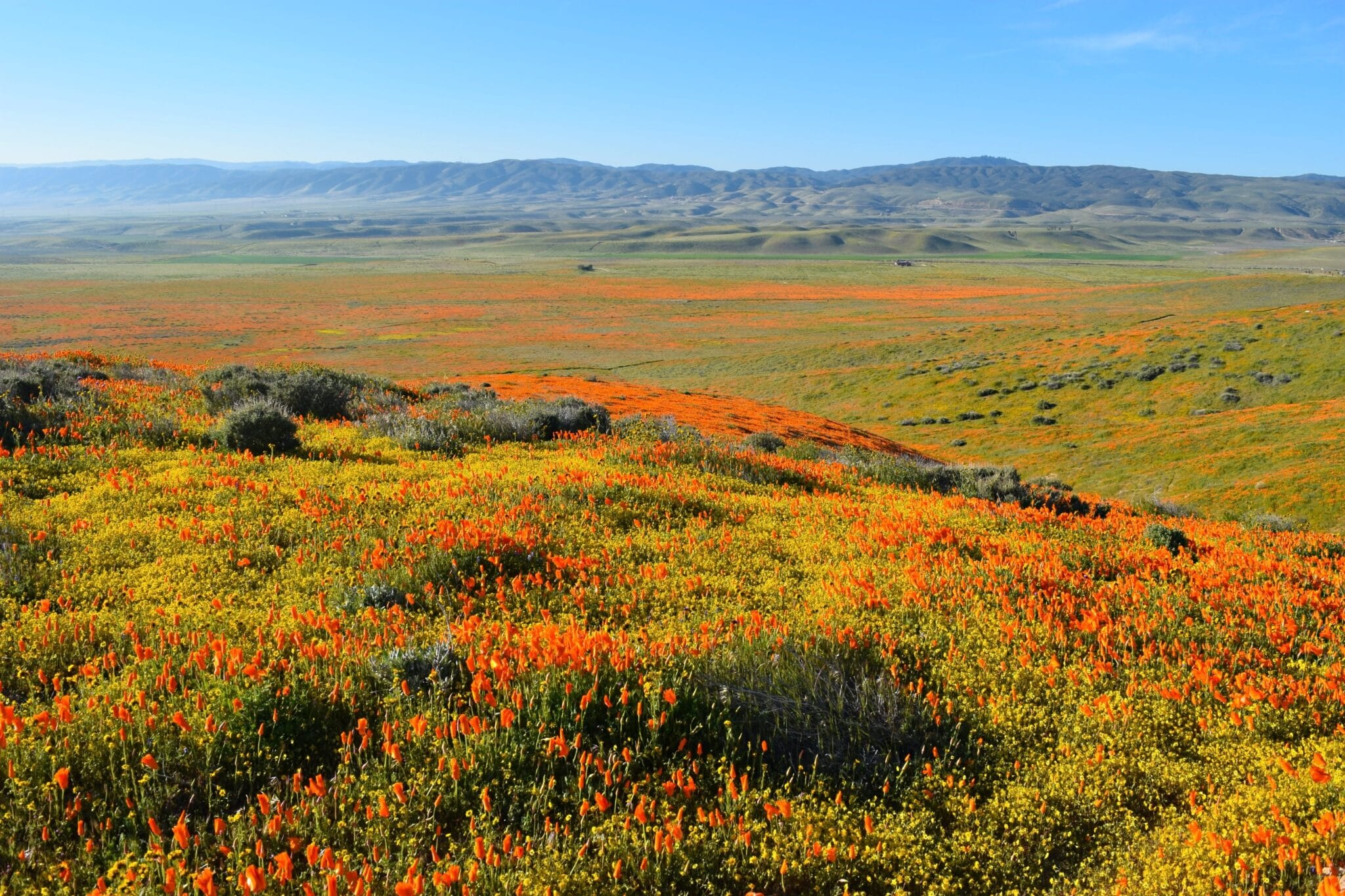
Key Takeaways
- Definition. A super bloom is an unusually intense wildflower display in arid or semi-arid regions, occurring when seeds dormant in soil seed banks germinate at scale after above-average winter rainfall.
- Three conditions required. Adequate rainfall (NPS Joshua Tree threshold: at least 0.5 inches in a single event); cool weather post-germination (UC Davis ecologists: ~6 weeks); viable seed bank from prior years.
- 2019 Joshua Tree benchmark. Required 8.25 inches of fall and winter precipitation, 229% of average. The most well-documented recent SoCal super bloom.
- 2026 confirmed location. Carrizo Plain National Monument, NASA Earth Observatory imagery via Landsat 8 and 9 on March 5 and March 13, 2026, with field confirmation March 7 and March 14. Yoseline Angel of NASA Goddard described the bloom as “stunning” from the ground.
- 2026 outliers. Antelope Valley CPR did not reach super bloom status; Anza-Borrego had a strong early bloom that ended early under heat; Death Valley window has closed; Joshua Tree did not super bloom.
- Why super blooms are getting rarer. Rising temperatures shorten the cool-weather germination window, drought reduces single-event 0.5-inch rainfall events, and earlier spring heat ends blooms before peak. The NPS calls super blooms “increasingly infrequent” at Joshua Tree.
- Recent super bloom years. 2017, 2019, 2023, 2026 (CA chaparral / Mojave / grassland sites). Death Valley most recent super bloom: 2016.
- How they’re officially confirmed. NASA Earth Observatory satellite imagery (Landsat 8/9), California Native Plant Society field botanist verification, BLM or NPS land-manager statements. No single legal definition exists.
What Is a Super Bloom?
A super bloom is a rare, large-scale wildflower display in arid or semi-arid regions of California, triggered when seeds that have stayed dormant in soil seed banks for years germinate together after the right combination of winter rainfall and post-germination cool weather. There is no single agreed-upon scientific threshold. Ecologists at UC Riverside and UC Davis treat a super bloom as a season in which native annual wildflowers cover wide expanses of ground, often in continuous color, well beyond what a typical year produces. NASA confirmed the 2026 Carrizo Plain bloom as a super bloom from satellite imagery in March 2026; Yoseline Angel of NASA Goddard called the visible scale “stunning” from the ground.
That paragraph is the working definition. The next section covers the three conditions that produce one.
What Causes a Super Bloom? The Three Conditions
Three conditions have to align. Joshua Tree National Park’s official guidance, anchored to decades of post-fire and post-rain bloom monitoring, is that wildflower seeds need at least half an inch of rain in a single event to germinate. Beyond rainfall, ecologists at UC Davis point to roughly six weeks of cool weather after germination as the bloom’s make-or-break window. Heat at the wrong time forces plants into abbreviated displays that fizzle in days. Frequent spring windstorms can desiccate emerging buds before they ever open. The third condition is dormancy. Native desert and chaparral annuals stay viable in the seed bank for years, sometimes decades, waiting for the right pulse of rain.
Get any one of those three wrong and you don’t get a super bloom. Get all three right and you get the satellite-visible orange-and-yellow events that send NASA scientists out to fieldwork sites with cameras.
Condition 1: Adequate winter rainfall
NPS Joshua Tree’s published threshold is the cleanest number to anchor on: at least 0.5 inches of rain in a single event is the minimum for native wildflower seed germination.
The 2019 Joshua Tree super bloom followed 8.25 inches of fall and winter precipitation, 229% of average, distributed across multiple storms. That is the published documented benchmark for what a super bloom year of rainfall looks like in the Mojave.
Rainfall distribution matters as much as total volume. Well-distributed rain across November through February allows successive cohorts of seeds to germinate at staggered times.
A single deluge in December followed by a dry January-February-March often produces a partial bloom that fizzles when soil moisture runs out. Atmospheric river events in California historically deliver this distributed precipitation; their absence is one of the structural reasons super blooms have become less reliable.
The 2026 water year is a textbook example of partial-conditions producing partial results. California began the 2026 water year on October 1, 2025 with reservoirs at 122% of average, boosted by three previous years of above-average snowpack. Late January went warm and dry. February delivered storms that briefly pushed snowpack to 66% of average. March 2026 was the driest March in California since recordkeeping began in 1895, with statewide precipitation totaling just 0.19 inches, 3.02 inches below normal. The April 1, 2026 statewide snowpack came in at 18% of average, the second-lowest April reading on record (only 2015 was lower). Northern Sierra: 6%.
Karla Nemeth, Director of the California Department of Water Resources, described the April 2026 conditions as the dry-tail signature on what had looked like a wet-winter year through January. The bloom outcome split accordingly. Carrizo Plain, sitting in the right elevation band with sufficient February-March soil moisture and cool-weather aspects, super-bloomed. Most of the state did not.
Condition 2: Six weeks of cool weather post-germination
UC Davis ecologists describe the window between seedling emergence and full flower as the bloom’s make-or-break period. Roughly six weeks of cool weather after germination is the threshold. Heat at the wrong time, especially in February or early March, forces plants into abbreviated displays that fizzle in days. Frequent spring windstorms desiccate emerging buds before they open.
This is where 2026 broke. Many California regions got rain, with Anza-Borrego receiving well-above-average winter precipitation, and Antelope Valley CPR was tracking toward super bloom in February.
Then March arrived hot and dry. April heat compressed the bloom window across the southern deserts and chaparral, ending the season weeks early.
NASA’s Earth Observatory documented Carrizo Plain because Carrizo’s grassland aspect and elevation insulated it from the worst of the heat compression. Other sites that had germinated successfully in February could not finish their bloom cycle.
Photographically: a super bloom needs cool sunny days for the petals to open. California poppy and most native annuals close their petals in cold or windy weather and at night.
A reader who arrives at peak germination but during a cold front will see closed buds. Mid-morning to mid-afternoon, sunny, calm, warm-but-not-hot is the open-petal window. Six weeks of those conditions in March-April is what produces the satellite-visible super bloom.
Condition 3: Viable seed bank from prior years
California native annuals deposit seeds in the soil that remain viable for years, sometimes decades. The seed bank is what makes super blooms possible. A site can rest dormant for a decade and then explode into bloom the year conditions align.
That seed bank also explains why super blooms cluster geographically. Slopes with deep historical seed banks (Walker Canyon, Antelope Valley, Carrizo Plain, Mt. George Napa, Death Valley alluvial fans) produce the visible super bloom events. Adjacent slopes with thinner seed banks may bloom moderately in the same season.
Documented multi-decade seed-bank persistence is well-established for California fire-following species. Mt. Diablo’s Papaver californicum (fire poppy) bloomed after the 1977 fire and again after the 2020 SCU Lightning Complex, a 43-year gap. Mt. George had fire poppy blooms after the 1964 fire and the 2017 Atlas Fire, a 53-year gap.
California poppy (Eschscholzia californica), the headline super bloom species, persists in seed banks for shorter intervals (typically 5-15 years between bloom cycles on any given slope) but the structural mechanism is the same.
One subtlety worth noting. Repeated drought years can deplete seed banks if existing flowering plants don’t get to set seed. A super bloom year produces seed that returns to the bank for the next cycle; a near-miss year that germinates without finishing flowering depletes the bank without replenishing it. This is one of the long-term concerns with climate-driven super-bloom decline: not just fewer trigger events, but possible seed-bank attrition on slopes that used to produce reliable displays.
How Are Super Blooms Officially Confirmed?
Super blooms have no single legal or regulatory definition. Confirmation in 2026 comes from a combination of three sources.
First, NASA Earth Observatory satellite imagery from the Landsat 8 and Landsat 9 missions captures wide-area land-surface reflectance changes. NASA scientists from Goddard Space Flight Center document confirmed sites with paired before-and-after imagery and field-visit verification.
2026 Carrizo Plain was confirmed via Landsat 8 and 9 imagery captured March 5 and March 13, 2026, with field confirmation on March 7 and March 14.
Second, the California Native Plant Society field-botanist team verifies bloom species mix and density on the ground. Bryce King, lead field botanist at CNPS, described the 2026 Carrizo bloom as “seemingly unending stretches of color” across the valley bottom and the Temblor Range. CNPS field botanists are the authority that distinguishes a super bloom from a strong-but-typical bloom year on the basis of species coverage and continuous-color extent.
Third, land managers issue official statements. The Bureau of Land Management described Carrizo Plain as “in full bloom” in March 2026. Monument Manager Johna Hurl reported in February that the bloom had emerged with yellows and splashes of orange, with more sprouting every day.
State Parks (for sites like Antelope Valley California Poppy Reserve and Anza-Borrego Desert State Park) and the National Park Service (for Death Valley and Joshua Tree) issue similar statements when their managed lands reach super bloom status.
The Theodore Payne Wildflower Hotline, operated by the Theodore Payne Foundation, is the practical week-by-week tracker. Phone (818) 768-1802 ext. 7. Tom Henschel narrates the weekly Friday updates from March through May. The Hotline launched in 1983; the Foundation that operates it was founded in 1960.
Hotline reports name sites, trails, and current conditions in real time. For 2026, the hotline reported common goldfields, hillside daisies (Monolopia lanceolata), purple Phacelia ciliata, and forked fiddlenecks across the Temblor Range as of mid-March.
Are Super Blooms Getting Rarer?
Yes. The National Park Service notes super blooms are “increasingly infrequent” at Joshua Tree. The basic math is straightforward.
Rising temperatures shorten the cool-weather germination window. Drought reduces the 0.5-inch rainfall events needed to wake the seed bank. Earlier spring heat brings blooms to a close before they peak.
2026 demonstrates this exactly. Many regions got rain. The 2026 water year began with reservoirs at 122% of average. Then March arrived hot and dry, snowpack collapsed by 24% in a single month, and what should have been peak bloom across the southern deserts ended weeks early.
Climate-change projections from peer-reviewed phenology research published in journals including Biological Reviews and ScienceDirect’s environmental sciences index suggest that super bloom frequency on California’s chaparral and Mojave sites will continue to decline as drought becomes more frequent and spring heat events arrive earlier.
Wet-year super blooms remain possible. They will be rarer than the 2017-2019-2023 cluster suggested, and the post-2023 gap to 2026 is consistent with that projection.
One countervailing pattern. Fire-following super blooms, driven by fire-cued germination of Papaver californicum, whispering bells, golden eardrops, and other smoke-cued species, may continue or even increase if California’s megafire frequency stays high.
Fire and rainfall interact in the seed-bank biology of fire followers in ways that don’t apply to non-obligate species like California poppy. The Eaton-Palisades fire follower bloom of 2026 is partly a function of the January 2025 fire-and-rain coincidence rather than the broader super bloom rainfall pattern.
Recent California Super Bloom Years
The most recent NASA-, CNPS-, or NPS-confirmed California super bloom years, with their primary sites:
- 2026: Carrizo Plain National Monument (NASA Earth Observatory confirmed via Landsat 8 and 9, March 5 and March 13). The only confirmed 2026 super bloom in California. The first NASA-documented super bloom of the post-2023 cycle. Antelope Valley, Anza-Borrego, Death Valley, and Joshua Tree did not super-bloom in 2026.
- 2023: Multiple sites including Carrizo Plain, Anza-Borrego Desert State Park, and Antelope Valley California Poppy Reserve. Followed an unusually wet winter; broadly considered the strongest multi-site super bloom of the 2020s.
- 2019: Walker Canyon (Lake Elsinore, now closed), Joshua Tree National Park (8.25 inches fall-winter precipitation, 229% of average), Carrizo Plain. Generated the #PoppyApocalypse social-media cycle that culminated in the closure of Walker Canyon to wildflower visitors.
- 2017: Carrizo Plain, Anza-Borrego, Antelope Valley CPR. The first major super bloom of the Instagram era; established the geotag template that 2019 amplified.
- 2016: Death Valley super bloom. Drew over 209,000 visitors; documented traffic jams and ecosystem damage. Death Valley’s most recent super bloom.
- 1998: A widely-documented multi-region El Niño-driven super bloom. Predates social media; the bloom drew local news coverage but not viral national attention.
Earlier than 1998, super blooms were generally not officially documented under the modern terminology. Local press in 2005, 1992, 1983, and 1969 reported notable wildflower seasons that today’s ecologists would likely call super blooms.
Super Bloom vs. Regular Wildflower Season
The line between a super bloom and a strong-but-typical wildflower season is not sharp.
CNPS field botanists draw the distinction by continuous-color extent and species coverage. A regular wildflower season produces a mosaic of bloom and non-bloom areas across a site. A super bloom produces continuous color across miles of valley floor, hillside, or alluvial fan, with multiple species simultaneously at peak.
NASA Earth Observatory’s threshold is more pragmatic. If the bloom is visible from Landsat orbit (550 km altitude, 30-meter resolution per pixel), it qualifies for satellite documentation. That is the operational test for “super bloom” in 2026.
What this means for visit planning: a 2026 trip to Antelope Valley CPR was not a wasted trip. The reserve had a meaningful bloom that ended early. It was not a super bloom. The Theodore Payne Hotline reports the same thing in different words every year for sites that produced strong blooms without crossing into super bloom territory. Calibrate expectations accordingly.
Where to See California Super Blooms
Super blooms cluster on five California regional ecologies. Each has different timing, species mix, and access infrastructure.
- Carrizo Plain National Monument (San Luis Obispo and Kern Counties). Native grassland with hillside daisies, goldfields, phacelia, fiddlenecks. The 2026 confirmed super bloom. Manager: Bureau of Land Management. Drive time from LA: ~3.5 hours.
- Antelope Valley California Poppy Reserve (Lancaster, western Mojave). Eight miles of paved-and-dirt trails on chaparral-grassland transition, dominated by California poppy. Manager: California State Parks. $10 vehicle fee. Drive time from LA: ~2 hours.
- Anza-Borrego Desert State Park (San Diego County). Sonoran and Colorado Desert annuals on alluvial fans: desert sand verbena, dune primrose, ocotillo, brittlebush. Manager: California State Parks. Drive time from LA: ~2.5 hours.
- Death Valley National Park (Inyo and San Bernardino Counties). Mojave Desert annuals on broad alluvial fans and dune systems. Less frequent super bloom cycle (2016 was most recent). Manager: NPS. Drive time from LA: ~4.5 hours.
- Joshua Tree National Park (Riverside and San Bernardino Counties). Mojave-Colorado Desert transition. Bloom timing strictly tied to elevation. Last super bloom: 2019. Manager: NPS. Drive time from LA: ~2 hours.
For current 2026-season status across all five sites plus Walker Canyon (closed) and Lake Manly (Death Valley’s reflooded basin), see our California super bloom and wildflower guide, updated through the bloom season.
Can Fires Cause Super Blooms?
Yes, but a different kind. Fire-following super blooms occur on chaparral burned by wildfire, when smoke-cued seeds germinate at scale in the first one to three springs after the fire. The biology is different from rainfall-driven super blooms.
The chemical signal is karrikinolide (KAR1), a butenolide molecule that forms when cellulose burns. Soil-banked seeds of fire-following species detect KAR1 at concentrations as low as 1 part per billion. The species responds to that signal at the molecular level via the KAI2 receptor, then proceeds through the standard germination pathway with cool weather and rainfall.
The headline fire-follower species is the California fire poppy (Papaver californicum), distinct from the California poppy that produces classical super blooms.
Fire poppies appear only after fire, persist for one to three seasons, then disappear back into the seed bank for decades until the next fire. Documented multi-decade gaps include Mt. Diablo (1977 fire to 2020 SCU Lightning Complex, 43 years) and Mt. George Napa (1964 fire to 2017 Atlas Fire, 53 years).
Spring 2026 is producing fire-follower blooms across the Eaton and Palisades fire footprints (Los Angeles County, January 2025), reported in National Geographic‘s May 7, 2026 feature by Dana Goodyear. We have a full deep-dive on the fire poppy at The California Fire Poppy: Rare to See, Not Rare in the Bank and a broader treatment of the fire-follower guild at California Fire Followers.
Frequently Asked Questions
What is a super bloom?
A super bloom is a rare, large-scale wildflower display in arid or semi-arid regions of California, triggered when seeds dormant in soil seed banks germinate together after the right combination of winter rainfall and post-germination cool weather. There is no single agreed scientific threshold; ecologists treat a super bloom as a season when native annuals cover wide expanses of ground in continuous color, well beyond a typical year. NASA confirmed the 2026 Carrizo Plain bloom from satellite imagery in March.
What causes a super bloom?
Three conditions have to align. Adequate winter rainfall (NPS Joshua Tree threshold: at least 0.5 inches in a single event); roughly six weeks of cool weather after germination (UC Davis ecologists’ window); and a viable seed bank from prior years. Heat at the wrong time forces plants into abbreviated blooms. Spring windstorms can desiccate emerging buds before they open.
How long does a super bloom last?
Two to six weeks at peak, with bloom emergence and fade extending the visible window. Heat events can compress the peak window to days. Cool spring weather can extend it to most of two months. The 2026 Carrizo Plain bloom was visible from late February through April; NASA Earth Observatory documented imagery March 5 and March 13. Theodore Payne’s Wildflower Hotline tracks weekly conditions during the typical March-May window.
When was the last super bloom in California?
Carrizo Plain National Monument in 2026, NASA-confirmed via Landsat 8 and 9 satellite imagery on March 5 and March 13, 2026. Before 2026, the most recent multi-site super bloom was 2023 (Carrizo Plain, Anza-Borrego, Antelope Valley CPR). The 2019 Walker Canyon-Joshua Tree-Carrizo bloom was the most viral, generating the #PoppyApocalypse social-media cycle. Death Valley’s most recent super bloom was 2016.
Where can I see a super bloom in California?
Five regional ecologies cluster super blooms: Carrizo Plain National Monument (BLM-managed grassland), Antelope Valley California Poppy Reserve (State Parks, $10 vehicle), Anza-Borrego Desert State Park (Colorado Desert), Death Valley National Park (Mojave Desert, less frequent), and Joshua Tree National Park (Mojave-Colorado transition). Walker Canyon at Lake Elsinore is closed since 2023. For current 2026-season conditions, check the Theodore Payne Wildflower Hotline or our California super bloom guide.
Are super blooms getting rarer?
Yes. The National Park Service notes super blooms are “increasingly infrequent” at Joshua Tree. Rising temperatures shorten the cool-weather germination window, drought reduces single-event 0.5-inch rainfall events, and earlier spring heat ends blooms before peak. The 2026 season is a textbook case: the water year began with reservoirs at 122% of average, then March 2026 became the driest March since 1895, and snowpack collapsed by 24% in a single month.
How is a super bloom officially confirmed?
Three sources. NASA Earth Observatory satellite imagery (Landsat 8 and 9 missions) captures wide-area land-surface reflectance changes; NASA Goddard scientists field-verify confirmed sites. The California Native Plant Society field-botanist team verifies bloom species mix and density. Land managers (BLM, State Parks, NPS) issue official statements when managed lands reach super bloom status. The Theodore Payne Wildflower Hotline (818-768-1802) is the practical week-by-week tracker.
What’s the difference between a super bloom and a regular wildflower season?
CNPS field botanists draw the line by continuous-color extent and species coverage. A regular season produces a mosaic of bloom and non-bloom areas; a super bloom produces continuous color across miles of valley floor, hillside, or alluvial fan with multiple species simultaneously at peak. NASA’s pragmatic threshold: if the bloom is visible from Landsat orbit (30-meter pixel resolution from 550 km altitude), it qualifies as super bloom for satellite documentation.
Is the 2026 super bloom prediction accurate?
NASA Earth Observatory and CNPS field botanists confirmed the 2026 Carrizo Plain super bloom in March 2026. Predictions for other California sites (Antelope Valley, Anza-Borrego, Death Valley, Joshua Tree) did not pan out in 2026 due to the driest March on record and a 24% single-month snowpack collapse. UC Riverside ecologist Loralee Larios characterized the 2025-2026 winter as “a few episodes of major rainfall but otherwise rather dry,” producing the unusually early, partial-bloom season that closed weeks ahead of typical timing.
Can fires cause super blooms?
Yes, but a different kind. Fire-following super blooms on chaparral burn scars are triggered by smoke-derived karrikinolide (KAR1) molecules, not rainfall alone. Fire poppy (Papaver californicum) is the headline fire-following species, distinct from the California poppy that produces classical super blooms. Documented multi-decade fire-follower seed-bank persistence: Mt. Diablo 43-year gap (1977 to 2020), Mt. George 53-year gap (1964 to 2017). The 2026 Eaton-Palisades fire-follower bloom is producing fire poppies across LA County chaparral burned in January 2025.
Which California regions have super blooms?
Five regional ecologies: chaparral-grassland transitions (Antelope Valley CPR, Walker Canyon, San Joaquin foothills), Mojave Desert annuals (Death Valley, Joshua Tree, Antelope Valley fringe), Colorado Desert annuals (Anza-Borrego, Coyote Canyon), San Joaquin grassland (Carrizo Plain Temblor Range), and post-fire chaparral (Mt. Diablo, Mt. George Napa, Santa Monica Mountains, Eaton-Palisades 2026 footprints). Each has different species mix, timing, and trigger mechanisms.
Does rain alone cause a super bloom?
No. Rain alone is insufficient. A super bloom requires well-distributed rainfall over months (not in a single dump), at least six weeks of cool temperatures after germination, calm conditions free of desiccating spring windstorms, and a viable seed bank from prior years. The 2026 season is a textbook case of partial conditions producing partial results. California started with reservoirs at 122% of average, then March arrived as the driest March on record, snowpack collapsed, and bloom across most of the state ended weeks early.
Related Coverage
This article is the definitional explainer for the broader MK Library super bloom and California native flora cluster. Companion deep-dives:
- California super bloom & wildflower guide. Year-by-year hub for super bloom forecasting, regional bloom maps, peak-timing calendars, and current-season status across all five regional ecologies. Includes the 2026 Carrizo Plain confirmation per NASA Earth Observatory.
- The California fire poppy: rare to see, not rare in the bank. Deep-dive on Papaver californicum, California’s only obligate smoke-cued poppy. Different ecology and bloom mechanics from the rainfall-driven California poppy super bloom.
- California fire followers. Parent guide to all fire-cued and fire-enhanced California natives, including whispering bells, golden eardrops, and the broader smoke-cued guild.
- Walker Canyon poppy fields: the 2026 closure-aware guide. The closed canyon, the 2019 #PoppyApocalypse, the death of CHP Sgt. Steve Licon, and where to go instead in 2026.
- Anza-Borrego wildflowers. Sonoran and Colorado Desert wildflower deep-dive on a different ecology than chaparral hillsides.
- California native plants for hummingbirds. Year-round-bloom California-native garden guide for readers who want the bloom at home.
Affiliate Disclosure: Some links in this article are affiliate links. If you purchase through them, MK Library earns a small commission at no extra cost to you. The Amazon links use the mklibrary-20 tag. We recommend products only when they fit the article’s editorial purpose.
Article Updates
May 8, 2026: First publication. Built on the broader “super bloom” SEMrush keyword cluster (1,900 vol US, KD 19% Easy, AI Overview + Things to know + Image pack + Video carousel SERP features). Anchored to NASA Earth Observatory’s confirmation of the 2026 Carrizo Plain super bloom (Landsat 8 and 9 imagery March 5 and March 13, 2026, with field confirmation March 7 and 14), the National Park Service Joshua Tree wildflower-germination 0.5-inch rainfall threshold, UC Davis ecologists’ six-week cool-weather post-germination window, the 2019 Joshua Tree super bloom 8.25-inch precipitation benchmark (229% of average), the California Department of Water Resources April 2026 conditions report (driest March since 1895, April 1 statewide snowpack at 18% of average, second-lowest in CA history), Karla Nemeth’s quoted assessment, the California Native Plant Society field-botanist confirmation methodology (Bryce King quote on “seemingly unending stretches of color”), the Theodore Payne Foundation Wildflower Hotline 1983-founded weekly-update tradition, and the documented California super bloom history (1998, 2017, 2019, 2023, 2026 plus Death Valley 2016). 12-question FAQ section with FAQPage JSON-LD schema for AI Overview / Things to know capture. Bidirectional internal linking to the California Super Bloom hub plus all five companion spokes (Fire Poppy, Fire Followers, Walker Canyon, Anza-Borrego, Hummingbird Plants).


