New Bullards Bar Reservoir is a 16-mile-long lake, an emerald paradise nestled in Northern California’s Sierra Nevada foothills, with recreation opportunities from paddleboarding on crystalline waters to exploring hidden waterfalls accessible only by boat. With its stunning turquoise waters, extensive trail network, and secluded boat-in camping options, this reservoir delivers an adventure experience you don’t want to miss out on.
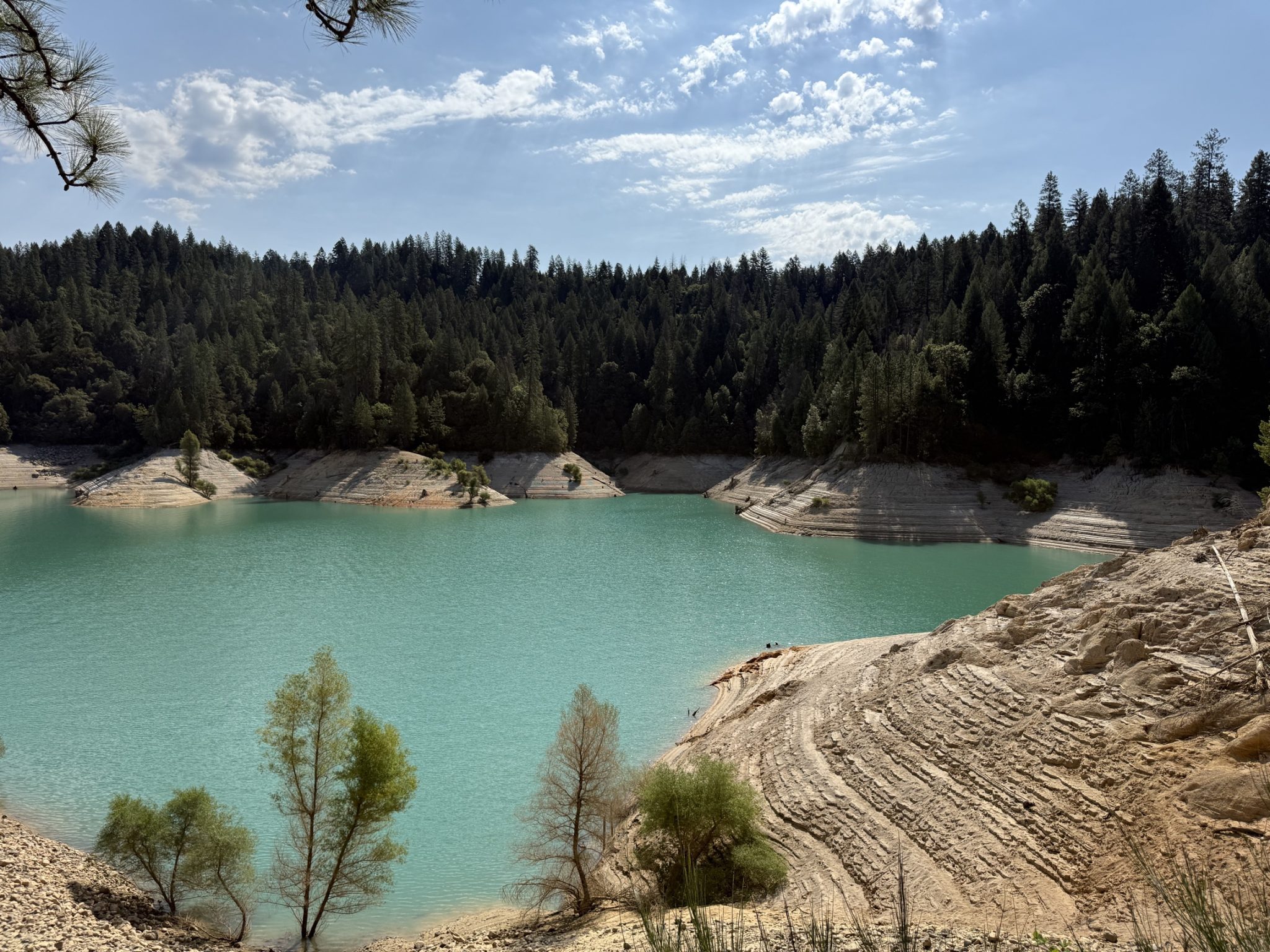
Table of Contents
- How to Get There
- Parking and Hours
- Paddleboarding and Kayaking
- Motorized Boats and Water Sports
- Bridger Falls
- Deadwood Falls
- Lake Conditions: Temperature, Wind, and Water Quality
- Hiking Adventures
- Camping Options
- Reservoir History
- The Science Behind The Reservoir’s Colors
- More California Lakes To Explore
Helpful Links:
- CA State Parks Website
- Yuba Water Agency Website
- Houseboat Rentals
- CA State Harmful Water Reports
- Paddle Boarding Accessories
- Sunscreen
- Coolers
How to Get There
Primary Access Routes
New Bullards Bar Reservoir sits approximately 45 minutes east of Marysville on Marysville Road, nestled in the Sierra Nevada foothills.
The reservoir offers multiple access points depending on your planned activities.
From Marysville/Yuba City Area:
Take Highway 20 towards Grass Valley, then turn left onto Marysville Road at the Chevron station. Follow Marysville Road and the signs to Dobbins/Bullards Bar Reservoir.
Turn right at the Willow Glen Restaurant to stay on Marysville Road. Continue for 14 miles to reach the dam area.
From Nevada City:
Take Highway 49 north from Nevada City through North San Juan into the Tahoe National Forest. Make a left turn onto Marysville Road at the U.S. Forest Service Ranger Station.
Continue south on Marysville Road for approximately 8 miles, crossing over the Bullards Bar Dam to reach Emerald Cove Marina.
Distance from Major Cities:
- Sacramento: Approximately 90 minutes northeast
- Reno: 2 hours west via Nevada City
- San Francisco Bay Area: 2.5 hours northeast
Parking and Hours
Boat Launch Hours and Access
The reservoir operates with specific hours designed to accommodate both recreation and mandatory watercraft screening requirements.
Boat launches operate daily from 6 a.m. to 9 p.m.. All motorized vessels must undergo mandatory watercraft screening before launch, a free process taking approximately five minutes.
Cottage Creek/Emerald Cove Marina
- Location: 12571 Marysville Road, Dobbins
- Approximately 200 parking spaces
- Located about 500 yards from high water line on boat ramp
- Full service marina with fuel, convenience store, boat rentals
Dark Day Boat Launch
- Location: Dark Day Rd, Camptonville, CA 95922
- Concrete boat ramp with adjacent day-use area
- 14 picnic sites available
- Restroom facilities and parking
- Best for paddle boarding and kayaking
Seasonal Considerations
Campground facilities typically open April 15 and close October 15 each year.
The reservoir experiences significant water level fluctuations: from June 1 to September 30, water levels may fluctuate up to 1.5 feet per 24 hours, while extreme fluctuations can occur between October 1 and May 31.
Paddleboarding and Kayaking

Water Conditions for Stand-Up Paddleboarding
New Bullards Bar Reservoir provides exceptional paddleboarding conditions, particularly during early morning hours when waters remain calm.
The reservoir’s stunning emerald and turquoise waters create a tropical-like experience surrounded by Sierra Nevada mountain scenery.
Optimal Paddling Times
Spring paddling from Dark Day Boat Launch offers the most favorable conditions, with calm waters and crisp mountain air.
Early morning launches provide glassy water conditions before afternoon winds develop. Summer wind forecasts show typical patterns of 4-8 knots, with stronger afternoon winds of 8-12 knots.
Paddling Distances and Routes
The reservoir’s 16-mile length and 55-60 miles of shoreline provide extensive paddling opportunities. With routes stretching up to 10 miles, a touring board built for distance makes a real difference out here. Venture Wild builds inflatable touring and race boards designed for exactly this kind of open-water mileage (use code THEMK for 10% off). Popular routes include:
- Dark Day to North Fork River inlet: 4-6 miles of scenic paddling through narrow arms
- Cottage Creek to Vista Point: 8-10 miles along the main body
- Garden Point exploration: 1-3 mile paddles from boat-in campsites
Distances and Key Features at New Bullards Bar Reservoir
• Dark Day to Garden Point Campground: 1 mile by boat – Boat-in campground access
• Cottage Creek/Emerald Cove to Garden Point: 3 miles by boat – Alternative launch point
• Dark Day to Dark Day Picnic Area: Walking distance – Day use area near campground
• Dark Day to Cottage Creek/Emerald Cove: 3-5 miles by boat – Between main boat launches
• Total Reservoir Length: 16 miles – North-south length of reservoir
• Total Shoreline: 55-60 miles – Total accessible shoreline
• Bullards Bar Trail Length: 14 miles – Main hiking trail around reservoir
• 8 Ball Trail Length: 3.8 miles – Forest trail with loop options
• Rebel Ridge Trail Length: 1.6 miles – Moderate descent trail
• 7 Ball Trail Length: 1.0 mile – Short steep connector
• Schoolhouse Trail Length: 0.7 mile – Quick descent from campground
Safety and Conditions
Paddleboarders should be aware of the reservoir’s steep shorelines, which limit access points around much of the water body.
Water levels can fluctuate significantly, particularly during spring snowmelt periods. The reservoir depth averages 250-300 feet, with maximum depth reaching 763 feet at the dam.
Motorized Boats and Water Sports
From the perspctive of a paddle boarder, operators of motorize boats around the lake were polite and gave wide berth. This was a great experience to be around.
Boating Regulations and Speed Zones
New Bullards Bar Reservoir operates under specific boating regulations designed to ensure safety and environmental protection.
The maximum speed limit is 20 mph between sunset and sunrise, while daytime speeds may be higher in designated areas.
Speed Restrictions:
- 5 mph or flat wake within 100 feet of the dam and designated houseboat mooring areas
- 5 mph within 200 feet of boat landing areas and shoreline
- No wake zones around marina and camping areas
- All boats must maintain safe speeds regardless of posted limits
Mandatory Watercraft Screening
All motorized vessels must undergo screening before launch at both Cottage Creek and Dark Day boat launches.
This free program operates daily from 6 a.m. to dusk on a first-come, first-served basis. Screening checks for visible mussels, aquatic vegetation, excessive standing water, and recent use in infested waters.
Preparation Requirements:
- Clean all aquatic plants, mud, and debris from watercraft and equipment
- Remove all drain plugs and drain bilge, live wells, and ballast tanks
- Dry all water-collecting areas including hull and compartments
Water Sports Activities
The reservoir supports various water sports including water skiing, wakeboarding, and personal watercraft operation.
Houseboating remains extremely popular, with rentals available through Emerald Cove Marina.
The relatively shallow nature of the reservoir creates warmer water conditions ideal for extended water activities.
Marina Services
Emerald Cove Marina provides comprehensive services including boat rentals, fuel sales, convenience store, fishing tackle, ice vending, and boat repair services.
The marina has expanded overnight dock space to accommodate campers storing boats overnight.
Bridger Falls
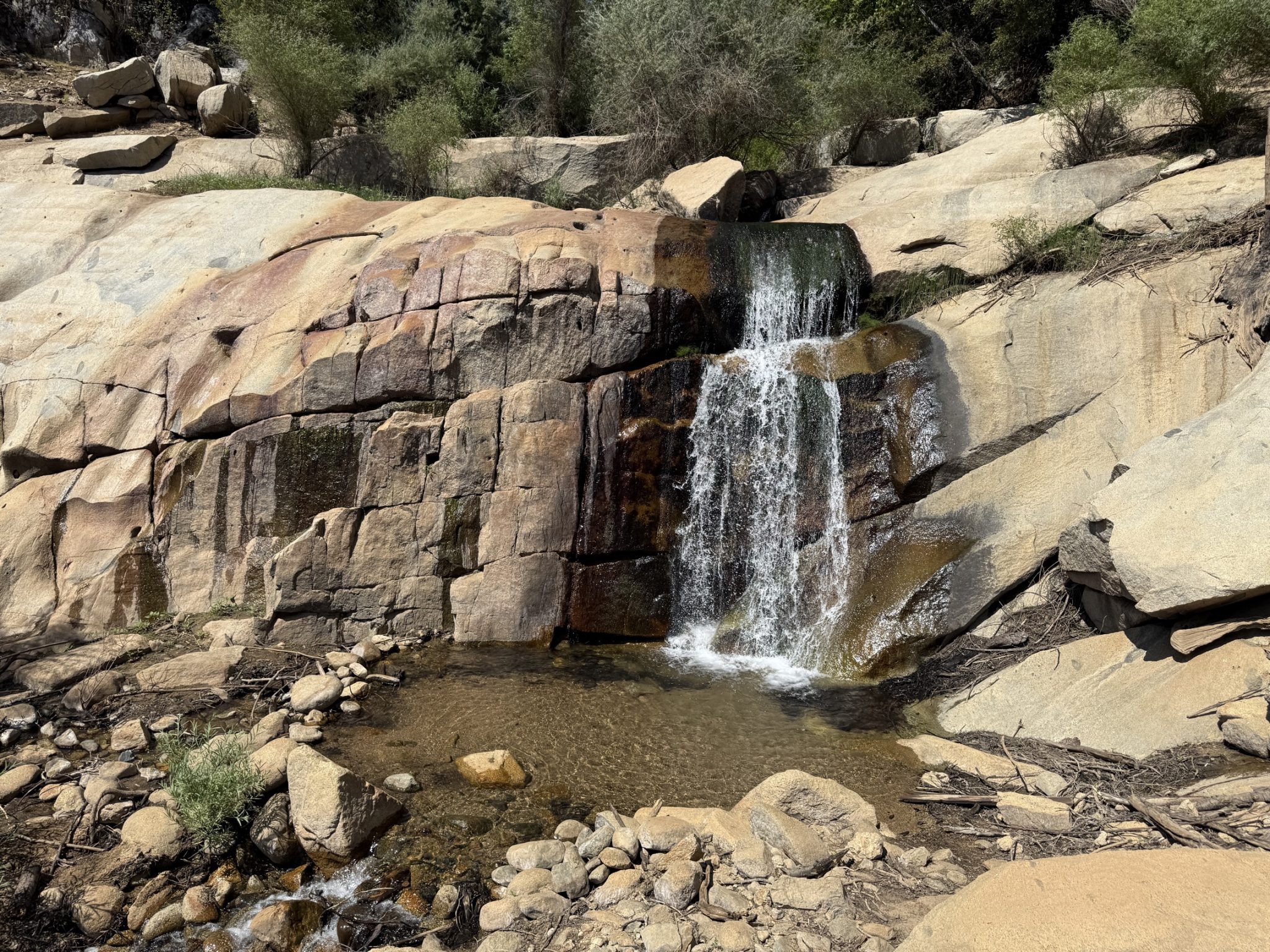
From Dark Day Boat Launch to the bottom of the falls, it is a 2.2 mile paddle, each way.
From there, its about a 160 foot walk across sand and granite to reach the base of the falls, where a small pool allows for lounging and taking in the views.
Deadwood Falls
Deadwood Falls, also known as Secret Falls, represents one of New Bullards Bar’s most spectacular hidden attractions.
This stunning waterfall can only be accessed when the reservoir reaches full capacity, making it a seasonal treasure available primarily during late spring and early summer.
To reach Deadwood Falls, visitors must navigate by boat to the North Fork River’s uppermost accessible point.
The journey requires cruising up the North Fork River to the pump house, which serves as the landmark indicating the farthest point accessible by motorized watercraft.
The trail to Deadwood Falls follows the right side of the pump house, winding through challenging terrain including rocky scrambles and uphill sections.
Hikers should bring proper footwear with good grip for navigating slippery rock surfaces. The payoff includes jaw-dropping waterfall views in a pristine wilderness setting.
Trail Details:
- Boat travel: Navigate to the pump house at the end of North Fork arm
- Hiking distance: Approximately 1.5 miles from the pump house
- Trail difficulty: Moderately challenging with climbs over slippery rocks
- Total round trip: 3 miles of hiking plus boat travel time
Mosquito repellent is essential, as the area hosts significant insect populations including giant ants and mosquitoes.
Deadwood Falls access depends entirely on reservoir water levels. The waterfall is only reachable when water levels are at or near full capacity, typically during late spring and early summer months.
During drought years or low water periods, the boat route may not extend far enough up the North Fork to access the trailhead.
Lake Conditions: Temperature, Wind, and Water Quality
Water Temperature Throughout the Year
New Bullards Bar Reservoir experiences distinct seasonal temperature variations that significantly impact recreational activities. The reservoir’s 2,000-foot elevation and relatively shallow depth for its size contribute to more dramatic temperature swings compared to deeper Sierra Nevada lakes.
Winter (December-February): 46-51°F
The coldest period at New Bullards Bar brings challenging conditions for water activities.
Morning temperatures can drop to 46°F, and ice formation is possible during extremely cold spells at the reservoir’s 2,000-foot elevation.
Wetsuits are essential for any water contact during this period.
Spring (March-May): 58-65°F
Spring marks rapid warming as snowmelt feeds the reservoir and longer daylight hours increase surface heating.
Water temperatures climb from the low 50s in March to the mid-60s by May, creating excellent fishing conditions as fish become more active.
Summer (June-August): 70-80°F
Peak summer delivers the warmest and most comfortable water temperatures for all recreational activities.
July and August represent optimal swimming, paddleboarding, and water skiing conditions, with surface temperatures reaching 75-80°F.
The reservoir’s relatively shallow nature compared to deeper Sierra lakes contributes to these warmer summer temperatures.
Fall (September-November): 64-68°F
Autumn brings gradually cooling but still pleasant water temperatures.
September maintains comfortable conditions around 64-68°F, while October and November see steady cooling toward winter ranges.
Fall represents prime fishing season as cooler temperatures concentrate fish activity.
Temperature Variations by Location
Surface vs. Deep Water:
- Surface temperatures can be 10-15°F warmer than deeper areas during summer
- Kokanee salmon fishing occurs at 70-85 feet deep where temperatures remain cooler year-round
- Thermoclines develop during summer, creating distinct temperature layers
Protected Coves vs. Main Body:
- Shallow coves and arms warm faster in spring and summer
- Main reservoir body maintains more stable temperatures
- North-facing shorelines remain cooler throughout the season
The reservoir’s temperature patterns make it particularly attractive for extended recreational seasons compared to higher elevation Sierra Nevada lakes that remain cold well into summer.
Wind Patterns and Conditions
Wind conditions at New Bullards Bar follow predictable daily patterns that affect water sports and paddling activities.
Daily Wind Cycle:
- Early Morning (6-9 AM): Calm conditions, 2-5 knots from northeast
- Mid-Morning (9 AM-12 PM): Light winds building, 3-6 knots
- Afternoon (12-6 PM): Peak winds, 8-12 knots from west/northwest
- Evening (6 PM-sunset): Diminishing winds, 4-6 knots
- Night: Generally calm, 2-4 knots
Wave Conditions
The reservoir’s elongated shape and surrounding topography create varied wave conditions depending on location and wind direction.
Protected coves and arms typically remain calmer, while the main body experiences larger waves during afternoon wind periods.
Water sports enthusiasts often prefer morning launches for optimal conditions.
Water Quality and Clarity
New Bullards Bar maintains excellent water quality with remarkable clarity throughout most seasons.
The reservoir’s stunning emerald and turquoise colors result from specific geological conditions and mineral content. Clean, clear water makes it ideal for swimming, diving, and underwater activities.
Hiking Adventures
Bullards Bar Trail System
The reservoir features over 20 miles of scenic hiking and biking trails ranging from easy lakeside walks to challenging forested routes.
The trail system interconnects to create various loop options for different skill levels.
Bullards Bar Trail
The signature trail runs mostly level along the reservoir shoreline, offering spectacular water views and forest scenery.
Access begins at Vista Point day-use area, with the trail contouring along the lake through dense forest on narrow single-track. Multiple beach access points allow for rest stops and swimming opportunities.
8 Ball Trail (3.8 miles)
This forested route parallels Marysville Road and connects with other trails to form diverse loop options.
The trail provides uphill challenges as it follows the road, transitioning back into forest where Marysville Road becomes less visible.
Rebel Ridge Trail (1.6 miles)
Features possibly more switchbacks than any other trail in the Tahoe National Forest.
This moderate descent through conifer forest connects to Bullards Bar Trail with a 600-foot elevation drop on narrow winding trail.
7 Ball Trail (1.0 mile)
A short, steep connector trail offering a 550-foot drop to Bullards Bar Trail. The trail features switchbacks and provides an exciting descent for experienced hikers.
Schoolhouse Trail (0.7 mile)
The easiest climb from Bullards Bar Trail to Marysville Road, featuring a 500-foot elevation change. This shaded trail provides quick access from Schoolhouse Campground to the main trail system.
Safety Considerations
Hikers should be prepared for poison oak abundance, though trails are usually kept trimmed. Rattlesnakes are present, especially near the shoreline in driftwood areas.
Ticks are common in spring months, particularly in grassy trail areas. Large Ponderosa Pines and Douglas Fir provide dense canopy cover over most trails.
Bring bug spray.
Camping Options
Drive-In Campgrounds
Cottage Creek Campground
The newest addition to the reservoir’s camping options, Cottage Creek features nine campsites positioned above the dam and Emerald Cove Marina.
Sites include paved areas for RV parking ranging from 24 to 50 feet wide, with additional space for tents and dining areas.
The campground accommodates groups of 12 to 18 people and provides breathtaking views of the Yuba River canyon and reservoir.
Dark Day Campground
Located within walking distance of the reservoir, this tent-only campground offers 10 total campsites including 3 double sites, 1 triple site, and 5 single sites.
Rates range from $24-$72 per night, with cash or check payment required.
The campground provides easy access to swimming, boating, and water skiing activities.
Schoolhouse Campground
Positioned about half a mile from Dark Day Boat Ramp and three miles from Cottage Creek Boat Ramp, Schoolhouse offers 56 campsites.
This campground serves as an excellent base for exploring the trail system, with direct access to the Schoolhouse Trail.
Boat-In Campgrounds
Garden Point Campground
Accessible only by boat, Garden Point features 16 campsites including 12 single family sites and 4 double family sites.
Located approximately 1 mile by boat from Dark Day launch or 3 miles from Emerald Cove Marina. Each site includes fire ring, picnic table, and vault toilets, though no potable water is available.
Madrone Cove Campground
Currently closed, this boat-in campground previously offered 10 single family campsites with vault toilets.
Current Fire Restrictions
Stage 2 fire restrictions are in effect on the Tahoe National Forest beginning August 22, 2025.
Campfires and charcoal BBQs are prohibited in most campgrounds. Individuals with valid campfire permits may use portable gas, kerosene, or pressurized liquid fuel devices with shut-off valves.
Reservoir History
New Bullards Bar Dam represents the fourth dam constructed at the Bullards Bar site, with a fascinating history spanning over a century.
The current structure succeeded earlier diversion dams built in 1899 and 1900, as well as a 200-foot concrete arch dam constructed by the Yuba River Power Company and later transferred to Pacific Gas and Electric Company in 1922.
The flood of 1955 served as the primary catalyst for creating the modern New Bullards Bar project.
This catastrophic event prompted the California state legislature to establish the Yuba County Water Agency in 1959, specifically designed to construct a major flood control reservoir.
Construction began in the 1960s as part of the ambitious Yuba Water Development Project. Unlike federal dam projects on nearby rivers, this initiative emerged from local grassroots efforts led by community leaders in one of California’s smallest and poorest counties.
The project was financed primarily through revenue bond issuance, demonstrating remarkable local determination.
Completed in 1970, New Bullards Bar Dam stands 645 feet tall, making it the fifth tallest dam in the United States.
The structure is a variable radius concrete arch dam capable of storing nearly one million acre-feet of water.
The dam maintains a minimum of 170,000 acre-feet dedicated to flood control storage.
The original 1924 Bullards Bar Dam remains fully submerged upstream of the current structure.
The 1900 diversion dam lies underwater approximately a quarter mile upstream from the present dam, creating an underwater archaeological site.
Today, the dam serves multiple critical functions beyond flood control, including hydroelectric power generation through the New Colgate Powerhouse (315 MW capacity), irrigation water supply, and extensive recreational opportunities.
The reservoir influences downstream river temperatures for fishery enhancement and provides clean hydroelectric power for California’s energy grid.
The Science Behind The Reservoir’s Colors
New Bullards Bar Reservoir’s legendary emerald and turquoise waters result from a complex interaction of geological factors unique to the Sierra Nevada foothills.
The reservoir sits within the northern portion of the Foothills fault system, composed of major Mesozoic fault structures extending throughout the region.
The bedrock geology contributing to the water’s distinctive coloration includes diverse formations:
Paleozoic Foundations:
- Metasediments and metavolcanics (undifferentiated formations)
- Calaveras and Shoo Fly Complexes creating the geological framework
Mesozoic Intrusions:
- Valley Pluton, Cascade Pluton, and Yuba Rivers Pluton granite complexes
- Ophiolite sequences including the Smartville Complex
Tertiary Volcanic Activity:
- Rhyolitic and andesitic volcanic deposits
- Valley Springs Formation contributing mineral content
The reservoir’s stunning blue-green hues result from suspended mineral particles and specific geological conditions.
Similar to other famous turquoise waters, the coloration derives from the interaction of very fine mineral particles suspended in the water column.
- Rock flour: Extremely fine particles from erosion of granite and metamorphic rocks
- Mineral suspension: Calcium carbonate and other light-colored minerals creating blue reflection
- Water depth: The reservoir’s significant depth (averaging 250-300 feet) enhances blue wavelength expression
- Sunlight interaction: Light reflection off suspended particles creates the characteristic turquoise appearance
The nearby Feather River Belt contains extensive serpentine formations, contributing to the unique mineral chemistry.
Serpentine, frequently associated with copper and iron pyrites in the Bullards Bar area, adds to the complex mineral content affecting water coloration.
Water clarity and color intensity vary seasonally based on runoff patterns, mineral loading, and particle suspension levels.
Spring snowmelt periods may temporarily alter the water’s appearance, while stable summer conditions showcase the most vibrant turquoise and emerald tones.
New Bullards Bar’s coloration shares characteristics with other famous blue waters like Lake Tahoe’s emerald bays and glacial-fed lakes, where suspended fine particles create similar optical effects.
The combination of granite-derived minerals, significant depth, and optimal particle size distribution creates the reservoir’s signature tropical appearance in a Sierra Nevada setting.
New Bullards Bar Reservoir offers an unmatched combination of natural beauty, recreational diversity, and historical significance. Whether you’re paddling through emerald waters, hiking to hidden waterfalls, or camping under Sierra Nevada stars, this remarkable destination delivers experiences that rival some of California’s most celebrated outdoor locations.
More California Lakes To Explore
Greater Sacramento
Sierra Nevadas