

Table of Contents
- Understanding 15kW Solar Systems
- Energy Output of 15kW Solar Systems
- Grid-Tied vs Off-Grid 15kW Systems
- Battery Backup and Reliability
- Cost of 15kW Solar Systems
- Comparing 15kW to Other System Sizes
- The Bottom Line Truth
Understanding 15kW Solar Systems
15kW solar systems are solar installations rated at 15,000 watts of peak capacity. This level of solar power generation is substantial: on sunny days it can typically produce roughly 60–75 kilowatt-hours (kWh) of electricity, often exceeding a typical home’s usage (about 30 kWh per day). A 15kW array can run dozens of appliances and hundreds of lights simultaneously. However, living completely off-grid requires more than just peak output – it demands storage and system design. We will explore how such a system performs, including its daily energy output, panel count, and the role of batteries for true off-grid power.

Rooftop solar arrays like the one pictured above can generate a great deal of power for a household. A 15kW installation usually consists of dozens of panels (often 50–60 standard panels, or about 38 high-efficiency panels) covering roughly 800–1,000 square feet of roof. This system could produce on the order of 60 kWh per day in good sun-. Off-grid, that means storing surplus energy for night and cloudy times – a 15kW solar system often pairs with batteries so that power captured on sunny days is available at night.
Energy Output of 15kW Solar Systems
A 15kW solar system delivers about 15,000 watts at peak. In practice, its daily production depends on sunlight and efficiency. In a good location, a well-sited 15kW system will generate on the order of 60–75 kWh of electricity per day. According to experts, a 7 kW system produces ~30–40 kWh/day, so a 15 kW system typically makes about twice that. Factoring system losses (wiring and inverter losses, temperature effects, dirt, etc.), the real output may average around 50–60 kWh/day.
For context, U.S. Energy Information Administration (EIA) data show the average home uses about 900–920 kWh per month (~30 kWh/day). That means a 15kW array can often produce double or triple a single home’s needs in sunny regions. For example, in Colorado a 15kW solar system generates roughly 12,900 kWh per year – about 160% of a typical household’s annual usage. Key factors affecting this output include:
- Sunlight and Climate: More peak sun hours yields more power. Desert or sunny states can generate significantly more kWh/day than cloudy northern areas.
- System Losses: Inverter and wiring losses typically reduce output by about 14%.
- Panel Condition: Shade, dirt, and heat can cut panel efficiency.
- Seasonality: Winter days are shorter, so winter output will be lower.
Grid-Tied vs Off-Grid 15kW Systems

A grid-tied 15kW solar setup connects to the utility grid and can feed any excess power back (net metering), using the grid as a backup at night. No batteries are strictly required in a standard grid-tie system. In contrast, a true off-grid system is completely independent. An off-grid setup needs a 15kW inverter, a battery bank, and charge controllers to store excess power. For example, in a fully off-grid 15kW system, batteries are mandatory to provide electricity when the sun isn’t shining.
Whether to include battery backup depends on your goals. If you want energy independence, a 15kW solar system with battery backup is essential. Without batteries, you can reduce your electric bill but still rely on the utility at night. Batteries let you store surplus solar energy for use after dark, greatly enhancing self-reliance. In summary:
- Grid-Tied 15kW System: Lower cost (no mandatory battery) and can use net metering. However, you remain partly dependent on the grid at night.
- Off-Grid 15kW System: Completely self-sufficient (with enough panels and storage) but at higher cost and complexity (battery bank, charge controller, backup generator).
- System Oversizing: Many off-grid designs intentionally oversize the array. By building a 15kW system larger than average daytime load, you can fully charge batteries during sunny days and ensure overnight power.
Battery Backup and Reliability
In an off-grid scenario, battery storage isn’t optional – it’s a must. You’ll need enough battery capacity to cover evenings and cloudy days. For example, if your home consumes ~30 kWh during the night, you’d want at least 40–50 kWh of battery storage to be safe. Lithium-ion batteries or deep-cycle lead-acid banks are common choices. A professional should size the battery bank based on daily usage, days of autonomy needed, and battery discharge limits. Key factors in battery sizing include:
- Storage Capacity: Amount of kWh you need to store (e.g. 2–3 days of usage). A 15kW Solar System is often paired with ~50–60 kWh of batteries for full backup.
- Daily Usage: Total household kWh used overnight.
- Autonomy Days: How many cloudy days you want to cover without sun (more days = more batteries).
- Depth of Discharge: Batteries shouldn’t be drained completely each day; typically only 50–80% is usable, so you may need larger capacity than just one night’s use.
- Voltage and Inverter Size: A 48V or higher system is efficient for large off-grid setups. Your inverter must match the 15kW array and battery voltage.
Cost of 15kW Solar Systems

The price of a 15kW solar system varies by region and equipment quality. In the U.S., typical installed costs are around $2.50–$3.00 per watt. That means a turnkey 15kW system often runs about $40,000–$45,000 before incentives. The 30% federal solar tax credit can reduce that to roughly $28,000–$32,000 net. Going the DIY route, 15kW panel kits start around $24,500 (hardware only)-, but you must still pay for labor, shipping, and any needed permits or upgrades.
- Panels & Inverters: Expect $30K–$35K for the solar equipment (panels, inverter, mounts) in a 15kW system at market rates.
- Battery Bank: Adding batteries can double or triple cost. A 50–60 kWh battery pack can cost $10K–$20K or more, depending on chemistry.
- Installation: Professional labor adds roughly $5K–$10K or more, plus permitting and inspection fees.
- Incentives: Tax credits (30% in the U.S.) and local rebates can significantly reduce net cost.
- Price per Watt: At $2.5–$3.0/W installed, each watt (or panel) contributes to the total. For example, at $2.80/W, a 15kW system is ~$42K before credits.
Comparing 15kW to Other System Sizes
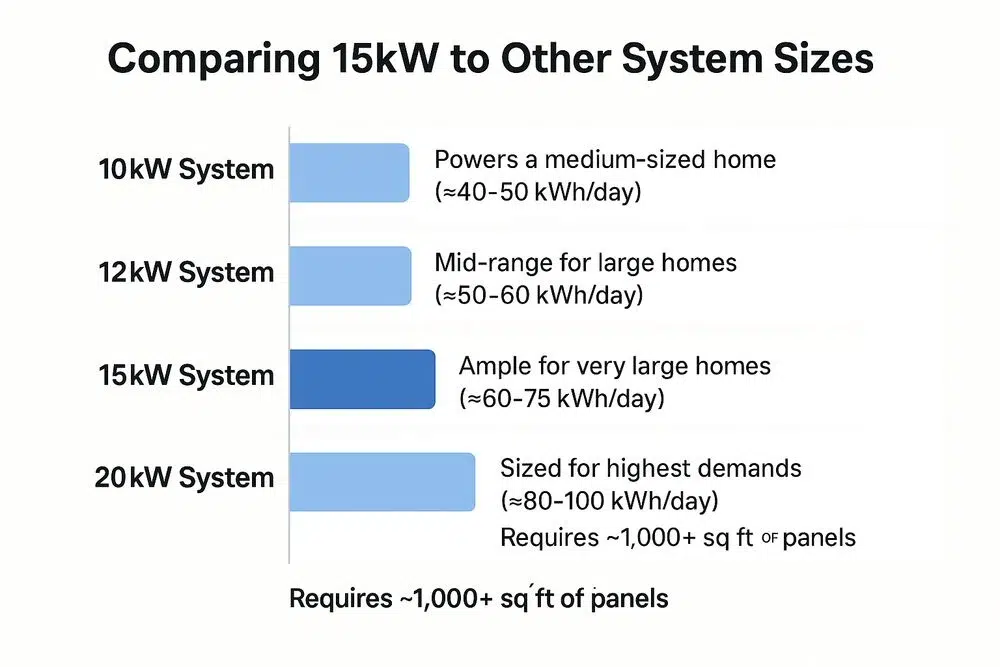
How does a 15kW Solar System compare to other sizes? As a rule of thumb, system output scales roughly linearly with capacity. A 10kW solar system (two-thirds the size) might produce about 40–50 kWh per day in similar sun conditions. A 12kW system yields a bit more (roughly 50–60 kWh/day). A 15kW system produces about 60–75 kWh/day, typically covering a very large home’s needs. A 20kW system could deliver ~80–100 kWh/day – useful for very large or multi-building properties. In summary:
- 10kW System: Powers a medium-sized home (~40–50 kWh/day). Requires fewer panels and costs less (often ~$25K–$30K after incentives).
- 12kW System: Mid-range for large homes (~50–60 kWh/day). Increases output at moderate extra cost and roof space.
- 15kW System: Ample for very large homes (~60–75 kWh/day). Often exceeds the needs of a typical family (covering ~130%+ of average use).
- 20kW System: Sized for highest demands (~80–100 kWh/day). Requires about 1,000+ sq ft of panels and significantly higher investment. Provides extra buffer for off-grid reliability.
In short, 15kW sits between 10–12 kW and 20 kW. If your usage is extremely high (large family, multiple homes, EV charging), a 20kW+ system might be considered. For average large homes, 15kW is often sufficient and more cost-effective than going all the way to 20kW.
The Bottom Line Truth

A 15kW solar system is a substantial setup that can often power a large home’s daytime needs on its own. With an average production of roughly 50–60 kWh per day, it typically exceeds the energy use of a standard American household. Off-grid, a 15kW Solar System can cover your needs, but only with proper storage. Integrating a battery bank (and possibly a backup generator) is essential for continuous power at night and during cloudy weather.
- A 15kW solar array often produces about twice as much power as an average home consumes (~30 kWh/day).
- To go off-grid, pair the panels with enough battery capacity (often ~50+ kWh) so you have power at night and during clouds.
- Total installed cost is significant (often $40K–$45K before incentives), though rebates/tax credits (30% federal in the U.S.) can greatly reduce the price.
- For less power demand, a 10–12 kW system might suffice; for very large loads, consider 20 kW or more.
In summary, 15kW solar systems can indeed power a typical home off-grid if designed correctly. By accurately estimating your energy needs (for example using a solar calculator or professional assessment) and including adequate battery backup, you can achieve near total home energy independence. If you’re uncertain, consult an expert installer or solar engineer to tailor the array size, inverter, and storage to your specific situation.


