
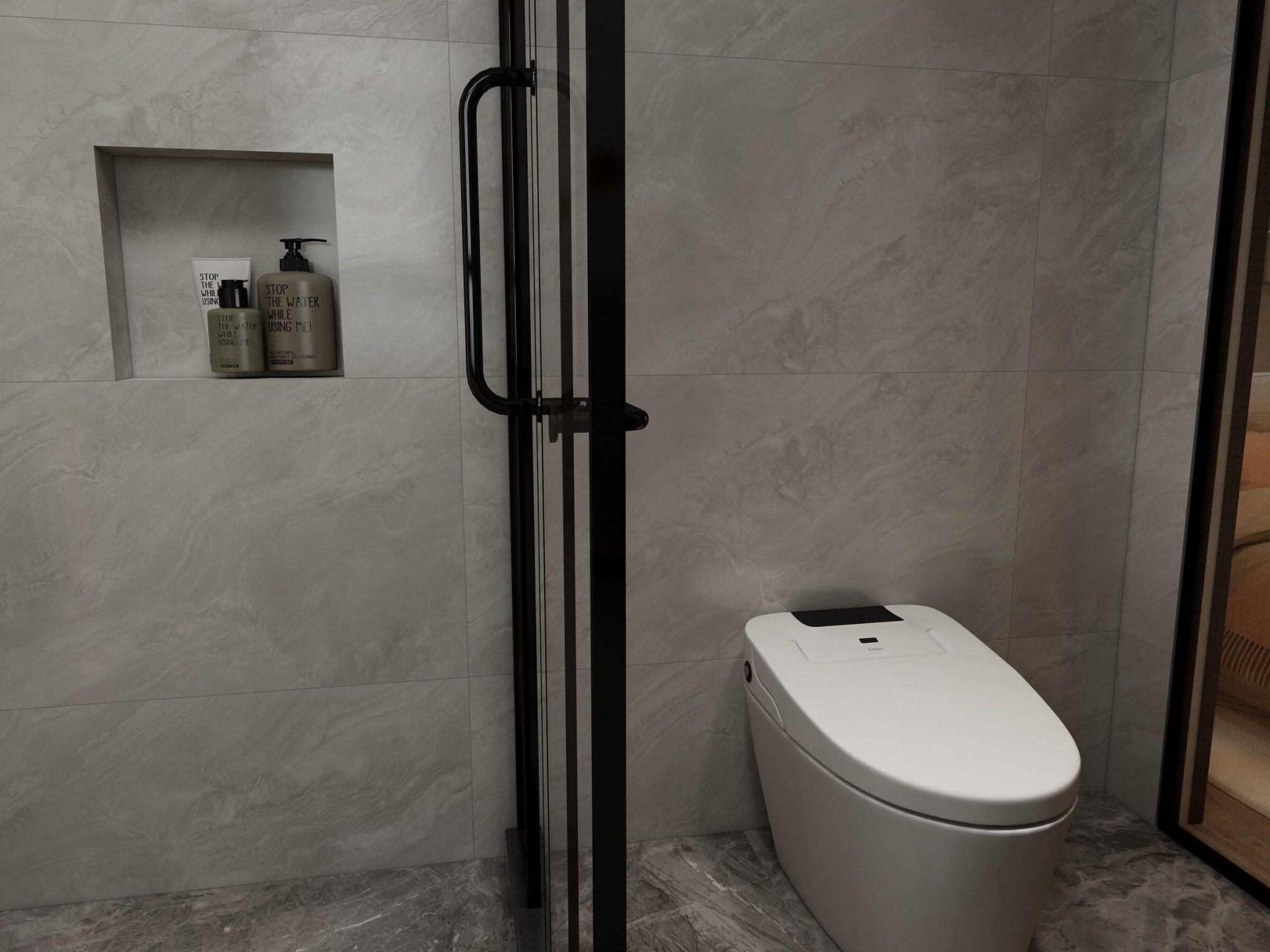
The HOROW X70 lifts its lid on approach, warms the seat, washes with water that has passed a UVC lamp, dries with warm air, and mists its own bowl with electrolyzed water before the lid comes back down. A smart toilet builds the bidet, the seat heater and the dryer into the ceramic of a one-piece toilet.
Fitting one into a Sacramento bathroom from the 1960s starts at the wall behind the old tank, where the drain distance, the water valve and the nearest outlet decide which model can go in.
✦ Key Takeaways
- A smart toilet joins a one-piece toilet to a powered bidet wand, heated seat, warm-air dryer and self-cleaning systems, all run from sensors and a remote.
- The HOROW X70 costs $1,599 and pairs a built-in tank with a 100 W pump, a 1.0/1.28 gallon dual flush, and a mechanical lever that flushes through a power outage at 29 psi or more.
- Before ordering, confirm a 12-inch rough-in, a grounded GFCI outlet within reach of the 35-7/16-inch cord, and water pressure between 8.7 and 116 psi.
- The health research supports warm water at low pressure and short washes. A 2022 systematic review found no trial that tested a bidet as a hemorrhoid treatment.
- Voice and app control come on one major model, the Kohler Numi 2.0. Matter 1.5 has no toilet device type, so Home Assistant automates the room around the toilet.
- Prices climb from about $450 for a TOTO bidet seat to $26,279 for a TOTO NEOREST NX2, with the X70 near the low end for an integrated unit.
- Sacramento’s City toilet rebate requires 1.1 gallons per flush or less, so the X70, at 1.28 on a full flush, does not qualify.
What a Smart Toilet Does
TOTO sold the first WASHLET in Japan in 1980 and passed 70 million shipped in November 2025, according to the company’s anniversary release. Bidet toilets sit in 80.2% of Japanese households. In the United States the figure is about 2.5%, the New York Times reported in May 2025, though the Americas grew from 5% of TOTO’s WASHLET sales in fiscal 2019 to 12.5% in fiscal 2024.
The word smart in this category means sensors and self-cleaning chemistry. Connectivity is rare: TOTO’s $26,279 NEOREST NX2 runs from a remote and has no app in the U.S. market.
| System | What it does | On the HOROW X70 |
|---|---|---|
| Bidet wand | Washes with warm water from a nozzle that extends under the seat | Stainless wand, rear, feminine, pulse and kid modes |
| Water treatment | Keeps the wash water and wand clean between uses | UVC lamp on the water path, triple filtration, self-rinsing nozzle |
| Heated seat | Holds the ring at a set temperature | Seasonal auto adjustment, 17-inch ADA height |
| Dryer | Blows warm air after the wash | Movable airflow |
| Bowl cleaning | Treats the ceramic after each visit | Electrolyzed water mist, optional Foam Shield |
| Deodorizer | Pulls odor through a filter or catalyst while seated | Platinum-catalyst unit |
| Hands-free controls | Opens the lid, flushes and lights the bowl without a touch | Approach sensor, foot-kick flush, dusk night light |
| Flush | Moves waste with a tank, a pump or line pressure | Built-in tank plus 100 W pump, 1.0/1.28 gallons |
The HOROW X70, System by System
Hidden in the X70’s body is a mechanical flush lever that works with no electricity and no battery, provided the house supplies at least 29 psi of water pressure. HOROW’s own T38P, the tankless model a step below it, needs a battery box to flush during an outage.
Flush and Plumbing
A built-in tank and a 100 W pump drive a six-second flush that HOROW rates below 43 dB. Tankless smart toilets flush on line pressure. The X70 refills its own reservoir and pumps from there, so it runs on inlet pressure as low as 8.7 psi as long as the line delivers 2.74 gallons per minute. The dual flush uses 1.0 or 1.28 gallons, and HOROW lists the toilet as compliant with California Energy Commission and Department of Energy rules.
Wash, Dry and Self-Cleaning
The curved stainless wand has a detachable plastic tip that rinses itself before and after each wash, and the water feeding it passes a UVC lamp and three filters. After each visit the bowl gets a mist of electrolyzed water, which HOROW says kills 99.9% of germs. TOTO’s term for its version of the same chemistry is EWATER+, which the company describes as hypochlorous acid made from tap water. Wash modes cover rear, feminine, pulse and a gentler kid setting, and the warm-air dryer swings its outlet to cover more ground.
Comfort and Controls
The seat sits 17 inches off the floor, ADA comfort height, and is up to four inches wider than a standard ring. A 15-minute alert flags a long sit. Seat, water and dryer temperatures shift with the seasons on their own. The X70 also has music-responsive lighting, the one feature on the spec sheet I would leave switched off.
Where the X70 Falls Short
The Foam Shield, which lays foam on the water before use to cut splashing, needs HOROW’s foam agent, sold separately, and HOROW warns that other cleaners can clog the system. Paul Rankin installed an X70 for Bob Vila’s September 2026 smart toilet roundup, where it was named Best Overall, and he logged three faults: the three-prong plug sticks out from the wall and keeps the tank from sitting flush, the side touch panel has to be tapped awake, and tapping a temperature control to check the setting also changes it. He also heard the deodorizer fan as a faint sound while seated. His summary: “Going back to an ordinary cold toilet seat is getting increasingly difficult.”
A November 2026 owner review on HOROW’s site reports that the supply hose did not mate with a standard U.S. angle stop without an adapter.
HOROW’s two-year warranty applies only to toilets bought directly from HOROW.com; one retailer listing shows one year.
| Spec | HOROW X70 |
|---|---|
| Price | $1,599 |
| Dimensions | 28-3/16 in L x 15-15/16 in W x 17-15/16 in H |
| Weight | 104 lb |
| Rough-in | 12 in only |
| Flush | Built-in tank, 100 W pump, 1.0/1.28 gal, 6 seconds |
| Electrical | 120 V, 60 Hz, 15 A; 820 W rated; 35-7/16 in cord |
| Water pressure | 8.7 to 116 psi; 29 psi for blackout flushing |
| Seat height | 17 in, ADA compliant, elongated |
| Compliance | CEC and DOE compliant |
| Warranty | 2 years when bought direct; 90-day returns |
| Connectivity | Remote and side panel; no app, Wi-Fi or voice |
What the Research Says About Washing
Warm water at low pressure is the setting with evidence behind it. In a 2011 study by Korean colorectal researchers, published in the Journal of Korean Medical Science, 20 volunteers sat for one-minute washes at different settings. Water at 38°C (100°F) at low or medium pressure lowered resting anal pressure, from 96.1 to 81.9 mmHg at the gentlest wide jet. Room-temperature water had no effect at any pressure, and the two highest pressures pushed the readings upward, which the authors linked to reflex contraction of the sphincter.
In a 2022 Journal of Water and Health study, 32 nursing students wore gloves while cleaning up after a bowel movement: paper alone left 39,499 colony-forming units of bacteria per glove on average, and a bidet wash before the paper left 4,147.
In the BIDLOW trial, a multicenter randomized study in Korea published in BMC Surgery in 2025, patients recovering from hemorrhoid surgery used either an electronic bidet or a warm sitz bath for a week. Wounds healed at the same rate, 97.1% and 97.6%, and the bidet group rated it convenient 85.3% of the time against 56.1% for the bath.
The trial did not prove the bidet equal to the bath on pain.
A 2005 study in The Gerontologist put wash-and-dry toilets in a Maryland nursing home, where about half of residents and staff reported a benefit and installation ran “more complex than expected.”
A 2022 systematic review in Evidence-Based Complementary and Alternative Medicine pooled six studies and 20,322 participants and found no trial that tested a bidet as a treatment for hemorrhoids or fissures. In a large Japanese cohort, men who used bidet toilets had more new cases of anal itching over three years, a relative risk of 1.36. Tsunoda’s 2021 review in the Journal of the Anus, Rectum and Colon traced perianal dermatitis to excessive washing in 26% of 3,541 patients.
Tsunoda’s clinic tells patients to wash for under five seconds with a weak, wide spray.
A one-year cohort funded by Japan’s sanitary-ware industry found a link between habitual use and symptoms of bacterial vaginosis, though not with diagnosed cases, and a three-year follow-up found no link to urogenital infection.
Nozzles collect bacteria, which is the reason the self-cleaning systems exist. A survey of all 292 bidet toilets in a Japanese university hospital, published in the Journal of Hospital Infection in 2017, found 86.9% of nozzles contaminated. Hot water can also burn skin that has lost feeling, and the Korean authors warned against high temperatures for older users and anyone with nerve damage.
Water: A 1960s Toilet Against the X70
A toilet from the 1960s uses 3.5 to 7 gallons per flush, according to TOTO USA. Federal law dropped the limit to 1.6 gallons in 1994, and California set 1.28 for every toilet sold or installed from January 1, 2014. EPA’s WaterSense program puts toilets at nearly 30% of a home’s indoor water use and estimates that replacing older models saves a household nearly 13,000 gallons and more than $170 a year.
California’s Civil Code 1101.4 required single-family homes to replace fixtures using more than 1.6 gallons by January 1, 2017, and it makes replacement a condition of final approval on permitted alterations. A permit for a new bathroom outlet can bring the toilet into the inspection.
Rebates in the Sacramento region depend on the water provider. The City of Sacramento expanded its program in August 2026 to pay up to $175 for replacing a pre-1992 toilet that uses 3.5 gallons or more, and up to $50 for a 1.6-gallon toilet from 1992 through 2013, with City pre-approval before the old one comes out. The replacement must be a MaP Premium toilet at 1.1 gallons or less, which leaves out the X70 and any other toilet on a 1.28-gallon full flush. Fair Oaks Water District pays up to $175 through December 31, 2026 under its 2026 rebate form. The Sacramento County Water Agency put its appliance rebates on hold.
TOTO’s WASHLET KC2 spec sheet lists a bidet spray of 0.07 to 0.11 gallons per minute, so a 30-second rear wash uses about a twentieth of a gallon.
Power, Plumbing and Permits Before Delivery
A tape measure and a water pressure gauge answer the fit questions for a smart toilet before it ships.
Rough-In
The rough-in is the distance from the finished wall to the center of the drain flange. American Standard measures it from the closet bolts to the drywall, with the baseboard ignored, and uses the rear pair on a toilet with four bolt caps. Most American bathrooms are 12 inches; some older ones are 10 or 14. The X70 fits a 12-inch rough-in and nothing else, and TOTO’s Nexus WASHLET+ S7A offers a 14-inch version for $132 more.
Outlet and Circuit
The X70 draws up to 820 W at 120 V and needs a 15-amp connection within reach of its 35-7/16-inch cord. Extension cords are out: HOROW says so, as do TOTO and Kohler, whose smart toilet installation guide calls for a grounded, dedicated circuit with Class A GFCI protection, an outlet centered 12 inches off the floor and 9 to 12 inches to the side of the toilet’s centerline, and nothing placed directly behind the tank.
Bathroom receptacles need GFCI protection under the National Electrical Code, which California adopted in its 2023 edition as the 2025 California Electrical Code, in force since January 1, 2026. The NEC first required a 20-amp circuit for bathroom receptacles in 1999, so a 1960s bathroom may share an older circuit with other rooms. Adding an outlet takes a permit: the City of Sacramento requires one for new outlets, which it handles through minor permits, and the County issues an electrical miscellaneous permit for a new 120 V receptacle.
Water Supply
HOROW wants the supply valve at least 8 inches off the toilet’s centerline and recommends 9 to 11 for working room. A pressure gauge on a hose bib reads static pressure in seconds; the X70 accepts 8.7 to 116 psi and needs 29 for the blackout lever. Check that the supply hose threads onto the existing angle stop before the plumber arrives, and line up a second person for the 104 lb lift. Swapping a toilet on existing plumbing needs no building permit, according to the Fair Oaks Water District, though relocating the drain does.
Where a Smart Toilet Fits in a Smart Home
One major smart toilet sold in the U.S. talks to a voice assistant. The Kohler Numi 2.0 has Amazon Alexa built in and stores per-person presets for water temperature, seat temperature, spray pressure, lighting and sound in the Kohler Konnect app, with five light and sound scenes named Sunrise, Forest, Deep Ocean, Bokeh and Miami. Kohler’s brochure adds that “the remote control will operate all functionality if voice control is not available.” TOTO’s NEOREST line runs from a remote in the U.S.; the company’s stool-scanning NEOREST models that report to its TOTO Wellness app went on sale in Japan in August 2025 and stay there.
The X70 has no app, Wi-Fi or voice control. Matter, the shared standard that lets devices from different brands work in Apple Home, Google Home, Alexa and Home Assistant, added cameras, closures and soil sensors in version 1.5 in November 2025 and still has no device type for a toilet or bidet. For a house already running Home Assistant, I would rather keep the toilet offline and make the room around it smart, because an offline toilet has no cloud account that a manufacturer can switch off.
- Leak alert. A moisture sensor on the floor under the supply valve reports as a moisture binary sensor in Home Assistant and can send a phone alert or close a motorized main valve.
- Night path. A motion sensor in the hall triggers low lighting from bed to bath after midnight, which pairs with the X70’s own dusk-activated night light.
- Exhaust fan. A humidity sensor and Home Assistant’s generic hygrostat run the fan until the room drops back to its normal reading.
- Energy. A panel-level monitor on the bathroom circuit tracks the toilet’s draw. Kohler says no adapter should go between its smart toilets and the outlet, and common smart plugs are rated for dry locations, so a plug-in smart switch is the wrong tool here.
Japan’s Top Runner efficiency program, run by its Ministry of Economy, Trade and Industry, set targets of 135 kWh a year for tankless washlet seats and 183 kWh for storage-tank models. At SMUD’s 2026 residential rates, 135 kWh costs about $17 a year at non-summer off-peak pricing and about $51 if every hour landed on the summer peak; SMUD is also the utility behind the heat pump water heater rebates in Sacramento. A Home Assistant energy dashboard shows the seat heater as its own line item, and the X70’s seasonal mode trims it in summer.
What a Smart Toilet Costs
Each step up the price ladder adds features, finish and brand name, and the X70 lands near the bottom of the integrated range.
| Model | Price | Type | Rough-in | App or voice |
|---|---|---|---|---|
| TOTO WASHLET C5 | $451 to $682 retail | Bidet seat on an existing toilet | Any, if the bowl fits | No |
| HOROW T38P | $1,299 | Integrated, tankless | 12 in | No |
| HOROW X70 | $1,599 | Integrated, tank plus pump | 12 in | No |
| TOTO Nexus WASHLET+ S7A | $3,588 to $3,767 | One-piece with WASHLET+ seat | 12 in; 14 in for $132 more | No |
| TOTO NEOREST RS | $6,932 | Integrated | Check the SKU | No |
| Kohler Numi 2.0 | Varies by finish | Integrated | Check the SKU | Alexa and Konnect app |
| TOTO NEOREST NX2 | $26,279 | Integrated flagship | 12 in | No |
A bidet seat is the least expensive way into washing: the C5 adds a heated seat, warm-air dryer and a self-cleaning wand to a toilet already in place, with no auto lid. The T38P earned a 4.5 out of 5 in Bob Vila’s hands-on review, which called its flush “truly strong enough that it never leaves anything behind.” The extra $300 for the X70 buys the tank, the pump and the battery-free outage flush.
Which Smart Toilet Fits Which Bathroom
Keep the Toilet You Have
Bidet seat, about $450 to $680
A newer 1.28-gallon toilet with an elongated bowl and an outlet nearby takes a WASHLET-style seat on the existing bolts. It gives the wash, the warm seat and the dryer, and skips the auto lid and bowl cleaning.
Replace a 1960s Toilet
HOROW X70, $1,599
A 12-inch rough-in with modest or uneven water pressure suits the X70’s tank and pump, and the mechanical flush covers outages. Budget for an electrician if the bathroom has no outlet beside the toilet.
Voice and App Control
Kohler Numi 2.0
Alexa, per-person presets and light and sound scenes come on the Numi 2.0 and nowhere else in the major brands. Everything still runs from the remote.
A 10- or 14-Inch Rough-In
Check before ordering
The X70 and T38P need 12 inches. TOTO’s Nexus WASHLET+ S7A has a 14-inch option, and an offset flange is plumber’s work worth pricing before the toilet ships.
Frequently Asked Questions
What is a smart toilet?
A smart toilet is a one-piece toilet with a built-in bidet wand, heated seat, warm-air dryer and automatic cleaning, run by sensors and a remote. Most also open the lid as you approach and flush on their own. The HOROW X70, TOTO NEOREST and Kohler Numi are examples.
Are smart toilets worth it?
For a bathroom that already needs a new toilet, yes: the X70 costs $1,599 and replaces a 3.5-gallon 1960s toilet with a 1.28-gallon one while adding the wash, heat and dryer. For a newer toilet that works, a $450 bidet seat delivers most of the comfort. Research supports warm, low-pressure, short washes.
How much does a smart toilet cost?
Integrated smart toilets run from $1,299 for the HOROW T38P and $1,599 for the X70 to $6,932 for a TOTO NEOREST RS and $26,279 for the NEOREST NX2. Bidet seats that fit an existing toilet start around $450. Installation and any new outlet add to the total.
Do smart toilets need electricity or a dedicated circuit?
Yes, every smart toilet needs a grounded 120 V outlet with GFCI protection, and extension cords are not allowed. The X70 needs a 15-amp connection within reach of its 35-7/16-inch cord. Kohler requires a dedicated circuit; TOTO says it depends on the model and local code.
Can a smart toilet flush without power?
Some can. The HOROW X70 has a mechanical flush lever that works with no electricity or battery when water pressure is at least 29 psi. The HOROW T38P needs a battery box for outage flushing, and the wash and seat heat stop on every model until power returns.
Do smart toilets need hot water?
No. Electronic toilets connect to the cold supply and heat the wash water and seat themselves, according to TOTO. HOROW rates the X70 at 820 W with 59°F inlet water.
Can a smart toilet connect to Alexa, Google or Home Assistant?
The Kohler Numi 2.0 has Alexa built in and uses the Kohler Konnect app. The HOROW X70 and TOTO’s U.S. NEOREST models have no app or network connection, and Matter 1.5 has no toilet device type. Home Assistant can still automate leak sensors, lighting and the exhaust fan around the toilet.
What are the disadvantages of smart toilets?
They cost more than standard toilets, need an outlet that older bathrooms often lack, and can weigh more than 100 lb; the X70 is 104. Washing too long or too hard is linked to anal itching and dermatitis in Japanese studies. Electronics also add parts that can fail, such as the pump, sensors and wand.
How do you clean a smart toilet?
The wand rinses itself and the bowl is misted with electrolyzed water on models like the X70, so routine cleaning covers the seat and outer surfaces. The X70’s nozzle tip detaches for washing. TOTO recommends soaking the wand in vinegar for 30 minutes to descale it and cleaning the deodorizer filter monthly.
Are smart toilets legal in California?
Yes, if they use 1.28 gallons per flush or less, the state limit since 2014. The HOROW X70’s full flush is 1.28 gallons and HOROW lists it as California Energy Commission compliant. Toilets above 1.6 gallons have been noncompliant in single-family homes since January 1, 2017.
Does a smart toilet qualify for Sacramento’s toilet rebate?
Only at 1.1 gallons per flush or less. The City of Sacramento pays up to $175 for MaP Premium replacements at that rating, so the X70’s 1.28-gallon full flush does not qualify. Fair Oaks Water District offers up to $175 through December 31, 2026.
How do I measure the rough-in for a smart toilet?
Measure from the finished wall, skipping the baseboard, to the center of the toilet’s floor bolts. A 12-inch reading is most common and fits the X70. A 10- or 14-inch reading needs a model built for that distance.
HOROW provided an X70 for evaluation.
Article Updates
- November 26, 2026: Original publication.