On May 6, 2026, the National Park Service quietly updated one page on their Death Valley site to add a fourth year to a list that had stood at three for a decade. The list is the documented record of Death Valley super blooms, and the years now read 1998, 2005, 2016, and 2026. Once a decade, give or take. Each one is the same equation solved differently: enough rain at the right time, enough sun, no drying winds. When all three conditions hold, hundreds of square miles of the hottest place in North America turn yellow and purple for a few weeks, and a million people try to be there to see it.
The 2026 version did not last. Peak ran from about mid-February through mid-March. By March 17, daily highs were already hitting 100°F, weeks ahead of when that threshold normally arrives.
By March 25, a Death Valley ranger named Nichole Andler told the Las Vegas Review-Journal “the superbloom is over.” That same day, the park hit 107°F, an all-time March record. Previous March all-time was 104°F, set on March 26, 2022.
The bloom that took twenty-eight years of climate to arrive ended in a single hot week.
I missed it. So did most of the people who will read this. Sunset, Scientific American, National Geographic, Popular Science, and Fox LA all filed coverage between February 19 and March 24, and by the time the words “best since 2016” reached most readers, the heat was already coming. This article is the retrospective. It walks through what NPS confirmed, why November 2025 set the whole thing in motion, what species you would have seen if you had been there, and what to watch for in the next decade so the next one is not also missed.

Key Takeaways
- 2026 is the fourth NPS-documented Death Valley super bloom. NPS updated nps.gov/deva/learn/nature/wildflowers.htm on May 6, 2026 to add 2026 to the canonical list of 1998, 2005, 2016, 2026. Average gap between events is 9.3 years.
- Peak ran mid-February through mid-March 2026. Park Ranger Nichole Andler declared the superbloom over on March 25, citing record heat and wind. The bloom was killed about four to six weeks earlier than the 2016 cycle.
- The trigger was a record-breaking November 2025 storm. Death Valley received 1.76 inches of rain in November 2025, breaking a 102-year-old record (1.70 inches set in 1923) and clearing the November normal of 0.10 inches by 17.6 times. September through November totaled 2.41 inches, also a fall record.
- The marquee species was Desert Gold (Geraea canescens). Yellow ray florets on three-foot stems covered south Badwater Road from Ashford Mill to Salsberry Pass. Phacelia crenulata supplied the purple half of the “yellow and purple hillsides” NPS describes for 2026.
- Lake Manly returned in early February 2026. NASA Landsat 8 imaged the temporary lake forming in Badwater Basin on November 7 and December 1, 2025. The same fall storms that triggered the bloom pooled water in the lowest point of North America.
- March 25 hit 107°F, an all-time March record. Daily highs at or above 100°F began March 17, weeks ahead of the typical mid-April onset. Climate research cited by the Las Vegas Review-Journal calls these temperatures roughly five times more likely because of climate change.
- Park access in 2026 has caveats. Entrance fee is $30 per vehicle and the park does not accept cash. Multiple roads remain closed from Hurricane Hilary 2023 damage, including Bonnie Clare, Lower Wildrose, Darwin Falls, and the final three miles of Phinney Canyon Road.
- The next super bloom requires October-December rainfall three to eight times the normal 0.4 inches. Watch for a wet November through January in the National Weather Service Las Vegas forecast for Furnace Creek, then half-inch single-storm events that break seed dormancy.
What Is a Death Valley Super Bloom?
A Death Valley super bloom is a once-per-decade event when an unusually wet fall and winter trigger mass germination of dormant annual seeds, producing wildflower densities high enough that hillsides and alluvial fans appear yellow, purple, white, and pink from a distance. NPS lists three required conditions: well-spaced rainfall throughout fall, winter, and spring; sufficient warmth from the sun; and a lack of drying winds. The term is descriptive rather than measured. There is no acreage threshold or species count that triggers the official designation. NPS classifies super blooms in retrospect, based on field observation and the three-conditions framework, and the working list since 1998 contains four years.
The Four-Bloom Canon: 1998, 2005, 2016, 2026
NPS does not advertise the documented super bloom list. It sits as one paragraph on the wildflowers page, easy to miss. What it tells you is that this region of the Mojave Desert produces a true super bloom roughly every ten years, and that we have a written record going back to 1998 that lets us read each cycle against the others.
1998: The Year the Term Stuck
Park Ranger Alan Van Valkenburg, who started at Death Valley in the early 1990s, wrote the canonical NPS statement on what a super bloom feels like. His framing appears in the February 19, 2016 NPS press release that announced the second super bloom of his career, but the experience he describes is from his first one in 1998:
“I’m not really sure where the term ‘super bloom’ originated, but when I first came to work here in the early 1990s I kept hearing the old timers talk about super blooms as a near mythical thing, the ultimate possibility of what a desert wildflower bloom could be. I saw several impressive displays of wildflowers over the years and always wondered how anything could beat them, until I saw my first super bloom in 1998. Then I understood. I never imagined that so much life could exist here in such staggering abundance and intense beauty.”
Park Ranger Alan Van Valkenburg, NPS Death Valley press release, February 19, 2016
1998’s trigger was a strong El Niño winter in 1997-1998 that delivered well above-average rain to the Mojave deserts. Storms moved through October and continued into spring, and the seeds responded.
By the time anyone had a name for what they were seeing, the term was already passing between rangers and old-timers as something local and mythological rather than scientific. NPS adopted it. The rest of us picked it up from there.
2005: Lake Manly’s Last Visit Before 2024
Seven years after 1998, another wet El Niño-influenced winter set up a 2005 super bloom. NPS records that 2005 also delivered Lake Manly to Badwater Basin, the rare temporary lake that fills only when fall and winter rainfall is heavy enough to overwhelm the basin’s evaporation.
Abby Wines, then a Management Analyst at the park, told CNN in 2023 that “the basin last accumulated that much water back in 2005.”
Lake and bloom traveled together. Same trigger, same season, same year.
The 2016 NPS press release referenced 2005 retroactively as “the best the park has experienced in a decade,” using it as the benchmark 2016 was about to clear. That language is how a working super bloom record gets built. Each new year is measured against the prior one, the prior one becomes the reference, and the canonical list becomes whatever the rangers have lived through and written down.
2016: The Famous One
Eleven years after 2005, the third super bloom arrived. October 2015 had delivered an extraordinary local storm: NPS records “over 3 inches of rain fell in just 5 hours in one area” of the park, against an annual park-wide average of less than 2 inches. Three months later, the seeds were responding.
Superintendent Mike Reynolds put it directly in the February 19, 2016 NPS press release: “Right now is the best time to visit Death Valley in over a decade.”
Van Valkenburg, in the same release, described what visitors were seeing: “The hills and alluvial fans that normally have just rocks and gravel are transformed by huge swaths of yellow, white, pink, and purple.”
NPS named three species in that release: Desert Gold, Desert Five-Spot, and Gravel Ghost. Three roads, too: Badwater Road, Twenty Mule Team Road, and Beatty Cutoff Road.
What followed was Death Valley’s all-time visitation record. NPS reported 1,296,283 visitors in 2016, attributing the spike to “publicity related to the centennial of the National Park Service and a rare ‘super bloom’ of wildflowers.” 2017 came in at 1,294,827, narrowly missing the record but holding it close.
Almost the entire 2016-2017 visitation surge was super-bloom tourism. National Geographic ran a March 2 cover treatment connecting the 1998-2005-2016 sequence to El Niño cycles. Bloom held into mid-March before higher-elevation flowers carried the story into late spring.
2026: The One That Ended Early
Ten years after 2016, the equation solved itself again.
Section three of this guide walks through the 2026 timeline in detail. What matters here is that the trigger and the early end both broke records. November 2025 set a 102-year-old precipitation mark. March 25, 2026 set an all-time monthly heat mark.
Between those two records, the four-bloom canon got a fourth entry.
NPS Park Ranger Matthew Lamar gave a Fox Weather interview in early March that has stuck with me as the most accurate single sentence anyone produced about the 2026 setup: “Since October, Death Valley has done the unthinkable. It’s been wet.”
| Year | Trigger | Peak Window | Lake Manly? | Source |
|---|---|---|---|---|
| 1998 | Strong El Niño winter 1997-1998 | Spring 1998 (mid-Feb to mid-April) | Yes (per ranger memory) | NPS press release Feb 19, 2016 (Van Valkenburg quote) |
| 2005 | Wet El Niño-influenced winter 2004-2005 | Spring 2005 | Yes | Abby Wines via CNN 2023; NPS 2016 press release |
| 2016 | October 2015 storm: 3″ in 5 hours locally | Mid-Feb through mid-March 2016 | No | NPS press release Feb 19, 2016 (Reynolds, Van Valkenburg) |
| 2026 | Sept-Nov 2025: 2.41″ (record); Nov alone: 1.76″ (broke 1923 record) | Mid-Feb through ~March 17-25 (early end from heat/wind) | Yes (NASA Landsat Nov 7, Dec 1, 2025) | NPS wildflowers.htm updated May 6, 2026; Andler quote March 25 |
The November 2025 Storm That Started It
Death Valley averages less than two inches of rain a year. November averages 0.10 inches. Most Novembers, nothing happens. Photographers do not show up. Rangers do not write press releases.
November 2025 broke that pattern by 17.6 times. Furnace Creek recorded 1.76 inches in the month, breaking a 102-year-old record set in 1923 (1.70 inches). The Las Vegas Review-Journal reported the new mark on December 2, 2025. NPS followed with an official press release on December 4 titled “Record Rainfall in Death Valley National Park” and noted that the September through November total had also broken a record: 2.41 inches versus the prior 2.36 inches set in 1923. Two records from the same century-old benchmark, both broken in the same fall.
NPS Acting Deputy Superintendent Abby Wines summarized what the park experienced: “From November through early January, we had about 2½ inches of rain, so we had more than our annual average in just 2½ months.”
Park Ranger Matthew Lamar’s framing made it onto Fox Weather: “Since October, Death Valley has done the unthinkable. It’s been wet.”
December 2025’s NPS release stayed measured. Officially, it was “too early to predict” a super bloom. The seeds were already responding.
Two of those storms also pooled water in Badwater Basin. NASA Landsat 8 satellites imaged Lake Manly forming on November 7 and December 1, 2025. Lake Manly is the temporary descendant of the Pleistocene-era inland sea that once filled the basin under hundreds of feet of water. It surfaces only when fall and winter rainfall outruns the basin’s evaporation rate, which is most of the time but not always. The 2024 atmospheric river had brought it back briefly. The November 2025 storms brought it back again, alongside the bloom that was about to follow.
The seed-coating threshold matters here. Popular Science cited NPS in March 2026 with a sentence I had not seen written this cleanly anywhere else: “A rainstorm of a half inch or more will wash the protective coating off wildflower seeds.” Half an inch in a single event. A trickle of 0.1-inch storms does not break the dormancy that desert annuals build into their seed coats. November 2025’s 1.76 inches almost certainly contained multiple half-inch-plus events, each one stripping coatings off another tier of seeds. By the time the rain stopped, mass germination was inevitable.
How the 2026 Bloom Played Out
First sign was a January 14 update from David Blacker, Executive Director of the Death Valley Natural History Association. Writing for IFLScience, he said: “At this time, we do not have any large areas of flowers blooming. However, we do have large areas of the park that are showing preliminary signs of an above-average bloom.”
That sentence is what cautious optimism reads like in the desert. Nothing visible yet. Everything required for it to be visible is in place.
By February 1, DVNHA Wildflower Report 2 listed specific viewing locations. Flowers were active at the park entrance sign pullout, in the flood-control berm near Furnace Creek, on the path to Furnace Creek itself, on Beatty Cutoff Road’s bottom third, and in the first two miles of Mud Canyon Road from North Highway to Hells Gate.
Species names were already specific: Gravel Ghost, Desert Gold, Mojave Aster, Golden Suncup, Brown-eyed Primrose, Desert Globemallow, Desert Five-Spot.
Three days later, Blacker spoke with the Las Vegas Review-Journal in a piece run February 4: “Death Valley is poised for a better-than-average bloom, and with a little luck (and maybe another rain), it could even be better than that.” His advice in the same piece: “Make sure you get your reservations soon and keep your fingers crossed.”
February 15 brought the headline DVNHA had been waiting for. Wildflower Report 3, posted that day, opened with: “The bloom has started! With the opening of the Badwater Road, we discovered that from Ashford Mill to Salsberry Pass, the bloom has begun.” Blacker rated the corridor 50 out of 100.
He added a warning: “There is no telling how long this might last, so don’t put off your visit.”
In retrospect, that was the most honest thing anyone wrote about 2026.
Four days later, on February 19, PetaPixel published “Wildflower Superbloom Sweeps Death Valley for First Time in 10 Years.” A week after that, Fox LA called it “the park’s strongest floral showing since the 2016 superbloom.”
By early March, National Geographic, Sunset, Popular Science, and Scientific American had all filed coverage. Photographers were posting daily. Jeff Sullivan published “2026 Death Valley Super Bloom So Far” on March 12.
The story was running.
March 16 was the day NPS posted current bloom locations on the park news index. Badwater Road between CA-190 and Sidewinder Canyon was active with Desert Gold, Phacelia, and Mojave Star.
Public Information Officer Jennette Jurado told National Geographic on March 24: “There are so many flowers that the hills are colored with flowers, visible from a distance.”
That was the high-water mark of the coverage.
March 17 was also when daily highs hit 100°F for the first time of the year. That threshold normally arrives in mid-April.
Eight days later, March 25 hit 107°F, an all-time March record. Previous March all-time was 104°F, set on March 26, 2022.
Park Ranger Nichole Andler called it: “The superbloom is over. The low-elevation areas, especially in the southern end of the park that in early spring were completely covered, that has passed because of the heat and the wind.” Her caveat: “Death Valley is still Death Valley, and it has all of the cool hikes, the beautiful vistas and the adventures if you’re prepared for them.”
By April, NPS reported “scattered flowers persisted at low elevations after the main bloom ended” while higher-elevation flowers began. By May 6, the wildflowers page had been updated to add 2026 to the canonical list. The peak ran roughly six weeks, mid-February to mid-March, three to four weeks shorter than 2016. That early end is the throughline.
Why the Bloom Died Early
Andler named the cause directly: heat and wind. NPS’s three super-bloom conditions are well-spaced rainfall, sufficient warmth, and lack of drying winds. The 2026 setup nailed the first two. The third failed catastrophically in late March, and it failed weeks ahead of schedule.
The Las Vegas Review-Journal’s March 25 piece laid out the heat data with unusual clarity. Daily highs above 100°F began March 17, abnormally early for that threshold. All-time March record had been 104°F, set on March 26, 2022. 2026’s reading on March 25 hit 107°F, a three-degree leap on a record that already required generations of climate to set.
Highest monthly average for March before 2026 was 75.1°F, set in 1957. 2026 came in at 79°F.
That same Review-Journal piece quoted climate research that calls these temperatures “five times more likely because of climate change and carbon emissions from the burning of fossil fuels.” NPS does not say that on the wildflowers page directly. The implications, though, run through the documented record.
Super blooms still happen on the historic ten-year cadence: 1998 to 2005 was seven years, 2005 to 2016 was eleven, 2016 to 2026 was ten, average 9.3 years.
That cadence is intact.
What is changing is duration. 2016’s bloom ran into mid-March with explicit promise from NPS that “flowers at higher elevations possible later in the spring” would carry the season longer. 2026’s died March 17 to 25 because the spring-end heat-and-wind window arrived four to six weeks early.
If you were planning a 2026 trip in mid-March, you were already too late. If you were planning a 2016 trip in mid-March, you were still on time.
That is the climate-change throughline. Same cadence, shorter window.
The Science of Why Super Blooms Happen
NPS lists three required conditions on the Death Valley wildflowers page. The order matters because the first one is structural, the second is seasonal, and the third is the wild card.
Condition one: well-spaced rainfall throughout fall, winter, and spring. The “well-spaced” qualifier is operative. A single August storm that drops two inches in a day is the wrong rainfall, even if the total is correct. Late-summer rain breaks seed dormancy too early. Seedlings dehydrate before winter cool weather arrives to support them. Tropical Storm Hilary in August 2023 delivered exactly the wrong kind of rainfall, which is why the 2024 bloom that followed was classified by NPS as “a ‘good bloom’ is likely, but not a superbloom.” The October-December window is the operative one for super bloom germination.
Per NPS analysis cited by the Las Vegas Review-Journal in December 2025, past super blooms in 1998, 2005, and 2016 were preceded by October-December rainfall three to eight times the normal 0.4-inch fall total. November 2025 hit 1.76 inches alone, and the September-November total reached 2.41 inches: roughly 6 times normal. That is the precipitation threshold reading.
Condition two: sufficient warmth from the sun. This is the easy condition. Death Valley provides plenty. Spring averages run 82°F in March, 90°F in April, 100°F in May. The challenge is not getting enough warmth. The challenge is staying below the threshold where heat starts killing seedlings before they can complete reproduction.
Condition three: lack of drying winds. This is what 2026 broke. Joshua Tree NPS scientists have written that “frequent springtime windstorms can end or prevent a spring bloom by desiccating seedlings.” Wind plus heat is the killer combination. Either alone is survivable. Together, they cook the bloom in days. March 2026 had both, four to six weeks earlier than expected.
The half-inch single-storm threshold I mentioned earlier is the practical reading on condition one. A rain event has to be heavy enough in a single storm to wash the protective coating off the seed. PopSci’s framing of it cited NPS directly. November 2025 had multiple half-inch-plus events. October 2015 had the famous one: three inches in five hours in one area of the park. The total over a winter matters less than the size and timing of individual storms.
Once-per-decade is the cadence NPS uses. The math holds. Doing the gap arithmetic across the canonical list: 1998 to 2005 is seven years, 2005 to 2016 is eleven, 2016 to 2026 is ten. Average across the 28-year window: 9.3 years per cycle. Four super blooms total in twenty-eight years. The arithmetic suggests that the next super bloom is most likely to fall somewhere between 2034 and 2037, depending on which October-December rainfall window cooperates.
Species Field Guide: What You’d Have Seen
NPS lists three elevation tiers for Death Valley wildflowers. Low elevation (under 3,000 feet) blooms first, mid-February through mid-April. Mid elevation (3,000 to 5,000 feet) follows, mid-April through early May. High elevation (5,000 to 11,000 feet) carries the season into July if the precipitation supports it. The 2026 super bloom was concentrated in the low tier. What follows is the field guide of what bloomed there, with taxonomy verified against Calflora and Calscape because NPS has not updated some genus names in years.
Desert Gold (Geraea canescens)
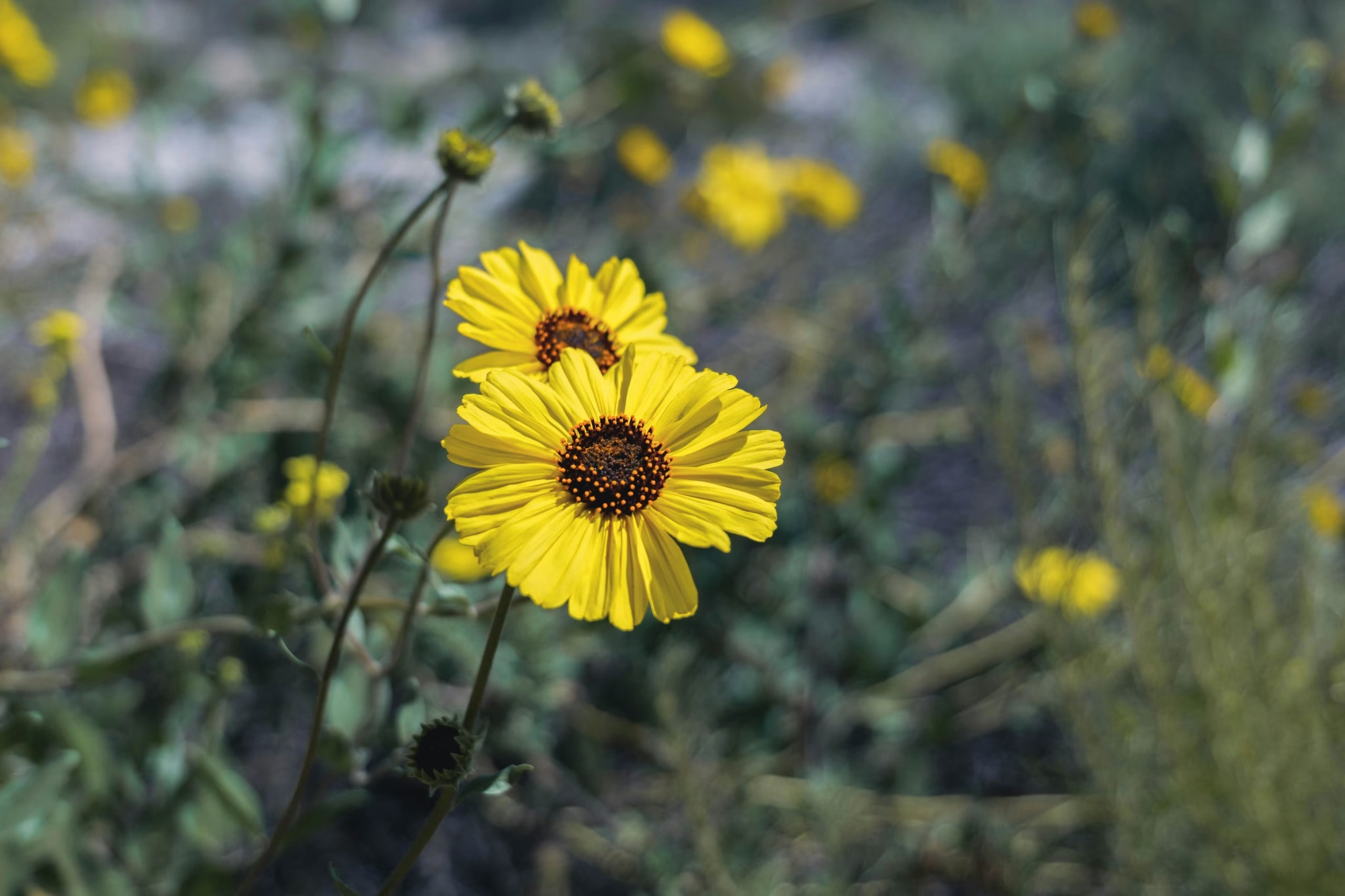
Asteraceae family. Yellow ray florets, plants up to three feet tall, blooming winter through spring in sandy desert soils and Creosote Bush Scrub.
Genus name comes from the Greek geraios, meaning “old man,” referring to the white hairs on the fruits. This is the species responsible for the yellow-blanket effect that defines a super bloom in 2016 and 2026 photography. NPS confirmed Desert Gold as one of the 2026 species in the March 16 bloom locations update for Badwater Road between CA-190 and Sidewinder Canyon.
Notch-leaf Phacelia (Phacelia crenulata)
Boraginaceae family (older classifications place it in Hydrophyllaceae). Violet to blue-purple flowers, three to twenty-four inches tall, blooming spring on sandy gravelly washes and slopes.
This is the species that supplies the purple half of the “yellow and purple hillsides” NPS describes for the 2026 bloom. Annual life cycle, which is why it shows up after wet falls and disappears after dry ones. Habitat spans Creosote Bush Scrub, Joshua Tree Woodland, and Pinyon-Juniper Woodland. Calscape lists it as Phacelia crenulata with the common name Cleftleaf Wild Heliotrope.
Caltha-leaf Phacelia (Phacelia calthifolia)
Boraginaceae family, sister species to Phacelia crenulata, also low-elevation.
NPS lists Caltha-leaf Phacelia as a typical Death Valley super-bloom species. Color falls in the same blue-violet range as P. crenulata, with leaves resembling those of Caltha (marsh marigold, hence the name). Both species can show up in the same wash, contributing to the saturated purple hillsides where conditions favor them.
Golden Evening Primrose / Yellow Cups (Chylismia brevipes)
Onagraceae family. Yellow four-petal flowers with eight yellow stamens, on tall stems often over twenty inches. Blooms March through May.
Habitat spans Mojave, Sonoran, and southern Great Basin deserts on dry washes, desert plains, rocky slopes, and creosote bush communities.
Taxonomy is messy: originally placed in Oenothera, then moved to Camissonia, then to Chylismia. NPS still uses Camissonia brevipes on the wildflowers page. Calflora and current Jepson Herbarium use Chylismia brevipes. I follow Calflora here because the project’s editorial guidelines treat it as the authoritative California taxonomy source.
Gravel Ghost (Atrichoseris platyphylla)
Asteraceae family. White to pink-tinged ray florets layered above a low basal rosette of rounded gray-green and purple leaves. Thin branching stems give the flowers a floating quality, hence the name.
Found across Creosote Bush Scrub in southern California, Arizona, Nevada, southwestern Utah, Sonora, and Baja California. Cited by name in the 2016 NPS press release as one of three species defining the bloom of that year, and confirmed in 2026 DVNHA Wildflower Reports 2 and 3. Also called Tobacco Weed and Parachute Plant.
Bigelow Monkeyflower (Diplacus bigelovii)
Phrymaceae family (formerly Scrophulariaceae). Magenta or deep pink corolla with darker red, purple, and yellow throat spots. Two to twenty-five centimeters tall.
Spring bloomer on desert and slope habitat. Reclassified from Mimulus to Diplacus; Calflora lists Mimulus bigelovii as not active. NPS still uses the older Mimulus bigelovii spelling on its wildflowers page.
Desert Five-Spot (Eremalche rotundifolia)

Malvaceae family. Rose-pink to lilac flowers with five petals, each marked with a dark red spot at the base. Eight to sixty centimeters tall.
Found in sandy and rocky washes in gravelly alkaline soils across the Sonoran and Mojave deserts at elevations from sea level to 1,500 meters. Flowers close at night and reopen in the morning, a useful tell for confirming the species against lookalikes.
Named in the 2016 NPS press release as one of three defining 2016 species, and cited again in 2026 DVNHA Reports and Stocktonia coverage.
Mojave Aster (Xylorhiza tortifolia)
Asteraceae family. Lavender, pale blue, or white ray florets, up to sixty per flower head, each over three centimeters across. Perennial herb or subshrub with branching, hairy, glandular stems, growing to two feet.
Habitat: dry canyons in Creosote Bush Scrub. NPS lists Mojave Aster as a mid-elevation species (3,000 to 5,000 feet) but cited it as a 2026 species at low-elevation Badwater Road locations in the March 16 update.
Mojave Aster’s lavender-purple supplies a complement to Phacelia‘s blue-purple in the field.
Bigelow’s Coreopsis (Leptosyne bigelovii)
Asteraceae family. Yellow disc florets at the center, five to ten yellow ray florets each up to 2.5 centimeters long, on plants ten to thirty centimeters tall. Spring bloomer.
Endemic to California, ranging from Merced and Inyo counties south to San Diego. Habitat includes Creosote Bush Scrub, Foothill Woodland, and Joshua Tree Woodland across the California Coast Ranges, southwestern Sierra Nevada, Transverse Ranges, and the Mojave and Colorado deserts.
Reclassified from Coreopsis bigelovii to Leptosyne bigelovii per current Jepson Herbarium. NPS uses both forms inconsistently.
Brown-eyed Evening Primrose (Chylismia claviformis)
Onagraceae family. Cited in DVNHA Wildflower Report 2 from February 1, 2026 and in 2024 species lists.
Same reclassification path as Chylismia brevipes: original placement in Oenothera, then Camissonia, now Chylismia per Calflora. The “Brown-Eyed Evening-Primrose” common name stays consistent across NPS, DVNHA, and Calflora literature even when the binomials drift.
Bloom-Year Comparison
Viewing Locations by Elevation Tier
NPS organizes Death Valley wildflower viewing by elevation. Low first, mid second, high last. The 2026 bloom concentrated almost entirely in the low tier, peaking from Ashford Mill to Salsberry Pass on Badwater Road. What follows is the verified-current viewing-area list as of NPS’s May 7, 2026 conditions update, with road-status caveats where they apply.
Tier 1: Low Elevation (Under 3,000 ft)
Badwater Road, Ashford Mill to Salsberry Pass. The corridor that delivered the 2026 yellow-and-purple hillsides. DVNHA Wildflower Report 3 rated this stretch 50 out of 100 on February 15, 2026. Specific zones noted in DVNHA Report 2: mile marker 1, miles 3 through 9, two miles north of Badwater. Open in 2026 with cautions per NPS conditions: loose gravel, soft shoulders, dust, large drops at shoulders, unpaved sections.
Furnace Creek Wash and Visitor Center area. Active viewing per DVNHA Report 2 from February 1. Specific spots: park entrance sign pullout (the flood control berm), the area next to the visitor center, the path to Furnace Creek itself. The road in is fully accessible.
Ashford Mill. Historic mining ruin south of Badwater, classic super-bloom photo zone in 2016 and 2026. Road open with cautions for soft shoulders.
Zabriskie Point. Open per the December 2025 NPS release that reopened Zabriskie Point, Dante’s View, Badwater Basin, and Mesquite Sand Dunes. Listed as a 2026 viewing area in DVNHA Report 2.
Dante’s View. Open in 2026. NPS specifically named Dante’s View as a wildflower hotspot in the 2024 spring release.
Mesquite Flat Sand Dunes. Open. Sand verbena territory, generally lower flower density than the Badwater corridor, but worth a stop at sunrise or sunset for the contrast between yellow flowers and dune shadow.
North Highway from Mud Canyon to Hells Gate. Reopened the week before DVNHA Report 2 (so late January 2026). NPS conditions page from May 7, 2026 still notes “loose gravel and missing shoulders from flood damage” remain on parts of the route. DVNHA called the first two miles plus the area near Grapevine Ranger Station “the best stretch.”
Beatty Cutoff Road, bottom third. Active 2026 viewing per DVNHA Report 2. Named in the 2016 NPS press release as a 2016 super-bloom corridor. Same road, two super blooms.
Tier 2: Mid Elevation (3,000 to 5,000 ft)
Daylight Pass Road. Open. Cited by the Las Vegas Review-Journal on February 4, 2026 as a viewing area. Mid-elevation blooming runs roughly mid-April through early May.
Towne Pass on CA-190 west. Open, the route into Panamint Valley. Bloom timing in this area runs late February through early April.
Panamint Valley. Cited as a major bloom zone in PopSci 2026 coverage and earlier in NPS’s March 25, 2024 release: “some locations in the park such as Panamint Valley are blanketed with dense concentrations of bright wildflowers.” Access via CA-190 west or Panamint Valley Road.
Father Crowley Vista. Open in 2026. PopSci coverage from March named it as a 2026 viewing location. Sits on the western edge of the park looking into Rainbow Canyon.
Tier 3: High Elevation (5,000 to 11,000 ft)
The high tier sits across the Panamint Range (Telescope Peak summits at 11,049 feet), the Cottonwood Mountains, and the Last Chance Range. NPS reports for 2026 noted “scattered flowers persisted at low elevations after the main bloom ended and flowers at higher elevations began to bloom in April.” That makes the high tier the May to July window. It is not the marquee super-bloom experience. The yellow-and-purple hillsides are a low-elevation phenomenon. The high-tier flora carries the season into early summer at lower density.
Roads Closed in 2026
Per the NPS conditions page updated May 7, 2026, the following remain closed or restricted, mostly from Hurricane Hilary 2023 damage and follow-on flooding:
- Bonnie Clare Road and Scotty’s Castle. “Due to flood recovery work. No access permitted, including pedestrians.” Reopening unknown, dependent on project completion.
- Lower Wildrose Road. Motorized vehicles prohibited (bicycles allowed). Likely closed until summer 2027.
- Darwin Falls Road. “Completely gone in many places.” Motorized vehicles prohibited. Hikers may park on CA-190 shoulder and walk in. Likely closed until summer 2027.
- Hunter Mountain Road. Extremely muddy with multiple stuck vehicles reported.
- Titus Canyon Road. Temporarily open after initial repairs. Second-phase closure scheduled October 1, 2026 through September 30, 2027.
- Phinney Canyon Road. Final 3 miles significantly washed out, impassable to all vehicles.
- Harry Wade Road. Deep sand approximately 6 miles south of Badwater Road junction. Caution.
Lake Manly Returned the Same Year
The same November 2025 storms that triggered the 2026 super bloom also pooled water in Badwater Basin. NASA Landsat 8 satellites imaged Lake Manly forming on November 7 and December 1, 2025. The lake is the temporary descendant of the Pleistocene-era inland sea that once filled the basin under hundreds of feet of water. Lake Manly surfaces only when fall and winter rainfall outruns the basin’s evaporation rate. The 2024 atmospheric river had brought it back briefly. The November 2025 storms brought it back alongside the bloom.
Park Ranger Abby Wines wrote in February 2024, the previous time Lake Manly returned, what stays accurate for 2026: “You might think with no drain to the sea, that Death Valley would always have a lake. But this is an extremely rare event.” Mike Reynolds, then Superintendent of Death Valley, added in March 2024: “Visitors for the next few years would prefer to see the natural polygon designs in the salt, rather than hard-crusted footprints and deep boat drag marks.” That guidance applies again. NPS has signed Badwater Basin as no-boating since the 2024 lake. The 2026 lake gets the same treatment.
Lake and bloom are paired phenomena, not coincidence. They share a trigger. Both 1998 and 2005 saw Lake Manly. NPS records do not mention a lake in 2016, but the rest of the cluster patterns hold. If you are tracking the next super bloom, watching for Lake Manly to surface in November-December imagery is one of the cleanest leading indicators. For the full Lake Manly story, including what kayaking access looked like during the 2024 lake and why it has been restricted since, the Lake Manly in Badwater Basin guide covers the geology, the visit logistics, and the boating restrictions in detail. The Badwater Basin guide covers the salt flat itself, including the 2005 flood reference. The Kayaking Death Valley guide covers the Hilary 2023 paddling window and current restrictions.
Practical Visit Information
Park entrance fee, 2026: $30 per private vehicle (7-day), $25 per motorcycle, $15 per person on foot or bicycle (age 16+). Annual passes: Death Valley Annual $55, America the Beautiful Annual $80, Senior Annual $20, Senior Lifetime $80. Military, Access, and 4th Grade Passes are free. The park does not accept cash. Credit, debit, and digital payments only. Source: nps.gov/deva/planyourvisit/fees.htm, last updated January 1, 2026.
Park hours: Open 24 hours, year-round. Visitors may enter or exit at any time per nps.gov/deva/planyourvisit/hours.htm.
Park phone: 760-786-3200. Mailing: P.O. Box 579, Death Valley, CA 92328. Press contacts: Matthew Lamar 760-786-3289, Nichole Andler 760-786-3279.
Furnace Creek Visitor Center is the central NPS facility. Open daily, hours commonly 8 AM to 5 PM. Services include ranger consultation, fee payment, the NPS bookstore, light snacks, the Junior Ranger program, the 20-minute park film, the famous thermometer, and ADA-assisted listening devices.
Stovepipe Wells Village is concessioner-operated by Destination Death Valley. The village includes the Toll Road Restaurant (recently renovated), the Badwater Saloon (full bar, lunch and dinner), a general store, hotel rooms with upgraded A/C, RV full-hookup sites, an NPS-operated tent campground nearby, a swimming pool and showers, and complimentary Wi-Fi at concession buildings. The Stovepipe Wells gas station has 24/7 fuel access at the pump (credit/debit only) and DC fast-charging since fall 2024. Address: 51880 Hwy 190, Death Valley, CA.
Gateway Towns
| Town | Direction | Notes |
|---|---|---|
| Lone Pine, CA | West (CA-190) | Best resupply for a Sierra-bound trip; Owens Valley gateway |
| Beatty, NV | North (NV-374) | Closest gas and lodging on the north side |
| Pahrump, NV | East (NV-160) | Larger Nevada town with full services |
| Las Vegas, NV | East/Southeast | About two hours; major airport |
| Shoshone, CA | South (CA-127) | South-end gateway; small village |
| Tecopa, CA | South (CA-127) | Smaller; near Shoshone |
Cell Service, Heat, and Etiquette
Cell coverage is very limited inside the park. Furnace Creek and Stovepipe Wells have spotty 4G via concessioner Wi-Fi or roaming. Most of the park is dead zone. Plan navigation offline. Download Google Maps or Gaia GPS coverage of the park before entering.
Heat math. The bloom window (mid-February through mid-April) is also the only safe casual-visitor window. By mid-April average highs are 90°F. By early May, 100°F. After early May, the park is unsafe for most casual hiking activity outside dawn hours. The 1913 record of 134°F still stands as the official Furnace Creek high. The 2001 record of 154 consecutive days at or above 100°F stands as the practical heat-stress benchmark.
Visitor etiquette from the 2024 NPS spring release applies to every super bloom: “Stay on the trail and let wildflowers prevail. If you are in a trailless area, walk on durable surfaces like rock and bare sand. Picking wildflowers is prohibited; removing flowers means fewer seeds and fewer future blooms to enjoy next year.” Also: “When parking along the road to take photos or to hike, be sure to pull completely onto the shoulder and watch for traffic.” The Andler quote on “the heat and the wind” carries through here. Even in a normal year, the spring window can collapse fast.
What to Watch for the Next One
The arithmetic of the four-bloom canon places the next likely Death Valley super bloom somewhere between 2034 and 2037, on the historic 9.3-year average. That is not a forecast. It is a probability frame. The actual trigger is the October-December rainfall window, and it will hit when it hits.
Three signals to watch for, in order of priority:
Signal one: October-December cumulative rainfall at Furnace Creek. The historic super-bloom threshold is three to eight times the normal 0.4-inch fall total. Twenty inches above normal across that three-month window is a very strong signal. Five inches above is a real possibility flag. The National Weather Service Las Vegas forecast office covers Furnace Creek. Their climate book at weather.gov/vef/deathvalley_climatebook is the authoritative ongoing record.
Signal two: half-inch single-storm events. The seed-coating threshold means total rainfall is less important than individual storm intensity. Two storms of 0.6 inches each beat ten storms of 0.1 inches each, even though the totals are equivalent. November 2025 had multiple half-inch-plus events in its 1.76-inch month. October 2015 had the famous one: 3 inches in 5 hours in one area.
Signal three: Lake Manly imagery. If NASA Landsat 8 catches Lake Manly forming in Badwater Basin in November-December imagery, you have a leading indicator that the precipitation has been heavy enough. Lake and bloom share a trigger. Watching the lake is watching the seeds.
Set the alert. Watch DVNHA’s Wildflower Reports starting in mid-January (dvnha.org). Watch the NPS press releases at nps.gov/deva/learn/news. When the words “preliminary signs of an above-average bloom” appear from David Blacker or his successor, you have roughly six weeks before peak. Plan accordingly: reserve early and skip the late March extension. The 2026 lesson is that the heat-and-wind window arrives earlier each cycle.
Tools and Books for the Next Super Bloom
The right reference book and a few field tools turn a wildflower trip from “look at all the yellow” into species-level identification you can recall and write down. What follows are the references I use, with Amazon links for convenience.
Sonoran Desert Wildflowers (Falcon Guide). The field guide that covers most low-elevation Death Valley species accurately. Color photos, range maps, blooming-window data. Compact enough for a daypack.
Nikon ACULON A211 10×42 binoculars. Useful at viewing pullouts where the flowers are too far off the road for hand-camera identification. Ten-times magnification is the working point for wildflower work. Anything more requires a tripod.
Home Prefer wide-brim sun hat. Death Valley sun is not optional shade. Wide brim, UPF 50, breathable. Cheap and effective.
Osprey Talon 22L. Daypack with hydration sleeve. Twenty-two liters carries the binoculars, the field guide, four liters of water, layers for cold mornings, snacks, sunscreen, and a first-aid kit. Roomy enough without being bulky.
Black Diamond Spot 400 headlamp. Sunrise and sunset are the right photography windows for the bloom. Spot 400 has a red mode for preserving night vision and 400 lumens of white when you need it. Useful when you arrive before dawn or stay past dusk.
Frequently Asked Questions
Is there a super bloom in Death Valley right now?
No. The 2026 Death Valley super bloom ended around March 17 to 25, 2026. NPS Park Ranger Nichole Andler told the Las Vegas Review-Journal on March 25 that “the superbloom is over,” citing record heat (107°F that day, an all-time March record) and drying winds. NPS reported in April that “scattered flowers persisted at low elevations after the main bloom ended” while higher-elevation flowers began. As of May 2026, the marquee yellow-and-purple hillsides are gone for the year.
When was the last super bloom in Death Valley?
The 2026 super bloom is the most recent. It is the fourth NPS-documented Death Valley super bloom on record, following 1998, 2005, and 2016. NPS officially classified 2026 in this list when the wildflowers page at nps.gov/deva/learn/nature/wildflowers.htm was updated on May 6, 2026. Before 2026, the most recent was 2016.
When is the next super bloom in Death Valley?
The historic average gap between Death Valley super blooms is 9.3 years (1998 to 2005 was 7 years, 2005 to 2016 was 11, 2016 to 2026 was 10). On that arithmetic, the next likely window is 2034 to 2037, but the actual trigger is October-December rainfall three to eight times the normal 0.4-inch fall total at Furnace Creek. Watch DVNHA’s Wildflower Reports starting in January and NPS press releases at nps.gov/deva/learn/news.
What caused the 2026 Death Valley super bloom?
A record-breaking November 2025 storm. Death Valley received 1.76 inches of rain in November 2025 alone, breaking a 102-year-old record (1.70 inches in 1923) and clearing the November normal of 0.10 inches by 17.6 times. September through November 2025 totaled 2.41 inches, also a fall record. NASA Landsat 8 imaged Lake Manly forming on November 7 and December 1, 2025. The wet fall met NPS’s three super-bloom conditions: well-spaced rainfall, sufficient warmth, lack of drying winds. The first two held through February. The third failed in late March.
What flowers bloom during a Death Valley super bloom?
The marquee species is Desert Gold (Geraea canescens), the yellow ray-floret species responsible for the yellow-blanket effect on Badwater Road. Notch-leaf Phacelia (Phacelia crenulata) supplies the purple half. Other low-elevation species seen in 2026 included Caltha-leaf Phacelia (P. calthifolia), Golden Evening Primrose (Chylismia brevipes), Gravel Ghost (Atrichoseris platyphylla), Bigelow Monkeyflower (Diplacus bigelovii), Desert Five-Spot (Eremalche rotundifolia), Mojave Aster (Xylorhiza tortifolia), Bigelow’s Coreopsis (Leptosyne bigelovii), and Brown-eyed Evening Primrose (Chylismia claviformis).
Where is the best place to see Death Valley wildflowers?
For low-elevation peak bloom in a super bloom year (mid-February through mid-April), the southern stretch of Badwater Road from Ashford Mill to Salsberry Pass is the marquee corridor. Furnace Creek Wash, Zabriskie Point, Dante’s View, Mesquite Flat Sand Dunes, the Mud Canyon corridor, and the bottom third of Beatty Cutoff Road are also classic. For mid-elevation flowers from mid-April through early May, Daylight Pass Road, Towne Pass on CA-190, Panamint Valley, and Father Crowley Vista are the main locations.
How long does a Death Valley super bloom last?
The 2016 super bloom ran into mid-March before higher-elevation flowers took over. The 2026 super bloom died March 17 to 25, ending about four to six weeks earlier than 2016 because of an early heatwave. Practical peak window is mid-February through mid-March, with mid-April through early May offering mid-elevation continuation in many years and May through July at high elevations when conditions hold. The early-end pattern is intensifying because the spring heat-and-wind window is arriving earlier with each cycle.
Why did the 2026 Death Valley super bloom end early?
Heat and wind. NPS condition three for super blooms is “lack of drying winds,” and that condition failed in late March 2026. Daily highs hit 100°F by March 17, weeks ahead of when that threshold normally arrives. March 25 reached 107°F, an all-time March record beating 104°F set on March 26, 2022. The Las Vegas Review-Journal cited climate research that calls these temperatures “five times more likely because of climate change and carbon emissions from the burning of fossil fuels.” The 2016 bloom ran into mid-March; 2026 died four to six weeks earlier.
Was 2024 a Death Valley super bloom?
No. NPS classified 2024 as “a ‘good bloom’ is likely, but not a superbloom” in their February 8, 2024 press release. The 2024 wildflowers were unusually robust because they germinated after Hurricane Hilary’s late-summer rainfall in August 2023, survived a warm winter, and got recharged by the February 2024 atmospheric river. The bloom was notable but did not reach the Geraea canescens-blanket density NPS reserves the super-bloom term for.
How much does it cost to visit Death Valley?
Park entrance fee in 2026 is $30 per private vehicle for a 7-day pass, $25 per motorcycle, or $15 per person on foot or bicycle. Annual passes: $55 for the Death Valley Annual Pass, $80 for the America the Beautiful Annual Pass. Senior Lifetime is $80, Senior Annual is $20. Military, Access, and 4th Grade passes are free. The park does not accept cash; credit, debit, and digital payments only.
Is Lake Manly still in Death Valley in 2026?
NASA Landsat 8 imaged Lake Manly forming in Badwater Basin on November 7 and December 1, 2025. As of early 2026 reports, water remained in the basin. Levels and access shift over time as the basin evaporates. NPS prohibits boating; the salt flat near the lake is signed against walking in wet areas because footprints can take years to disappear. For the full Lake Manly story, see the dedicated Lake Manly guide.
Will Death Valley have a super bloom in 2027?
The historic Death Valley super bloom cadence averages 9.3 years per cycle. The most recent super bloom was 2026. Statistically, 2027 is unlikely to deliver a second consecutive super bloom in the same park, because seed banks need time to recharge and the October-December rainfall pattern that triggers a super bloom does not typically repeat in back-to-back years. Watch the National Weather Service Las Vegas forecast for fall 2027 rainfall at Furnace Creek to see whether the precipitation conditions are setting up for an above-average bloom.
Bottom Line
The 2026 Death Valley super bloom is now the fourth entry on a four-entry list. NPS confirmed it on May 6, 2026 when the wildflowers page was updated to add 2026 alongside 1998, 2005, and 2016. The bloom ran from about February 15 to March 17, peaked across the southern Badwater Road corridor from Ashford Mill to Salsberry Pass, and was killed by record March heat (107°F on March 25, an all-time March mark) before most of the people who heard about it could plan a trip. The trigger was the November 2025 storm that broke a 102-year-old precipitation record set in 1923. Lake Manly returned the same year, on the same trigger, in the same basin.
What changes between 2016 and 2026 is duration, not cadence. Super blooms still average roughly once per decade. They are getting shorter as the spring heat-and-wind window arrives earlier each cycle. The next one will most likely fall between 2034 and 2037 if the precipitation cooperates. Watch the November rainfall at Furnace Creek. Watch DVNHA’s Wildflower Reports starting in January. Reserve early. Skip the late March extension. The 2026 lesson is that the window closes faster than the press cycle does.
Affiliate Disclosure: Some links in this article are affiliate links. If you buy a product through one of these links, MK Library may earn a small commission at no additional cost to you. We only recommend products we use and trust. This helps support our work and allows us to continue creating in-depth guides like this one.
Article Updates
- May 8, 2026: Article published. Coverage spans the four-bloom canonical record (1998, 2005, 2016, 2026), the November 2025 record-breaking storm trigger, the 2026 timeline from January 14 DVNHA preliminary signs through March 25 NPS Andler closure quote, the climate-change throughline on early-end duration, the science of NPS’s three super-bloom conditions, a ten-species low-elevation field guide with Calflora-verified taxonomy, viewing locations across all three elevation tiers with current 2026 closure status, the paired Lake Manly phenomenon, and a 12-question FAQ section. Two inline SVGs (bloom-year comparison chart, viewing-area schematic by elevation tier).
Related Coverage
The bloom story sits within a broader Death Valley cluster on this site. Each piece covers a different angle on the same wet-winter cycle:
- 2026 California Super Bloom Wildflowers Guide. The statewide hub covering Carrizo Plain, Anza-Borrego, Antelope Valley, Theodore Payne Hotline reports, and how 2026 played out across California.
- Visiting Lake Manly in Badwater Basin. The temporary lake that returned in November 2025 alongside the bloom. Geology, history, and the post-Hilary boating restrictions.
- Badwater Basin in Death Valley National Park. The salt flat itself, including the 2005 flood reference and how the basin behaves between wet years.
- Kayaking Death Valley National Park. The Hilary 2023 paddling window, why kayaking has been restricted since, and the brief 2024 lake.
- Anza-Borrego Wildflowers. The Sonoran/Colorado Desert counterpart, with the 2026 status and the post-Hilary Coyote Canyon closure.