

Two camphor trees grow on my block, and I love them from a safe distance. They are massive, fragrant, green year-round, and absolutely stunning shade trees. They are also vigorous growers, prolific seeders, and capable of cracking a sidewalk in half. The camphor tree (Cinnamomum camphora) is that kind of tree. Beautiful and complicated.
This guide covers everything you need to know about growing and caring for a camphor tree, including honest advice about whether you should plant one at all. If you live in California, especially the Sacramento Valley, you have probably seen these trees lining older neighborhoods. They thrive here. Whether that is a good thing depends on who you ask.

Table of Contents
- Key Takeaways
- What Is a Camphor Tree?
- A Brief History of the Camphor Tree
- Camphor Tree Uses
- How to Grow a Camphor Tree
- Camphor Tree Growth Rate and Lifespan
- Pruning Your Camphor Tree
- Camphor Tree Problems
- Are Camphor Trees Invasive?
- Should You Plant a Camphor Tree?
- Camphor Tree Toxicity
- Camphor Tree FAQ
- Article Updates
Key Takeaways
- Size and spread: Camphor trees generally reach 50 to 65 feet tall with a canopy spread of 50 to 60 feet. Some specimens grow past 100 feet.
- Growth rate: Rapid in the first few years, then approximately 24 inches per year. Seedlings can reach 4 to 5 feet in a single growing season.
- Hardiness zones: USDA zones 9 through 11 and Sunset Zones 8, 9, and 14. The Sacramento Valley and much of coastal California fall within these ranges.
- Lifespan: Usually 50 to 150 years, though Japanese specimens have survived for over 1,000 years.
- Invasive status: Classified as a Category I invasive pest in Florida and listed as invasive in Texas. Not classified as invasive in California, but spreads readily through bird-dropped seeds.
- Uses: The tree produces camphor oil, used in products like Tiger Balm, Vicks VapoRub, and traditional medicine. The wood is valued for furniture and chests.
- Toxicity: Toxic to humans in large doses and toxic to dogs and cats. Topical products at controlled concentrations are safe.
- Root damage potential: High. Powerful roots extend well beyond the canopy and can crack sidewalks, driveways, and foundations. Plant at least 18 feet from structures.
What Is a Camphor Tree?
The camphor tree is an evergreen in the Laurel family (Lauraceae), native to China, Japan, and Taiwan. You will also see it called camphor laurel or by its botanical name, Cinnamomum camphora. All three names refer to the same species.
Most camphor trees reach 25 to 50 feet in residential settings, though specimens in ideal conditions can stretch past 100 feet. The canopy spreads wide, often matching or exceeding the tree’s height, which is why mature camphors dominate their surrounding landscape.
Bark: Young camphor trees have smooth, greenish bark. As the tree matures, the bark turns gray-brown and develops deep vertical fissures, giving older specimens a rugged, textured appearance.
Leaves: Glossy, oval, and waxy to the touch. New growth comes in light green or even pinkish-red before deepening to dark green. Each leaf has three distinct veins running from the base. Crush one between your fingers and you will immediately smell the camphor oil. That scent is the tree’s signature.

Flowers: Small, greenish-white to pale yellow blooms appear on three-inch panicles in spring. They are easy to overlook, but pollinators find them.
Drupes: What most people call camphor tree berries are technically drupes. Small, dark-blue to black, about pea-sized. They are not edible for humans, but birds devour them. This is how camphors spread so effectively. A single bird can deposit seeds across an entire neighborhood.
Smell: Camphor has a sharp, medicinal-minty aroma with woody undertones. If you have ever used Tiger Balm or Vicks VapoRub, you know the scent. It is clean, cooling, and unmistakable. Cut a branch or even brush against the foliage and you will carry that smell on your hands for an hour.
| Botanical Name | Cinnamomum camphora |
| Common Names | Camphor tree, camphor laurel, camphorwood |
| Plant Type | Evergreen tree |
| Mature Size | 50-65 ft. tall, 50-60 ft. wide |
| Growth Rate | Rapid when young, then ~24 in/year |
| Lifespan | 50-150 years (some specimens 1,000+) |
| Sun Exposure | Full sun to partial shade |
| Soil Type | Moist, fertile; tolerates clay, loam, or sand |
| Soil pH | Slightly acidic to highly alkaline |
| Bloom Time | April |
| Flower Color | Greenish-white to pale yellow |
| Hardiness Zones | USDA 9-11, Sunset 8, 9, 14 |
| Native Area | China, Japan, and Taiwan |
| Toxicity | Toxic to people, toxic to cats, toxic to dogs |
A Brief History of the Camphor Tree
Camphor trees have been intertwined with human civilization for thousands of years. Marco Polo observed camphor being used in China during the 13th century. Egyptians incorporated camphor into their embalming practices. During the Black Death, Europeans burned camphor as a fumigant, believing its pungent smoke could ward off plague.
The real camphor story, though, belongs to Taiwan. At its peak in the late 1800s, Taiwan produced roughly 70% of the world’s natural camphor supply. The compound was not just a folk remedy. It was an industrial necessity. Camphor was a critical ingredient in celluloid (the first commercial plastic, used in everything from film stock to billiard balls), smokeless gunpowder, and early lacquers. Japan’s colonization of Taiwan in 1895 was motivated in no small part by controlling the camphor trade. For decades, Taiwan was known as the “Camphor Kingdom.”
The camphor tree arrived in the American South in 1875, planted on plantations for the same purpose: harvesting camphor oil from leaves and bark. The oil is extracted through steam distillation and has been used as a liniment in products like Tiger Balm, as an insect repellent, and to relieve chest congestion.
Camphors are also staggeringly long-lived. The best examples are in Japan. The Shoren’in Shrine in Kyoto has a camphor tree that is several hundred years old, designated as a city natural monument. Another at Yamada Shrine in Tottori was reportedly planted more than 1,000 years ago. The oldest may be the specimen at Kawago in Takeo City, Japan’s fifth-largest tree and supposedly more than 3,000 years old.
Perhaps the most powerful story belongs to Hiroshima. In 1973, Japan named the camphor the official tree of the city in honor of the trees that recovered after the atomic bombing. As those trees sprouted new leaves and bark from scorched trunks, they gave people hope to rebuild. Few trees carry that kind of history.
Camphor Tree Uses
The camphor tree has been harvested for centuries, and its uses stretch well beyond the medicine cabinet.
Camphor oil: Extracted through steam distillation of the wood, leaves, and bark. The oil comes in several grades. White camphor (the most refined) is used in medicinal products. Yellow and brown camphor contain higher concentrations of safrole and are used industrially. Blue camphor is the rarest grade.
Medicinal and topical: You will find camphor in Tiger Balm, Vicks VapoRub, chest rubs, and topical pain relievers. At controlled concentrations (usually 3% to 11%), it works as a mild analgesic, decongestant, and anti-inflammatory agent. The cooling sensation is the camphor activating cold-sensitive receptors in your skin.
Insect repellent: Camphor blocks have been placed in closets and drawers for generations to repel moths. The strong aroma also discourages mosquitoes, which is why camphor-based repellents remain common across Asia.
Woodworking: Camphorwood is prized for furniture, storage chests, and decorative pieces. The natural insect-repelling properties of the wood make camphorwood chests popular for storing wool and linen. The grain is attractive, and the wood carries a faint camphor scent for years after milling.
Spiritual and ceremonial: Camphor is burned in Hindu and Buddhist ceremonies as a purification ritual. The crisp, bright fragrance and the fact that camphor burns completely (leaving no residue) make it symbolically significant in these traditions.
Culinary (with caveats): In parts of East Asia, young camphor leaves are consumed as greens, and the roots have been brewed into tea. Camphor is also a traditional ingredient in Szechuan smoked duck. However, camphor is toxic in large quantities, and none of these uses should be attempted without understanding proper preparation and dosing.
How to Grow a Camphor Tree
If you are in California, the Central Valley or along the coast, your climate is almost tailor-made for camphor trees. They grow in Sunset Zones 8, 9, and 14, which covers Sacramento, the Bay Area, and most of the Southern California coast. In broader terms, camphor trees are hardy in USDA zones 9 through 11.
Camphor trees prefer full sun but tolerate partial shade. They are flexible on soil, accepting clay, loam, or sand with a pH range from slightly acidic to highly alkaline. The one thing they genuinely need is moisture when young. Once established, they become reasonably drought tolerant, which is another reason they do so well in California’s Mediterranean climate. If you are on the edge of zone 9, our guide to protecting trees from frost is worth reading.
Salt tolerance is moderate on the coast, and seaside tolerance is generally good in milder zones. If you are planting near the ocean, they will handle the conditions better than most shade trees their size.
The critical consideration is not where to plant a camphor tree. It is where not to plant one. Their root systems are relentless, and a mature camphor planted too close to infrastructure will cause damage. The Sacramento Tree Foundation recommends these minimum setback distances:
| Plant Away From | Minimum Distance |
| House foundation | 18 feet |
| Sidewalks and driveways | 8 feet |
| Swimming pools | 25 feet |
| Fences | 6 feet |
| Power lines | 30 feet |
| Other camphor trees | 30 feet |
Plant camphor trees in spring for the best results. Container-grown or bare-root stock both work. Dig the hole twice the width of the root ball and at the same depth. Water deeply after planting and keep the soil consistently moist through the first growing season. Not sure if a camphor fits your yard? Our guide to the best trees for small yards covers shade trees that work in tighter spaces.
Camphor Tree Growth Rate and Lifespan
Camphor trees grow fast, especially when young. In my own yard, I have watched camphor seedlings (dropped by birds) shoot from nothing to 4 or 5 feet in a single growing season. After the first few years, growth slows to about 24 inches per year, which is still a solid clip for a shade tree.
Because they grow quickly and can reach 50 to 65 feet tall with a canopy just as wide, you need to think carefully about placement. A camphor planted 10 feet from your garage will become a problem within a decade. If you have a sidewalk nearby, those roots will find it.
Watch for “strays” that pop up around your yard. Birds will deposit seeds everywhere, and each one can become a new tree surprisingly fast. Pull camphor seedlings the moment you spot them, and remove every bit of root. Leave even a fragment behind and it will regrow. Skip a season of pulling and you will end up with your own camphor tree plantation.
As for lifespan, camphor trees live anywhere from 50 to 150 years. That is a wide range, and it depends heavily on climate, disease pressure, and maintenance. But the outliers are extraordinary. Japan has camphor specimens that are several centuries old, and the ancient camphor at Kawago in Takeo City has been standing for an estimated 3,000 years. Even in an average residential setting, a well-maintained camphor can easily outlive the people who planted it.
Pruning Your Camphor Tree
Your camphor will need regular trimming when young and only occasional attention once it matures. Removing low branches early encourages a compact, manageable canopy. Let it go unpruned and the tree develops a wide, open canopy that can droop significantly under its own weight.

Cut branches back to where they originate. Make precise cuts flush to the stem with sterilized pruning shears. Pruning branches near the base helps develop a single, strong main trunk. Then thin branches on the trunk so they stand every 18 to 30 inches apart.
You can remove damaged or diseased limbs at any time of year. If the tree is outgrowing its space, prune it back in winter to control the spread. Do not top your camphor tree. The same rule applies to crepe myrtles and most shade trees. Blunt-cutting the crown leads to weak regrowth and dead branches that are far more likely to fall later.
A chainsaw is not a pruning tool. There are situations where careful, professional trimming is the right call. If your camphor is large enough to need more than hand shears and a pole saw, hire someone who knows what they are doing. You will end up with a healthier, safer tree.

Camphor Tree Problems
I will not sugarcoat this section. Camphor trees have real downsides, and you should understand them before planting one.
Root invasion: This is the single biggest complaint from camphor tree owners. The root system extends well beyond the canopy drip line and is strong enough to lift sidewalks, crack driveways, and buckle foundations. If you already have root damage, add tree inspection to your home maintenance checklist. If your camphor is within 15 feet of any hardscape, expect problems eventually. This is also why they are poor choices near pools, septic systems, and sewer lines.
Allelopathy: Camphor trees release chemicals from their roots and decaying leaves that suppress the growth of surrounding plants. Walk under a mature camphor and you will often notice sparse ground cover compared to other shade trees. This allelopathic effect also means the soil can remain hostile to other plants even after you remove the tree. If you are planning a garden bed within a camphor’s root zone, prepare for disappointing results.
Pests: The camphor shot borer is the primary insect threat. This beetle targets stressed trees, boring into trunks and branches and disrupting the tree’s ability to move water and nutrients. The redbay ambrosia beetle is a newer concern. It carries the fungus that causes laurel wilt disease (more on that below). Scales and mites can also affect foliage, though they are rarely fatal.
Diseases: Camphor trees are susceptible to several fungal diseases: anthracnose, armillaria, phytophthora, and verticillium wilt. Sooty mold is common but mostly cosmetic, covering leaves with a dark film that reduces photosynthesis. Root rot can be lethal in poorly drained soils.
The emerging threat is laurel wilt disease, caused by the fungus Raffaelea lauricola and spread by the redbay ambrosia beetle. This disease has been devastating Lauraceae family trees across the southeastern United States. Camphor trees are susceptible. In Sacramento, the well-known Java City camphor tree died from verticillium wilt, a reminder that even established urban camphors are not immune to disease. If you notice sudden wilting or branch dieback, consult a certified arborist immediately.
Branch drop: Large limbs on older camphor trees can fail without warning, especially if the tree was topped or improperly pruned in the past. Regular professional inspection is the best prevention.
Are Camphor Trees Invasive?
Yes, in several parts of the world. The severity depends on where you live.
Florida: Camphor trees carry a Category I designation from the Florida Exotic Pest Plant Council, the most severe invasive classification. They are listed as a Class 1 invasive pest. The trees are most damaging in north and central Florida, where they displace native species including the endangered Florida jujube (Ziziphus celata). In south Florida, the classification shifts to “caution,” but the ecological concerns remain.
Texas: Camphor trees are listed as invasive in Gulf Coast counties and are recognized by the Texas Invasive Species Institute. They spread through the same bird-dispersal mechanism that makes them problematic throughout the Southeast.
Australia: Introduced in 1822, the camphor laurel became a noxious weed across Queensland and New South Wales. Australia’s camphor problem is arguably worse than America’s.
California: Camphor trees are not classified as invasive here, but anyone who owns one knows they spread. I find camphor seedlings in my yard constantly, deposited by birds. Left alone, each one would grow into a full tree within a few years. The difference is that California’s drier climate and different native ecology keep them from becoming the same kind of ecological threat they pose in Florida’s subtropical forests.
If you need to remove a camphor tree, here are the proven removal methods. Always check local tree removal ordinances before you start.
- Stump treatment: Cut the tree down and immediately apply herbicide (glyphosate or triclopyr) to the fresh-cut stump surface. Timing matters. Apply within 30 minutes of cutting or the stump begins to seal.
- Basal bark spray: For smaller trees (under 6 inches in diameter), apply triclopyr mixed with oil to the bark around the base. This works without cutting the tree first.
- Seedling control: Pull young saplings by hand before they establish deep roots. This is the simplest and most reliable long-term strategy. Check your yard monthly during the growing season.
- Root removal: For complete elimination, excavate and remove as much of the root system as possible after felling. This is labor-intensive and may require heavy equipment, but it prevents regrowth.
The environmental effects of planting non-native trees is a topic worth understanding before adding any exotic species to your landscape.
Should You Plant a Camphor Tree?
The online consensus on camphor trees is that there is no consensus. People either love them or hate them. I fall somewhere in between. I love looking at the two camphor trees on my block from a safe distance. I get the shade benefits without dealing with the pruning, the seedling patrol, or the pesky camphor “minions” that sprout in every garden bed within a hundred-yard radius.
My cautious advice: only plant a camphor if you have the space, the patience, and the budget. Plant one (just one) in the largest open area of your yard, where it will provide maximum shade in summer. Keep it at least 18 feet from your house and 8 feet from any sidewalk or driveway. After planting, have a professional inspect and shape the young tree so it develops a strong central leader and a manageable canopy.
If a camphor is not the right fit, and for many yards it genuinely is not, these are similar trees worth considering. If you want something native that will not cause the same headaches.

Native Alternatives to Camphor Trees
| If You Want… | Consider Instead | Why |
| Large shade tree | Valley oak (Quercus lobata) | Native to the Central Valley, massive canopy, no invasive risk |
| Evergreen shade | Coast live oak (Quercus agrifolia) | Evergreen, drought tolerant, supports native wildlife |
| Fragrant foliage | California bay laurel (Umbellularia californica) | Same Laurel family, aromatic leaves, native to California |
| Ornamental beauty | Southern magnolia (Magnolia grandiflora) | Evergreen, broad waxy leaves, showy white flowers |
| Fast-growing native | Toyon (Heteromeles arbutifolia) | California native, fast growth, red berries attract birds |
For homeowners in the Southeast, native alternatives include live oak, wax myrtle, Dahoon holly, and winged elm. These provide similar shade and wildlife value without the invasive concerns.
Curious about other trees for your yard? We have guides to dogwood trees, maple tree varieties, and a comparison of the best trees for both summer shade and winter sun. If you are looking at another controversial “love it or hate it” shade tree, read our piece on sweetgum liquidambar trees before you commit.
Camphor Tree Toxicity
Camphor is toxic. The severity depends on the dose and the species exposed.
Humans: Ingesting raw camphor can cause nausea, vomiting, and abdominal pain. In larger doses, it can trigger convulsions and respiratory distress. Children face the greatest risk because even small amounts relative to body weight can be dangerous. The leaves, bark, and wood should not be consumed internally without proper guidance.
Dogs and cats: Camphor is toxic to both. Symptoms of ingestion include drooling, vomiting, diarrhea, and lethargy. If your pet chews on camphor bark, leaves, or drupes, contact your veterinarian or the Pet Poison Helpline immediately.
Birds: Extremely sensitive. In one documented case, 49 budgerigars in an aviary died within 24 hours from exposure to a camphor tree’s volatile compounds. If you keep birds, do not place aviaries near camphor trees.
The important nuance: Topical camphor products like Tiger Balm and Vicks VapoRub are safe at their formulated concentrations, generally 3% to 11%. The danger is with raw camphor from the tree, which is far more concentrated. The drupes’ bitterness naturally discourages human consumption, but pets and small children do not always make that distinction. Traditional Chinese medicine also contraindicates camphor during pregnancy.
Camphor Tree FAQ
Are camphor trees invasive?
Yes. Camphor trees are classified as Category I invasive in Florida and listed as invasive in Texas and parts of the Gulf Coast. They are also a serious invasive weed in Australia. In California, they are not formally classified as invasive but spread readily through bird-dropped seeds. The trees displace native plants and can dominate an area once established.
How fast do camphor trees grow?
Camphor trees grow rapidly in their first several years. Seedlings can reach 4 to 5 feet in a single growing season. After the initial growth spurt, the rate settles to around 24 inches per year. A camphor can reach 25 to 50 feet at maturity, with some specimens exceeding 100 feet in ideal conditions.
How long do camphor trees live?
Most camphor trees live 50 to 150 years. However, exceptional specimens in Japan have survived for centuries. The camphor tree at Kawago in Takeo City is estimated to be over 3,000 years old and is Japan’s fifth-largest tree. In a typical residential setting, a healthy camphor can easily outlive the homeowner who planted it.
Are camphor tree berries edible?
No. Camphor tree drupes (commonly called berries) are toxic to humans and should not be eaten. They contain camphor compounds that can cause gastrointestinal distress. Birds, however, eat them without apparent harm and are the primary way camphor trees spread to new locations.
How far should you plant a camphor tree from your house?
At least 18 feet from your house foundation. Camphor tree roots are powerful enough to crack foundations, buckle driveways, and damage underground utilities. The Sacramento Tree Foundation recommends 8 feet from sidewalks, 25 feet from pools, and 30 feet from power lines. When in doubt, add more distance.
Are camphor trees toxic to dogs?
Yes. All parts of the camphor tree are toxic to dogs, including the bark, leaves, and drupes. Symptoms of camphor poisoning in dogs include drooling, vomiting, diarrhea, and lethargy. If your dog ingests any part of a camphor tree, contact your veterinarian or the Pet Poison Helpline immediately.
What does camphor smell like?
Think of Tiger Balm or Vicks VapoRub. That minty, medicinal bite with a woody base is camphor. The fragrance is penetrating and unmistakable. Crush a leaf between your fingers and the smell hits instantly, strong enough to stay on your skin for an hour afterward.
How do you kill or remove a camphor tree?
The best approach is to cut the tree and immediately apply herbicide (glyphosate or triclopyr) to the fresh stump within 30 minutes. For smaller trees, basal bark spray works without cutting. Always remove seedlings by hand before they establish deep roots. Check local tree removal ordinances before beginning, as some areas require permits.
Can camphor trees grow in California?
Camphor trees thrive in California. They grow well in Sunset Zones 8, 9, and 14, which covers the Sacramento Valley, San Francisco Bay Area, and much of the Southern California coast. Sacramento’s climate, with warm summers and mild winters, is ideal for camphor trees. Many older California neighborhoods feature mature camphor trees as street and shade trees.
What is a camphor laurel?
Camphor laurel is simply another common name for the camphor tree (Cinnamomum camphora). The “laurel” refers to the tree’s membership in the Lauraceae (Laurel) family. Camphor tree, camphor laurel, and Cinnamomum camphora all refer to the same species. The name “camphor laurel” is used more commonly in Australia.
What are the benefits and uses of camphor?
Camphor oil is used in topical pain relievers (Tiger Balm), decongestants (Vicks VapoRub), and insect repellents. The wood is valued for furniture and storage chests because of its natural insect-repelling properties. Historically, camphor was an industrial ingredient in celluloid film, smokeless gunpowder, and early plastics. It remains important in Hindu and Buddhist ceremonial practices.
Are camphor trees good shade trees?
Camphor trees are excellent shade trees. Their evergreen canopy, which can spread 50 to 60 feet wide, provides year-round coverage. The dense foliage blocks significant sunlight. However, the forceful root system, invasive potential, and maintenance requirements mean they work best on large properties where they have room to spread without causing structural damage.
Pin This!
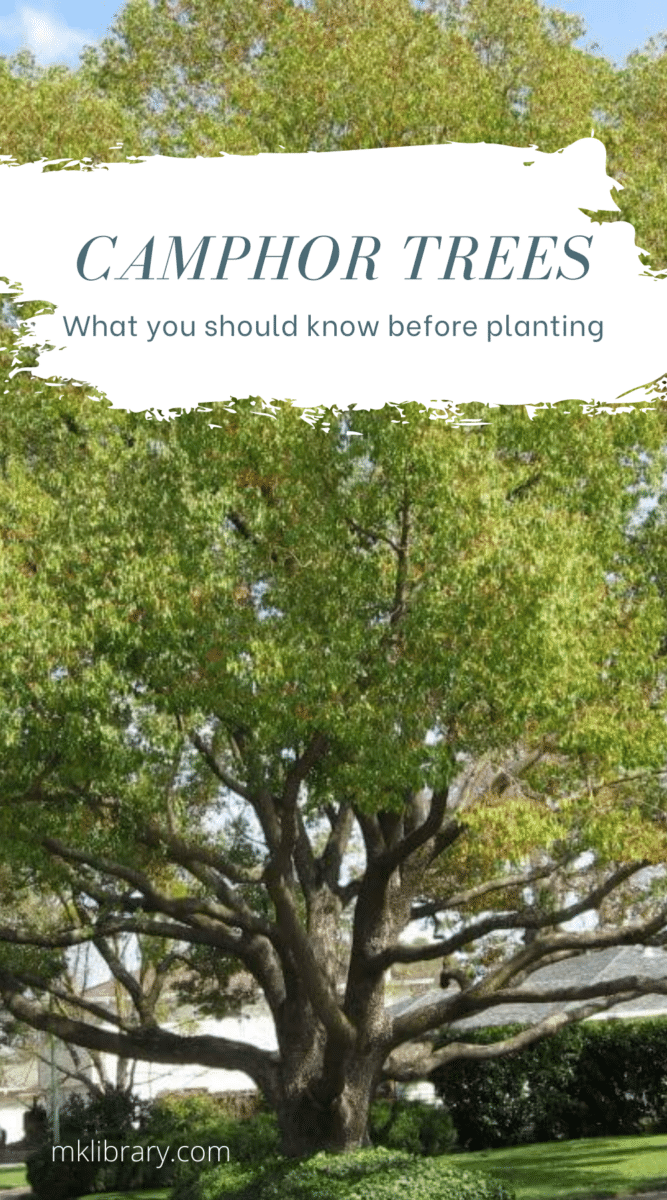
Affiliate Disclosure: Some links in this article are affiliate links. We may earn a small commission if you make a purchase, at no extra cost to you.
Article Updates
February 24, 2026: Comprehensive rewrite with expanded history (Taiwan camphor trade, Hiroshima), new sections on camphor tree uses and toxicity, planting distance table, native alternatives, and expanded FAQ from 4 to 12 questions. Added California-specific growing information including Sunset Zones. Added internal links to related tree and gardening guides.



Hi,I just had a company removed both of are Camphor trees that was 30 ft tall,after removing they grinded the stumps and now the smell on our backyard is really strong, should we be worried with our health?
I have 3 camphor trees in my ysrd snd they are doing very well, but ii seem to have a constant leaf drop.
Is this normal ?
Yep, that is pretty normal for the camphor trees. The oils from the leaves will suppress growth of plants around them, so you’ll want to keep your yard tidy for the most part.
Very normal. I live in Savannah GA and my front yard has 50 ft high Japanese Camphor, and it sheds leaves pretty much year round …sort of the same way a Live Oak does.
Thanks for this column, Mr. Mike! I have hundreds of camphor trees and seedlings of all different sizes on .34 acre. I wanted to develop the land, but learning about how camphor trees are invasive, take over (which they already have) and damage septic systems, I am thinking of selling the property. My question: If I have the lot cleared and all stumps removed, and fill added to bring the property elevation up, will that kill any seedlings that remain in the soil, if they are under the a couple feet of fill?
Hi
Can we make bonsai of camphor tree
NPS
I just endured Hurricane Michael this past fall, and it wiped out about 80% of our trees. The only ones left standing are some native pines, landscaped crape myrtles, landscaped palm trees, and then the camphors. I have two in my yard three in my yard that are standing tall and strong and two babies (sprouts only a couple feet). The storm took 17 of my 21 trees (including my beloved cedar and some gorgeous shade tree), and I’m not keen on removing the three well-established camphors. On the other hand, those sprouts I was considering transplanting (since one’s near my septic and one’s literally touching the house). Should I not transplant these baby trees since they’re invasive? I desperately need shade and my area desperately needs trees fast, but I want to be responsible. Anyone have any advice for me? Also, since it’s Class 1 Invasive Species, is it something illegal to even intentionally plant in Florida (thus illegal to transplant)? Thanks in advance for any guidance!
Plant moringa, it grows fast and has many uses.
Please! Never plant a camphor tree!!! This is the most invasive tree, our property is overrun with seedlings everywhere, the ones that have grown on the vacant property nearby, actively try to kill the slower growing native trees by choking out their sunlight. In ten years time a camphor can kill a native live oak tree, and we fight to keep them cut back all year long here. Our native insects don’t feed on camphors, so there are fewer birds around too. There are thousands of these trees that sprout every year, all year long here, (South Alabama), and now they are in the woodland areas. Yes, it’s a beautiful tree, but it belongs in its native land.
Thanks for stating the truth Diane. It is frustrating that MK is recommending planting them when they are invasive & are outcompeting native flora. How could any educated person do this? It is infuriating!!!
I bought a home in Fla. with a Camphor tree in the front yard about20/25′ from the house. It’s a lovely tree pruned to a more upright tall than a large wide spread. I’m concerned about the roots and closeness to the house, but I don’t want to cut it down as it gives valuable shade.
Suggestions?
We have a 70-year-old camphor here in California that has cost us thousands of dollars in plumbers over the past 12 years due to roots invading the sewer line. Just learned that the roots have now gone under the house into the backyard vegetable beds. Seems implausible, but a quick smell of the roots in backyard and front yard confirmed it. Get rid of your Camphor Mary. Gorgeous Asian tree best left in it’s native land.
There seems to be two types of Camphor trees in Florida, one grows to be quite large and the other type doesn’t grow much over 15 ft, and has a different bark, have you heard of this
It is my favorite wood to turn on the lathe.
We have two camphor trees in our yard. We planted one 17 years ago, and it is beautiful. They are grate for shade. We planted another one 3 years ago, and it’s taller then me now, and I’m 5’10. My grandmother also has one in her yard, and she told me when they bought that house over 60 years ago, that tree was already there. It’s very old, and still beautiful. When it says take care of the little ones that growing, you need to, because once it starts, and the root gets to long, will not be able to get rid of it. You have to have a big yard, to plant one of them.
Is camphor any good to use in a fireplace as a heat source?
I have a tree about 6 feet tall. It’s trunk & branches are dark green. My neighbor says it’s a Camphor tree. Are they right?
I just bought 2 young trees about 10′ and yes their bark is green.
I recently visited Galveston Island to visit some of the art galleries. I found a number of wooden sculptures that were sculted from camphor. The wood had striking colors that really made it stand out. When I asked about the type of wood, and was informed that these pieces were all carved from the camphor trees that were victims of huricane Ike. I thought the pieces were beautiful and wondered if this wood is conside and hard or soft wood and does anyone make furniture from this wood.
Thanks,
Bill